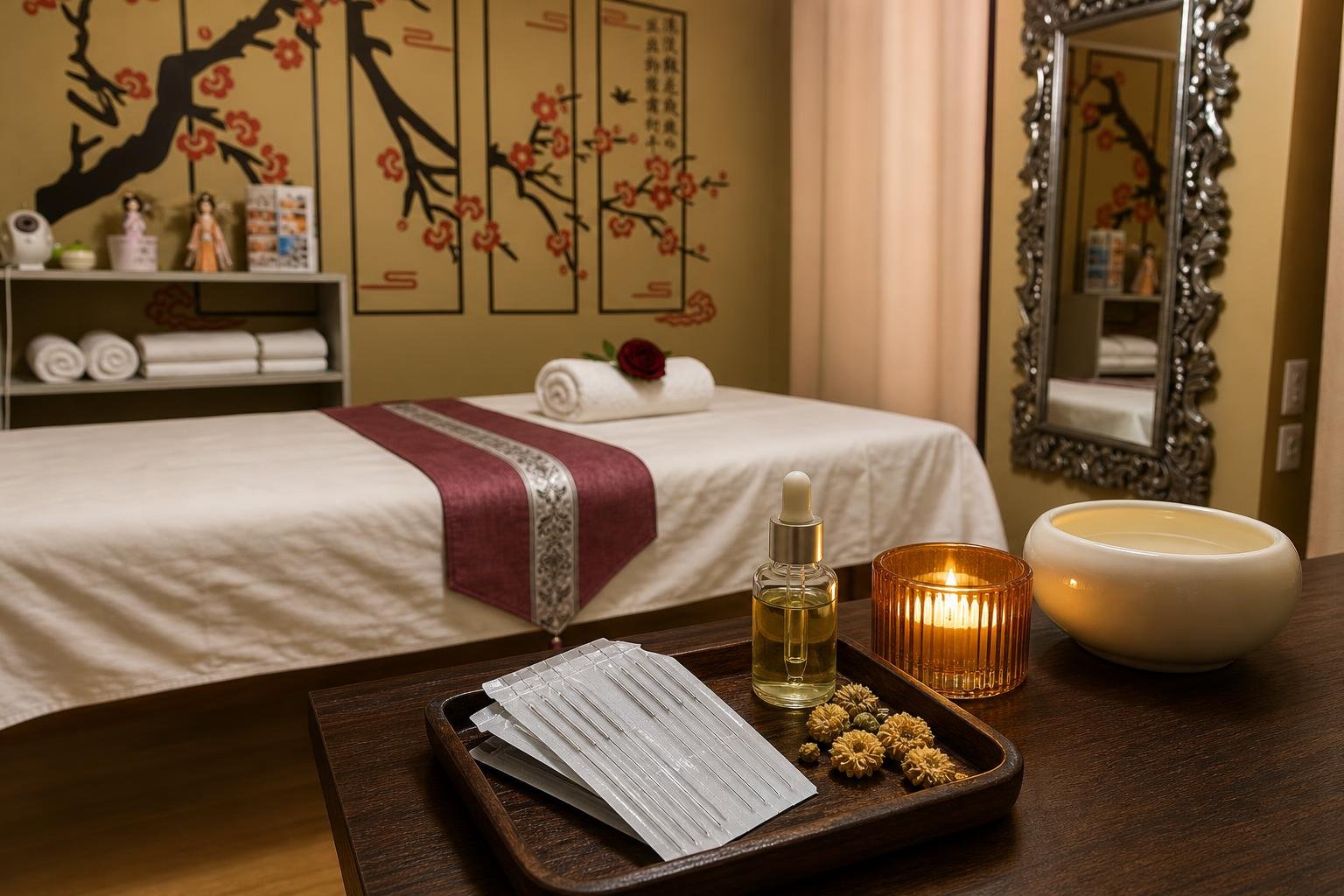
A woman who had been coming for her shoulders stopped me at the end of a session one afternoon. “I don’t know what happened,” she said, “but my colleague asked me this week what I had done to my skin.” She hadn’t done anything to her skin. She had done six sessions of acupuncture.
This is one of the quieter things I notice — that clients come in for one thing and often leave with a better face. Not a dramatic transformation. Just colour. A loosening around the jaw. A quality that is hard to name but easy to see.
What the face is actually showing
In Chinese medicine, the face is a map. A dull or grey complexion usually signals that circulation is sluggish — not dramatically low, just running at less than it should. The same is true of persistent puffiness under the eyes, or tension locked into the muscles of the jaw and forehead that you have stopped noticing because it has been there so long.
Fine needles placed along specific points — along the hairline, beside the nose, at the jaw angle, sometimes at a point behind the ear — do two things: they encourage local blood and fluid circulation, and they give those chronically braced muscles a prompt to let go. The skin that has been sitting on top of all that tension gets more oxygen and more movement. The change in colour usually happens within the first two or three sessions. The jaw takes a little longer.
This is not a “beauty treatment” in the usual sense
I want to be honest about this. Facial acupuncture does not freeze movement. It does not fill anything in. What it does is improve the quality of what is already there — which is, in my experience, often more than people expect.
In the old Chinese court physicians’ tradition, the face was considered a direct reflection of the organs. A practitioner worth their fee could read a patient’s health in their complexion before a word was exchanged. That is still, broadly, how I approach it: the face is the last thing to improve and the first to show when something inside is off. When we address what is underneath — circulation, tension, nervous-system bracing — the face tends to follow.
What a session looks like in practice
It runs for about thirty minutes as a standalone, but most people combine it with a body session first: an hour of Tui Na or a body acupuncture session, and then the face. The combination makes sense because a lot of facial tension originates in the neck and upper back — loosening the root first means the facial needles are working into something already partly open.
The needles on the face are very fine and generally stay in for fifteen to twenty minutes. Most people find it far less uncomfortable than they imagined. A few fall asleep. One client — a man from the Netherlands who came in sceptical and left booking two more sessions — described it as “the strange peace of having nothing to do while your face rests.”
The mirror after is usually the convincing part.
Who it tends to help most
People who carry a lot of expression tension — habitual frowning, jaw-clenching (often at night), a face that looks tired even after sleep. People with a complexion that has flattened and lost its character without any clear reason. People who have noticed their skin looks worse during high-stress periods and want to address the source rather than the surface. It pairs naturally with any body acupuncture course — you can read more about that on the acupuncture page.
If you have an active skin infection or broken skin on the face, we wait. Otherwise there is very little that makes this unsuitable, and most people are surprised that it took them this long to try it.
Yang Wang practises acupuncture at Chinese Massage – Tai Chi Tirana. The parlour is in central Tirana, a short walk from Bulevardi Myslym Shyri. Names in client stories have been changed.
Ready to Feel the Difference?
Book your session today — same-day appointments available.
Book Your Session