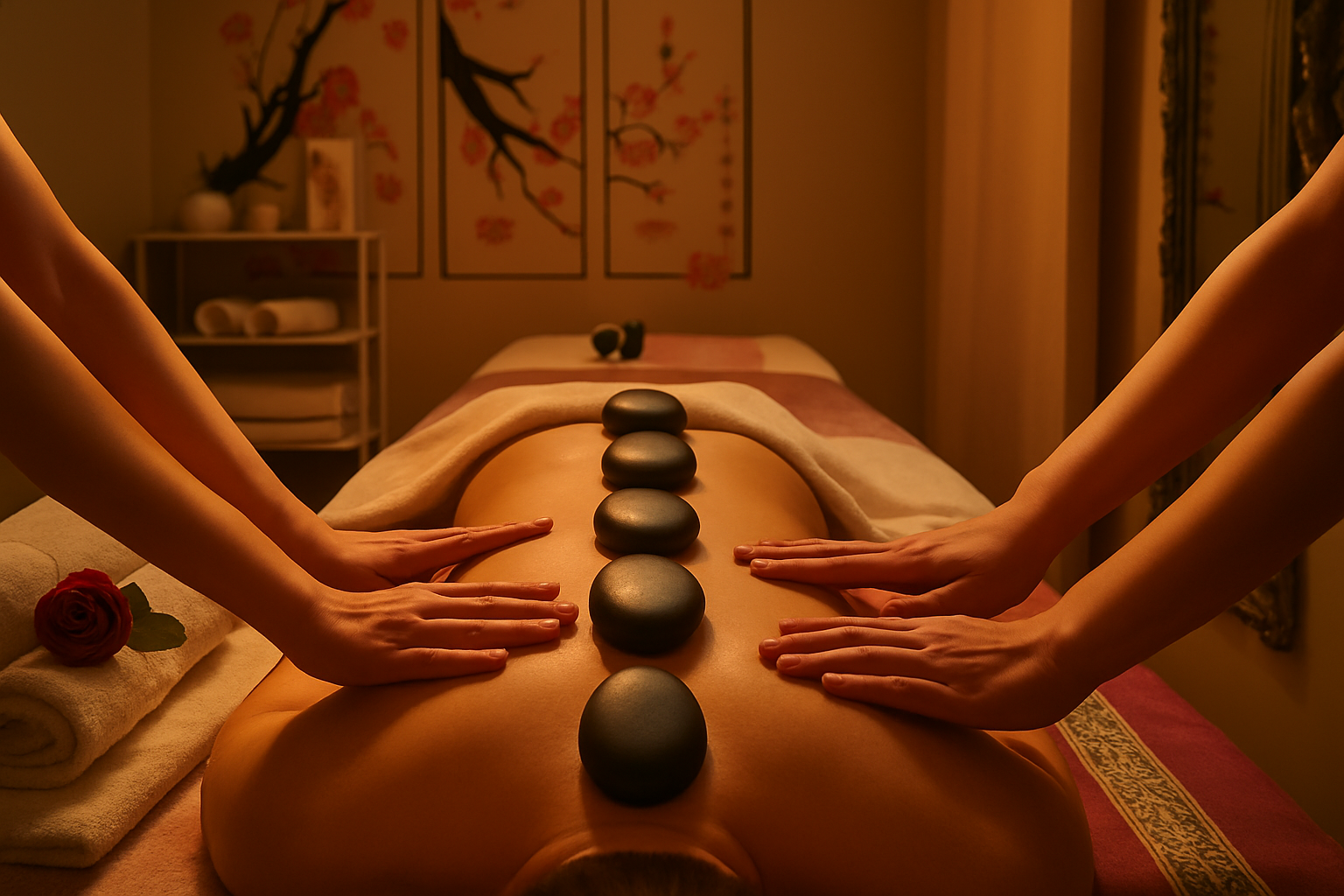
There is a small piece of history that I find pleasingly relevant to a massage parlour in modern Tirana: four-hands massage was, in its original form, a treatment reserved almost exclusively for royalty and high-ranking officials in several ancient cultures. The reasons it was so reserved tell us something interesting about both the historical practice and what the technique can offer the body today.
This is a piece about the history of four-hands work, the parallels between cultures that developed it independently, and why a treatment that was once the privilege of emperors has become something a working professional in Tirana can book for an evening session. (For the experiential side of the modality, see four-hand massage: relaxation and calm — written before this history piece, and a softer introduction.)
The Chinese imperial tradition
In imperial China, the practice of having multiple therapists work simultaneously on a single patient is documented from the Tang dynasty (618-907 CE) onward, though it almost certainly existed earlier. The court records of several emperors describe a specific protocol in which two — and sometimes four — physician-attendants would work the emperor’s body in synchronised fashion. The treatment was called si shou tui na (四手推拿) — “four-hands therapeutic massage.”
The reasons for the imperial reservation of the technique were several, and they help explain why it was not democratised earlier.
First, the practical reason: four-hands work requires twice as many trained practitioners as ordinary massage. In an era when high-quality bodywork training took many years and qualified therapists were rare, devoting two of them to a single patient was an expense few could afford. The emperor could afford it. Most could not.
Second, a quiet practical reason: court physicians were people the emperor’s household had to trust, and two therapists working at once provided a small mutual oversight. Each was, in a sense, a witness to the other during a treatment in which the emperor was physically vulnerable. Old court life was careful about such things.
Third, the therapeutic reason: the work suited the kind of complaints the emperor’s physicians regularly encountered. Court life produced a particular pattern — chronic stress, complex tiredness, the wear of constant low-grade vigilance — that responded better to whole-body work than to local treatment. The emperors knew, in their bodies, that the work made them feel different from ordinary massage. They could not have explained it the way we sometimes try to explain it now; they did not need to.
Court physicians who practised this technique developed specific traditions of how the work should be performed. The two practitioners were required to be of equivalent skill — one master and one apprentice was not acceptable. They were typically chosen from the same training lineage so that their work would be naturally synchronised. They were required to perform a brief synchronisation ritual before each session, often involving matched breathing and a moment of silence.
The Ottoman parallel
I find it remarkable that the Ottoman Empire, which had no direct contact with the Chinese imperial court for most of its existence, developed a strikingly similar practice in the same period.
The Ottoman hammam tradition — the elaborate bath culture of the empire — included, in its most refined version, a procedure called the tellak treatment. The bather would receive simultaneous attention from two or three attendants who worked the body in coordinated fashion. The treatment was reserved for the sultan, high officials, and visiting dignitaries. In ordinary public hammams, single-attendant treatments were available; the multi-attendant version was an exclusive variant.
The Ottoman practice differed in specifics from the Chinese — the hammam context involved hot stone benches, soap-based scrubbing, and a public-bath atmosphere very different from the private Chinese court. But the underlying observation was the same: synchronised work by multiple practitioners produced effects that single-practitioner work did not.
There is no evidence that the two traditions influenced each other. They developed in parallel because the underlying thing — what the body does when many careful hands work it at once — is something any tradition with enough patient observers would eventually notice. The human body is the same body, whether it is on a Chinese imperial table or an Ottoman marble bench.
The Liaoning training tradition
The specific lineage in which I was trained — based in Liaoning province, going back several generations — included four-hands work as part of the advanced curriculum. Not every Tui Na practitioner learns it, even in China. It is taught only to therapists who have completed several years of single-handed work and have demonstrated the specific qualities that the synchronised work requires.
The qualities are not what one might assume. Strength is not particularly important — four-hands work uses less force per therapist than single-handed work, not more. Speed is not important — the work is, if anything, slower than ordinary massage. What matters is a particular quality of attention — the ability to remain aware of both one’s own work and one’s partner’s work simultaneously, without losing precision in either.
This attentional skill is part trainable and part temperamental. Some excellent single-therapist practitioners never develop it well; their attention naturally concentrates on the immediate work in front of them and they cannot easily maintain the parallel awareness of a partner. Other therapists take to it almost immediately and find that it engages a quality of presence they had not previously known they had.
The training I received involved hundreds of hours of paired practice with a senior practitioner before I was permitted to perform four-hands work on paying clients. The senior practitioner would, at unpredictable moments during practice sessions, make small variations in his rhythm or pressure. My job was to detect the variation immediately and adapt to it, maintaining synchronisation through the change. Over months of this practice, the ability to maintain dual attention without effort developed.
How it travelled out of the courts
The transition of four-hands work from royal privilege to ordinary professional practice happened in different ways in different traditions.
In China, the technique slowly moved out of the imperial court as court physicians began practising privately in major cities, and over the twentieth century more and more practitioners were trained in it through proper schools rather than only through palace lineages. Even so, the technique remained relatively rare and was passed down most reliably within particular teaching lineages — the kind of lineage I was trained in.
In the Ottoman tradition, the tellak multi-attendant treatments slowly became available in some high-end hammams in the late 19th century, though they stayed luxury offerings for affluent customers for a long time.
The arrival of these techniques in Western practice happened mostly through the wellness and spa industry in the late twentieth century. Spa centres in California, Italy, and France began offering four-hands massage as a premium service in the 1990s. The careful refinement of the technique — distinguishing it from luxury simultaneous-massage offerings — has developed more recently, as practitioners trained in traditional lineages have begun teaching the underlying principles to a broader audience.
Why the price still reflects the history
A four-hands session costs more than twice a single-therapist session in our parlour. The premium over the simple two-therapist hourly cost reflects several factors that the imperial courts also understood.
The training investment is substantial. Maintaining a pool of therapists who can perform four-hands work together requires ongoing practice sessions and quality assurance that single-therapist work does not require. Pairs of therapists must practise together regularly even when not booked, to maintain their synchronisation skill.
The scheduling complexity is significant. Booking a four-hands session requires aligning the availability of two specific therapists who have trained together. We cannot substitute one therapist for another at the last minute the way we can for single-therapist work.
The room and equipment requirements are different. Four-hands work needs more open space around the table, specific lighting that allows both therapists to see clearly, and a particular acoustic environment that supports the rhythmic synchronisation.
The depth of the therapeutic effect, for clients for whom the technique is appropriate, justifies the premium. The clients who book it regularly know this from experience.
Trying it as a modern client
For clients considering four-hands work for the first time, my suggestions are:
If you have struggled to achieve deep relaxation through ordinary massage, this may be a useful experience to try. The brain’s response to synchronised work is qualitatively different from single-therapist work.
If your complaints are localised and specific (a stiff neck, a sore shoulder), single-therapist work is the better choice. Four-hands work is for whole-body integration, not for spot treatment.
Book the longer session (90 minutes) for your first time. The shorter version (60 minutes) is sufficient for maintenance work but does not allow the full effect to develop on a first visit.
Plan for a quiet evening after the session. The post-session integration effect is pronounced and benefits from being honoured rather than overridden with immediate activity.
The treatment that the emperors once kept for themselves is, in essence, what we offer at our parlour in Tirana on a Wednesday afternoon. The history is not the most important part. What synchronised work does to the human body is the same now as it was in the Tang dynasty court, the Ottoman hammam, and the Liaoning training rooms where I learned it.
The body responds, in its essentials, to the same intervention.
Yang Wang practises Chinese medicine at Chinese Massage – Tai Chi Tirana.
Ready to Feel the Difference?
Book your session today — same-day appointments available.
Book Your Session