How much hotter can a northern girl get?

I grew up in Liaoning, in the northeast of China, where winter is a serious person. Real winter – the kind that arrives in November and doesn’t apologise until spring, where the air bites your face and everyone walks fast with their shoulders up around their ears. As a girl I complained about the cold the way all northern children do: loudly, constantly, and without ever actually wanting it to go away.

So I thought I understood weather. I thought I was tough about it.

Then July in Tirana happened to me.

I want to be dramatic and say I have never known heat like this – but the honest truth is that my body has simply filed a complaint it has never filed before. By eleven in the morning I am negotiating with the fan. By two I have accepted that the fan is winning. I have eaten more watermelon this month than in my entire previous life, I keep a cold bottle pressed to my wrist like it’s medicine, and I have developed strong opinions about which side of the street has shade.

My Albanian friends find this hilarious. “But you’re from the cold place,” they say – as if that should make me better at summer, when in fact it has made me spectacularly worse. A northern girl, wilting, in front of everyone.

I’m told August is warmer. I’ve decided not to believe that yet.

So if you see a small Chinese woman moving very slowly from shade to shade near Myslym Shyri, holding a cold bottle like a treasure – hello. That’s me, surviving. Ask me again in winter, and I’ll be the happiest person in Tirana.

Yang Wang is a Liaoning transplant who runs a small Chinese massage parlour a short walk from Bulevardi Myslym Shyri.

When Liaoning Mothers Used Mud Cakes in Winter

Liaoning province, in the northeast of China, is cold. Not the Mediterranean kind of cold that Tirana has in February, where you can walk outdoors in a wool coat and feel pleasantly chilled. The Liaoning winter is a serious matter. Temperatures drop to minus twenty in January. The wind off the sea finds every gap in every wall. For most of the year, daily life is built around the management of cold.

In the village where my grandmother lived — about an hour outside Tieling — winter preparation began in October. The cellar filled with cabbage, daikon, sweet potatoes, dried mushrooms. The thick quilted bedding came out of the storage chests. The braziers were checked. And, in many households, the mud cakes were prepared.

I want to write about this practice because I think it explains something important about how a treatment we now offer in our parlour in Tirana originally lived in ordinary kitchens, ordinary winters, ordinary families — long before anyone thought to put it on a price list.

How the mud cakes came to be in the house

My grandmother’s mud cakes — the ones she used on my mother every December when her winter belly started — were not bought. They were made.

The recipe had been passed down in the family from at least my great-grandmother, possibly earlier. The ingredients were ordinary, mostly local, and combined according to a sequence my grandmother performed without thinking, the way an experienced cook makes dumplings.

The base was a particular kind of clay sourced from a river bank about twenty kilometres from the village. Once a year, in late summer, one of my uncles would drive out with a shovel and a few canvas sacks to collect the year’s supply. The clay was washed several times, dried on flat boards in the sun, ground in a stone mill, and stored in a sealed jar in the pantry.

In autumn, the mugwort was harvested from the hills above the village. The plants were cut, hung upside down in bundles in the attic, dried for a month, and the leaves were then stripped from the stems and ground to a coarse powder.

When the cakes were to be made — usually in late November, in time for the coldest months — the powdered clay was mixed with the mugwort, with cinnamon bark purchased from the herbalist in town, with a little dried ginger, and with one or two other ingredients I never fully learned because the recipe was somewhat closely held even within the family. The mixture was moistened with warm water, kneaded like a dough, and formed into flat cakes about the size of a hand and half a centimetre thick. The cakes were dried slowly on a warm stone near the stove, then wrapped in cloth and stored in a wooden box near the chimney.

By the time the winter cold-belly season arrived, the cakes were ready.

Who used them, and how

My grandmother used them on my mother, her daughter-in-law, when the winter belly came on her every year. She also used them on herself, on her own lower back, when the cold weather brought out the joint pain she had developed in her sixties.

The cake was warmed on the stove — never directly on the heat, but on a metal tray placed above the heat, slowly, until it was warm to the touch but not hot. It was then placed on the affected area, and a small bundle of moxa was lit above it. The treatment took about half an hour. My grandmother would sit in the chair next to the bed, knitting or talking quietly, watching the moxa carefully so that the heat was always the right intensity.

When the treatment was over, the cake was wrapped back in its cloth and returned to the box. The same cake could be used many times over the winter — only when it had crumbled and lost integrity would a new one be made.

This was not, in our family, a medical treatment in the modern sense. It was a household practice. It was as ordinary as making chicken broth for a cold or applying a hot compress to a stiff neck. The grandmothers did it. The mothers learned to do it. The daughters watched, and eventually learned themselves.

That this practice corresponds, almost exactly, to a treatment described in the Huangdi Neijing — the foundational text of Chinese medicine, compiled around the second century BCE — is something I only learned much later, in medical school. The connection between my grandmother’s hands and an ancient text was not something she would have considered relevant. She knew what she was doing because her mother had shown her.

From a village kitchen to a treatment room

I moved to Tirana in 2020, carrying this memory of my grandmother’s kitchen with me. What struck me, over the years since, was how strange it felt to take something that had simply been there — as ordinary in our house as a pot of broth on the stove — and one day write it on a treatment menu with a duration and a price beside it.

There is a particular Tirana feeling I have come to know well: the friend who hears what I do for a living, waves a hand, and says her cousin “knows someone” for everything. A plumber, a notary, a man with a van, and now, apparently, mud and moxa. The instinct to keep these things in the family, off the books, between people who trust each other, is not so different from how my grandmother kept her recipe — somewhat closely held, passed by hand rather than written down. (I have written elsewhere about the year of the Fire Horse and the small Chinese-calendar markers of my year — these family practices live alongside that bigger seasonal rhythm.)

Why this still matters

I do not bring up these old practices because I want to romanticise them. There are things modern medicine does that traditional practices cannot. Insulin saves lives. Antibiotics save lives. The MRI scanner sees inside the body in ways no pair of hands ever could.

But there are also things that modern medicine, in its rush toward measurement and intervention, has stopped being good at. The slow work of restoring a body that has been chronically depleted. The treatment of patterns rather than single diagnostic codes. The understanding that warmth, applied thoughtfully and over time, changes the body in ways that no pill can replicate.

Mud moxibustion is one of those slow treatments. We offer it in our parlour in Tirana because it works for the patterns it is designed to address — patterns my grandmother in Liaoning would have recognised at a glance, and which she certainly never needed a research trial to confirm.

When I prepare a mud cake for a client now — using mud and herbs imported from a producer in Shandong rather than collected from a river bank, prepared in our treatment room rather than a kitchen — I am performing, with small adjustments, the same intervention my grandmother performed decades ago in a village in Liaoning. The technology has not changed. The body has not changed. What works still works.

A small ritual I have started

I have begun, with first-time mud moxibustion clients, mentioning this history briefly during the intake. Not as a sales pitch — the treatment will work or not work on its own merits — but as context. Several clients have told me afterwards that knowing the treatment came from grandmothers, in real homes, made it feel more meaningful to them than something handed over in a cold consulting room.

I think they are right. Some kinds of healing belong to a longer tradition than a single profession or a single century. To offer them well, we have to remember where they came from.

That is part of why we offer this treatment in Tirana. Not because it is exotic, but because it is, in its origins, much closer to home than people might think.

Yang Wang practises mud moxibustion and other Chinese medicine modalities at Chinese Massage – Tai Chi Tirana. The parlour is in central Tirana, a short walk from Bulevardi Myslym Shyri.

The Liaoning Aunts: A History of Quiet Women

There were three older women in my family in Liaoning whose lives stayed in the background of our family memory, while the louder lives of the men around them were the ones that got told. This piece is about them — my three aunts — and about the kind of quiet steady work that women have done across many generations that does not get recorded but without which nothing else would have held together.

This is a personal piece. It is not a treatment guide. But it sits behind a lot of how I think about the older women who come into the parlour, and writing it down has been on my mind for a while.

What I know about my aunts

I had three aunts on my father’s side in Liaoning. The eldest, born in 1928, was my grandfather’s first daughter. The middle, born in 1933, was a year older than my father. The youngest, born in 1940, was the only sibling in their generation who got past primary school in any meaningful way — she trained as a schoolteacher and taught in a small town outside Shenyang for forty years.

The eldest aunt died in 2007. The middle aunt died in 2018. The youngest is still alive, in her mid-eighties, living quietly in the same town where she taught.

They lived long lives, the three of them. They were the kind of women who watched their families grow up around them, made the meals, kept the bedding aired, fed the chickens, remembered every birthday, knew which cousin was angry with which other cousin, kept the small disputes from becoming large ones.

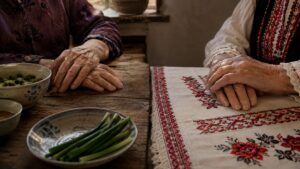
What I remember most about them, from the few visits we made when I was a child, is the kitchen of the eldest aunt. It was a long narrow room with a kang along one wall — the traditional brick bed-platform heated from underneath by the cooking fire. In winter, all the women in the family sat on the kang in the late afternoon, peeling vegetables, chopping garlic, drinking strong tea. The conversation was constant and never about anything in particular. It was the steady murmur that I now associate with how my aunts spent most of their adult lives.

The eldest aunt was the cook. She made a Liaoning cabbage stew with pork that, in my memory, is the food I have spent twenty years in Europe trying to find equivalents for. The middle aunt was the one who kept the accounts of who owed what to whom — not in money, but in favours, in eggs, in the borrowed jar of fermented bean paste that needed to be returned. The youngest, the schoolteacher, was the one who handled anything that required reading or writing. They divided the work without ever explicitly negotiating it.

None of them held any visible position outside the household. The eldest worked as a textile factory worker for thirty-eight years. The middle worked as an administrative assistant in a state agricultural office. The youngest, the schoolteacher, was the most publicly active. Their visible lives were ordinary. Their interior lives, and the family network they managed between them, were the larger thing.

The work that does not get recorded

I have come to see, with the perspective of distance and time, what my three aunts actually did across their long lives. None of it produced dramatic events. None of it generated biographies. But it was the work without which the events that do get recorded could not have happened.

The work of holding family together, across generations, falls disproportionately to women whose names do not appear in any chronicle. The wars and the careers and the public achievements are credited to visible people whose names enter the histories. The continuity — the meals, the mended quarrels, the remembered birthdays, the kang kept warm — is maintained by mostly-invisible women whose names rarely do.

I have come to think that one of the small useful things we can do, as people who notice what happens around us, is to give some attention to these women specifically. Not to over-romanticise them — my aunts were ordinary women doing necessary work, not saints — but to give them the kind of attention that the larger world did not. Naming them, in the small writing I do, is a way of saying that this kind of work matters, even when no one is keeping a record of it. (For another small piece on how Chinese calendar time shapes my year, I have written about the Chinese zodiac and what each cycle quietly carries.)

How this connects to the work I do

I work with many women in their forties, fifties, and sixties. They are the demographic that comes most often to the parlour. They come in carrying the accumulated weight of having held things together for decades. Family, careers, ageing parents, children growing up, complicated relationships, the practical running of households and small businesses.

The pattern of their bodies, when they come in, is recognisable. The upper back tension from carrying. The lower back tension from constant low-grade vigilance. The neck and shoulder restrictions from years of compromise postures. The chronic fatigue of having been responsible for too much for too long. Many of them will still insist, settling onto the table, that they are fine — do të kalojë, it’ll pass. The shoulders, when I reach them, tell a longer story.

I do not talk about any of this during the sessions. The sessions are quiet, focused on the work that needs to be done. But the parallels are present in my mind. I am working on a body that has been doing, for many years, the kind of work my aunts did in their Liaoning kitchen. The work is not recognised by the larger world. The body remembers it. Part of what bodywork can offer, in the right register, is a small acknowledgement that the body has been carrying something significant and that it is allowed, briefly, to put it down.

That is a small thing. It is, I think, also a real thing.

The youngest aunt, the one still alive

My youngest aunt is the one who is still here. She is now eighty-five. We speak by phone roughly once a month. The phone calls are mostly about ordinary things — what she ate, what she read, who came to visit, the weather in Liaoning. She does not have many strong opinions about large matters. She has the calm, settled register of someone who has lived a long time and seen enough not to be in a hurry.

The last time we spoke, a few weeks ago, she asked me about Tirana. She has never been to Albania and never will go — she is not in a condition to travel — but she likes to hear small details about my life here.

I told her about the parlour. About the clients who come every week. About a particular older Albanian woman who has been a regular for several years and who reminds me, in some way I cannot quite name, of her.

My aunt asked what the Albanian woman looked like.

I described her — the careful posture, the practical clothes, the warm but reserved manner, the way she sometimes sits in our front room after a session and seems to be thinking about things she does not put into words.

My aunt was quiet for a moment. Then she said, “She sounds like one of us.”

I told her she was probably right.

This is, in the end, what I think my aunts and the older clients at the parlour share. They are the women who hold things together. They have been doing this work for many generations, in Liaoning kitchens and in Tirana front rooms alike. They will, presumably, continue to do it. The least I can do, in the small writing I send out into the world, is to notice them.


Yang Wang practises Chinese medicine at Chinese Massage – Tai Chi Tirana.
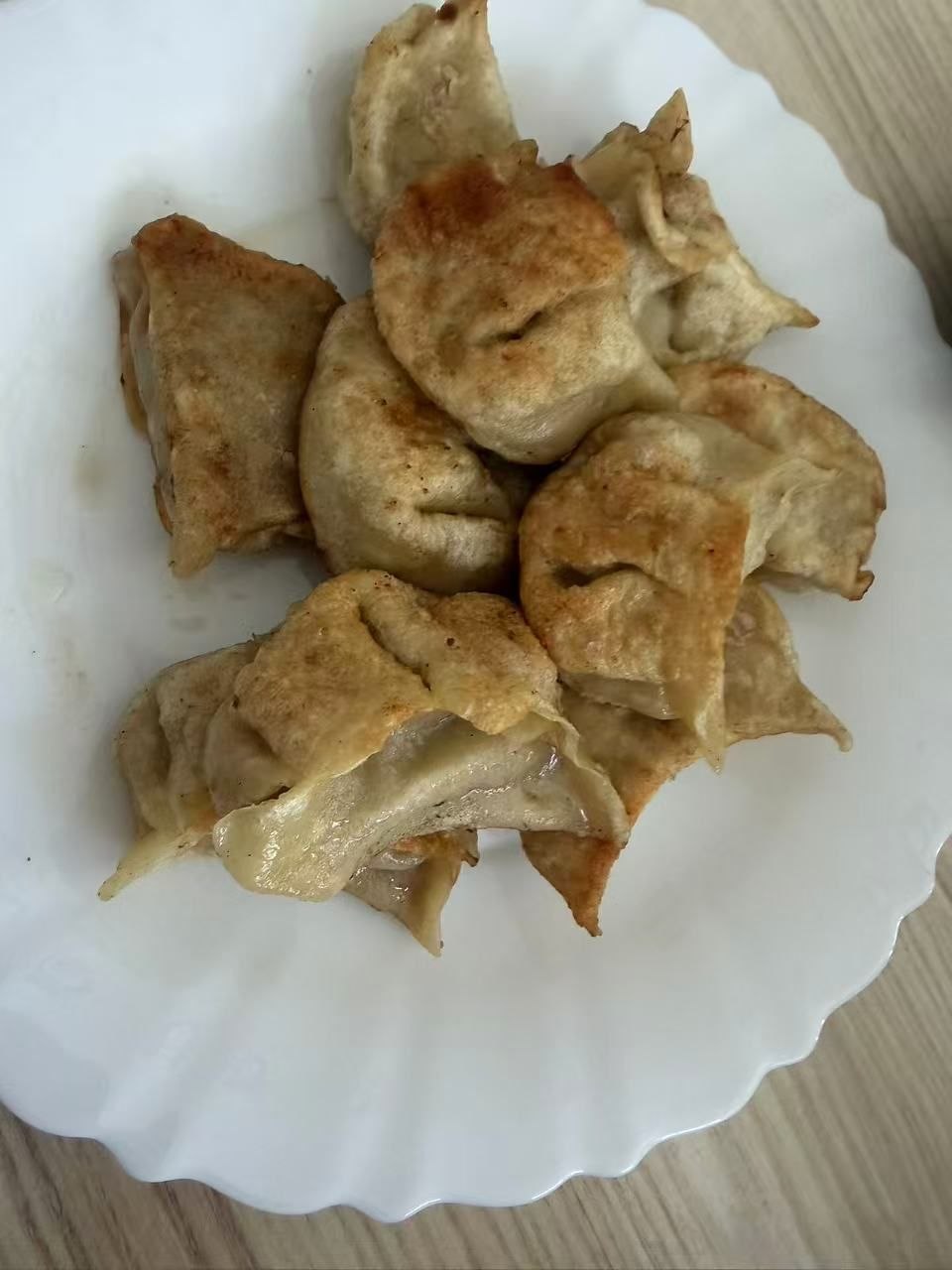
Homemade Jiao Zi and a Long Day Well Spent

Some evenings the parlour empties slowly. The last client leaves, the sheets are folded, and the four of us — Ying, Xiao, Wei, and I — stand there for a moment in that particular silence that only comes at the end of a day when you have used your hands without stopping. Someone says jiao zi? and the answer is always yes.

Tonight it is Xiao’s turn to lead, which means we are all in luck.

Xiao’s Dumplings Are Not a Democracy

Xiao makes jiao zi the way her grandmother made them in Liaoning: the filling first, then the dough rested for exactly as long as it takes to argue about the filling. The ratio of pork to cabbage is a matter she does not discuss. When Ying once suggested more ginger, Xiao looked at her the way you look at someone who has said something technically in Chinese but somehow wrong.

The rest of us are allowed to fold. This is the generous part. Ying folds quickly and her pleats are even. Wei folds slowly and his are — well, they hold together, which is the main thing. My own folds look like I am attempting origami for the first time after a twelve-hour shift. Xiao says nothing, but she refolds mine when she thinks I am not watching.

!Homemade Jiao Zi and a Long Day Well Spent

The Conversation That Happens Every Time

While we fold, we talk about home. This is not a sad conversation — it is a warm, slightly chaotic one that jumps between Mandarin and whatever Albanian word someone picked up from a client that day. Someone mentions their mother’s version of the filling. Someone else says their father would boil half and pan-fry half, and this produces a heated debate about which method is correct (it is pan-fried, obviously, but we let Wei have his opinion).

Wei pulls up a voice message from his family on his phone and plays it without warning, filling the kitchen with his aunt’s rapid northern Chinese, which none of us can quite follow because she speaks faster than anyone should. We laugh. The dumplings keep coming.

What Tirana Has That Home Did Not

Here is something I did not expect when I arrived: Tirana does not slow down in the evenings — it is a lively capital city that hums on into the night. But something in us needs to slow down, to step out of the day and reflect. That is harder to find when you are far from home. Here, after the parlour closes, we give ourselves that pause.

A neighbour knocked on our door once to bring us peppers from her balcony garden and stayed for forty minutes. We did not share a language, but we shared the peppers, and somehow that was enough.

The jiao zi fit into that pause perfectly. You cannot rush them. The folding takes time, and the talking fills the time, and by the end of it you have forgotten to be tired.

The Boiling Is the Dramatic Part

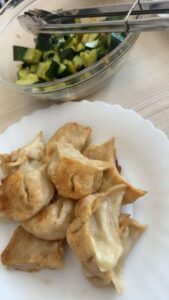
Xiao drops them into the pot in batches, and we all crowd around like it is a sporting event. When they float to the surface she counts to thirty in her head — she says this out loud every time as if reminding herself — and then fishes them out. The ones that split open are the cook’s privilege. Xiao eats these without ceremony, standing at the stove, which feels exactly right.

We eat with black vinegar and a little chilli oil. Wei insists on soy sauce as well, which Xiao permits but does not endorse. The kitchen window fogs up. Someone’s phone plays a playlist that is half Jay Chou and half, inexplicably, an Albanian iso-polyphony recording that Ying found and thought was beautiful, which it genuinely is.

Not a Recipe, Just an Invitation

I am not going to give you the recipe. That belongs to Xiao and her grandmother. What I will say is that if you ever find yourself in Tirana, far from home, with flour on your hands and your colleagues arguing cheerfully about ginger — you are probably right where you should be.

If you want to find us before the jiao zi hour, we are at the parlour most days, using those same hands for something slightly different.

Yang Wang practises Traditional Chinese Massage at Chinese Massage – Tai Chi Tirana. The parlour is in central Tirana, a short walk from Bulevardi Myslym Shyri. Names in team stories appear with permission and affection.
Cold Hands: Circulation, Raynaud’s, and Five Points

There are some clients who come to the parlour in January wearing two pairs of gloves. They take the outer pair off in the waiting area, but they keep the inner pair on until the very last moment, sometimes during the intake conversation. When they finally remove them, their hands are not just cool — they are blueish at the fingertips, mottled across the back of the knuckles, sometimes white at the nail beds. The skin temperature is several degrees below the rest of their body.

This is more common than people realise. About one in eight adults — more women than men, more after the age of forty — has measurably impaired peripheral circulation that makes their hands and feet uncomfortably cold even at room temperatures other people find pleasant. A smaller subset, perhaps one in twenty, has Raynaud’s phenomenon: episodes where the small blood vessels in the fingers spasm in response to cold or stress, cutting off circulation for several minutes at a time, sometimes painfully.

Both groups respond well, in my experience, to a particular kind of TCM intervention. The work is slow — circulation patterns do not change in a single session — but it is reliable. The grandmothers in northern China have been doing some version of it for a very long time, and from what I have read more recently, the way it works lines up reasonably well with what modern doctors know about how the small blood vessels behave.

What is happening in cold hands

Hands and feet are at the end of the circulatory road. They are also the parts of the body the autonomic nervous system is most willing to sacrifice when it perceives a threat. In a cold environment, in a stressed state, or after a long period of poor sleep, the sympathetic nervous system narrows the small arteries in the periphery to preserve core temperature for the vital organs. This is a sensible adaptation. The problem arises when the nervous system gets stuck in the constricted state and does not release it when the threat has passed.

For most people with cold hands, this stuck state has multiple contributors: chronic stress, dietary patterns that produce low-grade inflammation, sometimes a thyroid that is functioning at the lower edge of normal, sometimes — increasingly common since 2022 — a lingering effect of COVID-19 on small blood vessels.

For people with Raynaud’s, the same mechanism is operating in a more extreme form. The vessels do not just narrow — they spasm, often in response to stimuli that would not bother most people (a draught from an open refrigerator, holding a cold drink, mild emotional stress).

The conventional medical approach is, in most cases, to manage symptoms: keep warm, avoid triggers, sometimes vasodilator medications for severe cases. This is reasonable as far as it goes. It does not speak to the underlying nervous-system pattern — the stuck, over-guarded state — which is where, in my experience, acupuncture gently helps the body settle.

Five points for cold hands

The protocol I use for cold-hands clients is built around five points. Not used all at once — the combination shifts based on the individual presentation — but drawn from a core set.

Hegu (LI-4) — in the web between thumb and index finger. The classical “command point” for the hand and face. Needling here produces measurable vasodilation in the hand within ten to fifteen minutes. The effect is local but reliable, and the point has the added benefit of being easy to self-massage between sessions.

Laogong (PC-8) — in the centre of the palm. Translated as “labour palace.” Used in TCM to clear excess heat from the heart channel; from a vascular perspective, it directly affects palmar arterial flow. This is the point I use most often for clients whose cold hands are accompanied by mild anxiety — there is an interesting overlap between hand circulation and emotional state that this point seems to address.

Quchi (LI-11) — at the outer end of the elbow crease. Treats the entire forearm and acts as a relay station for circulation moving outward into the hand. Useful in clients whose poor circulation is part of a wider pattern of cold-type symptoms.

Zusanli (ST-36) — about four finger-widths below the kneecap. Not a hand point, but a foundational point for building underlying qi and warming the whole body. For clients whose cold hands are part of a deeper deficiency — chronic fatigue, low appetite, frequent colds — this point is almost always included.

Mingmen (GV-4) — on the lower back between the second and third lumbar vertebrae. “Gate of life.” A warming point that affects the body’s deep reserve. For severe cases, often combined with moxa (warming the point with the smouldering herb Artemisia vulgaris) rather than only with needling.

A standard protocol uses three or four of these points per session, sometimes alternating between sessions to cover the full range. We rarely use all five at once. (For more on how the body’s meridian map underlies these point choices, I have a longer piece on meridian conditioning that lays out the framework.)

The Liaoning grandmother method

There is something I learned from my own grandmother in Liaoning that is not in any acupuncture textbook, but which I use with cold-hands clients because it works.

She kept a small bowl of warm water on the table, and after meals — particularly in winter — she would place her hands in the bowl for two or three minutes. Not hot water. Warm. Around the temperature of a comfortable bath. The water reached past her wrists. She called it wenshou — warming the hands.

What this does, physiologically, is exactly what it sounds like: it provides a sustained, gentle warmth that allows the small blood vessels to dilate without the rebound vasoconstriction that comes from going abruptly between cold and hot. Cold hands held under hot tap water often feel worse afterwards, because the rapid warming causes a defensive over-reaction. Two minutes in warm water — slowly, with patience — teaches the vessels to relax.

I have recommended this practice to many cold-hands clients in the parlour. It is so unremarkable that some of them think I am joking. They go home, they try it, they come back two weeks later saying it has been the single most useful change they have made.

A word on the Tirana cold

People here are sure their hands will be fine because the radiators are good and the winter is short. A Tirana winter does not care how good your radiator is; the wet cold finds the hands first, on the walk to the car, and keeps them an hour after you are indoors. The warm-water habit is a small daily kindness for fingers that the season treats unkindly.

What to expect from a course of treatment

For ordinary cold hands (without Raynaud’s), a typical course is six to eight weekly sessions, followed by a maintenance session every six to eight weeks through the cold months. Most clients notice clearer improvement by the third or fourth session — hands that warm up faster after coming in from the cold, fewer episodes of needing gloves indoors, an overall reduction in the time spent feeling chilled.

For Raynaud’s specifically, the work is slower and the results are less complete. Realistic expectation: a meaningful reduction in the frequency and severity of episodes, often to the point where they become rare and brief, but not necessarily a full elimination. Clients with primary Raynaud’s (the form without an underlying autoimmune cause) respond better than clients with secondary Raynaud’s (where the cause is something like scleroderma or lupus). Acupuncture should not replace medical monitoring for the autoimmune form, but it can be a useful adjunct that reduces dependence on vasodilator medication.

A particular note for post-COVID circulation problems: these have become common in the parlour. The pattern is usually a relatively young, otherwise healthy adult who developed cold hands or feet after a COVID infection and has not seen them resolve months later. I read once that small blood-vessel changes after COVID are well-known to doctors now and that they sometimes take a long time to settle. In my own practice, acupuncture seems to help in about three cases out of four — slower than for ordinary cold hands, often needing twelve sessions or more — but the hands do come back.

The honest summary

If your hands are cold for no obvious reason, the first thing to do is see a general practitioner to rule out the conditions that mimic poor peripheral circulation: thyroid trouble, anaemia, autoimmune conditions. Once those are excluded — or being treated — acupuncture is one of the better-known traditional approaches for this complaint, and the doctors I have spoken with tend to recognise it as a sensible thing to try. Combined with the warm-water practice the grandmothers knew, daily gentle hand exercises, and (if appropriate for you) certain warming herbs in your diet, the change can be substantial.

You should not expect miracles in the first week. You should expect the hands to start remembering how to be warm by about the fourth week. By the third month, most clients are out of gloves indoors.

The body learns these things back if it is shown how.


Yang Wang practises acupuncture and Tui Na at Chinese Massage – Tai Chi Tirana.
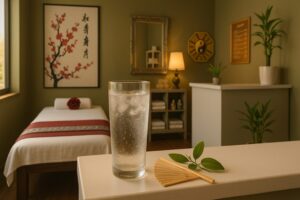
Mud Moxibustion: The Quiet Cousin of Acupuncture

There is a treatment we offer at the parlour that almost no one in Tirana has heard of before they walk in. Most of our long-term clients have tried Tui Na. Many have tried acupuncture, cupping, gua sha, hot stones. But mud moxibustion — ni jiu in Mandarin, 泥灸 — they encounter for the first time when they ask about a treatment for chronic abdominal cold, painful periods that nothing else has touched, or the kind of deep tiredness that sleep does not repair.

This is one of the older treatments in the Chinese pharmacopoeia. It is also, in my opinion, one of the most underrated. It does what acupuncture does — moves stuck qi, warms the deep tissue, addresses cold-type patterns — but it does it through a different mechanism, and for certain clients it is dramatically more effective. (For the acupuncture half of this comparison and how the meridian-point system underlying both treatments is mapped, I have a foundational piece on meridian conditioning.)

What it actually is

Mud moxibustion combines two ancient ingredients: medicinal mud and moxa, the herb Artemisia vulgaris (mugwort, in English; pelin in Albanian, where the plant grows wild on the hillsides outside Tirana — you have probably walked past it a hundred times on a Sunday hike without a second glance).

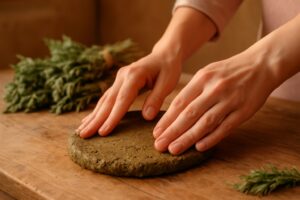
The mud is not ordinary mud. It is a specific medicinal preparation, traditionally made from a base of fine silt taken from particular river beds, mixed with powdered herbs — typically Artemisia, Angelica sinensis, Cinnamomum cassia (cinnamon bark), and several other warming herbs depending on the formula. The mixture is dried and stored in cakes or sheets. To use it, the practitioner moistens it slightly, warms it to body temperature, and applies it as a layer over a specific area of the body — usually the lower abdomen, the lower back, or along the spine.

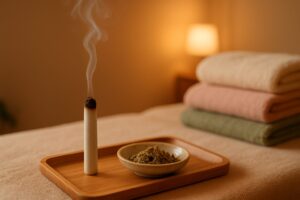
Over the layer of warmed mud, a small amount of moxa is burned at a controlled distance. The smoke and heat penetrate down through the mud, which acts as a carrier and a temperature regulator. The result is a deep, even, sustained warming of the underlying tissue and the points beneath it, combined with the topical absorption of the herbal compounds in the mud.

A session lasts thirty to forty-five minutes. The client lies comfortably on the table. The sensation is unlike anything else in TCM — not the brief sharpness of a needle, not the dull pressure of cupping, not the focused heat of a single stone. It is broad, warm, slow, settling. Many clients fall asleep during the second half of the session.

What it helps with — and what it does not

Mud moxibustion is specifically indicated for what TCM calls cold-damp accumulation in the lower body. This is a pattern more than a single condition, but in the people I see it tends to show up as:

Chronic abdominal cold — the sensation of a persistently cool lower belly, often with bloating, sluggish digestion, and frequent loose stools. Many women describe this as feeling “as if my insides are cold from the inside out.”

Painful menstrual periods — particularly the kind that come with low-back ache, cold sensitivity, and pain that responds better to heat than to pain medication.

Chronic lower back pain that worsens in cold weather. Not the acute strain kind; the kind that comes back every winter and lasts until April.

Postpartum recovery, especially for women who feel cold and depleted after giving birth (something Chinese medicine takes very seriously and works with actively, while in the modern medical setting it often gets less attention than it deserves).

Chronic fatigue with a “cold and damp” quality — heavy limbs, low motivation, a body that feels weighed down rather than tense.

It is not the right treatment for: acute injuries, fevers, infections, conditions with a “heat” pattern (red face, easily irritable, dry mouth, insomnia from agitation), or pregnancy (heating the abdomen during pregnancy is contraindicated in classical practice).

A small story about my mother

When I was a child in Liaoning, my mother had what we then called “the winter belly.” Every December, around the time the first snow came, her lower abdomen would become tender and cold to the touch. Cramping that came not with her period but seemingly with the season. She drank ginger tea. She wore extra layers. She felt, in her own words, that her yang was leaking out of her like heat from a poorly built house.

Once a winter, my grandmother would prepare what she called the “mud cake.” She made it herself, from a recipe handed down through several generations. River silt, dried mugwort from the summer harvest, cinnamon bark, ginger, two or three other things I never learned the names of. She would warm the cake on the stove, lay it across my mother’s abdomen, and burn a small bundle of moxa above it for half an hour.

My mother would emerge from this treatment looking like she had taken a long bath in a warm sea. Calm, slightly flushed, the cold gone out of her face. The treatment was an annual event. It always worked.

I did not understand, at the time, that I was watching a thousand-year-old protocol being performed in my grandmother’s kitchen. To me it was just what we did in December.

Why the Western reader rarely encounters this

There are two reasons mud moxibustion has remained obscure outside China, even as acupuncture and cupping have become familiar in European wellness centres.

The first is practical. The mud is difficult to source authentically outside China. The herbal formula is complex and the quality varies considerably. We import ours from a specific manufacturer in Shandong province with multi-generational expertise in the preparation. Many Western practitioners who have heard of the technique substitute generic clay or skip the treatment entirely. The result is, predictably, disappointing, and the technique gets a reputation it does not deserve.

The second is cultural. The treatment is messy, slightly slow, and aesthetically far from the polished image many Western wellness centres want to project. It does not photograph well for Instagram. The mud stains the towels. There is a small amount of smoke from the moxa. Some practitioners who specialise in “clean” modern TCM avoid it precisely because of these unglamorous practicalities.

We do it because it works, and because we have not yet found a substitute that does the same thing.

A few things I have found interesting along the way

When I started looking into the modern explanations of how this treatment works, I came across a few things that I found interesting to share. The smoke from the burning moxa carries small aromatic compounds — the same kinds of compounds that give certain medicinal plants their smell — and these are absorbed through the skin during the session. The mud itself, more than anything else, holds the heat steady at a temperature that the skin would not tolerate from the moxa directly. The three together — heat, smoke, and herb — do something none of them does alone.

For painful menstrual periods especially, I have read that there are studies showing the treatment reduces the pain meaningfully, sometimes more than over-the-counter pain medicine, and that the relief continues into the next cycle without further treatment. I do not pretend to know the studies in detail. What I know is what I see in the parlour, which lines up reasonably well with what I have read.

For chronic digestive discomfort — what Chinese medicine calls a tired or cold “middle warmer,” and what Western medicine often calls IBS or “functional” digestive issues — there is, from what I gather, a similar picture. The body responds; the mechanism is not fully mapped; the practitioners who do the work consistently see results.

When it is the right answer

I do not recommend mud moxibustion as a first treatment for most complaints. For an acute problem, acupuncture or Tui Na is usually faster. For ordinary stress and muscle tension, a relaxation massage is more straightforward.

Mud moxibustion is the right answer when:

The complaint is chronic, has resisted other approaches, and has a clear “cold” quality. The client feels the affected area is cold to their own touch, the pain is worse in winter or with cold exposure, and they instinctively reach for hot water bottles or heating pads.

The complaint involves the lower abdomen or lower back, where the deep penetrating warmth of the mud-moxa combination reaches better than any other modality.

The client has the patience for a slow treatment. This is not a single-session fix. A typical course is three to five sessions, once a week or every two weeks. Improvement is usually noticed by the third session.

The first session feels, to most clients, like a deep rest in a warm place — almost meditative. The therapeutic effect builds in the days afterwards, often most strongly in the second and third night of sleep following the treatment.

It is one of the oldest tools we have. It is also, when used in the right pattern, one of the most effective. That is why it has survived for as long as it has, in spite of everything that has changed around it.


Yang Wang practises Chinese medicine at Chinese Massage – Tai Chi Tirana.
The Zgara at Liqeni: A Saturday Ritual

There is a small Saturday ritual I have built into my life in Tirana that I do not often write about because it feels too ordinary to constitute material. But after years of being asked, by clients and by friends, what my favourite parts of the city are, I have come to realise that the ordinary is the most interesting thing I have to say.

This piece is about the walk I take down to Liqeni Artificial after a long Saturday at the parlour, the grilled food I eat at Zgara Korçare Liqeni, the grill house by the lake, and the small accumulated wisdom of a regular table at a working-class restaurant where the cook has known what I order before I sit down for a few years now.

How the ritual began

I did not start this ritual deliberately. It built itself over time, the way most enduring practices do.

When I first moved to Tirana in 2020, I worked long hours building up my practice here, with a particular intensity on weekends when the calendar was fullest. I would finish a Saturday’s work — usually four or five sessions, ending around eight in the evening — and find myself too tired to cook and too restless to simply go home and sleep. I needed a transition.

I tried various restaurants in the first year. The fashionable spots in Bllok. The newer Italian places on the boulevards. The Turkish kebab stands near the centre. None of them quite worked for the kind of decompression my body needed after a working day. They were either too loud, too curated, or too aimed at being a destination rather than a routine.

The walk down to Liqeni Artificial — a little over twenty minutes from the parlour — became the part of the evening that worked. The lake is one of Tirana’s quieter areas in the late evening, particularly in the cooler months. The walk down through the residential streets, the wide path around the water, the changing light on the surface — these were what my body needed after a day of being indoors.

The Zgara Korçare came into the ritual later, almost by accident. I was walking past one Saturday evening and saw an older man eating alone at one of the outdoor tables, looking content in a way that struck me. I went in, ordered what he was eating, and sat at the table next to his. He nodded at me without speaking. I ate the meal and discovered that this was what I had been looking for without knowing it.

That was a couple of years ago now. I have eaten there nearly every Saturday since.

What the cook knows

The cook at Zgara Korçare is a man in his late fifties who has been at the restaurant for many years. He is from Korça originally — hence the restaurant’s name — and he came to Tirana in the late 1990s as part of the post-communist migration from the south. His grill technique is specific to the Korça region: high heat, simple seasoning, particular cuts of meat selected for their behaviour under direct flame.

What he makes for me, almost without consultation, is a small plate of grilled lamb with the bone in, a piece of fresh bread, a small side of seasonal pickled vegetables, a glass of water, and — if it is winter — a small cup of çaj mali. He brings these to the table without my having to specify anything. I sit, eat slowly, sometimes nod to other regulars, and leave after about forty minutes.

The ritual takes a particular form. I do not bring work. I do not bring my phone unless I am expecting a specific call. I do not read. I simply sit and eat, and let the cumulative weight of the working week move out of my shoulders.

The cook has, across these years, gradually learned things about me that we have never discussed in detail. He knows I work at the parlour up the hill. He knows I am Chinese, originally from Liaoning. He knows I have a quiet preference for being alone at the meal rather than making conversation. He respects these preferences without making them a topic.

In return, I have learned things about him. His daughter studied in Italy and now works in Milan. He has not been back to Korça in two years because he cannot easily leave the restaurant. He has a particular pride in the lamb he sources from a specific shepherd outside Pogradec. He has been working in restaurants since he was fifteen, and he intends, he told me once, to keep working until his hands stop functioning.

We are not friends in any conventional sense. We have an arrangement, sustained over these years, in which he prepares food I have come to depend on and I appear reliably on Saturday evenings to receive it. The arrangement has its own form of warmth.

The Liaoning parallel I did not expect

It took me a while to notice something about this ritual that, in retrospect, should have been obvious from the start.

In my hometown in Liaoning, my father had a similar weekly ritual. He worked as a foreman at a small factory near the village. On Saturday evenings, he would walk about fifteen minutes from the factory to a small restaurant near the river that served a particular kind of grilled fish. He would eat there alone, return home after dinner, and spend the rest of the evening reading or talking quietly with my mother.

The cook at the restaurant in Liaoning, like the cook at Zgara Korçare, had known my father’s preferences without his having to ask. The cook brought the same fish, the same accompaniments, the same small cup of strong tea. My father ate slowly, paid, and walked home.

I did not know, when I came to Tirana, that I would eventually build a similar ritual on the other side of the world. I did not consciously model it on my father’s. But the pattern — a regular Saturday evening, a small working-class restaurant, a cook who knew the order, a quiet solo meal as the transition from working week to rest — turned out to be something I needed in a way I had not articulated to myself.

There is something my mother said once about my father, after his death, that I have come to understand only recently. She said that the weekly meal at the riverside restaurant had been, for him, the meal that “kept him being himself.” His work was demanding. Family life had its own demands. The hour alone at the restaurant, with food prepared by someone who knew him without needing him to perform, was the hour in which he simply was himself, with no other demand on the experience.

I now think this is part of what the Saturday evening at Zgara Korçare does for me. It keeps me being myself. (I have written elsewhere about the year of the Fire Horse and other small Chinese-calendar pieces of my year, if you want a sense of how I mark time.)

What this has to do with the work

I sometimes wonder why I find this kind of small ritual so important when I work in a profession that exists, in some sense, to provide similar experiences to other people. We do, after all, offer ninety-minute sessions in which clients are cared for without being asked to perform anything. We provide much of what I describe in this Saturday ritual at the restaurant — predictable warmth, attentive care, no requirement to be impressive.

But the parlour, for me, is the place where I provide this kind of care. The Saturday ritual at Zgara Korçare is the place where I receive it.

This is, I have come to believe, an important asymmetry to maintain. People in care-giving professions — therapists, doctors, teachers, parents of small children — need to receive care in some form that is not just their own profession reflected back at them. The receiving needs to come from a different domain entirely. The cook at the grill restaurant, who has never been to my parlour and has only a vague idea of what I do, can offer me a kind of care that my own colleagues cannot, precisely because his care has no professional resemblance to my own work.

This is also part of why I encourage clients of the parlour, when the conversation turns this way, to find their own version of this ritual. Whatever they receive at the parlour, they also need somewhere else — somewhere that does not look like the parlour — where they are simply allowed to be themselves and receive care from someone who does not require them to be anyone in particular.

For some clients, this is a coffee at the same café every morning. For others, it is a small fishmonger at Pazari i Ri who has known them for years. For others, it is the woman at a particular bakery who saves them a specific loaf if they are late. For others, it is a tailor, a barber, a flower seller, a cobbler. The form does not matter. The function does.

A note on the diaspora

For clients who are returning to Tirana after years in the diaspora — Italy, Germany, Greece, the UK — I sometimes think this kind of ritual is particularly important to rebuild. The diaspora life often involves a kind of perpetual transit, in which the small consistent presences of a stable life are interrupted. Coming back to Tirana is not just coming back to a city; it is coming back to the possibility of small stable presences. The cook who knows your order. The waiter who saves your table. The flower seller who asks about your mother.

These presences are part of what makes a place feel like a home rather than a temporary stop. Many diaspora returnees, in my observation, underestimate how much they have missed these small stabilities until they begin rebuilding them. The first time the cook at a regular restaurant remembers your face after several visits, the relief is unexpectedly large. You had not realised, in the diaspora years, that the small recognitions were a kind of nourishment.

For my own settling into Tirana over these years, the Saturday evening at Zgara Korçare has been one of the structures that have made the city feel like home rather than a place I am working in. I do not know whether the cook there has thought about it in similar terms. I suspect he has. The arrangements we sustain, even silently, are usually understood by both parties.

This is one of the small wisdoms that my life in Tirana has slowly taught me. The big sustaining structures of a life are not the dramatic ones. They are the boring weekly ones. The walk down to the lake. The grill restaurant. The cup of çaj mali in the winter. The nod from the cook. The slow walk home.

These are what keep us being ourselves.


Yang Wang practises Chinese medicine at Chinese Massage – Tai Chi Tirana. The parlour is in central Tirana, a short walk from Bulevardi Myslym Shyri.