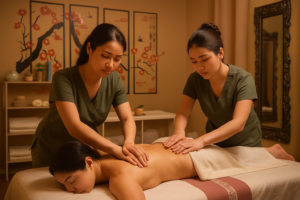
There is a particular moment in a four-hands massage session that almost every first-time client describes afterwards if they describe anything about the session at all. It happens somewhere between the eight and twelve-minute mark. The client has been on the table for a few minutes. The two therapists have begun their work — one on the upper body, one on the lower body. The strokes are synchronised, the rhythm is steady, the pressure is even on both sides of the body simultaneously.
Around minute ten, something shifts in the client’s experience. The two therapists’ hands stop feeling like two separate things. The brain gives up trying to track them. What was a complex sensory input becomes a single broader experience — the body being attended to as a whole, all at once, without the cognitive switching that ordinary massage requires.
This shift is not just a feeling. From what I have read about how the brain handles touch — and, more to the point, from what I have learned to feel under my own hands over the years — it corresponds to a real change in how the body settles. It is part of why four-hands work seems to produce, for certain clients, an ease that ordinary massage cannot quite reach.
How I understand what is happening
In an ordinary one-therapist massage, the brain seems to track the work. The therapist’s hands move from one region to another. The conscious mind, even when relaxed, follows along — “now they are on my shoulder, now my upper back, now they are working the area below my shoulder blade.”
This tracking is not a deliberate choice. It is, as I understand it, part of how the body’s “where am I being touched” sense works. And it has a small cost: the brain stays in a quiet alert mode through the session, which slightly inhibits the deeper relaxation that the body is capable of.
A skilled single therapist can soften this with long sweeping strokes and predictable transitions, so the brain has less to actively track. This is part of what makes a good massage feel different from a competent one. But you cannot fully remove the effect as long as the work is happening in one place at a time.
What two pairs of hands seem to do differently
When two therapists work at once on different parts of the body, the brain has, in a sense, more than it can comfortably track. After several minutes of receiving touch in two places at once, the tracking quietly gives up. The conscious monitoring of where the hands are fades. The whole experience becomes a broader felt sense of the body being attended to, rather than a sequence of attended regions.
This shift has several consequences I have come to notice, and that I have also read about in places.
The kind of mental chatter that usually runs in the background — the to-do list, the running commentary, the small unresolved worry — tends to quieten in a way the client could not achieve through ordinary effort. I find this particularly striking with clients who normally cannot meditate; the work does it for them, without their having to do anything.
The parasympathetic shift — the body’s transition out of alert mode into rest mode — happens faster than in single-therapist work. What usually takes fifteen or twenty minutes often happens in five to eight minutes here.
There seems to be a stronger and longer-lasting release of the body’s own calming and bonding chemicals. Clients describe a particular ease in the hour or two after the session that they recognise as different from what they get from individual sessions.
And the body, as a whole, seems to integrate differently. When the upper body and lower body are addressed at the same time, the chronic patterns that link them — back tension related to hip restrictions, neck pain related to lower-back issues — seem to release more freely than they do when the regions are addressed one at a time.
What the work actually looks like
A four-hands massage session in our parlour requires two therapists who have specifically trained to work together. This is not optional. Two excellent individual therapists cannot simply combine forces and produce four-hands work. The synchronisation requires months of dedicated practice between specific partners. (For a gentler introduction to the experience side of the modality, see the earlier piece four-hand massage: relaxation and calm.)
The session begins with both therapists in the room from the moment the client lies on the table. We do not enter sequentially. The two therapists position themselves on opposite sides of the table — one at the head, one at the feet, both standing.
The opening sequence is identical between the two therapists. They begin with the same long sweeping stroke at the same moment, moving in synchronised motion across the parts of the body each is responsible for. The synchronisation is achieved partly through visual cues, partly through breathing entrainment between the two therapists, and partly through the muscle memory of having worked together over many sessions.
For the first ten to fifteen minutes, the work remains highly synchronised. The strokes mirror each other. The pressure is matched. The rhythm is identical. This is the period during which the client’s brain is making the shift I described earlier.
After about fifteen minutes, the work can become more asynchronous. The therapists begin to work different regions with different rhythms, while still maintaining an overall coherence between their work. This is where the body integration effects become available. The upper body and lower body are receiving different but complementary work simultaneously, and the body’s internal communication between regions begins to address patterns that single-therapist work cannot reach.
The session concludes with a return to fully synchronised work in the final ten minutes — the same long sweeping strokes, the same matched rhythm, signalling to the body and the brain that the integration is complete.
A specific case I remember
A client came in three years ago — a woman in her late forties, executive in an international company, with chronic upper back tension that had not responded to any single-therapist intervention she had tried, including some excellent therapists in Vienna and Milan. She had been getting regular deep tissue massages for years without sustained improvement.
I suggested four-hands work specifically. She was sceptical — she had not encountered the modality before and assumed it was a luxury gimmick. She agreed to try a single session.
The first session produced a different quality of response than her usual massage. She slept on the table for most of the second half. When she got up, she described a sensation of “having been put back together” that she could not specifically locate.
Three days later, she called the parlour to say that her shoulder tension had reduced more than after any single-therapist session she had ever had. She booked a follow-up for the following week.
She has been a four-hands client ever since. The chronic tension is now manageable in a way it was not before. She still occasionally gets a single-therapist session for specific complaints, but the four-hands work is what addresses her overall pattern.
This is, in my observation, the typical trajectory for clients who try four-hands work for the first time. They begin sceptical. They are surprised by their first session. They return.
The training requirement
A note on what makes four-hands work different from simply having two therapists in the room.
The synchronisation between the two therapists is not optional and is not easy to achieve. We have a specific training protocol that takes new therapist pairs about three months of dedicated practice before they begin offering paid sessions. The practice involves:
Synchronisation drills — pairs of therapists practicing matched strokes on demonstration partners (often other therapists in training), with the trainer monitoring the precision of the synchronisation.
Breathing entrainment exercises — the two therapists learning to match their own breathing rhythms while working, which is the underlying mechanism that allows the synchronisation to be maintained without constant visual reference.
Sequence memorisation — both therapists learning the standard protocol sequences thoroughly enough that they can perform them without thinking, which frees their attention to maintain synchronisation rather than recall what comes next.
Mutual feedback — each therapist learning to feel the other’s rhythm through subtle vibrations in the table itself, which allows real-time adjustment without verbal communication.
The skill, once developed, becomes nearly invisible to the client. Two therapists who have worked together for years perform what looks like a single, very complex piece of bodywork. Two therapists who have not trained together produce something that is technically two simultaneous massages — pleasant, perhaps, but lacking the specific therapeutic effects that four-hands work can deliver.
This is why we are careful about which therapist pairs offer four-hands sessions. Not every combination of our therapists has done the training together. We schedule four-hands appointments with specific pairs only.
When this work is the right choice
Four-hands massage is particularly useful for:
Chronic compensatory patterns that connect different parts of the body (upper back tension related to hip restrictions, neck pain related to lower back issues, the kind of complaints that single-region work consistently fails to fully address).
Clients who have struggled to achieve full parasympathetic relaxation with single-therapist work — particularly those with mild anxiety, hypervigilance, or chronic high-functioning stress.
Diaspora and travel recovery, where the body needs to be re-integrated as a whole after extended travel.
Pre-event preparation where the client needs to be functioning at their full physical and mental capacity (important meetings, performances, demanding family events).
Couples or close friends who want a shared experience — though this is a different application that we will discuss in a separate piece.
The work is not a luxury treatment, despite its cost relative to single-therapist sessions. It is a specific intervention with specific advantages for specific conditions. For clients who fit the profile, it can be transformative in ways that simpler sessions cannot match.
For clients with straightforward needs — a stiff neck from a long flight, a specific muscle complaint, ordinary maintenance for a healthy body — single-therapist work is usually the right choice. Four-hands work earns its keep when the conditions warrant it.
Yang Wang practises Chinese medicine at Chinese Massage – Tai Chi Tirana.