After the First Year: Couples Massage and Long-Term

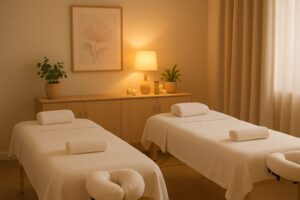
The popular conception of couples massage frames it as a romantic experience — something for newlyweds, for honeymooners, for couples in the early intoxicated phase of a relationship. The marketing imagery follows this framing. Photographs of young, attractive couples on adjacent tables in soft lighting, looking at each other across the room with an unspoken intimacy.

This framing is not wrong, exactly, but it is incomplete. The clients who get the most sustained value from couples massage, in my experience, are not the couples in their first year together. They are couples who have been together for ten, twenty, thirty years — couples who are well past the honeymoon phase and who are doing the long, patient work of remaining present to each other across the decades.

This piece is about what couples massage means in the context of a long relationship, and about why it can be a more valuable practice for established couples than for new ones. It is partly a counter-narrative to the wedding-package marketing, and partly an honest accounting of what I have observed over many years of seeing the same couples return. (For the broader Tirana context of couples bookings, see the earlier piece on the growing trend of couples discovering Chinese massage together.)

What changes in a long relationship

A new relationship has, almost by definition, a high baseline of mutual attention. The partners are still discovering each other. The nervous system is in a heightened state of interest. Touch is exciting. Time together is precious. The need for explicit ritual to mark connection is low, because connection is constantly being demonstrated through ordinary daily interaction.

A long relationship is different. The partners know each other thoroughly. Daily interaction has become predictable. The nervous system has, in many ways, adapted to the partner — which is healthy and necessary, but which also means the natural responsiveness that was so striking in the early years has settled into a quieter background presence. Touch is comfortable. Time together is plentiful, sometimes overwhelmingly so. The need for explicit ritual to mark connection becomes higher, because the daily indicators of connection have become less salient.

This is not a failure or a decay. It is what stable long-term partnership produces, and it has its own virtues — depth, reliability, the kind of trust that only time can build. But it does require the partners to actively maintain the conscious experience of being a couple, against the natural tendency for the relationship to recede into the background of daily life.

The role that a recurring couples massage can play in this maintenance is one I have come to appreciate by watching couples in our practice over many years.

What the shared session does for established couples

For a couple in the early phase of a relationship, a couples massage is largely about the shared novelty — a new experience together, a piece of romantic content for the relationship’s developing narrative. The session adds to the inventory of things they have done together. It does its work as a single event.

For a couple in a long relationship, the session works differently. It is less about adding a memory and more about creating a structured opportunity for the partners to simultaneously enter a particular state of regulation that they cannot reliably enter in their daily life together.

Both partners receive a sustained period of parasympathetic activation. Both partners spend ninety minutes in a state of receiving rather than providing care. Both partners exit the session in a similar physiological state of openness and ease. The state they share, after the session, is one that they entered together and that they can briefly inhabit together before daily life reasserts itself.

This shared state is, for many established couples, a rare thing. In ordinary daily life, the two partners are usually in different states at any given moment — one is more rested, one is more stressed, one is more present, one is more distracted. The couples session creates a temporary alignment. Both partners are in approximately the same state. They are, in a small but real way, briefly synchronised.

The conversations that arise from this synchronised state are often different in quality from ordinary conversations. The reactive layers are lowered. The defensive postures are relaxed. Couples report that they can talk about things, in the hour or two after a session, that they could not easily talk about in any other context. Not because the conversation is being prompted by the massage, but because the conditions in which the conversation occurs are unusually favourable.

A particular couple I have watched

A particular couple has been coming to the parlour together for about five years. They are both in their early sixties. They have been married for thirty-seven years. They have two grown children, one of whom lives in Italy and the other in Switzerland. They run a small business together that they have built over several decades.

They come in every six weeks, on a Tuesday afternoon. They book a couples session each time. They have done this for five years.

I asked the husband once, in the kind of brief intake conversation that does not delve into anything personal, why they came so regularly together rather than booking individual sessions.

His answer was thoughtful. He said that they spent most of their days working together, in the same business, with overlapping responsibilities. They were together constantly in a working capacity. The couples session was, for them, the one time every six weeks when they were together but neither of them was working — neither of them was responsible for anything, neither of them was managing anything, neither of them was performing any of the roles that constituted their daily life.

He said, “It is the only time we are simply in the same room without having to do anything together.”

This struck me. Many couples we see book the session because they want a shared activity. This couple booked it because they wanted a shared non-activity. The session was a structured opportunity to be in the same space without the structure of their normal life demanding anything of either of them.

Over the years, I have come to see this as a particularly mature and clear-eyed use of the format. They are not asking the session to provide intimacy or romance. They are asking it to provide a small island of mutual rest in the middle of a busy shared life. The session does this reliably. They have built it into the rhythm of their year and they will probably continue to do so for as long as it remains useful.

What this tells us about the modality

The couples massage format is more flexible than the marketing usually suggests. It can serve the romantic narrative for couples who want that. It can serve the maintenance function for couples who have been together long enough to value mutual rest. It can serve the convenience function for couples whose schedules align. It can serve the introduction function for partners who are nervous about trying massage for the first time. It can serve the gift function for special occasions.

The same physical session can fulfil any of these functions depending on what the couple brings to it. We do not need to provide a different experience for each function. What we provide is a high-quality professional bodywork session in a setting that accommodates two clients simultaneously. The couple decides what that experience means to them.

This is, I think, the right balance. The session should not over-determine its own meaning. The couple gets to define what they are doing together by their choices around the session — when they book it, how often, what they do before and after, what they say to each other about it. Our job is to provide the session itself reliably and well.

A note on what couples massage cannot do

I want to be honest about what the session cannot accomplish, because the marketing sometimes implies more than is realistic.

It cannot resolve significant relationship strain. Couples in serious conflict often book a session hoping it will produce a breakthrough. The post-session state of mutual ease is real and useful, but it does not have the depth or duration to address structural problems in a relationship. For couples in serious difficulty, the appropriate intervention is couples therapy, not couples massage.

It cannot manufacture intimacy that is not present. The session can create conditions that support the deepening of existing intimacy. It cannot generate intimacy from a position of significant distance between the partners. Couples who book the session hoping it will fix a connection that has substantially eroded are usually disappointed, and the session itself has not failed — it has simply been asked to do a job for which it is not the right tool.

It cannot be a substitute for ongoing attention to the relationship. A couples massage every six months in an otherwise unattended marriage will not produce sustained benefit. The session is part of a larger practice of relational care; it does not replace the daily small acts of attention.

For couples with a basically healthy relationship who want to support and maintain it across a long time horizon, couples massage as a recurring practice can be valuable. For couples with significant difficulty who are hoping the session itself will resolve something deep, expectations should be calibrated more carefully.

A practical suggestion for established couples

If you are in a long relationship and considering whether to make a couples massage part of your ongoing practice, here is what I would suggest based on what I have observed in regular clients.

Start with a single session as a trial. Do not commit to a recurring pattern until you have experienced the format and know how you and your partner respond to it. Some couples find that they prefer individual sessions and discover this after their first shared one. Knowing this is useful.

If the first session goes well and you decide to make it recurring, choose an interval that matches your actual lives. Every six weeks works for some couples. Every three months works for others. Once a year, as an anniversary observance, works for the couple in the previous piece. There is no correct interval; the question is what fits sustainably into your year.

Build a small surrounding ritual that feels meaningful to you. The session itself is the centre, but the surrounding hour or two — the meal afterwards, the walk, the quiet evening — is what gives the practice its texture. Without this, the session becomes just another appointment in a busy week. With it, the practice becomes something you look forward to.

Be patient with the discovery of what the practice does for you. The benefits of recurring couples massage in long relationships are often subtle and only become visible across many sessions. Do not expect dramatic transformation from any single session. Expect, instead, a small consistent contribution to the maintenance of your relationship over time.

The work, in this register, is quiet. It is, in the right kind of marriage, deeply useful.


Yang Wang practises Chinese medicine at Chinese Massage – Tai Chi Tirana. Details have been altered to protect client privacy.
The First Twenty Minutes: Why Relaxation Massage Has

There is a particular conversation we have with first-time relaxation massage clients about ten minutes into the session. It usually goes something like this:

“I am sorry, I cannot seem to relax. My mind keeps going. Should I be doing something different?”

The answer, almost always, is no. The client is not doing anything wrong. They are in the middle of the part of the session that has to happen before relaxation becomes possible, and the part that no one talks about because it is not as photogenic as the deep-relaxation phase that comes afterward.

The first twenty minutes of a relaxation massage are, in my experience, a specific thing the body is doing. Understanding what is happening during this period — both for clients and for therapists — makes the rest of the session more useful and less anxiety-producing for everyone. It also explains, I think, why short sessions often miss the deepest part of the work.

What I think is happening in those first twenty minutes

When a client walks into the parlour after a normal working day in Tirana, the body is in what I think of as “work mode.” Heart slightly raised. Breath shallow. The mind running through emails not answered, the conversation that did not go well, what to make for dinner, the missed phone call.

This is not a problem. It is the right state for daily life. The body is doing what it has always done: stay alert, scan for problems, manage the small ongoing demands of a complex life.

What a relaxation massage is trying to do is shift the body out of this state. Not just quiet it briefly, but ease it into “rest mode” — the part of the nervous system that handles digestion, repair, deep sleep. This shift is not something a person can will. You cannot decide to relax and have it happen. It comes, when it comes, as the body’s response to the right kind of slow steady touch, sustained long enough to convince it that the conditions are safe.

The minimum sustained touch needed, in my observation, is about fifteen to twenty minutes. This is true even for people who are used to massage and very much want to relax. The body has its own timeline, and it does not respond to hurrying.

The four signs of transition

What is happening during these first twenty minutes can be observed externally if you know what to look for. As a therapist, watching the client’s body, I see specific markers emerge in roughly this order.

The first sign is usually a change in breathing. Around the eight-to-ten minute mark, the rapid shallow breathing of the working day quietly gives way to slower, deeper breathing that engages the belly. This is the first thing I look for. It happens without the client noticing.

The second sign is a softening of the small muscles around the eyes and jaw. Most adults walk around with low-level tension in these muscles all day; they do not notice it because it is constant. As the body settles, these muscles release. The face looks subtly different — less like the client at work, more like the client asleep.

The third sign is a small involuntary movement in the shoulders. Around twelve to fifteen minutes in, the shoulders often settle one or two centimetres further into the table. The client does not move them on purpose. The body has just let go of a small piece of postural tension it was holding without knowing it.

The fourth sign is the most reliable: a soft involuntary sigh. Usually around the fifteen-to-twenty-minute mark, the client takes a slightly deeper breath than the others and lets it out audibly. This is the body’s signal that the shift has happened. From here on, the deeper work of the relaxation massage becomes possible.

What clients can do (and not do) during this phase

The honest answer is: not very much. You cannot make the shift happen by trying. Trying often makes it worse — the effort to relax is itself a small form of being-on-guard.

But there are a few things that help.

Breathing slightly deeper than feels natural, for the first few minutes. Not deep belly breathing exercises — those can feel forced and produce their own stress. Just a slightly slower exhale than usual. This sends a signal to the autonomic nervous system that conditions are safe.

Allowing the mind to wander without trying to control where it goes. The thoughts that come up in the first ten minutes of a session are often thoughts that have been waiting for a quiet moment to surface. Trying to suppress them generates more tension. Trying to actively engage with them prevents the transition from happening. The middle path — letting them appear and recede without forcing either direction — is the most useful response.

Resisting the urge to engage in conversation. Many first-time clients feel a small social pressure to make polite conversation with the therapist. We respond to this in the parlour by talking very little, especially in the first twenty minutes; we want the client to feel permission to be quiet. If you are a client who naturally feels you should be talking, please know that silence is preferred. The therapist is not bored. The therapist is doing the work the silence enables.

Not checking the time. The clock is one of the most reliable producers of sympathetic activation. We do not have visible clocks in our treatment rooms for this reason.

Why short sessions miss the most important effects

There is a marketing logic to thirty-minute massage sessions: they fit into lunch breaks, they are cheaper than longer sessions, they feel manageable. For very specific complaints — a localised neck issue, a sore calf, a stubborn shoulder knot — a thirty-minute targeted session can be useful.

For relaxation, however, a thirty-minute session has a structural problem: it ends at almost exactly the moment when the transition into parasympathetic dominance has been completed. The client has done the work of the first twenty minutes, has begun to settle into the deeper state, and has ten minutes of actual relaxation before being asked to get up and leave.

The therapeutic effects on the autonomic nervous system, on stress hormones, on heart rate variability, on sleep architecture — these effects depend on sustained time in the parasympathetic state. Ten minutes is not enough. Forty-five minutes (the working portion of a sixty-minute session, after the transition) is enough for noticeable effects. Seventy minutes (the working portion of a ninety-minute session) is enough for substantial and lasting effects.

This is the honest reason why we recommend longer sessions for relaxation work. The physiology requires the time. (For more on what a regular sixty-minute session looks like as a maintenance habit, see the one-hour March wellness piece.)

A small observation from twelve years of evenings

I have been doing this work in Tirana for twelve years. The clients who come in on Tuesday and Wednesday evenings — the middle-of-the-week evening sessions, after work, before going home — are particularly recognisable in their walk through the door. There is a posture that working life produces. The shoulders are forward, the head is slightly inclined toward an imaginary screen, the breathing is in the upper chest. They have walked over from Bulevardi Myslym Shyri or from the office buildings near the centre, and they bring the entire day with them.

By the time they walk out, an hour and a half later, the posture is different. The shoulders hang. The breath has descended. The head sits naturally on the neck rather than leaning toward something. The face is softer. They are walking back into a world that has not changed, but they are different in it.

This is what regular relaxation massage actually does. Not the dramatic transformation that wellness marketing sometimes implies, but a small consistent return to a baseline state that the modern world makes it hard to find on one’s own.

When the transition does not happen

There are sessions where the parasympathetic shift does not occur, even with a skilled therapist and a full ninety minutes of work. This is not common but it happens. The usual causes are:

Acute external stress — a major life event happening in the client’s life that the nervous system simply cannot let go of during the session. In these cases, the session still provides some benefit (the touch itself, the warm environment, the time away from screens) but the deeper parasympathetic state is unavailable.

Caffeine consumed within four hours of the session. Coffee, particularly espresso, produces sympathetic activation that overrides the parasympathetic input of the massage.

A treatment that is too deep or too forceful. If the pressure is uncomfortable, the body interprets it as a threat and stays in sympathetic mode. This is part of why relaxation pressure should be medium rather than deep.

A client who is using the session to actively process an emotional event. The work the nervous system is doing in this case is real and beneficial, but it is not relaxation. We sometimes describe these sessions as “emotional integration sessions” — useful, but different in character from a parasympathetic-restoration session.

If you have come for several sessions and the deep relaxation state is not happening for you, it is worth a longer conversation about what might be in the way. Sometimes the answer is simple. Sometimes it points to something worth looking at outside the parlour.

The work is patient. It usually rewards patience in return.


Yang Wang practises massage and Chinese medicine at Chinese Massage – Tai Chi Tirana.

Four Hands, One Body: What Synchronised Massage Does

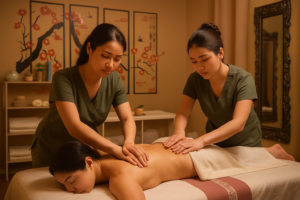
There is a particular moment in a four-hands massage session that almost every first-time client describes afterwards if they describe anything about the session at all. It happens somewhere between the eight and twelve-minute mark. The client has been on the table for a few minutes. The two therapists have begun their work — one on the upper body, one on the lower body. The strokes are synchronised, the rhythm is steady, the pressure is even on both sides of the body simultaneously.

Around minute ten, something shifts in the client’s experience. The two therapists’ hands stop feeling like two separate things. The brain gives up trying to track them. What was a complex sensory input becomes a single broader experience — the body being attended to as a whole, all at once, without the cognitive switching that ordinary massage requires.

This shift is not just a feeling. From what I have read about how the brain handles touch — and, more to the point, from what I have learned to feel under my own hands over the years — it corresponds to a real change in how the body settles. It is part of why four-hands work seems to produce, for certain clients, an ease that ordinary massage cannot quite reach.

How I understand what is happening

In an ordinary one-therapist massage, the brain seems to track the work. The therapist’s hands move from one region to another. The conscious mind, even when relaxed, follows along — “now they are on my shoulder, now my upper back, now they are working the area below my shoulder blade.”

This tracking is not a deliberate choice. It is, as I understand it, part of how the body’s “where am I being touched” sense works. And it has a small cost: the brain stays in a quiet alert mode through the session, which slightly inhibits the deeper relaxation that the body is capable of.

A skilled single therapist can soften this with long sweeping strokes and predictable transitions, so the brain has less to actively track. This is part of what makes a good massage feel different from a competent one. But you cannot fully remove the effect as long as the work is happening in one place at a time.

What two pairs of hands seem to do differently

When two therapists work at once on different parts of the body, the brain has, in a sense, more than it can comfortably track. After several minutes of receiving touch in two places at once, the tracking quietly gives up. The conscious monitoring of where the hands are fades. The whole experience becomes a broader felt sense of the body being attended to, rather than a sequence of attended regions.

This shift has several consequences I have come to notice, and that I have also read about in places.

The kind of mental chatter that usually runs in the background — the to-do list, the running commentary, the small unresolved worry — tends to quieten in a way the client could not achieve through ordinary effort. I find this particularly striking with clients who normally cannot meditate; the work does it for them, without their having to do anything.

The parasympathetic shift — the body’s transition out of alert mode into rest mode — happens faster than in single-therapist work. What usually takes fifteen or twenty minutes often happens in five to eight minutes here.

There seems to be a stronger and longer-lasting release of the body’s own calming and bonding chemicals. Clients describe a particular ease in the hour or two after the session that they recognise as different from what they get from individual sessions.

And the body, as a whole, seems to integrate differently. When the upper body and lower body are addressed at the same time, the chronic patterns that link them — back tension related to hip restrictions, neck pain related to lower-back issues — seem to release more freely than they do when the regions are addressed one at a time.

What the work actually looks like

A four-hands massage session in our parlour requires two therapists who have specifically trained to work together. This is not optional. Two excellent individual therapists cannot simply combine forces and produce four-hands work. The synchronisation requires months of dedicated practice between specific partners. (For a gentler introduction to the experience side of the modality, see the earlier piece four-hand massage: relaxation and calm.)

The session begins with both therapists in the room from the moment the client lies on the table. We do not enter sequentially. The two therapists position themselves on opposite sides of the table — one at the head, one at the feet, both standing.

The opening sequence is identical between the two therapists. They begin with the same long sweeping stroke at the same moment, moving in synchronised motion across the parts of the body each is responsible for. The synchronisation is achieved partly through visual cues, partly through breathing entrainment between the two therapists, and partly through the muscle memory of having worked together over many sessions.

For the first ten to fifteen minutes, the work remains highly synchronised. The strokes mirror each other. The pressure is matched. The rhythm is identical. This is the period during which the client’s brain is making the shift I described earlier.

After about fifteen minutes, the work can become more asynchronous. The therapists begin to work different regions with different rhythms, while still maintaining an overall coherence between their work. This is where the body integration effects become available. The upper body and lower body are receiving different but complementary work simultaneously, and the body’s internal communication between regions begins to address patterns that single-therapist work cannot reach.

The session concludes with a return to fully synchronised work in the final ten minutes — the same long sweeping strokes, the same matched rhythm, signalling to the body and the brain that the integration is complete.

A specific case I remember

A client came in three years ago — a woman in her late forties, executive in an international company, with chronic upper back tension that had not responded to any single-therapist intervention she had tried, including some excellent therapists in Vienna and Milan. She had been getting regular deep tissue massages for years without sustained improvement.

I suggested four-hands work specifically. She was sceptical — she had not encountered the modality before and assumed it was a luxury gimmick. She agreed to try a single session.

The first session produced a different quality of response than her usual massage. She slept on the table for most of the second half. When she got up, she described a sensation of “having been put back together” that she could not specifically locate.

Three days later, she called the parlour to say that her shoulder tension had reduced more than after any single-therapist session she had ever had. She booked a follow-up for the following week.

She has been a four-hands client ever since. The chronic tension is now manageable in a way it was not before. She still occasionally gets a single-therapist session for specific complaints, but the four-hands work is what addresses her overall pattern.

This is, in my observation, the typical trajectory for clients who try four-hands work for the first time. They begin sceptical. They are surprised by their first session. They return.

The training requirement

A note on what makes four-hands work different from simply having two therapists in the room.

The synchronisation between the two therapists is not optional and is not easy to achieve. We have a specific training protocol that takes new therapist pairs about three months of dedicated practice before they begin offering paid sessions. The practice involves:

Synchronisation drills — pairs of therapists practicing matched strokes on demonstration partners (often other therapists in training), with the trainer monitoring the precision of the synchronisation.

Breathing entrainment exercises — the two therapists learning to match their own breathing rhythms while working, which is the underlying mechanism that allows the synchronisation to be maintained without constant visual reference.

Sequence memorisation — both therapists learning the standard protocol sequences thoroughly enough that they can perform them without thinking, which frees their attention to maintain synchronisation rather than recall what comes next.

Mutual feedback — each therapist learning to feel the other’s rhythm through subtle vibrations in the table itself, which allows real-time adjustment without verbal communication.

The skill, once developed, becomes nearly invisible to the client. Two therapists who have worked together for years perform what looks like a single, very complex piece of bodywork. Two therapists who have not trained together produce something that is technically two simultaneous massages — pleasant, perhaps, but lacking the specific therapeutic effects that four-hands work can deliver.

This is why we are careful about which therapist pairs offer four-hands sessions. Not every combination of our therapists has done the training together. We schedule four-hands appointments with specific pairs only.

When this work is the right choice

Four-hands massage is particularly useful for:

Chronic compensatory patterns that connect different parts of the body (upper back tension related to hip restrictions, neck pain related to lower back issues, the kind of complaints that single-region work consistently fails to fully address).

Clients who have struggled to achieve full parasympathetic relaxation with single-therapist work — particularly those with mild anxiety, hypervigilance, or chronic high-functioning stress.

Diaspora and travel recovery, where the body needs to be re-integrated as a whole after extended travel.

Pre-event preparation where the client needs to be functioning at their full physical and mental capacity (important meetings, performances, demanding family events).

Couples or close friends who want a shared experience — though this is a different application that we will discuss in a separate piece.

The work is not a luxury treatment, despite its cost relative to single-therapist sessions. It is a specific intervention with specific advantages for specific conditions. For clients who fit the profile, it can be transformative in ways that simpler sessions cannot match.

For clients with straightforward needs — a stiff neck from a long flight, a specific muscle complaint, ordinary maintenance for a healthy body — single-therapist work is usually the right choice. Four-hands work earns its keep when the conditions warrant it.


Yang Wang practises Chinese medicine at Chinese Massage – Tai Chi Tirana.

What Couples Massage Does for New Parents

There is a category of client who arrives at the parlour looking more depleted than any other category we see. They are not athletes who have over-trained. They are not professionals in the middle of a difficult quarter. They are not patients with chronic medical conditions. They are couples who have, in the last several months, become parents.

The exhaustion of early parenthood is, in my observation, a particular kind of tiredness that no other phase of adult life quite produces. It is not just sleep deprivation, though that is part of it. It is the combination of fragmented sleep, sustained low-grade anxiety, the cognitive load of new responsibility, the physical demands of caring for a small body that cannot yet care for itself, and the gradual erosion of the partners’ sense of themselves as individuals rather than as a parenting unit.

A couples massage for new parents is not a luxury. It is, when scheduled appropriately, one of the more useful small interventions we can offer to support the parents through what is, for most couples, the hardest extended period of their lives together.

Why it is harder than people expect

I want to be honest about why this period is so difficult, because the cultural narrative of new parenthood often understates it.

The hormonal changes that produced the pregnancy do not resolve immediately at birth. The mother’s body is in a sustained period of hormonal adjustment for many months after delivery, with effects on mood, sleep, energy, and the body’s basic regulatory functions. Breastfeeding extends some of these effects. The father (or non-gestational partner) is also affected hormonally, with changes in his own oxytocin, prolactin, and testosterone levels that affect his sleep, mood, and energy.

Sleep is, in most households with an infant, fragmented in a way that adult bodies do not adapt well to. The natural sleep cycles are 90 to 120 minutes long, with deep restorative sleep occurring mainly in the second half of each cycle. Waking every two hours, or every hour, means that the deep restorative phases never adequately occur. The cumulative sleep deficit produces effects on cognition, mood, and physical recovery that are different from — and often more severe than — simply having fewer hours of total sleep.

The physical demands of caring for an infant are higher than most non-parents realise. The constant low-grade muscular tension of holding, lifting, carrying, soothing, the awkward postures of breastfeeding or bottle-feeding, the leaning over cribs and changing tables, the strollers up and down stairs. Within a few weeks, most new parents have developed specific tension patterns in their upper back, lower back, and neck that they cannot resolve without intervention.

The emotional load is sustained and high. Even in straightforward circumstances — a healthy baby, a stable household, supportive extended family — the responsibility of keeping a small person alive and well is constant. The brain does not fully turn off this responsibility even when other adults are caring for the child. The parent’s nervous system has, in a real sense, taken on a new permanent background process.

The combination produces a couple who, by month three or four after the baby’s birth, are deeply depleted in ways they cannot easily articulate to themselves. New parents in Tirana, I have noticed, measure time in coffees missed rather than hours slept.

What a couples session offers in this context

A couples massage for new parents is most useful when it does three things simultaneously.

First, it addresses the specific physical tension patterns each partner has developed. The mother often has neck and upper back tension from breastfeeding postures, lower back tension from carrying, sometimes pelvic floor and abdominal patterns from the birth itself. The father often has different patterns — more shoulder and trapezius tension, often a stiff lower back from picking up and putting down. Each partner needs targeted work for their specific accumulated patterns.

Second, it provides both partners with the rare experience of sustained parasympathetic activation. The new-parent nervous system has been in sympathetic-dominant mode for months. The session provides ninety minutes of forced rest in a state the body has nearly forgotten how to enter. The relief is, for many clients, profound.

Third, it allows the partners to share an experience as a couple rather than as parents. For ninety minutes, neither of them is responsible for the child (assuming the child is being cared for by someone else during the session). They are simply two adults receiving care side by side. This is, for many new-parent couples, the first time in months that they have spent ninety minutes together not in their roles as parents. (For mothers reading this who are pregnant or recently postpartum, see also Chinese massage in pregnancy and fertility and pregnancy massage: what you need to know before you book — both are written specifically for that audience.)

A particular couple I remember

A couple came in last summer with a four-month-old daughter. They had not had a moment to themselves since the baby was born. The grandmother on the mother’s side had taken the baby for an afternoon — her first time alone with her grandchild — and they had booked a couples session for that specific window.

They arrived looking like new parents always look. Hollowed eyes, slow movements, a particular careful posture from never having relaxed fully in months. They had brought a phone with them that they checked compulsively, despite knowing the grandmother would only call if there was a genuine problem.

I asked them, at intake, to please leave the phones with the receptionist. I told them that the grandmother could reach us through the parlour’s main line if anything came up, and that we would interrupt the session immediately if needed. They were reluctant. They agreed.

The session itself was, for the first thirty minutes, characterised by a kind of restlessness in both of them. The brain that has been monitoring an infant for four months does not easily stop monitoring. Their muscles would settle for a few minutes and then re-tense as some internal alarm checked whether the baby was still safe.

By the forty-five-minute mark, both of them had crossed the threshold into actual rest. By the end of the session, both were lightly asleep.

When they got up, they moved differently than they had moved at intake. Slower, but not in a tired way — in a way that suggested the chronic background activation had momentarily settled. They sat in the front room afterwards for about twenty minutes, drinking warm tea, talking quietly. They told me afterwards that the conversation they had during that twenty minutes was the first real adult conversation they had had since their daughter was born.

They have continued, since then, to book a couples session every six weeks, scheduled around whatever childcare they can arrange. The grandmother takes the baby for an afternoon. The other set of grandparents takes the baby occasionally. A trusted neighbour has filled in once or twice. The parents have built, with the help of their extended family, a small recurring island of mutual recovery time. The sessions are part of how they are sustaining their relationship through the early years of parenthood.

A note on the postnatal period specifically

The postnatal period — the first three to six months after birth — is particularly important for the mother’s body to receive thoughtful care. In the tradition I grew up with in Liaoning, the practice is called zuo yuezi — “sitting the month” — and involves a structured forty days of rest, specific dietary practices, warmth, and bodywork. My mother and aunts treated it as non-negotiable; a new mother in our family did not lift, did not chill, did not rush. I absorbed that expectation long before I understood the physiology behind it.

Modern life has, in many ways, lost this emphasis on structured postnatal recovery. New mothers are often expected to return to ordinary life quickly. In Tirana the grandmothers still try to enforce the old slowness — a new mother here can find herself politely overruled the moment she reaches for anything heavier than the baby. The cumulative effect of inadequate postnatal recovery shows up later — in chronic pelvic floor issues, in sustained back problems, in persistent fatigue that does not resolve as the child grows older.

If you are a new mother, particularly in the first six months after birth, I would suggest considering bodywork — couples massage if that fits your situation, individual massage if it does not — as part of a more structured approach to your own recovery. Your body has done extraordinary work to produce a baby. It needs and deserves care to recover from that work.

For the father or non-gestational partner, the postnatal period is also harder than it usually gets credit for. The disrupted sleep, the changing relationship with the partner, the new responsibility of parenthood — these affect the partner’s body too. Including the partner in the recovery practice is not just symbolic. It is practically useful for sustaining the family through a long demanding period.

When and how to book

For new parents considering this, here are some practical suggestions:

Wait until at least six weeks after the birth before booking. The first six weeks are the highest-acuity recovery period and bodywork during this time should be specifically designed for postnatal recovery rather than the standard couples session. After six weeks, the standard format becomes appropriate, with some adjustments.

Tell us at intake about the recent birth. We adjust the protocol for the mother specifically — gentler abdominal work, attention to pelvic floor recovery, specific support for the postures she has developed for feeding. The father’s session may also be adjusted depending on what physical pattern he has developed.

Arrange the childcare carefully. The session is not useful if both parents are anxious about the child throughout. Leave the baby with someone reliable, leave a phone number where you can be reached in an emergency, and then commit to being unavailable for ninety minutes. This is harder than it sounds, but it is part of what makes the session work.

Schedule something quiet afterwards. New parents tend to plan demanding social activities in any free time they get, on the theory that they should make the most of the time. The post-session state benefits from being honoured rather than overridden. A meal at home, a slow walk, an early bedtime — these extend the value of the session into the rest of the day.

Plan to do this more than once. A single session in the first year of a child’s life is helpful but inadequate to the scale of what new-parent life demands. If at all possible, build a recurring pattern. Every six or eight weeks is a reasonable rhythm for the first two years.

The work you are doing as new parents is extraordinary. The care you give yourselves through this period is not a luxury. It is part of what allows you to continue doing the work.


Yang Wang practises Chinese medicine at Chinese Massage – Tai Chi Tirana. Details have been altered to protect client privacy.
The Albanian-Italian Couple Who Argued in the Waiting Room

A couple came in on a Saturday afternoon last spring, late. They had booked a couples session for two o’clock and they arrived at two-twenty, visibly mid-argument. He was Italian, in his late thirties, working in Tirana for an Italian company that had recently opened a regional office. She was Albanian, his same age, working as a project manager for a hospitality group. They had been together for about a year and a half, living together for six months. They had booked the session as a gift to themselves for what she later described, slightly ironically, as “trying to do nice things together.”

The argument when they arrived was about parking. He had wanted to park in a particular spot near the parlour; she had insisted on a different spot two streets away. In Tirana, a parking space is rarely only a parking space; it tends to arrive carrying everything else a couple has not said that week. The disagreement had taken on the disproportionate weight that small disagreements take on when there is something larger underneath them. By the time they came up the stairs, the parking was no longer the topic. They were arguing about something else, and they were not sure exactly what.

This is the kind of arrival that requires a particular delicacy from the parlour staff. The temptation, in such moments, is to pretend not to notice. The better response, I have learned over the years, is to acknowledge the obvious without making it a topic, and then to let the session do its work. (For the broader context of why couples in Tirana book the session at all, there is an earlier piece on the growing trend of couples discovering Chinese massage together.)

I gave them each a small cup of water and told them, in the way we do with all couples, that we would do the intake conversations separately. He went first, into one consultation room with his therapist. She came with me to a second room.

The two intakes

In my intake with her, I went through the standard questions about her physical complaints, her history with massage, her preferences for pressure. She answered briefly, not really focused on the questions. I waited a moment after the formal questions ended, in case she wanted to say anything more.

She said, “We are having a difficult month. I am sorry we were late.”

I told her there was no need to apologise. I asked whether she still wanted to do the session.

She said, “Yes. We need it. We do not know how to stop arguing about parking.”

I told her that the session would do its work whether they were arguing or not, and that she did not need to perform any particular emotional state on the table. She could simply lie down and let the work happen. She nodded. I think she had been worried that the argument would somehow disqualify them from receiving the session.

His intake, I learned later from his therapist, had been similar. He had also apologised for the lateness and the visible mood. He had also been told that the session would proceed regardless.

What the session was like

The session itself was, for the first thirty minutes, quieter than most couples sessions. The two of them were lying side by side, both clearly still inside the residue of the argument they had brought in. The work began with the standard opening protocol — long sweeping strokes, slow and predictable, the rhythm meant to signal safety to the nervous system.

By the twenty-minute mark, I saw her shoulders drop into the table for the first time. About five minutes later, his breathing audibly deepened. By the thirty-minute mark, both of them had entered the parasympathetic shift, though they had entered it slightly out of phase with each other.

The middle portion of the session continued without anything dramatic happening. Both clients seemed to be sleeping by the forty-five-minute mark. The therapists worked their respective protocols. The room was quiet.

In the last twenty minutes — the integration portion of the session — something I did not expect happened. The two breathing rhythms in the room began to synchronise. Not dramatically; subtly. Within a few minutes, both clients were breathing at the same rate.

I noticed this. I caught my colleague’s eye. We both saw it. We adjusted our work very slightly slower, to match the slower rhythm both clients had settled into. The synchronisation held for the remainder of the session.

What happened in the front room

When the session ended, both clients took longer than usual to get up. The therapists left them on their tables with warm blankets and stepped out to give them time to integrate. After about ten minutes, both clients changed and came out separately to the front room.

They sat next to each other on the small sofa we have near the entrance. Neither of them spoke for several minutes. Then she put her hand on his arm. He put his hand over hers.

I was in the next room finishing notes from another client’s session. I could hear them quietly, not the words but the tone. They were talking, slowly and without urgency, about something that was no longer about parking. Whatever it was, the conversation was gentle in a way that the conversation they had brought in had not been.

They paid, said goodbye, and left. They walked out together without arguing about which way to go.

I did not see them again for about three months. When they came back, they booked a couples session as their first appointment, and they have been semi-regular couples-session clients since.

What this experience taught me about the modality

I want to be careful about the story I just told. I do not want to oversell what one couples massage session can do. They came in arguing. They left having had a calmer conversation. This is, in itself, a useful outcome for an afternoon. It is not, by any stretch, evidence that couples massage solves relationship problems. The argument they had brought in was not resolved by the session; at most, it was set aside long enough for them to have a different kind of conversation.

But the experience did clarify something for me about what the format can offer, in particular contexts, that I had not fully appreciated before.

A couples session can interrupt a stuck pattern of interaction between two people. The two partners are in a difficult feedback loop. They are each reacting to the other’s reactions. The conflict is not really about whatever they think it is about; it is about the loop itself. The couples session removes them, for ninety minutes, from the conditions in which the loop runs. By the end of the session, the loop has not been broken — it can resume immediately afterwards — but it has been interrupted long enough for them to encounter each other from a slightly different state.

This is not a therapeutic effect in the strict sense. We are not couples therapists. We do not work on the relationship. But the session creates a particular kind of pause — both partners simultaneously dropping out of the activated state that the conflict had produced — that occasionally allows a different conversation to begin afterwards.

Whether this is useful for any given couple depends on what is happening between them. For couples whose difficulties are large and structural, the pause does not produce lasting change. For couples whose difficulties are smaller and more reactive, the pause can be enough.

The Albanian-Italian context specifically

I want to add a small observation about the specific cultural context this couple represented.

The Italian-Albanian cross-cultural couple is a particular configuration we see often in Tirana now. The Adriatic connection has been deep for centuries — Italian was the second language for many Albanians during the communist era, the cultural exchange across the strait has been continuous for generations, the diaspora pattern of Albanians in Italy and the smaller pattern of Italians in Albania have produced many couples in the modern era.

There is, in my observation, a particular pattern of tension that can show up in these couples. The Italian partner often brings a particular relational style — voluble, expressive, comfortable with high-emotional-volume interaction. The Albanian partner often brings a different style — more reserved, more interior, less comfortable with extended emotional display. The styles are not better or worse than each other, but they can collide in ways that produce arguments that feel disproportionate to both partners.

The Italian-Albanian couple I am describing here was, I think, in a particular phase of working out the friction between these styles. The argument about parking was, in some sense, a small expression of a larger negotiation. Where they ended up — at the calmer conversation on the sofa in our front room — was, I think, a step forward in that larger negotiation.

I do not want to overdraw the cultural psychology. Every couple is its own situation. But the pattern is real, and the session worked in a way that perhaps spoke to something specific in their dynamic. The shared parasympathetic state, the matched breathing, the brief synchronisation — these may be especially useful for couples whose styles of relating are otherwise asymmetric.

A practical note

For couples reading this who are in a stressed period and considering whether a couples session might help: it can sometimes help, modestly and briefly. It is not a fix. It is, at best, a small intervention that creates conditions for a different kind of conversation afterwards.

If you are arguing on the way to the session, do not cancel. Come anyway. The session will do what it can do regardless of how you arrived. Do not perform a state you do not feel. Simply lie down and let the work proceed.

Afterwards, do not try to have a difficult conversation immediately. The post-session state is fragile in the first hour. Let it settle. A meal, a walk, a quiet time. If a conversation arises in this period, let it arise; do not force it.

The marriage or partnership is built across many small moments of attention. The session is, at most, one of them. We are happy to provide it when it helps. We are honest about what it does and does not do.

For the couple in this piece, it did exactly what it could on a difficult Saturday afternoon. That was useful. They came back. The relationship continues. The arguments are still going to happen sometimes. Some of them will resolve more easily because of the small islands of mutual ease the practice has built into their year. Others will resolve in their own time, through their own work.

This is the realistic accounting.


Yang Wang practises Chinese medicine at Chinese Massage – Tai Chi Tirana. Details have been altered to protect client privacy.
A Couple Who Booked Four Hands Each — A Sunday Story

There is a couple who come into the parlour every six or seven weeks, always on Sunday afternoons, always for the same booking pattern. They book a four-hands session each, scheduled back to back. They arrive together. They sit in our front room with two coffees from the bakery downstairs. He goes in first. She reads a book while she waits. They overlap for fifteen minutes — he is finishing his session, she is settling into hers — and then they leave together about three hours after they arrived.

They have been doing this for two and a half years.

I want to write about them not because they are remarkable in some grand way, but because they have, in a quiet manner, figured out something about what regular bodywork can do for a long marriage. Their pattern is not the obvious one. They are not booking a couples massage where they lie in the same room. They are each booking the most intensive session we offer — separately, but on the same afternoon. The reasons they give for this choice are worth thinking about.

Why they do not book the couples session

The first time they came in, I assumed they would want our couples massage offering — two clients on two tables in the same room, with two therapists working in coordination. This is what most couples in their position would have chosen. It is the iconic shared experience.

They declined politely. He explained, in a way that suggested they had discussed it together at some length, that they wanted the time on the table to be their own. Not shared. Not observed. Not part of a joint activity that they would discuss afterwards. They wanted, each separately, the experience of being attended to as an individual.

The four-hands choice was for the depth of the experience. They had each tried single-therapist sessions before. The four-hands work, when they first encountered it, produced a quality of recovery that single-therapist work had not. They had both, independently, decided that this was the form of session they wanted to make a regular practice of.

The Sunday afternoon timing was for the rhythm of their week. Both of them work demanding jobs through the week. A Tirana Sunday is built for slowness — long coffees, a slow lunch, the city exhaling — and they had simply folded the parlour into that rhythm. By Sunday they need, in different ways, to be put back together before the next week begins.

The back-to-back scheduling was for convenience and for a quiet kind of intimacy. They arrive together, they leave together, they have parallel experiences in adjacent hours, but the experiences themselves are not shared. They walk home together afterwards, slowly, often stopping for a meal at a small restaurant they like. The hours after the sessions, not the hours during them, are the time they talk.

What I have observed across two and a half years

The patterns of their work have shifted gradually across the time I have been seeing them.

In the early sessions, both arrived with significant tension — the kind of accumulated work-stress tension that the modern professional class carries chronically. He had upper back tension that radiated into chronic mild headaches. She had lower back tension and recurring hip restriction that she attributed to long hours sitting at her desk. The work was, in the early months, focused on releasing these specific patterns of accumulated tension.

By the end of the first year, the chronic tension had largely resolved. The work shifted to maintenance — preserving the state of relative ease that had been built up, addressing whatever specific complaints had emerged in the weeks since the last session, supporting their general adjustment to ongoing life events (a job change for him, a family illness for her, the various small and large events that any couple in their forties navigates).

In the second year, something I had not quite anticipated began to emerge. The sessions began to function, in some sense, as a marker of time for them. The seven weeks between sessions became a kind of unit of measurement for their lives together. They would arrive and tell me, in the small intake conversation, what had happened in the seven weeks since their last visit. Births in extended family. A nephew’s graduation. A trip to the coast. Small triumphs and small setbacks.

I am not the centre of these stories. I am, at most, a quiet recipient of them. But the regular returning to the parlour, the consistent presence of this rhythm in their lives, seems to have become part of how they organise the larger arc of their relationship. They have built a small ritual around the bodywork that does something for them as a couple, even though the sessions themselves are individual.

What four-hands offers that other forms do not, in this context

There is a particular suitability of four-hands work for the kind of pattern this couple has built. Several factors. (The foundational piece on what four-hands work actually feels like is four-hand massage: relaxation and calm, if you have not encountered the modality before.)

The depth of the parasympathetic shift produced by four-hands work means each session has substantial therapeutic effect. They cannot afford — between their work schedules — to come more often than every six or seven weeks. The session needs to do significant work each visit. Four-hands work delivers more therapeutic effect per session than single-therapist work, which makes the longer interval sustainable.

The whole-body integration effect of four-hands work addresses the kind of full-system fatigue that demanding professional lives produce. Single-therapist work often addresses specific complaints well but leaves a more general sense of being depleted untouched. The four-hands sessions seem to address the underlying depletion as well as the specific complaints.

The clear individual focus of each session — each client receiving full attention from two therapists — supports their preference for separate rather than shared experiences. The couples massage they declined would have shared the experience and made it joint. The four-hands sessions allow each of them to receive a private hour of complete attention, which is something neither of them gets in the rest of their lives.

The post-session integration period — the deep ease that lasts for several days after a session — gives them a period of mutual lower stress that supports the relationship between sessions. They have both told me, in different ways and at different times, that their interactions with each other in the days following a session pair tend to be the easiest weeks of the cycle.

A specific Sunday I remember

A particular Sunday last October stands out. They had had what he described later as “an unusually heavy month.” His work had gone through a difficult patch. Her father — who lives in a village outside Tirana — had been ill, and she had been driving up to see him most weekends, eating into her own recovery time. They arrived on this Sunday looking more depleted than I had seen them in some time.

We did the standard protocol for both of them, with some adjustments based on what they each needed. Her session, in particular, included extra time on the lower back and sacrum, where the weeks of driving and sitting with her father had accumulated tension.

When I checked on her about halfway through her session, she had begun to cry softly on the table. Not loud crying. The quiet kind that releases something the body has been holding. I caught the eye of the second therapist, who nodded slightly to indicate that she had noticed too. We adjusted our rhythm slightly slower, slightly gentler, but we did not stop or speak. The crying continued for several minutes and then subsided. She slept for the last twenty minutes of the session.

When she got up at the end, she did not mention what had happened on the table, and I did not ask. We had a brief normal conversation. She paid, she said goodbye, she joined her husband in the front room.

I heard from her about two weeks later, not specifically about that session but about life in general. Her father had improved. The driving up was less frequent now. The session, she said in passing, had been “exactly what I needed without my having known I needed it.” This is, I think, the highest compliment a client can pay to bodywork. The need was something she had not even fully identified to herself, and the work had recognised and addressed it without requiring articulation.

What this suggests about the modality

I do not want to overclaim what regular four-hands sessions can do for a relationship or a life. Most of what produces a good long marriage happens entirely outside the parlour, in the daily small decisions and acts of two people. We are, at most, a small ongoing support that makes some of those decisions slightly easier.

What I do think the pattern of this particular couple suggests is that intensive bodywork, scheduled regularly enough to be a real ongoing presence rather than a sporadic intervention, can function as something more than the sum of its individual sessions. It becomes a structure in the year. A marker of time. A regular returning-to-oneself that supports the harder work of being present in a complicated life.

The four-hands modality is particularly suited to this role because each session is substantial enough to justify the longer interval between visits. Many of our regular clients book single-therapist sessions every two or three weeks. This couple books four-hands sessions every six or seven weeks. The frequencies produce different rhythms in the life around them. Neither is right or wrong; they suit different temperaments and different circumstances.

For clients considering whether to add four-hands work to their regular practice, this is one of the questions worth asking yourself: am I looking for frequent maintenance, or for deep periodic resets? The answer points toward different choices.

For this couple, the deep periodic reset has been the right answer for two and a half years. They will, I think, continue to come for some time. We will continue to be glad to see them.


Yang Wang practises Chinese medicine at Chinese Massage – Tai Chi Tirana. Details have been altered to protect client privacy.
Relaxation Massage Is Not Lazy Massage — A Misconception

A client came in last spring — a man in his early fifties, athletic build, the kind of body that has worked physically for years — asking specifically for “deep tissue, the deeper the better.” He had been to massage therapists in Germany, Switzerland, and Italy over the years. His standard request was always the same: maximum pressure, no easy moves, leave him feeling like he had done a workout.

He was sceptical when I suggested we begin with a relaxation session before any deep tissue work. He told me, with the slight frustration of someone who had encountered this suggestion before, that relaxation massage was “for tourists” and that he needed real work.

I told him I understood the framing but that I wanted to disagree with it carefully. I suggested he give me one ninety-minute relaxation session. If, at the end of that session, he still felt he needed deep tissue work, we would book a deep tissue session for the following week and that would be the protocol from then on. He agreed, looking unconvinced.

He came back two weeks later for a second relaxation session, and a third the week after that. We never booked the deep tissue session. He has been a regular relaxation client for fourteen months.

This piece is, in a sense, the conversation he and I had on the second visit, when he asked me to explain what had happened. (For a broader comparison of massage styles in Tirana, I have a longer piece on the various massage styles and what each one does best.)

The misconception in detail

The misconception that relaxation massage is “lighter” or “easier” than therapeutic or deep tissue work has several roots, none of them entirely without basis.

The first root is genuine practitioner skill differential. There are massage therapists who perform relaxation work without any real grounding in how the body settles — light gliding strokes, pleasant but generic, without the structure of a real protocol. These sessions are pleasant in the moment but do not produce the deeper physiological effects of a well-designed relaxation massage. Many people’s experience of “relaxation massage” has been at this level, and their judgment that it is not a serious intervention is, for the work they received, correct.

The second root is the marketing of spa centres that have positioned relaxation massage as the entry-level offering — the package one buys with a hotel stay, the gift certificate one gives a friend for their birthday. This positioning has made relaxation massage look, from a cultural perspective, like the “easy” option compared to therapeutic or sports massage.

The third root is the deeper cultural framing of work and ease. In many places — and Tirana is no exception — there is a quiet conviction that anything good for you must be a little unpleasant. Exercise should leave you sore. Massage should hurt, or it cannot really be doing anything. We will sit two hours over a single coffee, and then assume that rest, to count, has to be earned the hard way. The pleasure of the experience is taken as evidence that the experience is not therapeutic.

All three of these framings are wrong in different ways, but the third is the most important. The body does not work on the principle that suffering produces healing. Many of its most important regulatory functions — sleep, digestion, immune balance, hormonal rhythms — are reinforced by experiences that feel pleasant, not by experiences that feel hard.

What real relaxation massage actually requires from the therapist

A skilled relaxation massage is not the absence of careful therapeutic work. It is a particular kind of work, performed with a specific set of choices that produce specific effects on the body. The choices include:

Pressure depth. Medium pressure, not light. The difference matters. Light pressure (a feathery touch) is often perceived as ticklish or vaguely irritating, recruits the sympathetic nervous system, and does not produce the deeper parasympathetic shift. Medium pressure (enough to compress muscle tissue but not enough to produce discomfort) is what activates the receptors that trigger parasympathetic dominance. Deep pressure, while appropriate for therapeutic work, does not produce the relaxation effect because the body interprets it as a stress.

Stroke rhythm. Slow and continuous, with minimal pauses. The nervous system reads stroke rhythm as a signal about the environment. Slow, predictable, sustained rhythm signals safety. Quick, varied, interrupted rhythm signals attention required. The therapist’s choice of rhythm directly determines which mode the client’s nervous system enters.

Sequence and continuity. Each region of the body is addressed in a sequence that prevents the client from anticipating where the work will go next. This is harder than it sounds. The conscious mind, in the absence of predictability, releases some of its monitoring function and the deeper relaxation becomes available. A therapist who works the body in a too-predictable pattern actually reduces the depth of the parasympathetic response.

Stroke direction. Strokes generally move in the direction of venous return (toward the heart) for circulatory effect, but with strategic variation. The directional pattern is not random; it follows a specific logic that supports the parasympathetic shift.

Temperature management. The body’s temperature regulation matters significantly. Too cool and the muscles cannot release; too warm and the body becomes uncomfortable. The therapist monitors temperature continuously through skin contact and ambient cues, adjusting blanket coverage as the session progresses.

Breathing entrainment. A skilled therapist subtly matches their own breathing rhythm to the client’s, then gradually slows their own breathing to lead the client’s into a deeper pattern. This is one of the more advanced techniques and is rarely taught explicitly; it is learned through years of attentive practice.

The combination of these choices, sustained over ninety minutes, is not “easy” work for the therapist. It requires sustained attention, precise calibration, and a quality of presence that is more cognitively demanding than the application of stronger pressure would be. After a day of three or four relaxation sessions — performed correctly — therapists are as tired as after a day of deep tissue work, but tired in a different way.

What happens when the work is done right

For the athletic client I mentioned at the start of this piece, the first session produced an experience he had not expected. He fell asleep within twenty minutes — he later told me he had not realised he was that tired. He woke up briefly when I asked him to turn over. He slept through most of the second half of the session.

When the session ended, he sat up slowly, with a kind of confusion. He said, in a voice slightly different from the one he had used at intake, “I do not understand what just happened.”

What had happened was that his nervous system had entered a parasympathetic state it had not been in for many years. He had not consciously realised, before the session, that he was operating in a state of chronic low-grade activation. Once the state was present, the contrast was unmistakable.

He came back two weeks later in part because he had slept differently in the days after the session — not just better, but in a way he could feel was different in its quality. He kept coming because the cumulative effect of regular sessions produced changes in how he handled stress in his daily life that no other intervention had produced.

A memory from training — fifteen years ago in China

There is a moment I still think about from my training years in China. A fellow student — a young woman in our cohort — was technically excellent from early on. Her pressure was right, her strokes were appropriate, her sequences made sense. But when we observed each other’s practice sessions, as students do, her relaxation work left something unnamed missing. The clients said the sessions were “nice.” Nice was not what we were aiming for.

Watching her work one afternoon, with the client’s knowledge, I saw it: she was working in working-time. Technically correct in every visible way, but the tempo of her own body — her breathing, the pace of her transitions — was still running at the speed of someone getting through a task. The session was, in the way that matters most, performed at the wrong rhythm.

We talked about it afterwards. She thought about it for a few days. The next time we observed her, the work was different. The strokes were the same. The pressure was the same. But her own breathing had slowed across the session, and the client settled into a depth of relaxation she had not reached in previous sessions. Afterwards the client said it had been her best session in a long time.

That student went on to become one of the most trusted practitioners in our training group. She would tell you, if you asked, that the change was almost nothing — a small adjustment in her own breathing rhythm. But the small adjustment was the difference between a session that was nice and a session that was therapeutic.

When relaxation is, in fact, not enough

I want to be honest about the limits of this argument. There are conditions for which relaxation massage is not the right intervention.

A specific acute muscular complaint — a strained calf, a stuck neck, a stubborn shoulder — is better addressed by targeted therapeutic work. The relaxation session might feel pleasant but will not resolve the specific complaint.

Severe acute pain. The body is too activated for the parasympathetic shift to take hold. A specific intervention for the pain comes first.

Active inflammation, recent injury, post-surgical recovery in the acute phase. These require modified approaches.

But for chronic stress, accumulated tension without a specific localised complaint, insomnia, anxiety, the general background fatigue of modern life — these are exactly the conditions for which a well-performed relaxation massage is the most appropriate intervention. The work is not lazy. The work is precise, sustained, and demanding in its own right, and it produces measurable changes that no amount of deep pressure could.

If you have been getting deep tissue massages for years and the effects have stopped feeling cumulative — try a real relaxation session, performed by someone who knows what they are doing. You might be surprised by what your nervous system has been missing.


Yang Wang practises massage and Chinese medicine at Chinese Massage – Tai Chi Tirana. The parlour is in central Tirana, a short walk from Bulevardi Myslym Shyri.

Couples Massage Is Not What Movies Show — A Practical Guide

There is a particular image of couples massage in popular culture that bears almost no resemblance to what the experience actually is. The image involves rose petals on the table, candles arranged in clusters, soft jazz, two glasses of champagne waiting for the end of the session, and a kind of glamorous romantic intimacy that exists more in advertising than in any real spa I have visited or worked in.

The reality is simultaneously more ordinary and more interesting. Two people in the same room, on two tables, receiving professional bodywork in parallel. The room is warm, comfortable, well-lit but not bright. There is no champagne; most couples here would rather have a strong coffee afterwards anyway. The therapists are present and focused. The couple, depending on their preference, either talks quietly during the early part of the session or remains silent throughout. There are no rose petals.

The interesting part is what the shared experience actually does for the couple, which is often different from what people expect when they book the session for the first time. This piece is for couples considering booking a session and trying to figure out what to expect, and for anyone receiving the session as a gift and wondering what they have signed up for. (There is an earlier short piece, a growing trend in Tirana — couples discovering Chinese massage together, which sketches the broader context.)

What it is, and what it is not

A couples massage at our parlour is two simultaneous individual sessions performed in the same room by two therapists. The therapists work independently of each other — this is not four-hands work, where the therapists coordinate. Each therapist focuses on their own client. The clients are next to each other but are receiving separate treatments.

The choices we make about pressure, technique, and protocol are determined individually for each client at intake. If one partner wants firm pressure on a specific complaint and the other wants gentle relaxation work, we deliver these different sessions in parallel. The fact of being in the same room does not require the two sessions to be identical.

What couples massage is not: a romantic experience designed to produce intimacy. Romance is the client’s business, not ours. We provide professional bodywork. If the shared experience produces a quality of connection between the partners, that is welcome, but we do not engineer it. Our job is to deliver excellent sessions to each person on the table.

What couples massage is also not: a discount for booking two. The pricing reflects the use of two simultaneous therapists and the dedicated room. We do not offer a discount for the couples format. If price is the deciding factor, two separate single-therapist sessions on the same day are often more economical.

Why people book it

There are several reasons couples choose this format over individual sessions, and the reasons matter because they affect what kind of session is most appropriate.

Convenience. The couple has a single window of time available — a Sunday afternoon, a weekend in Tirana, a wedding anniversary on a specific evening — and they want to share the experience rather than each go separately. The couples session lets them book one appointment instead of two.

Comfort with the unfamiliar. One partner has never had a professional massage and is nervous about the experience. Having the other partner in the room reduces the anxiety considerably. We see this frequently — a partner who has been getting regular sessions for years brings the other partner in for the first time, and the shared format makes the introduction much smoother.

Shared rhythm. Some couples have built a regular practice of receiving sessions together as part of their ongoing relationship. The shared time is a touchstone in the week or month. They have decided, deliberately, that the parallel experience is part of how they care for themselves together.

Special occasions. Anniversaries, birthdays, milestones in the relationship. The session marks an event in a particular way that individual sessions would not.

Discharge after travel. A couple has just arrived in Tirana — sometimes from abroad, sometimes after a difficult drive — and wants to recover together before the rest of their trip begins.

The booking pattern that works less well, in my experience, is the booking pattern that approaches the session as a substitute for difficult conversation or accumulated relationship tension. The session itself cannot resolve relationship strain. It can sometimes create conditions in which strain becomes more workable, but it is not a therapeutic intervention for relationships. We are massage therapists, not couples counsellors.

The intake conversation

The intake before a couples session is slightly different from the intake before an individual session. We ask each partner the same questions we would ask any individual client — about their physical complaints, their history with massage, their preferences for pressure and technique — but we do these intakes separately. Each partner has their own brief private conversation with their therapist before the session begins.

The reason for the separate intakes is practical. People are sometimes reluctant to mention certain things in front of their partner. A specific medical condition they have not yet disclosed. A particular area of pain they prefer not to discuss. A psychological context (recent grief, anxiety about something) that they would rather their therapist know about quietly. The separate intakes allow each client to give us the full information we need without performing it for the partner.

The therapists then briefly coordinate between themselves before the session begins, agreeing on the overall rhythm and ambient temperature and which protocols each will use. The clients lie on their tables. The session begins.

The early minutes

The first minutes of a couples session have a particular quality that is different from individual sessions. Both clients are slightly aware of the other’s presence. The room has more sensory input than a single-client room would. There is a small ongoing recalibration as each partner registers that the other is also being attended to.

For many couples, this awareness gradually fades over the first ten to fifteen minutes. The partners settle into their own experiences. By the twenty-minute mark, most couples have entered what is essentially a parallel rather than shared experience — they are both receiving sessions in the same physical space, but their attention has turned inward.

For some couples, the awareness of the other persists throughout the session and is actually part of what they value about the format. They like knowing that the other is also being cared for at the same time. The parallel experience, even without explicit interaction, has a quality of shared time that they appreciate.

Neither pattern is more correct. The session works either way.

A small parlour observation

I have been doing this work for many years, and I have observed an interesting pattern in couples sessions that I do not entirely have an explanation for.

Couples who have been together for more than five or six years tend to develop a kind of breathing synchronisation during a couples session that does not happen in individual sessions. About twenty minutes in, the breathing patterns of the two partners begin to align. They are not visible to the partners themselves — neither of them is consciously coordinating — but if I watch the rise and fall of both chests, I can usually see the synchronisation begin to emerge around the twenty-minute mark.

This is not, as far as I can tell, the same phenomenon as the breath-matching that occurs between trained therapy partners (which I described in a piece about four-hands work). The therapist breath-matching is the result of deliberate training. The couple breath-matching seems to emerge spontaneously, perhaps because the partners’ nervous systems have, over years of intimate cohabitation, developed an unconscious responsiveness to each other.

I have begun, when I notice this happening, to think of it as evidence that the relationship is in a state of basic regulation. The two nervous systems are speaking to each other quietly. The session is providing the conditions in which this normally invisible communication becomes briefly observable.

When the synchronisation does not happen — which is rare, but it occurs — it sometimes points to a couple that is going through a more difficult period. I do not comment on this to the clients. It is not my business and might be misleading anyway. But it is, for me, one of the small interesting features of the work.

What to expect afterwards

The post-session experience for couples is often slightly different from individual sessions in one specific way: many couples report that the conversations they have in the hour after the session have a different quality than usual.

The parasympathetic state produced by the session shifts the nervous system into a more open, less defended mode. Combined with the shared experience just completed, this often makes whatever conversation arises between the partners more relaxed, more honest, less reactive. Couples often go out for a meal afterwards and find that the conversation flows easily, that small irritations from the past week feel less important, that they can talk about something that has been weighing on them without it becoming a problem.

This is not the session’s purpose. It is a useful side effect.

The effect is usually best preserved by not planning an immediate high-stimulation activity after the session. A quiet meal at a small restaurant near the parlour, a walk, an unhurried afternoon — these honour the post-session state. A loud event, a difficult social situation, a stressful conversation — these tend to override the effect quickly.

When this is the right choice

A couples massage session is particularly appropriate when:

The two partners both want a professional bodywork session and find it more pleasant to share the timing.

One partner is new to massage and the other’s presence helps with comfort.

The relationship has a regular self-care rhythm and the session fits into it as part of the broader pattern.

A special occasion calls for a shared experience that is not strictly romantic in the conventional sense.

It is a less appropriate choice when:

The partners have significantly different bodywork needs that would be better served by different therapists or different types of sessions.

One partner wants to discuss their physical complaints in detail and the other partner does not want to hear about them.

The relationship is in a stressed period and the session is being booked as an attempt to repair the strain.

The booking is being made primarily for the romantic-package aesthetics rather than for the therapeutic value.

For couples who have not yet tried it, my honest recommendation is to come once, see what the actual experience is like, and decide afterwards whether the format suits you. Some couples discover that they prefer it. Others discover they prefer individual sessions. Either answer is fine, and the discovery is the value of the first try.


Yang Wang practises Chinese medicine at Chinese Massage – Tai Chi Tirana. The parlour is in central Tirana, near Bulevardi Gjergj Fishta.

What a Real Relaxation Massage Does to Your Vagus Nerve

There is a common misconception, even among people who book massages regularly, that relaxation massage is the lighter, less serious version of therapeutic massage. The “spa version.” Nice, but somehow not real treatment. Therapeutic massage works on a specific complaint; relaxation massage is just a treat.

I have come to think this framing has it almost backwards. A relaxation massage, done well, does real things to the body — to the breath, to the heart’s rhythm, to how deeply someone sleeps for the next several nights, to how the body holds tension during the days that follow. These effects are not subtle, they are not “just relaxation,” and they do not happen from a quick fifteen-minute thumb-pressure session. They emerge from a sustained sixty or ninety minutes of careful full-body work, of a kind the modern world rarely makes time for.

This piece is the longer answer to clients who ask, slightly apologetically, whether they “really need” the longer relaxation session, or whether they would be better off with something shorter and more targeted. For most people who have been chronically stressed for years, the longer session is — and this surprises them — the more important one.

A nerve I think about a lot — the vagus

There is one nerve in the body I find myself thinking about more than any other. It is called the vagus nerve, and it is the long quiet wire that connects the brain to most of the organs in the chest and belly. When this nerve is doing its job well, the heart slows down a little, the breath drops deeper, the stomach gets on with digesting, the body settles into rest mode. When it is not — and in most people who have been stressed for years, it is not — the body stays in a slightly alert, slightly braced state, all day, every day, for years.

I read once that doctors measure how well the vagus nerve is working by looking at small variations in the timing between heartbeats. A relaxed, well-regulated body has more variation. A chronically stressed body has a more rigid, less-varying rhythm. That little detail stays with me — the body’s internal music has more notes when it is well.

What interests me is that, from what I have read and from what I have seen on the table over many years, relaxation massage done well is one of the more reliable things a person can do to bring this nerve back into good working order. Not the only thing — slow breathing helps, time outdoors helps, certain kinds of singing and humming help — but a sustained session of careful slow touch is one of them.

How the work seems to settle the vagus

A few different things appear to be happening at once during a well-performed relaxation session. I will describe them in the order they happen, as I understand them.

The first is the slow steady pressure on the belly during the front-of-body portion of the session. The vagus nerve has feeler-branches in the belly wall and around the organs. Slow, sustained contact in this region — which not every therapist actually does, because some are uncomfortable working the abdomen — seems to settle the nerve quickly.

The second is the small amount of work we do around the outer ear. There is a branch of the vagus that comes up through the ear, and gentle work in the curve of the ear seems to produce an immediate quietening effect. The first time a teacher pointed this out to me, in my training, I did not believe it. Then I tried it on a fidgety client and watched her settle within a minute. I have used it ever since.

The third is harder to put my finger on, but I have read that scientists have looked at what the brain does during sustained gentle touch and they see particular regions calming down — the parts that scan for threat — while other regions, the ones associated with feeling safe with another person, become more active. The body’s stress hormones drop. The body’s bonding hormones rise. None of this is mystical. It is, as far as I can tell, what touch has always done; we just have better names for it now.

The fourth is the breathing itself. Lying face down on a warm table, with someone moving slowly in a steady rhythm, the breath naturally drops lower in the body. And deeper breathing, in turn, nudges the body further out of fight-or-flight and into rest, so the effect builds on itself across the session.

The cumulative effect of all of this over sixty or ninety minutes is, in my experience, much larger than people expect from a single session. I have seen clients whose heart rate visibly slows. Their face changes colour slightly as the blood pressure comes down. After regular sessions, many tell me they sleep differently for two or three nights afterwards. I cannot promise these effects to anyone — bodies respond differently — but I see them often enough that I take the work seriously.

What this looks like in the parlour

A standard relaxation massage in our parlour takes sixty or ninety minutes (we recommend ninety for first-time clients, sixty for regulars who know what they need). The session unfolds in a specific sequence — one that has been refined over decades of patient work, generation by generation, by therapists in the Tui Na tradition.

The first ten minutes are about settling. The client lies face down on the table. We use slow, broad, sweeping strokes across the back — work that produces almost no specific therapeutic effect on the muscles but which signals to the nervous system that a sustained period of touch is beginning. The body uses this period to commit to the session. The breathing slows. The shoulders drop into the table.

The middle forty to seventy minutes are the working portion. Specific regions are addressed in sequence: back, shoulders, neck, scalp, arms, hands, then (after the client turns over) abdomen, legs, feet. The pressure is medium — neither the deep work of therapeutic massage nor the light feathery touch some spas use. Medium pressure is what helps the body settle into rest most reliably; lighter pressure is sometimes perceived as ticklish or as not enough, and deeper pressure tends to keep the body on alert.

The last ten minutes are integration. The strokes become slower and broader again, signalling to the body that the session is ending. We give the client several minutes lying still on the table at the end of the work, often with a warm towel across the eyes, before asking them to sit up. This integration period matters: getting up too quickly truncates the cumulative parasympathetic effect.

A common observation from clients

There is a particular response that emerges in clients who come for relaxation massage regularly. The first session, they often describe as “very relaxing.” The second session, “I slept the best I have slept in months.” The third or fourth session, they begin to notice something they had not expected: a change in how they handle stressful situations in daily life.

The change is not dramatic. It is more that they have, at some level, a memory of what the parasympathetic state feels like. When a difficult moment arises — a stressful meeting, a frustrating commute, a difficult conversation — there is now a different reference point to return to. The body remembers there is another way to be. The recovery from the stress moment is faster, and the residual tension that used to accumulate over the day accumulates less.

This effect is what makes regular relaxation massage a genuine intervention rather than a luxury. It is not just about feeling good during the hour on the table. It is about teaching the nervous system, over weeks and months, what its own non-stressed baseline actually feels like.

Why an hour is not the same as ninety minutes

A point that surprises many clients: the difference between a sixty-minute and a ninety-minute relaxation session is not proportional to the extra thirty minutes.

The first thirty minutes of a session are largely spent in the settling phase. The body is committing to the work, the breathing is deepening, the shoulders are dropping. The therapeutic effects on the autonomic nervous system are beginning but have not yet reached their peak.

The middle thirty minutes are where most of the parasympathetic activation happens. Heart rate variability begins to improve. Cortisol begins to drop. The brain regions associated with default-mode rumination quiet down.

The last thirty minutes — the ones that are absent from a sixty-minute session — are where the deepest effects accumulate. The integration of the parasympathetic state into the body’s regulatory baseline happens during this period. Clients who have ninety-minute sessions report substantially deeper and longer-lasting effects than clients who have sixty-minute sessions, even though the difference in time is only fifty percent.

For chronic stress, anxiety, or insomnia, the ninety-minute session is meaningfully more therapeutic. For maintenance once the underlying state has improved, sixty minutes can be sufficient. (I have written separately about the one-hour March wellness session in Tirana, which sketches a regular maintenance rhythm.)

A note on what relaxation massage is not

Relaxation massage is not appropriate for: acute injury (the work would either be too gentle to help, or risk aggravating the area); active inflammatory conditions (fever, acute illness); pregnancy without specific prenatal training (we have therapists trained for prenatal work; the general relaxation protocol is modified during pregnancy); and certain specific medical conditions that require a more targeted approach.

Relaxation massage is appropriate for, and particularly useful for: chronic stress, mild to moderate anxiety, insomnia not caused by an underlying medical condition, recovery from prolonged work periods, the support of grief and emotional adjustment, and as a regular maintenance intervention for general wellbeing.

It is not, despite the casual way it is often described, the “less serious” version of massage. It is a different kind of work, with real effects, and for many people in the modern world it is exactly what the nervous system has been quietly asking for.


Yang Wang practises massage and Chinese medicine at Chinese Massage – Tai Chi Tirana. The parlour is in central Tirana, by the Lana.