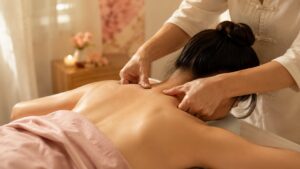
There is a specific shape that walks into the parlour around six in the evening. The shoulders are slightly forward, slightly up, slightly turned inward toward each other as if the body had spent the day apologising for taking up space. The neck has lost its lazy curve and become a straight column. The clavicles have rotated downward by perhaps eight or ten degrees. When I press the upper trapezius with two fingers, the tissue does not yield — it answers like a piece of fabric that has been ironed too many times in the same direction.
This is the office shoulder. We see five or six of them every evening between 17:30 and 19:30, walking up from the cafés on Bulevardi Myslym Shyri after work. The diagnosis is rarely a mystery. What is interesting is the question of what the body is actually doing wrong, and why pressing harder almost never helps.
A muscle that forgets is not a muscle that needs more force
There is a common belief — held by therapists as well as clients — that a tight muscle is a strong muscle pulling. So the instinct is to push against it with equal force, the way you would push against a stuck drawer. With the upper trapezius and the levator scapulae, this instinct produces almost no result, and sometimes makes the next morning worse.
The problem is that the office shoulder is not strong. It is exhausted. After eight hours of holding the same low-grade contraction — keyboard, mouse, slightly hunched, slightly forward — those small postural muscles have entered a state that physiology calls protective splinting. They are not contracting voluntarily anymore. They have lost the neuromuscular signal to release. They are stuck in the “on” position the way a light switch can be jammed.
You cannot un-jam a switch by pressing harder on the switch itself. You have to work around it.
How Tui Na approaches this differently
Classical therapeutic massage — Tui Na in the Chinese tradition — has a specific protocol for this presentation, and it has changed almost nothing in the last thousand years. The opening movements are not on the trapezius at all. They are on the muscles around it. The forearms first, then the chest, then the upper back below the shoulder blades, then the back of the neck where it meets the skull.
The principle is simple: a muscle that has forgotten how to relax has to be given permission by its neighbours. When the surrounding tissue becomes soft, the over-contracted muscle is no longer the only one holding the structure together, and it can let go. This usually happens around the twenty-minute mark, often without the client noticing. They report afterwards that their shoulders feel “lower,” but they cannot pin down the moment when the lowering happened.
A client of mine — an interpreter who works for an Italian firm in Tirana, three days a week onsite, two days remote — described it once as the moment when “the muscle finally exhaled.” She was on the table thinking about a contract she was reviewing in her head. The exhale was not hers. It was somewhere along the right side of her neck. She felt it as a small drop, a settling, the way a building settles after a long warm afternoon.
Something I read once that confirmed what the hands already knew
I came across an article, several years ago, about how scientists had measured what happens in the trapezius muscle when therapists work on it in different ways. The detail that stayed with me was this: pressing the tight muscle directly relaxed it only for a short time. Working the neighbouring tissue — the chest, the forearm — relaxed the trapezius for much longer, even though no one touched the trapezius itself.
I do not remember the names or the dates. What I remember is feeling pleased. Tui Na practitioners have been working this way for many generations without anyone needing to measure it. The principle is one the body teaches you, if you spend long enough listening to it: the tight place is rarely the source of the tightness. The source is usually somewhere upstream, and the tight place is the body’s downstream complaint.
Why the morning matters more than the evening
A small detail that gets lost in most office-stress conversations: the office shoulder does not start at nine in the morning when work begins. It starts in the first ninety seconds of waking, when most people roll out of bed and check their phone before they have stretched.
That first ninety seconds is a window. The fascia is at its most pliable after a night of horizontal rest. If the first thing the body does is curl forward and look down at a screen, it commits to the day’s posture in a way that is very hard to undo later. If the first thing the body does is roll the shoulders three times in each direction, reach overhead, and yawn a real yawn — the kind that involves the entire chest — the day starts from a different baseline.
I tell this to clients sometimes. I do not tell it to make them feel they have done something wrong. I tell it because the cheapest, most boring intervention is also the most effective, and a session every two or three weeks is much more useful when it is built on top of a morning that is not already pre-stressed.
The return-from-Italy version
A particular kind of office shoulder I see often: the client who has lived in Italy for ten or fifteen years and moved back to Tirana for work. The pattern is the same — keyboard, sitting, screens — but there is an additional layer. Returning from a diaspora carries a quiet tension of its own. The body is doing two things at once: holding the new daily life, and re-negotiating an old one. Stories of mothers, apartments rented out, languages re-warming after years away.
That tension lives in the body somewhere, and for many returning women it lives between the shoulder blades. The first session usually goes longer than planned. We talk less than usual. Sometimes the second session is the one where they actually fall asleep on the table — which is, in my experience, the body’s signal that it has decided to trust the room.
What to do, if you do not want to come in yet
You do not need to book a session to start working with this. Three things, ranked by usefulness, that anyone with an office shoulder can do today.
First, when you sit down at your desk, set the screen one finger-width higher than your relaxed gaze. This single adjustment unloads the levator scapulae by enough to change your evening.
Second, twice a day — once mid-morning, once mid-afternoon — stand up, raise your arms straight overhead, and yawn deliberately for ten seconds. The yawn is not optional. It opens the chest the way nothing else does.
Third, before sleep, press your shoulder blades together for five seconds, then let them slide down your back as if a thread is pulling them toward your pockets. Five repetitions. Done lying down or standing, either works.
If after a few weeks the body still has not remembered how to hang its shoulders, that is when the table starts to make sense. The work is gentler than people expect, and the results, when they come, tend to last.
Yang Wang practises therapeutic massage and acupuncture at Chinese Massage – Tai Chi Tirana. The parlour is in central Tirana, a short walk from Bulevardi Myslym Shyri.