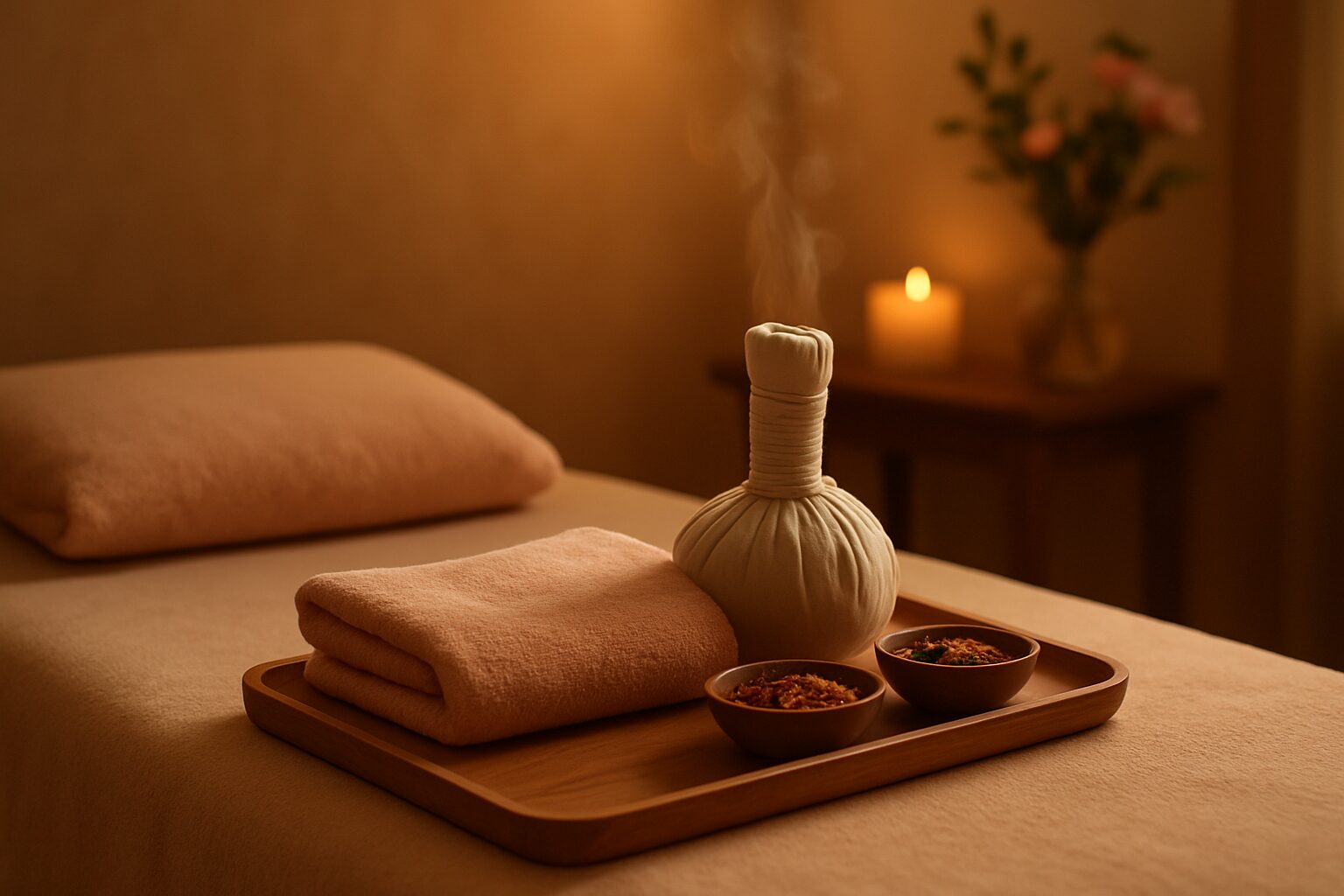
A friend of a regular client came in last February asking, slightly embarrassed, about “a treatment my friend talked about for the cold belly.” She had been to a gastroenterologist, a nutritionist, an integrative medicine doctor in Italy, and a private practice in Pristina. She had been told she had irritable bowel syndrome, then mild colitis, then “functional digestive disturbance,” then nothing in particular but “a sensitive system.” She had been on three different elimination diets. She had taken probiotics for fourteen months. She still felt, every winter, as if there was a cold stone sitting low in her abdomen.
“A hot water bottle helps for an hour,” she said. “Then the cold comes back, like a guest who heard there was raki.”
I asked her if she would be willing to try something built for exactly that cold weight in the belly. She agreed.
What the body is saying when the belly is cold
In the language doctors usually use, “the cold belly” is not a category. The complaint, when patients describe it, gets filed under stress, IBS, anxiety, or “no organic finding.” This is not wrong, exactly — there is no tumour, no inflammation on the scan, no infection in the blood work. But it leaves the patient without a useful way of thinking about what they are experiencing.
In Chinese medicine, this presentation is one of the oldest and most clearly described patterns. It is called zhong jiao xuhan — “deficient cold in the middle warmer” — and the descriptions in classical texts (the Shang Han Lun, second century CE) read so close to what these clients describe that the translation is almost comical. The patient feels a cold weight in the lower abdomen. The cold worsens with cold weather, cold drinks, and emotional stress. The bowel movements are loose or alternating. Appetite is variable. There is often fatigue, particularly in the morning, that does not respond to coffee.
The pattern is real. From what I have read, it lines up reasonably well with what modern doctors know about how the nervous system controls blood flow in the digestive organs. The reason the doctors I have met do not always recognise the pattern is that their training organises the symptoms differently, not that the symptoms are imaginary.
Why a heating pad helps for an hour and then stops
The natural instinct, when one’s belly is cold, is to apply heat. A hot water bottle. A heating pad. A warm cloth straight off the radiator. This works. It works because peripheral heat applied to the abdominal wall produces a brief reflex vasodilation in the underlying tissue, the muscles relax, the cramping eases. For the duration of the heat exposure, and for about an hour afterwards, the body feels better.
The reason the effect does not last is that the heat is treating the symptom, not the underlying pattern. The autonomic dysregulation that is causing the chronic cold sensation is not changed by an hour of external warmth. Once the warmth is removed, the system returns to its baseline state. The next afternoon, the belly is cold again.
Mud moxibustion operates differently. It does deliver heat — that is true and important. But it delivers it through a different combination of mechanisms that produce lasting change, not just symptomatic relief.
First, the heat is sustained, deep, and even. Unlike a hot water bottle on the surface of the abdomen, the mud-and-moxa combination raises tissue temperature in the deep abdominal wall and the underlying organs for a sustained forty-five minutes. This is long enough for the autonomic nervous system to register a real change in conditions and begin to update its baseline assumptions about the area.
Second, the herbal compounds in the medicinal mud — particularly the warming herbs Aconitum (used in tiny safe doses), Cinnamomum cassia, Zingiber officinale, and Angelica sinensis — produce specific effects on local circulation and inflammatory signalling that are different from those of pure heat alone.
Third, the smoke from the burning moxa contains volatile compounds that are absorbed through the skin and have measurable systemic effects on parasympathetic tone — the part of the nervous system that governs digestive function. This is the slowest of the three mechanisms and the one that, in my experience, produces the most lasting change. Clients often report that the most noticeable improvements appear two to three days after the session, not during the session itself. (For women whose digestive patterns sit alongside fertility or pregnancy questions, the related piece on Chinese massage in pregnancy and fertility covers a different angle of the same broader picture.)
What the protocol looks like
The protocol I use for chronic cold-belly presentations is straightforward but it asks for patience.
First session: a full intake, including pulse and tongue diagnosis, dietary history, sleep patterns, menstrual history if relevant, history of past abdominal surgery or infection. The treatment itself focuses on the lower abdomen — Qihai (CV-6), Guanyuan (CV-4), Zhongji (CV-3) — points along the conception vessel that correspond to the deep digestive and reproductive organs. The mud is laid in a broad band from just below the navel to just above the pubic bone. Moxa is burned above the mud for forty-five minutes.
Sessions two and three: same anatomical area, sometimes adding the lower back (Mingmen, GV-4, and the kidney shu points on the lower back), depending on whether the cold pattern extends to a sense of low-back coldness or weakness.
Sessions four and five: focusing on integration — making sure the changes are holding, often combined with a brief acupuncture treatment to address any secondary patterns that have emerged.
Most clients come weekly for the first three sessions, then move to a session every two weeks for the next two. By the fifth session, the majority report that their belly no longer feels cold most of the time, that they have stopped needing the hot water bottle in the evening, that their digestion has become more predictable.
The friend who came in from the cold
The client I mentioned at the start of this piece came for five sessions across seven weeks. Her improvement was gradual — not the dramatic immediate change some treatments produce, but the slow, steady kind that you can only see by looking back.
By the third session, her loose stools had largely resolved.
By the fourth session, she had stopped needing a hot water bottle to fall asleep — something she had been doing every night, even in summer, for nearly four years.
By the fifth session, she said something that I have heard from other clients in similar treatment courses, and which I have come to recognise as a marker that the deeper pattern has shifted: she felt, for the first time in years, that she did not have to think about her belly. It had become quiet. It had returned to being a part of her body that simply did its work without complaint.
She comes in now for a maintenance session every two or three months, usually when the season is changing. She does not need it for the cold belly anymore; she comes for the general settling effect, the way one might book a session with a good acupuncturist for the autumn-to-winter transition. The kind of maintenance most of us only ever schedule for the car.
A small note on the evening cup
I have started, with cold-belly clients, to suggest a warm drink in the evening — particularly in winter. A cup of çaj mali does nicely; so does plain hot water with a slice of ginger. The point is simply warmth from the inside, taken slowly, while the mud moxa does its work during the day.
I make no grand claims for the tea. It is a small, sensible habit, the kind of thing that costs nothing and quietly helps — like keeping your socks on in February instead of insisting, against all evidence, that the apartment floor is warm. The body does not need to understand the theory. It just registers that the right kind of warmth has finally arrived.
When to consider it
If you have a chronic, recurrent sense of coldness or discomfort in the lower abdomen that has not responded to standard medical workup and that worsens with cold weather or cold drinks — this is worth considering. If you have painful periods that respond more to warmth than to medication — also worth considering. If you are postpartum and feel as if your body is taking longer than expected to return to itself, particularly with a cold or depleted quality — this is one of the treatments classical Chinese medicine developed specifically for this presentation.
If your symptoms are acute, new, or accompanied by red flag features (fever, blood in the stool, significant weight loss, severe pain), see a doctor first. Chronic functional patterns are where mud moxibustion is most useful; new or alarming symptoms need a different first step.
The work is slow. The change, when it comes, tends to be the kind that stays.
Yang Wang practises Chinese medicine at Chinese Massage – Tai Chi Tirana. The parlour is in central Tirana, by the Lana.
Ready to Feel the Difference?
Book your session today — same-day appointments available.
Book Your Session