Cold in the Belly: Mud Moxibustion vs. a Heating Pad

A friend of a regular client came in last February asking, slightly embarrassed, about “a treatment my friend talked about for the cold belly.” She had been to a gastroenterologist, a nutritionist, an integrative medicine doctor in Italy, and a private practice in Pristina. She had been told she had irritable bowel syndrome, then mild colitis, then “functional digestive disturbance,” then nothing in particular but “a sensitive system.” She had been on three different elimination diets. She had taken probiotics for fourteen months. She still felt, every winter, as if there was a cold stone sitting low in her abdomen.

“A hot water bottle helps for an hour,” she said. “Then the cold comes back, like a guest who heard there was raki.”

I asked her if she would be willing to try something built for exactly that cold weight in the belly. She agreed.

What the body is saying when the belly is cold

In the language doctors usually use, “the cold belly” is not a category. The complaint, when patients describe it, gets filed under stress, IBS, anxiety, or “no organic finding.” This is not wrong, exactly — there is no tumour, no inflammation on the scan, no infection in the blood work. But it leaves the patient without a useful way of thinking about what they are experiencing.

In Chinese medicine, this presentation is one of the oldest and most clearly described patterns. It is called zhong jiao xuhan — “deficient cold in the middle warmer” — and the descriptions in classical texts (the Shang Han Lun, second century CE) read so close to what these clients describe that the translation is almost comical. The patient feels a cold weight in the lower abdomen. The cold worsens with cold weather, cold drinks, and emotional stress. The bowel movements are loose or alternating. Appetite is variable. There is often fatigue, particularly in the morning, that does not respond to coffee.

The pattern is real. From what I have read, it lines up reasonably well with what modern doctors know about how the nervous system controls blood flow in the digestive organs. The reason the doctors I have met do not always recognise the pattern is that their training organises the symptoms differently, not that the symptoms are imaginary.

Why a heating pad helps for an hour and then stops

The natural instinct, when one’s belly is cold, is to apply heat. A hot water bottle. A heating pad. A warm cloth straight off the radiator. This works. It works because peripheral heat applied to the abdominal wall produces a brief reflex vasodilation in the underlying tissue, the muscles relax, the cramping eases. For the duration of the heat exposure, and for about an hour afterwards, the body feels better.

The reason the effect does not last is that the heat is treating the symptom, not the underlying pattern. The autonomic dysregulation that is causing the chronic cold sensation is not changed by an hour of external warmth. Once the warmth is removed, the system returns to its baseline state. The next afternoon, the belly is cold again.

Mud moxibustion operates differently. It does deliver heat — that is true and important. But it delivers it through a different combination of mechanisms that produce lasting change, not just symptomatic relief.

First, the heat is sustained, deep, and even. Unlike a hot water bottle on the surface of the abdomen, the mud-and-moxa combination raises tissue temperature in the deep abdominal wall and the underlying organs for a sustained forty-five minutes. This is long enough for the autonomic nervous system to register a real change in conditions and begin to update its baseline assumptions about the area.

Second, the herbal compounds in the medicinal mud — particularly the warming herbs Aconitum (used in tiny safe doses), Cinnamomum cassia, Zingiber officinale, and Angelica sinensis — produce specific effects on local circulation and inflammatory signalling that are different from those of pure heat alone.

Third, the smoke from the burning moxa contains volatile compounds that are absorbed through the skin and have measurable systemic effects on parasympathetic tone — the part of the nervous system that governs digestive function. This is the slowest of the three mechanisms and the one that, in my experience, produces the most lasting change. Clients often report that the most noticeable improvements appear two to three days after the session, not during the session itself. (For women whose digestive patterns sit alongside fertility or pregnancy questions, the related piece on Chinese massage in pregnancy and fertility covers a different angle of the same broader picture.)

What the protocol looks like

The protocol I use for chronic cold-belly presentations is straightforward but it asks for patience.

First session: a full intake, including pulse and tongue diagnosis, dietary history, sleep patterns, menstrual history if relevant, history of past abdominal surgery or infection. The treatment itself focuses on the lower abdomen — Qihai (CV-6), Guanyuan (CV-4), Zhongji (CV-3) — points along the conception vessel that correspond to the deep digestive and reproductive organs. The mud is laid in a broad band from just below the navel to just above the pubic bone. Moxa is burned above the mud for forty-five minutes.

Sessions two and three: same anatomical area, sometimes adding the lower back (Mingmen, GV-4, and the kidney shu points on the lower back), depending on whether the cold pattern extends to a sense of low-back coldness or weakness.

Sessions four and five: focusing on integration — making sure the changes are holding, often combined with a brief acupuncture treatment to address any secondary patterns that have emerged.

Most clients come weekly for the first three sessions, then move to a session every two weeks for the next two. By the fifth session, the majority report that their belly no longer feels cold most of the time, that they have stopped needing the hot water bottle in the evening, that their digestion has become more predictable.

The friend who came in from the cold

The client I mentioned at the start of this piece came for five sessions across seven weeks. Her improvement was gradual — not the dramatic immediate change some treatments produce, but the slow, steady kind that you can only see by looking back.

By the third session, her loose stools had largely resolved.

By the fourth session, she had stopped needing a hot water bottle to fall asleep — something she had been doing every night, even in summer, for nearly four years.

By the fifth session, she said something that I have heard from other clients in similar treatment courses, and which I have come to recognise as a marker that the deeper pattern has shifted: she felt, for the first time in years, that she did not have to think about her belly. It had become quiet. It had returned to being a part of her body that simply did its work without complaint.

She comes in now for a maintenance session every two or three months, usually when the season is changing. She does not need it for the cold belly anymore; she comes for the general settling effect, the way one might book a session with a good acupuncturist for the autumn-to-winter transition. The kind of maintenance most of us only ever schedule for the car.

A small note on the evening cup

I have started, with cold-belly clients, to suggest a warm drink in the evening — particularly in winter. A cup of çaj mali does nicely; so does plain hot water with a slice of ginger. The point is simply warmth from the inside, taken slowly, while the mud moxa does its work during the day.

I make no grand claims for the tea. It is a small, sensible habit, the kind of thing that costs nothing and quietly helps — like keeping your socks on in February instead of insisting, against all evidence, that the apartment floor is warm. The body does not need to understand the theory. It just registers that the right kind of warmth has finally arrived.

When to consider it

If you have a chronic, recurrent sense of coldness or discomfort in the lower abdomen that has not responded to standard medical workup and that worsens with cold weather or cold drinks — this is worth considering. If you have painful periods that respond more to warmth than to medication — also worth considering. If you are postpartum and feel as if your body is taking longer than expected to return to itself, particularly with a cold or depleted quality — this is one of the treatments classical Chinese medicine developed specifically for this presentation.

If your symptoms are acute, new, or accompanied by red flag features (fever, blood in the stool, significant weight loss, severe pain), see a doctor first. Chronic functional patterns are where mud moxibustion is most useful; new or alarming symptoms need a different first step.

The work is slow. The change, when it comes, tends to be the kind that stays.


Yang Wang practises Chinese medicine at Chinese Massage – Tai Chi Tirana. The parlour is in central Tirana, by the Lana.
Mud Moxibustion: The Quiet Cousin of Acupuncture

There is a treatment we offer at the parlour that almost no one in Tirana has heard of before they walk in. Most of our long-term clients have tried Tui Na. Many have tried acupuncture, cupping, gua sha, hot stones. But mud moxibustion — ni jiu in Mandarin, 泥灸 — they encounter for the first time when they ask about a treatment for chronic abdominal cold, painful periods that nothing else has touched, or the kind of deep tiredness that sleep does not repair.

This is one of the older treatments in the Chinese pharmacopoeia. It is also, in my opinion, one of the most underrated. It does what acupuncture does — moves stuck qi, warms the deep tissue, addresses cold-type patterns — but it does it through a different mechanism, and for certain clients it is dramatically more effective. (For the acupuncture half of this comparison and how the meridian-point system underlying both treatments is mapped, I have a foundational piece on meridian conditioning.)

What it actually is

Mud moxibustion combines two ancient ingredients: medicinal mud and moxa, the herb Artemisia vulgaris (mugwort, in English; pelin in Albanian, where the plant grows wild on the hillsides outside Tirana — you have probably walked past it a hundred times on a Sunday hike without a second glance).

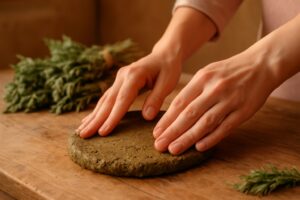
The mud is not ordinary mud. It is a specific medicinal preparation, traditionally made from a base of fine silt taken from particular river beds, mixed with powdered herbs — typically Artemisia, Angelica sinensis, Cinnamomum cassia (cinnamon bark), and several other warming herbs depending on the formula. The mixture is dried and stored in cakes or sheets. To use it, the practitioner moistens it slightly, warms it to body temperature, and applies it as a layer over a specific area of the body — usually the lower abdomen, the lower back, or along the spine.

Over the layer of warmed mud, a small amount of moxa is burned at a controlled distance. The smoke and heat penetrate down through the mud, which acts as a carrier and a temperature regulator. The result is a deep, even, sustained warming of the underlying tissue and the points beneath it, combined with the topical absorption of the herbal compounds in the mud.

A session lasts thirty to forty-five minutes. The client lies comfortably on the table. The sensation is unlike anything else in TCM — not the brief sharpness of a needle, not the dull pressure of cupping, not the focused heat of a single stone. It is broad, warm, slow, settling. Many clients fall asleep during the second half of the session.

What it helps with — and what it does not

Mud moxibustion is specifically indicated for what TCM calls cold-damp accumulation in the lower body. This is a pattern more than a single condition, but in the people I see it tends to show up as:

Chronic abdominal cold — the sensation of a persistently cool lower belly, often with bloating, sluggish digestion, and frequent loose stools. Many women describe this as feeling “as if my insides are cold from the inside out.”

Painful menstrual periods — particularly the kind that come with low-back ache, cold sensitivity, and pain that responds better to heat than to pain medication.

Chronic lower back pain that worsens in cold weather. Not the acute strain kind; the kind that comes back every winter and lasts until April.

Postpartum recovery, especially for women who feel cold and depleted after giving birth (something Chinese medicine takes very seriously and works with actively, while in the modern medical setting it often gets less attention than it deserves).

Chronic fatigue with a “cold and damp” quality — heavy limbs, low motivation, a body that feels weighed down rather than tense.

It is not the right treatment for: acute injuries, fevers, infections, conditions with a “heat” pattern (red face, easily irritable, dry mouth, insomnia from agitation), or pregnancy (heating the abdomen during pregnancy is contraindicated in classical practice).

A small story about my mother

When I was a child in Liaoning, my mother had what we then called “the winter belly.” Every December, around the time the first snow came, her lower abdomen would become tender and cold to the touch. Cramping that came not with her period but seemingly with the season. She drank ginger tea. She wore extra layers. She felt, in her own words, that her yang was leaking out of her like heat from a poorly built house.

Once a winter, my grandmother would prepare what she called the “mud cake.” She made it herself, from a recipe handed down through several generations. River silt, dried mugwort from the summer harvest, cinnamon bark, ginger, two or three other things I never learned the names of. She would warm the cake on the stove, lay it across my mother’s abdomen, and burn a small bundle of moxa above it for half an hour.

My mother would emerge from this treatment looking like she had taken a long bath in a warm sea. Calm, slightly flushed, the cold gone out of her face. The treatment was an annual event. It always worked.

I did not understand, at the time, that I was watching a thousand-year-old protocol being performed in my grandmother’s kitchen. To me it was just what we did in December.

Why the Western reader rarely encounters this

There are two reasons mud moxibustion has remained obscure outside China, even as acupuncture and cupping have become familiar in European wellness centres.

The first is practical. The mud is difficult to source authentically outside China. The herbal formula is complex and the quality varies considerably. We import ours from a specific manufacturer in Shandong province with multi-generational expertise in the preparation. Many Western practitioners who have heard of the technique substitute generic clay or skip the treatment entirely. The result is, predictably, disappointing, and the technique gets a reputation it does not deserve.

The second is cultural. The treatment is messy, slightly slow, and aesthetically far from the polished image many Western wellness centres want to project. It does not photograph well for Instagram. The mud stains the towels. There is a small amount of smoke from the moxa. Some practitioners who specialise in “clean” modern TCM avoid it precisely because of these unglamorous practicalities.

We do it because it works, and because we have not yet found a substitute that does the same thing.

A few things I have found interesting along the way

When I started looking into the modern explanations of how this treatment works, I came across a few things that I found interesting to share. The smoke from the burning moxa carries small aromatic compounds — the same kinds of compounds that give certain medicinal plants their smell — and these are absorbed through the skin during the session. The mud itself, more than anything else, holds the heat steady at a temperature that the skin would not tolerate from the moxa directly. The three together — heat, smoke, and herb — do something none of them does alone.

For painful menstrual periods especially, I have read that there are studies showing the treatment reduces the pain meaningfully, sometimes more than over-the-counter pain medicine, and that the relief continues into the next cycle without further treatment. I do not pretend to know the studies in detail. What I know is what I see in the parlour, which lines up reasonably well with what I have read.

For chronic digestive discomfort — what Chinese medicine calls a tired or cold “middle warmer,” and what Western medicine often calls IBS or “functional” digestive issues — there is, from what I gather, a similar picture. The body responds; the mechanism is not fully mapped; the practitioners who do the work consistently see results.

When it is the right answer

I do not recommend mud moxibustion as a first treatment for most complaints. For an acute problem, acupuncture or Tui Na is usually faster. For ordinary stress and muscle tension, a relaxation massage is more straightforward.

Mud moxibustion is the right answer when:

The complaint is chronic, has resisted other approaches, and has a clear “cold” quality. The client feels the affected area is cold to their own touch, the pain is worse in winter or with cold exposure, and they instinctively reach for hot water bottles or heating pads.

The complaint involves the lower abdomen or lower back, where the deep penetrating warmth of the mud-moxa combination reaches better than any other modality.

The client has the patience for a slow treatment. This is not a single-session fix. A typical course is three to five sessions, once a week or every two weeks. Improvement is usually noticed by the third session.

The first session feels, to most clients, like a deep rest in a warm place — almost meditative. The therapeutic effect builds in the days afterwards, often most strongly in the second and third night of sleep following the treatment.

It is one of the oldest tools we have. It is also, when used in the right pattern, one of the most effective. That is why it has survived for as long as it has, in spite of everything that has changed around it.


Yang Wang practises Chinese medicine at Chinese Massage – Tai Chi Tirana.
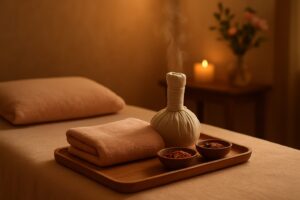
Mud Moxibustion for Women’s Cycle Pain: What Three Generations of Grandmothers Already Knew

There is a kind of period pain that no painkiller fully reaches. It begins in the lower back, wraps around through the lower abdomen, and settles deep behind the pubic bone. Heat helps for an hour. Ibuprofen takes the sharpest edge off. But the underlying ache stays, a heavy gripping presence, sometimes for two or three days each month. Women who have lived with this for years often describe it not as pain exactly but as an exhausting hostage situation — the body holding the rest of life captive until the cycle releases it.

About one in three women experiences cycle pain severe enough to interfere with daily activities at least one day a month. About one in eight experiences it severely enough that it shapes how they plan their work, their social life, their travel. Some of these cases have an identifiable medical cause — endometriosis, fibroids, adenomyosis — for which the correct first step is gynaecological investigation. But many do not. The medical workup comes back unremarkable. The pain persists. The woman is told it is “normal.”

This pattern, in Chinese medicine, is one of the most clearly described conditions in the classical texts. The diagnosis is usually some variation of xuhan tongjing — cold-deficiency painful periods — and the treatment has not changed substantially in eight hundred years, because what was developed eight hundred years ago worked, and continues to.

What the body is doing during a painful period

The uterus is a muscle. During menstruation, it contracts to expel its lining. In most women these contractions are mild enough to be barely noticeable; the cervix has dilated slightly, blood flow to the uterine wall is adequate, the contractions are coordinated.

In dysmenorrhoea, the contractions are either too strong, too sustained, or insufficiently coordinated. The uterine muscle goes into something close to a localised cramp state. Blood flow into the muscle itself can be temporarily reduced, which causes the muscle to release more pain-signalling chemicals (prostaglandins), which causes more contraction, which further reduces blood flow. The cycle perpetuates itself until the menstrual flow runs its course.

There are several reasons this can happen. In some women, there is simply a higher baseline level of inflammatory signalling. In others, the issue is hormonal — the relative balance of oestrogen and progesterone, particularly in the days before the period begins. In others — and this is the group where mud moxibustion is most effective — the pattern is one of insufficient warmth and movement in the pelvic region, a chronic baseline of poor circulation that becomes acutely problematic when the uterus is asked to work hard during menstruation. (For women approaching pregnancy or post-partum, there is a related piece on Chinese massage in pregnancy and fertility that sits in the same broader picture.)

Why warmth changes the picture

The single best home thing a woman can do for cycle pain — and this is something every traditional culture I have ever read about figured out long ago — is to apply heat to the lower belly and lower back. Hot water bottles, warm towels, heated wheat bags, sitting close to the stove. Doctors I have spoken with say that heat works about as well as ibuprofen for this kind of pain, with no side effects. Grandmothers knew this, of course, without anyone needing to confirm it for them.

But heat from a hot water bottle is shallow and brief. It addresses the symptom for the duration of the contact, and then the body returns to its previous state.

Mud moxibustion does what a hot water bottle does, but at three different levels at once.

Surface and middle-layer warmth: similar to but more even than a hot water bottle, sustained for forty-five minutes, deep enough to relax the abdominal wall and influence underlying tissue.

Deep penetrating warmth: through the moxa smoke and volatile herbal compounds, reaching the underlying pelvic organs and nervous structures in a way that surface heat cannot.

Cumulative effect over a treatment course: the changes produced by a single session do not vanish when the session ends. Over three to five treatments, the baseline pelvic blood flow improves, the autonomic regulation of uterine function shifts toward better coordination, and the inflammatory baseline drops. The next several cycles tend to be progressively less painful.

This is the part conventional treatment cannot easily replicate. Painkillers treat the episode. Hormonal contraception suppresses the cycle entirely. Heat helps for an hour. Mud moxibustion is one of the few interventions that addresses the underlying pattern in a way that produces persistent improvement.

A small case from last spring

A young woman — twenty-six, working in tourism in Tirana — came in last March. Severe cycle pain for ten years, becoming worse rather than better as she had moved through her twenties. Her gynaecologist had ruled out endometriosis with ultrasound and clinical examination. She had been on a low-dose combined contraceptive pill for three years, which had reduced but not eliminated the pain, and which she wanted to come off because she was hoping to start a family within the next two years.

Her cycle pain was, in TCM terms, almost a textbook cold-stagnation presentation. Cold hands and feet generally. Pain that responded to heat much more than to medication. Pain that was worse when she had been working long days standing up (she was in retail tourism). Pain that was worse in winter than in summer.

We did five sessions of mud moxibustion across two cycles. Once per week for three weeks, then a gap, then twice more in the second cycle, timed to the days before her period began.

First cycle after starting treatment: pain still present, but the worst day was a six out of ten instead of a nine, and she did not need to take time off work.

Second cycle: worst day a four, two days of mild discomfort instead of the usual four.

Third cycle (no treatment that month, to see if the changes held): worst day a five, but the pattern of discomfort had shortened from four days to two.

She continues to come in for a single maintenance session every other cycle, in the week before the period begins. She came off the contraceptive pill six months ago. Her cycles have been manageable since.

This is a typical course of treatment for this presentation. Not all women respond this well; some respond better, some less well. The response rate, in my own practice, is about three women out of four, with full responders (significant lasting improvement) and partial responders (some improvement, less dramatic) roughly evenly split.

A practical note on timing

For best results, the first treatment in a course should be scheduled about a week before the period is due to begin. The subsequent treatments are usually scheduled in the same window relative to the cycle. This timing allows the warming and circulatory effects of the treatment to be present during the days when the body most needs them.

I always combine the in-parlour treatment with a few simple home practices: drinking warm rather than iced liquids in the week before the period, avoiding sitting on cold surfaces for long periods, and a small warm-water foot bath in the evenings during the days before menstruation. These small practices amplify the effect of the in-parlour sessions considerably.

For women who have tried everything and found nothing that works well, mud moxibustion is worth a real attempt. Five sessions across two cycles is usually enough to know whether your particular pattern is going to respond.

The grandmothers, after all, had been doing some version of this for centuries before we brought it into a parlour like ours. They knew what they were doing.


Yang Wang practises Chinese medicine at Chinese Massage – Tai Chi Tirana. Names and details in client stories have been changed.