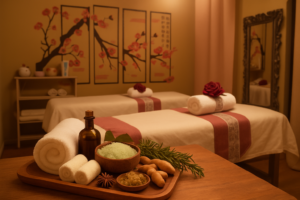
There is a category of client who arrives at the parlour looking more depleted than any other category we see. They are not athletes who have over-trained. They are not professionals in the middle of a difficult quarter. They are not patients with chronic medical conditions. They are couples who have, in the last several months, become parents.
The exhaustion of early parenthood is, in my observation, a particular kind of tiredness that no other phase of adult life quite produces. It is not just sleep deprivation, though that is part of it. It is the combination of fragmented sleep, sustained low-grade anxiety, the cognitive load of new responsibility, the physical demands of caring for a small body that cannot yet care for itself, and the gradual erosion of the partners’ sense of themselves as individuals rather than as a parenting unit.
A couples massage for new parents is not a luxury. It is, when scheduled appropriately, one of the more useful small interventions we can offer to support the parents through what is, for most couples, the hardest extended period of their lives together.
Why it is harder than people expect
I want to be honest about why this period is so difficult, because the cultural narrative of new parenthood often understates it.
The hormonal changes that produced the pregnancy do not resolve immediately at birth. The mother’s body is in a sustained period of hormonal adjustment for many months after delivery, with effects on mood, sleep, energy, and the body’s basic regulatory functions. Breastfeeding extends some of these effects. The father (or non-gestational partner) is also affected hormonally, with changes in his own oxytocin, prolactin, and testosterone levels that affect his sleep, mood, and energy.
Sleep is, in most households with an infant, fragmented in a way that adult bodies do not adapt well to. The natural sleep cycles are 90 to 120 minutes long, with deep restorative sleep occurring mainly in the second half of each cycle. Waking every two hours, or every hour, means that the deep restorative phases never adequately occur. The cumulative sleep deficit produces effects on cognition, mood, and physical recovery that are different from — and often more severe than — simply having fewer hours of total sleep.
The physical demands of caring for an infant are higher than most non-parents realise. The constant low-grade muscular tension of holding, lifting, carrying, soothing, the awkward postures of breastfeeding or bottle-feeding, the leaning over cribs and changing tables, the strollers up and down stairs. Within a few weeks, most new parents have developed specific tension patterns in their upper back, lower back, and neck that they cannot resolve without intervention.
The emotional load is sustained and high. Even in straightforward circumstances — a healthy baby, a stable household, supportive extended family — the responsibility of keeping a small person alive and well is constant. The brain does not fully turn off this responsibility even when other adults are caring for the child. The parent’s nervous system has, in a real sense, taken on a new permanent background process.
The combination produces a couple who, by month three or four after the baby’s birth, are deeply depleted in ways they cannot easily articulate to themselves. New parents in Tirana, I have noticed, measure time in coffees missed rather than hours slept.
What a couples session offers in this context
A couples massage for new parents is most useful when it does three things simultaneously.
First, it addresses the specific physical tension patterns each partner has developed. The mother often has neck and upper back tension from breastfeeding postures, lower back tension from carrying, sometimes pelvic floor and abdominal patterns from the birth itself. The father often has different patterns — more shoulder and trapezius tension, often a stiff lower back from picking up and putting down. Each partner needs targeted work for their specific accumulated patterns.
Second, it provides both partners with the rare experience of sustained parasympathetic activation. The new-parent nervous system has been in sympathetic-dominant mode for months. The session provides ninety minutes of forced rest in a state the body has nearly forgotten how to enter. The relief is, for many clients, profound.
Third, it allows the partners to share an experience as a couple rather than as parents. For ninety minutes, neither of them is responsible for the child (assuming the child is being cared for by someone else during the session). They are simply two adults receiving care side by side. This is, for many new-parent couples, the first time in months that they have spent ninety minutes together not in their roles as parents. (For mothers reading this who are pregnant or recently postpartum, see also Chinese massage in pregnancy and fertility and pregnancy massage: what you need to know before you book — both are written specifically for that audience.)
A particular couple I remember
A couple came in last summer with a four-month-old daughter. They had not had a moment to themselves since the baby was born. The grandmother on the mother’s side had taken the baby for an afternoon — her first time alone with her grandchild — and they had booked a couples session for that specific window.
They arrived looking like new parents always look. Hollowed eyes, slow movements, a particular careful posture from never having relaxed fully in months. They had brought a phone with them that they checked compulsively, despite knowing the grandmother would only call if there was a genuine problem.
I asked them, at intake, to please leave the phones with the receptionist. I told them that the grandmother could reach us through the parlour’s main line if anything came up, and that we would interrupt the session immediately if needed. They were reluctant. They agreed.
The session itself was, for the first thirty minutes, characterised by a kind of restlessness in both of them. The brain that has been monitoring an infant for four months does not easily stop monitoring. Their muscles would settle for a few minutes and then re-tense as some internal alarm checked whether the baby was still safe.
By the forty-five-minute mark, both of them had crossed the threshold into actual rest. By the end of the session, both were lightly asleep.
When they got up, they moved differently than they had moved at intake. Slower, but not in a tired way — in a way that suggested the chronic background activation had momentarily settled. They sat in the front room afterwards for about twenty minutes, drinking warm tea, talking quietly. They told me afterwards that the conversation they had during that twenty minutes was the first real adult conversation they had had since their daughter was born.
They have continued, since then, to book a couples session every six weeks, scheduled around whatever childcare they can arrange. The grandmother takes the baby for an afternoon. The other set of grandparents takes the baby occasionally. A trusted neighbour has filled in once or twice. The parents have built, with the help of their extended family, a small recurring island of mutual recovery time. The sessions are part of how they are sustaining their relationship through the early years of parenthood.
A note on the postnatal period specifically
The postnatal period — the first three to six months after birth — is particularly important for the mother’s body to receive thoughtful care. In the tradition I grew up with in Liaoning, the practice is called zuo yuezi — “sitting the month” — and involves a structured forty days of rest, specific dietary practices, warmth, and bodywork. My mother and aunts treated it as non-negotiable; a new mother in our family did not lift, did not chill, did not rush. I absorbed that expectation long before I understood the physiology behind it.
Modern life has, in many ways, lost this emphasis on structured postnatal recovery. New mothers are often expected to return to ordinary life quickly. In Tirana the grandmothers still try to enforce the old slowness — a new mother here can find herself politely overruled the moment she reaches for anything heavier than the baby. The cumulative effect of inadequate postnatal recovery shows up later — in chronic pelvic floor issues, in sustained back problems, in persistent fatigue that does not resolve as the child grows older.
If you are a new mother, particularly in the first six months after birth, I would suggest considering bodywork — couples massage if that fits your situation, individual massage if it does not — as part of a more structured approach to your own recovery. Your body has done extraordinary work to produce a baby. It needs and deserves care to recover from that work.
For the father or non-gestational partner, the postnatal period is also harder than it usually gets credit for. The disrupted sleep, the changing relationship with the partner, the new responsibility of parenthood — these affect the partner’s body too. Including the partner in the recovery practice is not just symbolic. It is practically useful for sustaining the family through a long demanding period.
When and how to book
For new parents considering this, here are some practical suggestions:
Wait until at least six weeks after the birth before booking. The first six weeks are the highest-acuity recovery period and bodywork during this time should be specifically designed for postnatal recovery rather than the standard couples session. After six weeks, the standard format becomes appropriate, with some adjustments.
Tell us at intake about the recent birth. We adjust the protocol for the mother specifically — gentler abdominal work, attention to pelvic floor recovery, specific support for the postures she has developed for feeding. The father’s session may also be adjusted depending on what physical pattern he has developed.
Arrange the childcare carefully. The session is not useful if both parents are anxious about the child throughout. Leave the baby with someone reliable, leave a phone number where you can be reached in an emergency, and then commit to being unavailable for ninety minutes. This is harder than it sounds, but it is part of what makes the session work.
Schedule something quiet afterwards. New parents tend to plan demanding social activities in any free time they get, on the theory that they should make the most of the time. The post-session state benefits from being honoured rather than overridden. A meal at home, a slow walk, an early bedtime — these extend the value of the session into the rest of the day.
Plan to do this more than once. A single session in the first year of a child’s life is helpful but inadequate to the scale of what new-parent life demands. If at all possible, build a recurring pattern. Every six or eight weeks is a reasonable rhythm for the first two years.
The work you are doing as new parents is extraordinary. The care you give yourselves through this period is not a luxury. It is part of what allows you to continue doing the work.
Yang Wang practises Chinese medicine at Chinese Massage – Tai Chi Tirana. Details have been altered to protect client privacy.