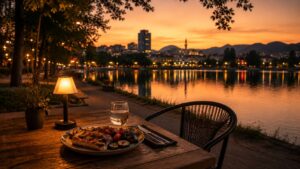
There is a small Saturday ritual I have built into my life in Tirana that I do not often write about because it feels too ordinary to constitute material. But after years of being asked, by clients and by friends, what my favourite parts of the city are, I have come to realise that the ordinary is the most interesting thing I have to say.
This piece is about the walk I take down to Liqeni Artificial after a long Saturday at the parlour, the grilled food I eat at Zgara Korçare Liqeni, the grill house by the lake, and the small accumulated wisdom of a regular table at a working-class restaurant where the cook has known what I order before I sit down for a few years now.
How the ritual began
I did not start this ritual deliberately. It built itself over time, the way most enduring practices do.
When I first moved to Tirana in 2020, I worked long hours building up my practice here, with a particular intensity on weekends when the calendar was fullest. I would finish a Saturday’s work — usually four or five sessions, ending around eight in the evening — and find myself too tired to cook and too restless to simply go home and sleep. I needed a transition.
I tried various restaurants in the first year. The fashionable spots in Bllok. The newer Italian places on the boulevards. The Turkish kebab stands near the centre. None of them quite worked for the kind of decompression my body needed after a working day. They were either too loud, too curated, or too aimed at being a destination rather than a routine.
The walk down to Liqeni Artificial — a little over twenty minutes from the parlour — became the part of the evening that worked. The lake is one of Tirana’s quieter areas in the late evening, particularly in the cooler months. The walk down through the residential streets, the wide path around the water, the changing light on the surface — these were what my body needed after a day of being indoors.
The Zgara Korçare came into the ritual later, almost by accident. I was walking past one Saturday evening and saw an older man eating alone at one of the outdoor tables, looking content in a way that struck me. I went in, ordered what he was eating, and sat at the table next to his. He nodded at me without speaking. I ate the meal and discovered that this was what I had been looking for without knowing it.
That was a couple of years ago now. I have eaten there nearly every Saturday since.
What the cook knows
The cook at Zgara Korçare is a man in his late fifties who has been at the restaurant for many years. He is from Korça originally — hence the restaurant’s name — and he came to Tirana in the late 1990s as part of the post-communist migration from the south. His grill technique is specific to the Korça region: high heat, simple seasoning, particular cuts of meat selected for their behaviour under direct flame.
What he makes for me, almost without consultation, is a small plate of grilled lamb with the bone in, a piece of fresh bread, a small side of seasonal pickled vegetables, a glass of water, and — if it is winter — a small cup of çaj mali. He brings these to the table without my having to specify anything. I sit, eat slowly, sometimes nod to other regulars, and leave after about forty minutes.
The ritual takes a particular form. I do not bring work. I do not bring my phone unless I am expecting a specific call. I do not read. I simply sit and eat, and let the cumulative weight of the working week move out of my shoulders.
The cook has, across these years, gradually learned things about me that we have never discussed in detail. He knows I work at the parlour up the hill. He knows I am Chinese, originally from Liaoning. He knows I have a quiet preference for being alone at the meal rather than making conversation. He respects these preferences without making them a topic.
In return, I have learned things about him. His daughter studied in Italy and now works in Milan. He has not been back to Korça in two years because he cannot easily leave the restaurant. He has a particular pride in the lamb he sources from a specific shepherd outside Pogradec. He has been working in restaurants since he was fifteen, and he intends, he told me once, to keep working until his hands stop functioning.
We are not friends in any conventional sense. We have an arrangement, sustained over these years, in which he prepares food I have come to depend on and I appear reliably on Saturday evenings to receive it. The arrangement has its own form of warmth.
The Liaoning parallel I did not expect
It took me a while to notice something about this ritual that, in retrospect, should have been obvious from the start.
In my hometown in Liaoning, my father had a similar weekly ritual. He worked as a foreman at a small factory near the village. On Saturday evenings, he would walk about fifteen minutes from the factory to a small restaurant near the river that served a particular kind of grilled fish. He would eat there alone, return home after dinner, and spend the rest of the evening reading or talking quietly with my mother.
The cook at the restaurant in Liaoning, like the cook at Zgara Korçare, had known my father’s preferences without his having to ask. The cook brought the same fish, the same accompaniments, the same small cup of strong tea. My father ate slowly, paid, and walked home.
I did not know, when I came to Tirana, that I would eventually build a similar ritual on the other side of the world. I did not consciously model it on my father’s. But the pattern — a regular Saturday evening, a small working-class restaurant, a cook who knew the order, a quiet solo meal as the transition from working week to rest — turned out to be something I needed in a way I had not articulated to myself.
There is something my mother said once about my father, after his death, that I have come to understand only recently. She said that the weekly meal at the riverside restaurant had been, for him, the meal that “kept him being himself.” His work was demanding. Family life had its own demands. The hour alone at the restaurant, with food prepared by someone who knew him without needing him to perform, was the hour in which he simply was himself, with no other demand on the experience.
I now think this is part of what the Saturday evening at Zgara Korçare does for me. It keeps me being myself. (I have written elsewhere about the year of the Fire Horse and other small Chinese-calendar pieces of my year, if you want a sense of how I mark time.)
What this has to do with the work
I sometimes wonder why I find this kind of small ritual so important when I work in a profession that exists, in some sense, to provide similar experiences to other people. We do, after all, offer ninety-minute sessions in which clients are cared for without being asked to perform anything. We provide much of what I describe in this Saturday ritual at the restaurant — predictable warmth, attentive care, no requirement to be impressive.
But the parlour, for me, is the place where I provide this kind of care. The Saturday ritual at Zgara Korçare is the place where I receive it.
This is, I have come to believe, an important asymmetry to maintain. People in care-giving professions — therapists, doctors, teachers, parents of small children — need to receive care in some form that is not just their own profession reflected back at them. The receiving needs to come from a different domain entirely. The cook at the grill restaurant, who has never been to my parlour and has only a vague idea of what I do, can offer me a kind of care that my own colleagues cannot, precisely because his care has no professional resemblance to my own work.
This is also part of why I encourage clients of the parlour, when the conversation turns this way, to find their own version of this ritual. Whatever they receive at the parlour, they also need somewhere else — somewhere that does not look like the parlour — where they are simply allowed to be themselves and receive care from someone who does not require them to be anyone in particular.
For some clients, this is a coffee at the same café every morning. For others, it is a small fishmonger at Pazari i Ri who has known them for years. For others, it is the woman at a particular bakery who saves them a specific loaf if they are late. For others, it is a tailor, a barber, a flower seller, a cobbler. The form does not matter. The function does.
A note on the diaspora
For clients who are returning to Tirana after years in the diaspora — Italy, Germany, Greece, the UK — I sometimes think this kind of ritual is particularly important to rebuild. The diaspora life often involves a kind of perpetual transit, in which the small consistent presences of a stable life are interrupted. Coming back to Tirana is not just coming back to a city; it is coming back to the possibility of small stable presences. The cook who knows your order. The waiter who saves your table. The flower seller who asks about your mother.
These presences are part of what makes a place feel like a home rather than a temporary stop. Many diaspora returnees, in my observation, underestimate how much they have missed these small stabilities until they begin rebuilding them. The first time the cook at a regular restaurant remembers your face after several visits, the relief is unexpectedly large. You had not realised, in the diaspora years, that the small recognitions were a kind of nourishment.
For my own settling into Tirana over these years, the Saturday evening at Zgara Korçare has been one of the structures that have made the city feel like home rather than a place I am working in. I do not know whether the cook there has thought about it in similar terms. I suspect he has. The arrangements we sustain, even silently, are usually understood by both parties.
This is one of the small wisdoms that my life in Tirana has slowly taught me. The big sustaining structures of a life are not the dramatic ones. They are the boring weekly ones. The walk down to the lake. The grill restaurant. The cup of çaj mali in the winter. The nod from the cook. The slow walk home.
These are what keep us being ourselves.
Yang Wang practises Chinese medicine at Chinese Massage – Tai Chi Tirana. The parlour is in central Tirana, a short walk from Bulevardi Myslym Shyri.