Chinese Massage – Tai Chi Tirana

The Liaoning Aunts: A History of Quiet Women

There were three older women in my family in Liaoning whose lives stayed in the background of our family memory, while the louder lives of the men around them were the ones that got told. This piece is about them — my three aunts — and about the kind of quiet steady work that women have done across many generations that does not get recorded but without which nothing else would have held together.

This is a personal piece. It is not a treatment guide. But it sits behind a lot of how I think about the older women who come into the parlour, and writing it down has been on my mind for a while.

What I know about my aunts

I had three aunts on my father’s side in Liaoning. The eldest, born in 1928, was my grandfather’s first daughter. The middle, born in 1933, was a year older than my father. The youngest, born in 1940, was the only sibling in their generation who got past primary school in any meaningful way — she trained as a schoolteacher and taught in a small town outside Shenyang for forty years.

The eldest aunt died in 2007. The middle aunt died in 2018. The youngest is still alive, in her mid-eighties, living quietly in the same town where she taught.

They lived long lives, the three of them. They were the kind of women who watched their families grow up around them, made the meals, kept the bedding aired, fed the chickens, remembered every birthday, knew which cousin was angry with which other cousin, kept the small disputes from becoming large ones.

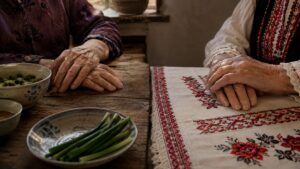
What I remember most about them, from the few visits we made when I was a child, is the kitchen of the eldest aunt. It was a long narrow room with a kang along one wall — the traditional brick bed-platform heated from underneath by the cooking fire. In winter, all the women in the family sat on the kang in the late afternoon, peeling vegetables, chopping garlic, drinking strong tea. The conversation was constant and never about anything in particular. It was the steady murmur that I now associate with how my aunts spent most of their adult lives.

The eldest aunt was the cook. She made a Liaoning cabbage stew with pork that, in my memory, is the food I have spent twenty years in Europe trying to find equivalents for. The middle aunt was the one who kept the accounts of who owed what to whom — not in money, but in favours, in eggs, in the borrowed jar of fermented bean paste that needed to be returned. The youngest, the schoolteacher, was the one who handled anything that required reading or writing. They divided the work without ever explicitly negotiating it.

None of them held any visible position outside the household. The eldest worked as a textile factory worker for thirty-eight years. The middle worked as an administrative assistant in a state agricultural office. The youngest, the schoolteacher, was the most publicly active. Their visible lives were ordinary. Their interior lives, and the family network they managed between them, were the larger thing.

The work that does not get recorded

I have come to see, with the perspective of distance and time, what my three aunts actually did across their long lives. None of it produced dramatic events. None of it generated biographies. But it was the work without which the events that do get recorded could not have happened.

The work of holding family together, across generations, falls disproportionately to women whose names do not appear in any chronicle. The wars and the careers and the public achievements are credited to visible people whose names enter the histories. The continuity — the meals, the mended quarrels, the remembered birthdays, the kang kept warm — is maintained by mostly-invisible women whose names rarely do.

I have come to think that one of the small useful things we can do, as people who notice what happens around us, is to give some attention to these women specifically. Not to over-romanticise them — my aunts were ordinary women doing necessary work, not saints — but to give them the kind of attention that the larger world did not. Naming them, in the small writing I do, is a way of saying that this kind of work matters, even when no one is keeping a record of it. (For another small piece on how Chinese calendar time shapes my year, I have written about the Chinese zodiac and what each cycle quietly carries.)

How this connects to the work I do

I work with many women in their forties, fifties, and sixties. They are the demographic that comes most often to the parlour. They come in carrying the accumulated weight of having held things together for decades. Family, careers, ageing parents, children growing up, complicated relationships, the practical running of households and small businesses.

The pattern of their bodies, when they come in, is recognisable. The upper back tension from carrying. The lower back tension from constant low-grade vigilance. The neck and shoulder restrictions from years of compromise postures. The chronic fatigue of having been responsible for too much for too long. Many of them will still insist, settling onto the table, that they are fine — do të kalojë, it’ll pass. The shoulders, when I reach them, tell a longer story.

I do not talk about any of this during the sessions. The sessions are quiet, focused on the work that needs to be done. But the parallels are present in my mind. I am working on a body that has been doing, for many years, the kind of work my aunts did in their Liaoning kitchen. The work is not recognised by the larger world. The body remembers it. Part of what bodywork can offer, in the right register, is a small acknowledgement that the body has been carrying something significant and that it is allowed, briefly, to put it down.

That is a small thing. It is, I think, also a real thing.

The youngest aunt, the one still alive

My youngest aunt is the one who is still here. She is now eighty-five. We speak by phone roughly once a month. The phone calls are mostly about ordinary things — what she ate, what she read, who came to visit, the weather in Liaoning. She does not have many strong opinions about large matters. She has the calm, settled register of someone who has lived a long time and seen enough not to be in a hurry.

The last time we spoke, a few weeks ago, she asked me about Tirana. She has never been to Albania and never will go — she is not in a condition to travel — but she likes to hear small details about my life here.

I told her about the parlour. About the clients who come every week. About a particular older Albanian woman who has been a regular for several years and who reminds me, in some way I cannot quite name, of her.

My aunt asked what the Albanian woman looked like.

I described her — the careful posture, the practical clothes, the warm but reserved manner, the way she sometimes sits in our front room after a session and seems to be thinking about things she does not put into words.

My aunt was quiet for a moment. Then she said, “She sounds like one of us.”

I told her she was probably right.

This is, in the end, what I think my aunts and the older clients at the parlour share. They are the women who hold things together. They have been doing this work for many generations, in Liaoning kitchens and in Tirana front rooms alike. They will, presumably, continue to do it. The least I can do, in the small writing I send out into the world, is to notice them.


Yang Wang practises Chinese medicine at Chinese Massage – Tai Chi Tirana.

Homemade Jiao Zi and a Long Day Well Spent

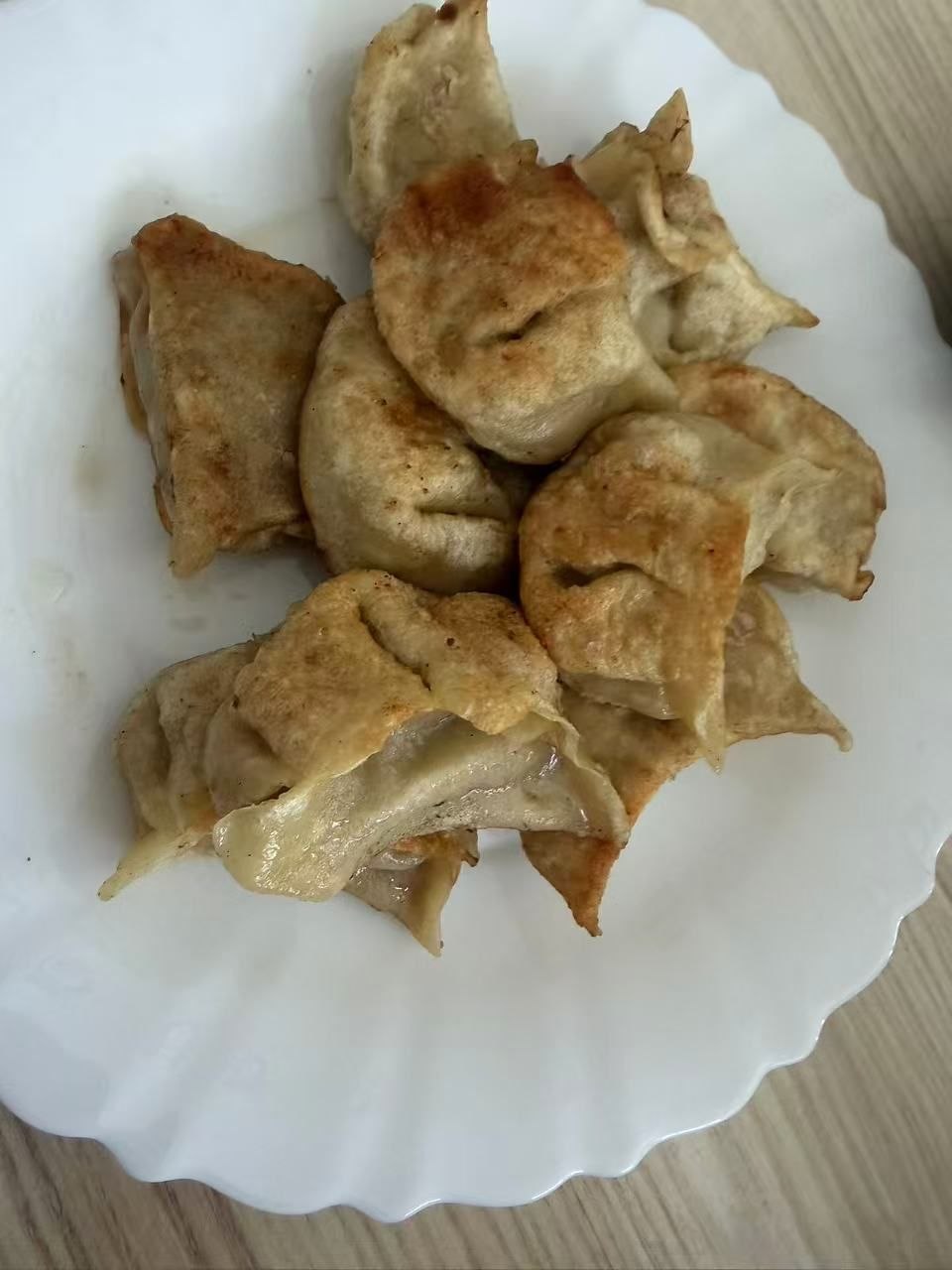
Some evenings the parlour empties slowly. The last client leaves, the sheets are folded, and the four of us — Ying, Xiao, Wei, and I — stand there for a moment in that particular silence that only comes at the end of a day when you have used your hands without stopping. Someone says jiao zi? and the answer is always yes.

Tonight it is Xiao’s turn to lead, which means we are all in luck.

Xiao’s Dumplings Are Not a Democracy

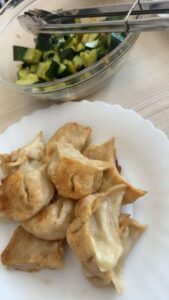
Xiao makes jiao zi the way her grandmother made them in Liaoning: the filling first, then the dough rested for exactly as long as it takes to argue about the filling. The ratio of pork to cabbage is a matter she does not discuss. When Ying once suggested more ginger, Xiao looked at her the way you look at someone who has said something technically in Chinese but somehow wrong.

The rest of us are allowed to fold. This is the generous part. Ying folds quickly and her pleats are even. Wei folds slowly and his are — well, they hold together, which is the main thing. My own folds look like I am attempting origami for the first time after a twelve-hour shift. Xiao says nothing, but she refolds mine when she thinks I am not watching.

!Homemade Jiao Zi and a Long Day Well Spent

The Conversation That Happens Every Time

While we fold, we talk about home. This is not a sad conversation — it is a warm, slightly chaotic one that jumps between Mandarin and whatever Albanian word someone picked up from a client that day. Someone mentions their mother’s version of the filling. Someone else says their father would boil half and pan-fry half, and this produces a heated debate about which method is correct (it is pan-fried, obviously, but we let Wei have his opinion).

Wei pulls up a voice message from his family on his phone and plays it without warning, filling the kitchen with his aunt’s rapid northern Chinese, which none of us can quite follow because she speaks faster than anyone should. We laugh. The dumplings keep coming.

What Tirana Has That Home Did Not

Here is something I did not expect when I arrived: Tirana does not slow down in the evenings — it is a lively capital city that hums on into the night. But something in us needs to slow down, to step out of the day and reflect. That is harder to find when you are far from home. Here, after the parlour closes, we give ourselves that pause.

A neighbour knocked on our door once to bring us peppers from her balcony garden and stayed for forty minutes. We did not share a language, but we shared the peppers, and somehow that was enough.

The jiao zi fit into that pause perfectly. You cannot rush them. The folding takes time, and the talking fills the time, and by the end of it you have forgotten to be tired.

The Boiling Is the Dramatic Part

Xiao drops them into the pot in batches, and we all crowd around like it is a sporting event. When they float to the surface she counts to thirty in her head — she says this out loud every time as if reminding herself — and then fishes them out. The ones that split open are the cook’s privilege. Xiao eats these without ceremony, standing at the stove, which feels exactly right.

We eat with black vinegar and a little chilli oil. Wei insists on soy sauce as well, which Xiao permits but does not endorse. The kitchen window fogs up. Someone’s phone plays a playlist that is half Jay Chou and half, inexplicably, an Albanian iso-polyphony recording that Ying found and thought was beautiful, which it genuinely is.

Not a Recipe, Just an Invitation

I am not going to give you the recipe. That belongs to Xiao and her grandmother. What I will say is that if you ever find yourself in Tirana, far from home, with flour on your hands and your colleagues arguing cheerfully about ginger — you are probably right where you should be.

If you want to find us before the jiao zi hour, we are at the parlour most days, using those same hands for something slightly different.

Yang Wang practises Traditional Chinese Massage at Chinese Massage – Tai Chi Tirana. The parlour is in central Tirana, a short walk from Bulevardi Myslym Shyri. Names in team stories appear with permission and affection.

The Zgara at Liqeni: A Saturday Ritual

There is a small Saturday ritual I have built into my life in Tirana that I do not often write about because it feels too ordinary to constitute material. But after years of being asked, by clients and by friends, what my favourite parts of the city are, I have come to realise that the ordinary is the most interesting thing I have to say.

This piece is about the walk I take down to Liqeni Artificial after a long Saturday at the parlour, the grilled food I eat at Zgara Korçare Liqeni, the grill house by the lake, and the small accumulated wisdom of a regular table at a working-class restaurant where the cook has known what I order before I sit down for a few years now.

How the ritual began

I did not start this ritual deliberately. It built itself over time, the way most enduring practices do.

When I first moved to Tirana in 2020, I worked long hours building up my practice here, with a particular intensity on weekends when the calendar was fullest. I would finish a Saturday’s work — usually four or five sessions, ending around eight in the evening — and find myself too tired to cook and too restless to simply go home and sleep. I needed a transition.

I tried various restaurants in the first year. The fashionable spots in Bllok. The newer Italian places on the boulevards. The Turkish kebab stands near the centre. None of them quite worked for the kind of decompression my body needed after a working day. They were either too loud, too curated, or too aimed at being a destination rather than a routine.

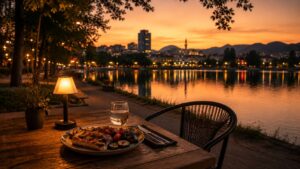
The walk down to Liqeni Artificial — a little over twenty minutes from the parlour — became the part of the evening that worked. The lake is one of Tirana’s quieter areas in the late evening, particularly in the cooler months. The walk down through the residential streets, the wide path around the water, the changing light on the surface — these were what my body needed after a day of being indoors.

The Zgara Korçare came into the ritual later, almost by accident. I was walking past one Saturday evening and saw an older man eating alone at one of the outdoor tables, looking content in a way that struck me. I went in, ordered what he was eating, and sat at the table next to his. He nodded at me without speaking. I ate the meal and discovered that this was what I had been looking for without knowing it.

That was a couple of years ago now. I have eaten there nearly every Saturday since.

What the cook knows

The cook at Zgara Korçare is a man in his late fifties who has been at the restaurant for many years. He is from Korça originally — hence the restaurant’s name — and he came to Tirana in the late 1990s as part of the post-communist migration from the south. His grill technique is specific to the Korça region: high heat, simple seasoning, particular cuts of meat selected for their behaviour under direct flame.

What he makes for me, almost without consultation, is a small plate of grilled lamb with the bone in, a piece of fresh bread, a small side of seasonal pickled vegetables, a glass of water, and — if it is winter — a small cup of çaj mali. He brings these to the table without my having to specify anything. I sit, eat slowly, sometimes nod to other regulars, and leave after about forty minutes.

The ritual takes a particular form. I do not bring work. I do not bring my phone unless I am expecting a specific call. I do not read. I simply sit and eat, and let the cumulative weight of the working week move out of my shoulders.

The cook has, across these years, gradually learned things about me that we have never discussed in detail. He knows I work at the parlour up the hill. He knows I am Chinese, originally from Liaoning. He knows I have a quiet preference for being alone at the meal rather than making conversation. He respects these preferences without making them a topic.

In return, I have learned things about him. His daughter studied in Italy and now works in Milan. He has not been back to Korça in two years because he cannot easily leave the restaurant. He has a particular pride in the lamb he sources from a specific shepherd outside Pogradec. He has been working in restaurants since he was fifteen, and he intends, he told me once, to keep working until his hands stop functioning.

We are not friends in any conventional sense. We have an arrangement, sustained over these years, in which he prepares food I have come to depend on and I appear reliably on Saturday evenings to receive it. The arrangement has its own form of warmth.

The Liaoning parallel I did not expect

It took me a while to notice something about this ritual that, in retrospect, should have been obvious from the start.

In my hometown in Liaoning, my father had a similar weekly ritual. He worked as a foreman at a small factory near the village. On Saturday evenings, he would walk about fifteen minutes from the factory to a small restaurant near the river that served a particular kind of grilled fish. He would eat there alone, return home after dinner, and spend the rest of the evening reading or talking quietly with my mother.

The cook at the restaurant in Liaoning, like the cook at Zgara Korçare, had known my father’s preferences without his having to ask. The cook brought the same fish, the same accompaniments, the same small cup of strong tea. My father ate slowly, paid, and walked home.

I did not know, when I came to Tirana, that I would eventually build a similar ritual on the other side of the world. I did not consciously model it on my father’s. But the pattern — a regular Saturday evening, a small working-class restaurant, a cook who knew the order, a quiet solo meal as the transition from working week to rest — turned out to be something I needed in a way I had not articulated to myself.

There is something my mother said once about my father, after his death, that I have come to understand only recently. She said that the weekly meal at the riverside restaurant had been, for him, the meal that “kept him being himself.” His work was demanding. Family life had its own demands. The hour alone at the restaurant, with food prepared by someone who knew him without needing him to perform, was the hour in which he simply was himself, with no other demand on the experience.

I now think this is part of what the Saturday evening at Zgara Korçare does for me. It keeps me being myself. (I have written elsewhere about the year of the Fire Horse and other small Chinese-calendar pieces of my year, if you want a sense of how I mark time.)

What this has to do with the work

I sometimes wonder why I find this kind of small ritual so important when I work in a profession that exists, in some sense, to provide similar experiences to other people. We do, after all, offer ninety-minute sessions in which clients are cared for without being asked to perform anything. We provide much of what I describe in this Saturday ritual at the restaurant — predictable warmth, attentive care, no requirement to be impressive.

But the parlour, for me, is the place where I provide this kind of care. The Saturday ritual at Zgara Korçare is the place where I receive it.

This is, I have come to believe, an important asymmetry to maintain. People in care-giving professions — therapists, doctors, teachers, parents of small children — need to receive care in some form that is not just their own profession reflected back at them. The receiving needs to come from a different domain entirely. The cook at the grill restaurant, who has never been to my parlour and has only a vague idea of what I do, can offer me a kind of care that my own colleagues cannot, precisely because his care has no professional resemblance to my own work.

This is also part of why I encourage clients of the parlour, when the conversation turns this way, to find their own version of this ritual. Whatever they receive at the parlour, they also need somewhere else — somewhere that does not look like the parlour — where they are simply allowed to be themselves and receive care from someone who does not require them to be anyone in particular.

For some clients, this is a coffee at the same café every morning. For others, it is a small fishmonger at Pazari i Ri who has known them for years. For others, it is the woman at a particular bakery who saves them a specific loaf if they are late. For others, it is a tailor, a barber, a flower seller, a cobbler. The form does not matter. The function does.

A note on the diaspora

For clients who are returning to Tirana after years in the diaspora — Italy, Germany, Greece, the UK — I sometimes think this kind of ritual is particularly important to rebuild. The diaspora life often involves a kind of perpetual transit, in which the small consistent presences of a stable life are interrupted. Coming back to Tirana is not just coming back to a city; it is coming back to the possibility of small stable presences. The cook who knows your order. The waiter who saves your table. The flower seller who asks about your mother.

These presences are part of what makes a place feel like a home rather than a temporary stop. Many diaspora returnees, in my observation, underestimate how much they have missed these small stabilities until they begin rebuilding them. The first time the cook at a regular restaurant remembers your face after several visits, the relief is unexpectedly large. You had not realised, in the diaspora years, that the small recognitions were a kind of nourishment.

For my own settling into Tirana over these years, the Saturday evening at Zgara Korçare has been one of the structures that have made the city feel like home rather than a place I am working in. I do not know whether the cook there has thought about it in similar terms. I suspect he has. The arrangements we sustain, even silently, are usually understood by both parties.

This is one of the small wisdoms that my life in Tirana has slowly taught me. The big sustaining structures of a life are not the dramatic ones. They are the boring weekly ones. The walk down to the lake. The grill restaurant. The cup of çaj mali in the winter. The nod from the cook. The slow walk home.

These are what keep us being ourselves.


Yang Wang practises Chinese medicine at Chinese Massage – Tai Chi Tirana. The parlour is in central Tirana, a short walk from Bulevardi Myslym Shyri.
What an Albanian Grandmother Taught Me About Cupping

A Letter from the Studio · Yang Wang

What an Albanian Grandmother Taught Me About Cupping

A personal reflection on tradition, memory, and what has always been home.

It was a quiet Wednesday afternoon at the studio when I first noticed.

A client — a teacher from Tirana, in her fifties — was lying on the table after her cupping session. The marks were that deep purple kind, the ones that show up on a body that has been carrying tension for too long. She looked at them in the mirror and laughed.

Then she said something that stopped me.

"My grandmother used to do this for us. With glass cups. In the village."

In China, where I am from, this would not have surprised anyone. Every Chinese grandmother knows about 拔罐 — ba guan, "pulling cups". But when I came to Albania in 2020, I had assumed I was bringing something new. Something foreign. A Chinese gift to a curious country.

That afternoon, I started asking questions.

I Started Asking Everyone

In the weeks that followed, I asked everyone. My clients. My neighbors on Rruga Astrit Sulejman Balluku. The man at the fruit stand. The woman who runs the qebaptore around the corner.

The answer was almost always the same. "Ah yes — kupa. Or ventuza. My grandmother. My aunt. In the village."

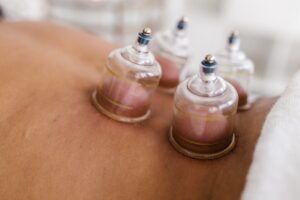
In nearly every Albanian family, somewhere, there was a memory. Someone's nënë who would warm a glass cup over a candle and place it on a sore back. Always glass cups. Always at home. Always with the same purpose: to pull the badness out of the body.

But here was the thing that puzzled me.

In the villages, the practice was alive — quietly, in kitchens, by grandmothers. In Tirana, in Durrës, in Shkodër, almost no one was doing it anymore. People spoke about it the way you might speak about an old recipe — with affection, but with a small distance.

In China, cupping has never gone away. Every neighborhood has someone who does it. So why, in Albania, had it become a "grandmother's thing"? Why had the cities let go of something the villages had so carefully kept?

What I Found That Night

I am not a historian. I am a practitioner. But that question stayed with me, and one Tuesday night I sat down with my computer, made a cup of tea, and started reading.

What I found surprised me more than anything any client had ever told me.

Hippocrates

The first surprise was Hippocrates of Kos — born around 460 BC, the "father of medicine". He practiced cupping. Not as a curiosity. Not as folk medicine. As one of his main tools. He used it for back pain, neck pain, lung problems, period pain — the same things I treat in sessions today.

I sat there with my tea, thinking: Hippocrates? The Greek? Greece is not far from Tirana. You can drive there in a few hours.

Galen, and a Roman Road Through Illyricum

Galen of Pergamon (129–200 AD) was the most influential doctor in European history before the Renaissance. He treated Roman emperors. He was a passionate practitioner of cupping and bloodletting. He even publicly criticized other doctors who did not practice cupping enough.

And here is what I had not understood: the Roman Empire reached Albania. The province was called Illyricum. Roman doctors trained in Galen's methods walked the same roads I walk now. They cupped patients in the same towns where my clients' grandmothers — centuries later — would cup their grandchildren.

The tradition had not come from somewhere else. It had been here.

The Barbershop Revelation

The third surprise is the one I keep telling everyone about.

In medieval Europe, cupping and bloodletting moved into the monasteries. Monks performed them for centuries — until 1163, when a Church council decided priests should not be drawing blood. So the practice moved to the barbers.

For the next six hundred years, barbers across Europe did not just cut hair. They pulled teeth. They cupped patients. They drew blood. They were known as barber-surgeons.

The Hidden Symbol

When a medieval barber-surgeon performed a bloodletting, he gave the patient a wooden stick to grip. After the procedure, the bloody white bandages were hung outside the shop to dry. White cloth, stained red, twisting in the wind.

Eventually a painted symbol replaced the bandages. A wooden pole. Striped red and white.

That sign never disappeared.

I want every Albanian reading this to do something for me.

The next time you walk through Tirana — or Durrës, or Shkodër, or Korçë — count the barbershops. Look at the spinning red-and-white poles outside them. Every single one is a 900-year-old advertisement for cupping and bloodletting. We just stopped seeing it.

Five Hundred Years of Hijama

For five and a half centuries — from 1385 to 1912 — Albania was part of the Ottoman Empire. Ottoman medicine had a deep tradition of cupping, called hijama. The Turkish surgeon Şerefeddin Sabuncuoğlu wrote in detail about it in the fifteenth century. His techniques were practiced in every major Ottoman city. Tirana. Shkodër. Berat. Gjirokastër.

So when an Albanian grandmother heated a glass cup and placed it on her grandchild's back in 1962, she was doing something her own grandmother had learned from her own grandmother, in an unbroken line going back through Ottoman hijama, Byzantine medicine, Roman doctors, Galen, and Hippocrates.

Two and a half thousand years of practice. On this soil.

I came here in 2020 thinking I was bringing a Chinese gift. I was wrong. I was returning something that had been home all along.

What I Want You to Know

This is what I love most about Albania, and one of the reasons I have stayed.

The country is generous in a way that surprised me when I first arrived. Mikpritja — the welcome you give a guest — is real here. People offered me food before they knew my name. Friendship before I had earned it. They taught me Albanian by repeating words patiently, the way my own grandmother in Liaoning would have taught a child.

But what I did not expect was that Albania would also welcome my work this way — as something familiar. Not strange. Not foreign. As something that fit.

When I sit with a client at the studio and place the cups, I am not introducing anything new. I am continuing a conversation between Albanian bodies and these techniques that started when the Romans built their road through Illyricum. The grandmothers were not wrong to do it. The cities are not wrong to come back to it.

And I am not the one who brought it. I am the one who happens to know its modern Chinese form — the meridian theory, the diagnostic precision, the clean equipment — and I am grateful, every day, that Albania has welcomed me to bring that form back home.

If your grandmother used to do kupa in the village — yes, this is the same thing.

If you have always thought of cupping as something exotic from China — yes, it is also Greek, and Roman, and Ottoman, and Albanian.

If you have a tight neck after too many hours at a screen — well, Hippocrates would have known what to do. So would your grandmother. So do I.

Come and see us, on Rruga Astrit Sulejman Balluku. The tradition is older than the building. And it is yours.

Continue the Tradition

Book a cupping session at Chinese Massage – Tai Chi Tirana

Book a Session Or call: 068 541 4141

The Best Chinese Massage in the Heart of Tirana

The Best Chinese Massage in the Heart of Tirana

Experience authentic Chinese massage techniques designed to restore your energy and soothe your soul, right in the vibrant center of Tirana! 🌿

✅ Authentic Techniques: Traditional methods for deep healing.
✅ Professional Care: Expert therapists dedicated to your wellbeing.
✅ Premium Oasis: A calm, zen atmosphere in the middle of the capital.

Treat yourself to the care you deserve. Your journey to wellness starts here! ⛩️🙌

After You Leave

After You Leave — Tai Chi Wellness

Behind the Calm

After You Leave

The door closes softly behind you. For a moment the room is quiet again — the calm that remains after an hour of slower breathing, relaxed shoulders, and a mind that has finally let go of the noise outside.

You leave feeling lighter. That is how it should be.

But the story of that hour does not end when you step outside.

In our center there are three massage rooms. I work together with two massage therapists, and after each guest leaves we begin a quiet routine that repeats many times every day.

The bed is cleared first. The sheets that held the last hour are removed and replaced with new ones — smooth, fresh, carefully arranged so the next person sees only calm order when they enter.

Towels are folded again, clean and soft.

The showers are washed until the glass is clear and the tiles shine. Toiletries are checked and replaced so that everything feels untouched and ready.

Windows open for fresh air. The room breathes again.

A light fragrance returns slowly to the space. The floor is cleaned. Decorations are adjusted. Candles straightened. Small stones placed back in their perfect order. Music returned to the beginning.

Each room must feel as if it has been waiting quietly for the next guest.

This is teamwork. Three rooms, three therapists, many small details. We move quietly from room to room, preparing everything again.

Most guests experience one peaceful hour.

For us, that hour begins long before they arrive and continues long after they leave.

Because every guest who walks through our door is important. They trust us with their time, their comfort, their relaxation. The room they enter should reflect that respect.

Everything must be ready.
When the next door opens, the room should feel fresh, calm, and prepared —
as if this moment had been created just for them.

Yang Wang

Yang Wang

Founder & Therapist — Chinese Massage – Tai Chi Tirana Wellness Center

International Women’s Day at Chinese Massage – Tai Chi Tirana

International Women’s Day at Chinese Massage – Tai Chi Tirana

🌸 we protect the unique you


You’re used to taking care of your family’s well-being, but you often forget to take care of your own body.
🌸
This International Women’s Day, we protect the unique you.

🌿 Special treatments
for you
  • 🌿 Relaxation Massage
  • 🌿 Deep Stress Release
  • 🌿 Balance your body and mind

💆‍♀️ Your relaxation moment
book now
🇦🇱 Albanian
Book now

🇬🇧 English
Book now

#InternationalWomensDay
#RelaxationMassage
#Wellness
#SelfCare
#taichitcm
#acupuncture
Chinese Massage – Tai Chi Tirana · March 8

The Art of Chinese Massage | Newly redesigned for your comfort

🌿 We are delighted to welcome you back to our TCM center in central Tirana. We’ve newly redesigned our therapy rooms to create an even fresher, more modern, and deeply welcoming relaxing and cozy place. 🌿 👉

BOOK NOW: www.taichi.al/book-now/ 📍 Central Tirana

The benefits of the Chinese Massage

Discover the benefits of Chinese Massage. 🌿 Precision techniques for total wellness, stress relief, and body harmony. Heal naturally, live better.

🔗 Visit www.taichi.al for more.

A Gentle Space for Healing: Our Commitment to You

Here at www.taichi.al, our foundation is built on balance and respect. Traditional Chinese Medicine (TCM) teaches us that health flows from harmony—within the body, and in our connections with others. We strive to make our center a sanctuary where this harmony is felt from the moment you book your appointment.

We understand that life can be unpredictable. Sometimes, an appointment made with the best intentions needs to be changed or cancelled. If this happens, please know we simply ask for a quick message or call. This small act of consideration allows us to offer that precious time to someone else in need of care. When appointments are missed without notice, it prevents us from helping another client, and a space for healing goes unused.

Likewise, our practitioners dedicate their energy to creating a safe, focused environment for your well-being. To maintain this sanctuary for all, we kindly request that interactions remain respectful and appropriate. Harassment of any kind undermines the very principles of care and tranquility we uphold, and cannot be part of our practice.

So, what does this mean for you as a valued client? It means you can always expect a space of mutual respect. Our commitment is to provide professional, compassionate acupuncture and TCM massage in an atmosphere free from judgment or pressure. We honor your time and your journey to wellness, and we welcome open, polite communication.

When we all contribute to this respectful environment, something beautiful happens. We can focus entirely on what we do best: guiding your body’s natural healing processes. Whether through the mindful placement of an acupuncture needle or the restorative flow of a TCM massage, our full attention can be on fostering your peace and vitality.

We invite you to be part of this harmonious circle. If you need to reschedule, just let us know. If you have questions, ask openly. Together, we can cultivate a center where everyone feels safe, respected, and truly cared for. Your path to better health awaits, and we are here to support you with kindness and professionalism.

Ready to experience true balance? Book your appointment with peace of mind, and let’s restore your harmony, together.