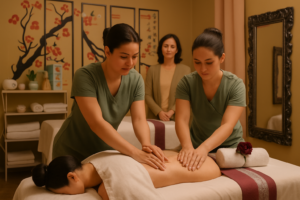
There is a particular Wednesday morning at the parlour that does not appear on any client schedule. It is the standing time when our four-hands practice pairs work together — not on clients, but on each other and on training partners — to maintain the synchronisation that the work requires.
If a client could observe these sessions, the impression would probably be that nothing particularly important is happening. Two therapists working together on a mat, performing what looks like an ordinary massage protocol. The therapist on the table speaking very little. The pair working in steady rhythm, sometimes pausing, sometimes adjusting position. The whole thing lasts about ninety minutes and looks, from outside, fairly unremarkable.
What is happening, however, is the careful maintenance of a skill that is invisible when it is working and conspicuously absent when it is not. The synchronised four-hands work that produces the therapeutic effects I have written about in earlier pieces depends on this ongoing practice. Without it, two excellent therapists become two therapists doing simultaneous massage — pleasant, but missing the integrated effect that the practice exists to produce.
This piece is for clients who have ever wondered what goes into the work they receive when they book a four-hands session, and for the small but real number of practitioners who write to me asking how we structure the training. (For the client-facing experience of the modality, the earlier four-hand massage: relaxation and calm is the gentler entry point.)
The first thing two therapists learn
The first competency that a pair of therapists training together must develop is breath synchronisation. Not while working — that comes later. While simply sitting near each other, in silence, the two therapists learn to match their own breathing rhythms.
This sounds simple. It is not. Each of us has a natural breathing rhythm that varies according to our physical state, our mental state, the time of day, what we ate for breakfast, and twenty other small factors. Asking two people to match their breathing requires both of them to be aware of their own rhythm, aware of the partner’s rhythm, and able to make small adjustments without making the adjustments themselves into a stressor.
A pair of therapists training to do four-hands work begins by spending sessions of fifteen or twenty minutes simply sitting near each other and matching breath. The trainer (usually an experienced four-hands practitioner) gives feedback: “you slipped at minute eight,” or “the third inhale was rushed.” The pair works at this until they can sit for the full twenty minutes with no detectable break in synchronisation.
This skill — apparently abstract — is the foundation of everything that comes after. The breathing rhythm is what allows the two therapists to maintain coordinated work for ninety minutes without explicit communication. When the breath drifts, the work drifts. When the breath holds, the work holds.
The mirror-stroke drill
After breath synchronisation has been established, the pair begins the mirror-stroke drill. One therapist performs a long sweeping stroke on a training body (a third person, often another therapist in training). The second therapist performs the same stroke at the same moment on the opposite side of the body or on a different body region.
The trainer observes for: timing alignment (do the strokes begin and end at exactly the same moment?), pressure matching (does the body feel equal pressure on both sides?), rhythm consistency (are the strokes the same speed?), and trajectory mirroring (do the strokes follow corresponding paths on each side?).
Each of these dimensions is independent. A pair can have perfect timing alignment but mismatched pressure. They can have matched pressure but slightly different speeds. The training is to develop all four dimensions simultaneously, to the point where the third party on the table cannot tell whether two different people or one person is performing the strokes.
This drill takes weeks of practice to reach a level where it can be sustained for more than a few minutes. Most new pairs find that one therapist tends to be slightly faster, or one tends to apply slightly more pressure, and the asymmetry has to be consciously corrected for an extended period before it becomes naturally balanced.
Sequence memorisation under conditions
Once basic mirror-stroke work is reliable, the pair begins memorising specific protocols — the standard sequences that constitute a full four-hands session. These sequences are not improvised. They are carefully designed and have been refined over many years to produce specific effects on the body in a specific order.
A standard ninety-minute four-hands session has about forty discrete sequence elements, each with specific timing, specific positions for both therapists, and specific transitions to the next element. The pair must memorise all forty elements so thoroughly that no thought is required during the session.
The challenge is that memorisation alone is not enough. The two therapists must also memorise how the sequence works in combination — what their partner is doing at each moment, where the partner’s hands will be, what kind of pressure the partner will be applying. This shared memorisation allows them to coordinate without constant visual reference.
Training under conditions means practising the sequence under various small disruptions — adjusted room temperature, occasional interruptions, varying training partners with different body sizes. The pair learns to maintain the sequence and the synchronisation through these variations, which prepares them for the small unpredictabilities of real client work.
The mutual feedback skill
Perhaps the subtlest skill the pair develops is mutual feedback — the ability to feel the partner’s work through indirect cues. The two therapists are working on opposite sides of the body, often not able to see each other’s hands directly. They cannot speak during a session in any meaningful way. Yet they must maintain coordination through every transition.
The mechanism turns out to be the table itself. When a therapist applies pressure on one side of the body, a small vibration travels through the table. The partner, with practice, learns to feel these vibrations through their own contact with the table and to use them as a guide to their partner’s rhythm.
This sensitivity takes considerable time to develop. New pairs often miss the vibrations entirely for the first month of practice. By the third month, they begin to feel them but cannot yet interpret them reliably. By six months, the vibration-feedback has become a primary navigation tool that operates below conscious awareness.
I learned this skill from my teacher in Liaoning more than twenty years ago. He had a particular exercise: he would blindfold both members of a training pair and have them perform a sequence using only the table-vibration feedback to maintain synchronisation. The first time my partner and I attempted this, we lost coordination within three minutes. By the time we passed the test — being able to maintain blindfolded synchronisation for the full sequence — almost a year had passed.
A note about my colleagues
We have at our parlour several four-hands practice pairs. Each pair has its own history, its own particular rhythms, its own subtle variations in how they work together. A client who books a four-hands session does not generally know which pair will be performing it (we schedule based on availability), but each pair has a slightly different character to their work.
My most frequent partner — a therapist who has been with us for nearly seven years — and I have developed something that is hard to describe but which experienced clients sometimes recognise. We have worked together long enough that our breathing rhythms have shifted to match each other even outside the sessions. When we sit in the same room before a client arrives, our breaths have, without effort, fallen into the same pattern.
This is not mystical. It is the result of many hundreds of hours of paired practice. The body, exposed to a partner’s rhythm consistently enough, slowly takes it on. I have read that the same thing happens with people who live together for many years, with musicians who play together for a long time, with close family. Coordinated work, sustained, does this on its own.
What this means for the work clients receive
The client who books a session does not need to know any of this. The work is invisible when it is working well; the client simply receives a session that feels coherent and integrated. That coherence is the product of the training described here.
But for clients who are interested, the small piece of context is this: when a four-hands session is performed by a pair that has done this training together, the effects on the client’s brain and body are qualitatively different from what two excellent individual therapists could produce by working simultaneously. The synchronisation is itself a therapeutic input. It is the input that produces the brain-shift I described in an earlier piece — the transition from sequential sensory tracking to integrated whole-body processing.
This is why we are careful about the pairs we offer four-hands work from, and why we resist the temptation to schedule four-hands sessions with whichever two therapists happen to be available. The integrity of the work depends on the integrity of the pair.
A small story about a young pair
A pair of younger therapists at the parlour completed their four-hands training last winter. They are both excellent single-handed practitioners. They had trained together for the full six-month curriculum, passed all the standard assessments, and were ready to begin offering paid four-hands sessions.
For their first session together, I arranged for the client to be one of our most experienced regulars — a woman who had been receiving four-hands sessions for several years and who had given permission to be the first booking for a new pair.
After the session, I asked her, casually, how it had been.
She said, “Different from yours, of course. But it worked.”
I asked her to elaborate.
“It worked,” she said. “I could feel them being slightly more careful than your pair would be. Their rhythm is younger somehow. But the integration was there. By the end of the session, I had stopped tracking which one was where. That is the test, no?”
She was right. That is the test. The young pair had passed it on their first paid session, which is what their six months of training had been for.
They are now one of our regular four-hands pairs. They will, over the years, develop their own particular qualities of work. They will, in time, train the next pair after them. The craft, in this way, continues.
Yang Wang practises Chinese medicine at Chinese Massage – Tai Chi Tirana.