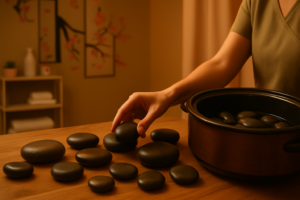
Choosing Stones: What Makes a Good Set

Most clients do not think about the stones themselves. They feel the warmth, register that the experience is pleasant, and move on. This is reasonable. The therapist’s job is to make the materials of the work disappear so that the client can simply experience the effect.

But the stones matter. The choice of which stones to use, where to source them, how to maintain them, and how to retire them when they have reached the end of their useful life — these decisions affect what the client receives in ways that are subtle but consistent. A bad stone set produces sessions that feel slightly off in ways most clients cannot articulate. A good set produces sessions where everything falls into place naturally.

This piece is about the stones, and about the small craft decisions that lie behind a volcanic stone therapy session. It is partly for clients who are curious about the materials of their treatment, and partly for the small but growing number of practitioners who write to me asking how we source our stones in Tirana. (The foundational long-form piece on the modality itself — origin, variations, contraindications — is the volcanic stone massage guide.)

What kind of stone

The stones used in volcanic stone therapy are, almost always, basalt. The reasons for this are specific and not interchangeable.

Basalt is a dark, fine-grained igneous rock formed from rapidly cooled volcanic lava. Its specific composition — high in iron, magnesium, silica, and various trace minerals — gives it three properties that make it nearly ideal for therapeutic stone work.

First, it has high thermal mass. A basalt stone of a given size holds significantly more heat than a stone of the same size made of granite, marble, or sedimentary rock. This means a basalt stone, once warmed to working temperature, releases its heat to the body over a longer period and at a more even rate.

Second, its surface — when properly tumbled and polished — has a very specific quality. It is smooth without being slippery. The friction coefficient against oiled skin is in a range where the stone glides predictably without sliding uncontrollably. Marble is too slippery; granite is too rough; sedimentary stones are too soft to retain a usable surface after weeks of work.

Third, its hardness is in a useful range — about 6 on the Mohs scale (where talc is 1 and diamond is 10). Hard enough to retain its shape under daily use, soft enough to absorb the small impacts of being handled without chipping easily. A harder stone (granite, quartz) is more durable but transfers less heat and feels different against the body. A softer stone (sandstone, limestone) feels pleasant but breaks down within months of regular use.

We use stones sourced from a specific volcanic region in central Italy where the basalt has a particular fineness of grain and trace mineral profile that produces what experienced therapists describe as a “warm” rather than “hot” thermal quality — a difficult-to-quantify property that nonetheless makes a real difference in the client’s experience of the session.

What size, what shape

A working stone set for parlour use contains stones of carefully graded sizes. Our standard set has fifty-four stones across eight size categories.

The largest stones — about the size of a flattened pear, roughly 250 to 320 grams — are placement stones for the sacrum and the upper back. These are not moved during the session; they sit on key points and provide sustained warm-weighted contact.

The medium-large stones — about palm-sized, 150 to 200 grams — are the primary working stones for the back, hips, and large muscle groups. They are oval, slightly flattened, with one edge slightly more rounded than the other for different stroke types.

The medium stones — fitting in the curve of the fingers, 80 to 120 grams — are for the shoulders, calves, and forearms.

The smaller stones — 40 to 70 grams — are for the face, hands, and the spaces between the toes.

The smallest stones — under 30 grams, about the size of a small almond — are for very specific point work and for placement between the fingers and toes.

Each size has a specific shape developed for its use. The placement stones are flatter on the side that will rest against the body. The working stones have a particular curvature that fits the natural shape of the human hand and produces a comfortable grip when the therapist is working. The smallest stones have rounded surfaces with no edges that could catch on small structures.

The grading of the set matters more than people realise. A set with too few stones in a given size category forces the therapist to use stones that are not quite right for the work, and the session feels subtly clumsy. A well-graded set means the therapist always has the right stone within reach for what the moment requires.

How the stones are heated

The heating of the stones, in a modern parlour like ours, is done in a dedicated heating unit — a thermostatically controlled water bath that holds the stones at the working temperature between uses. Our unit is set at 58 degrees Celsius, which is at the lower end of the working range but produces what I consider the safest and most comfortable temperature.

The water in the heating unit is changed between every client and treated with a small amount of mild disinfectant. The stones themselves are cleaned with a brush after each use and given a deeper cleaning weekly.

The temperature matters. Too low (below 50°C) and the heat does not penetrate adequately into deep tissue. Too high (above 65°C) and the stones become uncomfortable on the skin, particularly during the active stroke portions of the session. The therapeutic window is, in practice, between 55 and 62 degrees, with most clients comfortable around 58.

For clients with reduced heat sensation — particularly those with diabetic neuropathy or other peripheral nerve conditions — we use stones at the lower end of the range and increase the verbal check-ins during the session. Heat that the client cannot accurately feel is heat that can cause harm without warning.

How a stone wears out

A working basalt stone has a life of several years if treated well. The stone does not “wear out” in a dramatic way; it gradually changes character.

After about two years of regular use, the surface develops a slight microscopic roughening that reduces its glide quality. Most therapists do not notice this consciously; they begin to compensate by using slightly more oil, or by altering their stroke pressure.

After about three years, the stone may develop small surface fissures that, while not visible to the casual observer, change the thermal conduction pattern of the stone. The heat transfer becomes less even.

After about four to five years, the stone has aged enough that it is time to retire it from working use. We use retired stones for other purposes — sometimes as decorative pieces, sometimes for training new therapists, sometimes given as gifts to long-term clients who have asked about them.

The replacement cycle is staggered so that we are not retiring an entire set at once. Each year, a portion of the set is renewed, which means the working set always has stones of various ages — some new and brilliantly polished, some well-broken-in and familiar, some near the end of their useful life. The variety, in fact, produces a more flexible set than a uniformly aged set would.

A small story about a particular stone

There is one stone in our current working set that I have a particular attachment to. It is a medium-large oval, well-polished, perfectly weighted at about 175 grams. It came in our most recent batch from Italy about three years ago and has been one of my primary working stones since the day it arrived.

The reason I like it is difficult to describe. It fits my hand in a way that other stones of similar size do not quite. The thermal release feels right under my palm. When I am working a stubborn area of a client’s back, this is the stone I reach for first. The others are good. This one is, for my work, slightly better.

Most therapists who do this work for long develop similar attachments to particular stones in their sets. The phenomenon is partly individual variation in the stones themselves (no two are identical), partly the gradual mutual adjustment of stone and hand over years of use, partly something harder to articulate.

When this particular stone eventually retires from working use, I will keep it. Not for any particular practical reason. Some objects accumulate enough association with good work that retiring them all the way feels wrong.

The Liaoning footnote

I mentioned in another piece that my grandmother used pieces of brick — smoothed by time, kept in a wooden box near the stove — for the household version of warm-stone application she performed on my mother and aunts in winter. The bricks were not basalt. They were kiln-fired clay. The thermal properties were different. The effect, by all reports, was satisfactory for the household-medical purposes for which the bricks were used.

The lesson I take from this is not that basalt is unnecessary — for the professional version of the work, the precision of basalt matters — but that the underlying principle of stone-and-warmth is robust enough to survive considerable variation in materials. Different cultures, different centuries, different available rocks. The body responds, in its essentials, to the same intervention.

What the professional version adds — the carefully sourced basalt, the steady heating, the graded set, the trained hands — is precision. The same intervention, performed more reliably, with better outcomes across a broader range of complaints. This is worth paying for. But the underlying wisdom of the technique does not depend on the precision; the precision sharpens something that was already valuable.

This is, in a sense, the answer to clients who ask whether they could get the same effect at home with a smooth river stone heated in warm water. Yes, in part. You will get something. The session at the parlour offers more of it, more reliably, with the safety of a trained pair of hands. But the underlying impulse — to use warm stone to address the body’s chronic cold — is one you can trust regardless of the source.

The grandmothers, again, knew.


Yang Wang practises Chinese medicine at Chinese Massage – Tai Chi Tirana.
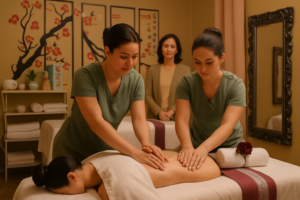
The Choreography: How Two Therapists Train to Work as One

There is a particular Wednesday morning at the parlour that does not appear on any client schedule. It is the standing time when our four-hands practice pairs work together — not on clients, but on each other and on training partners — to maintain the synchronisation that the work requires.

If a client could observe these sessions, the impression would probably be that nothing particularly important is happening. Two therapists working together on a mat, performing what looks like an ordinary massage protocol. The therapist on the table speaking very little. The pair working in steady rhythm, sometimes pausing, sometimes adjusting position. The whole thing lasts about ninety minutes and looks, from outside, fairly unremarkable.

What is happening, however, is the careful maintenance of a skill that is invisible when it is working and conspicuously absent when it is not. The synchronised four-hands work that produces the therapeutic effects I have written about in earlier pieces depends on this ongoing practice. Without it, two excellent therapists become two therapists doing simultaneous massage — pleasant, but missing the integrated effect that the practice exists to produce.

This piece is for clients who have ever wondered what goes into the work they receive when they book a four-hands session, and for the small but real number of practitioners who write to me asking how we structure the training. (For the client-facing experience of the modality, the earlier four-hand massage: relaxation and calm is the gentler entry point.)

The first thing two therapists learn

The first competency that a pair of therapists training together must develop is breath synchronisation. Not while working — that comes later. While simply sitting near each other, in silence, the two therapists learn to match their own breathing rhythms.

This sounds simple. It is not. Each of us has a natural breathing rhythm that varies according to our physical state, our mental state, the time of day, what we ate for breakfast, and twenty other small factors. Asking two people to match their breathing requires both of them to be aware of their own rhythm, aware of the partner’s rhythm, and able to make small adjustments without making the adjustments themselves into a stressor.

A pair of therapists training to do four-hands work begins by spending sessions of fifteen or twenty minutes simply sitting near each other and matching breath. The trainer (usually an experienced four-hands practitioner) gives feedback: “you slipped at minute eight,” or “the third inhale was rushed.” The pair works at this until they can sit for the full twenty minutes with no detectable break in synchronisation.

This skill — apparently abstract — is the foundation of everything that comes after. The breathing rhythm is what allows the two therapists to maintain coordinated work for ninety minutes without explicit communication. When the breath drifts, the work drifts. When the breath holds, the work holds.

The mirror-stroke drill

After breath synchronisation has been established, the pair begins the mirror-stroke drill. One therapist performs a long sweeping stroke on a training body (a third person, often another therapist in training). The second therapist performs the same stroke at the same moment on the opposite side of the body or on a different body region.

The trainer observes for: timing alignment (do the strokes begin and end at exactly the same moment?), pressure matching (does the body feel equal pressure on both sides?), rhythm consistency (are the strokes the same speed?), and trajectory mirroring (do the strokes follow corresponding paths on each side?).

Each of these dimensions is independent. A pair can have perfect timing alignment but mismatched pressure. They can have matched pressure but slightly different speeds. The training is to develop all four dimensions simultaneously, to the point where the third party on the table cannot tell whether two different people or one person is performing the strokes.

This drill takes weeks of practice to reach a level where it can be sustained for more than a few minutes. Most new pairs find that one therapist tends to be slightly faster, or one tends to apply slightly more pressure, and the asymmetry has to be consciously corrected for an extended period before it becomes naturally balanced.

Sequence memorisation under conditions

Once basic mirror-stroke work is reliable, the pair begins memorising specific protocols — the standard sequences that constitute a full four-hands session. These sequences are not improvised. They are carefully designed and have been refined over many years to produce specific effects on the body in a specific order.

A standard ninety-minute four-hands session has about forty discrete sequence elements, each with specific timing, specific positions for both therapists, and specific transitions to the next element. The pair must memorise all forty elements so thoroughly that no thought is required during the session.

The challenge is that memorisation alone is not enough. The two therapists must also memorise how the sequence works in combination — what their partner is doing at each moment, where the partner’s hands will be, what kind of pressure the partner will be applying. This shared memorisation allows them to coordinate without constant visual reference.

Training under conditions means practising the sequence under various small disruptions — adjusted room temperature, occasional interruptions, varying training partners with different body sizes. The pair learns to maintain the sequence and the synchronisation through these variations, which prepares them for the small unpredictabilities of real client work.

The mutual feedback skill

Perhaps the subtlest skill the pair develops is mutual feedback — the ability to feel the partner’s work through indirect cues. The two therapists are working on opposite sides of the body, often not able to see each other’s hands directly. They cannot speak during a session in any meaningful way. Yet they must maintain coordination through every transition.

The mechanism turns out to be the table itself. When a therapist applies pressure on one side of the body, a small vibration travels through the table. The partner, with practice, learns to feel these vibrations through their own contact with the table and to use them as a guide to their partner’s rhythm.

This sensitivity takes considerable time to develop. New pairs often miss the vibrations entirely for the first month of practice. By the third month, they begin to feel them but cannot yet interpret them reliably. By six months, the vibration-feedback has become a primary navigation tool that operates below conscious awareness.

I learned this skill from my teacher in Liaoning more than twenty years ago. He had a particular exercise: he would blindfold both members of a training pair and have them perform a sequence using only the table-vibration feedback to maintain synchronisation. The first time my partner and I attempted this, we lost coordination within three minutes. By the time we passed the test — being able to maintain blindfolded synchronisation for the full sequence — almost a year had passed.

A note about my colleagues

We have at our parlour several four-hands practice pairs. Each pair has its own history, its own particular rhythms, its own subtle variations in how they work together. A client who books a four-hands session does not generally know which pair will be performing it (we schedule based on availability), but each pair has a slightly different character to their work.

My most frequent partner — a therapist who has been with us for nearly seven years — and I have developed something that is hard to describe but which experienced clients sometimes recognise. We have worked together long enough that our breathing rhythms have shifted to match each other even outside the sessions. When we sit in the same room before a client arrives, our breaths have, without effort, fallen into the same pattern.

This is not mystical. It is the result of many hundreds of hours of paired practice. The body, exposed to a partner’s rhythm consistently enough, slowly takes it on. I have read that the same thing happens with people who live together for many years, with musicians who play together for a long time, with close family. Coordinated work, sustained, does this on its own.

What this means for the work clients receive

The client who books a session does not need to know any of this. The work is invisible when it is working well; the client simply receives a session that feels coherent and integrated. That coherence is the product of the training described here.

But for clients who are interested, the small piece of context is this: when a four-hands session is performed by a pair that has done this training together, the effects on the client’s brain and body are qualitatively different from what two excellent individual therapists could produce by working simultaneously. The synchronisation is itself a therapeutic input. It is the input that produces the brain-shift I described in an earlier piece — the transition from sequential sensory tracking to integrated whole-body processing.

This is why we are careful about the pairs we offer four-hands work from, and why we resist the temptation to schedule four-hands sessions with whichever two therapists happen to be available. The integrity of the work depends on the integrity of the pair.

A small story about a young pair

A pair of younger therapists at the parlour completed their four-hands training last winter. They are both excellent single-handed practitioners. They had trained together for the full six-month curriculum, passed all the standard assessments, and were ready to begin offering paid four-hands sessions.

For their first session together, I arranged for the client to be one of our most experienced regulars — a woman who had been receiving four-hands sessions for several years and who had given permission to be the first booking for a new pair.

After the session, I asked her, casually, how it had been.

She said, “Different from yours, of course. But it worked.”

I asked her to elaborate.

“It worked,” she said. “I could feel them being slightly more careful than your pair would be. Their rhythm is younger somehow. But the integration was there. By the end of the session, I had stopped tracking which one was where. That is the test, no?”

She was right. That is the test. The young pair had passed it on their first paid session, which is what their six months of training had been for.

They are now one of our regular four-hands pairs. They will, over the years, develop their own particular qualities of work. They will, in time, train the next pair after them. The craft, in this way, continues.


Yang Wang practises Chinese medicine at Chinese Massage – Tai Chi Tirana.