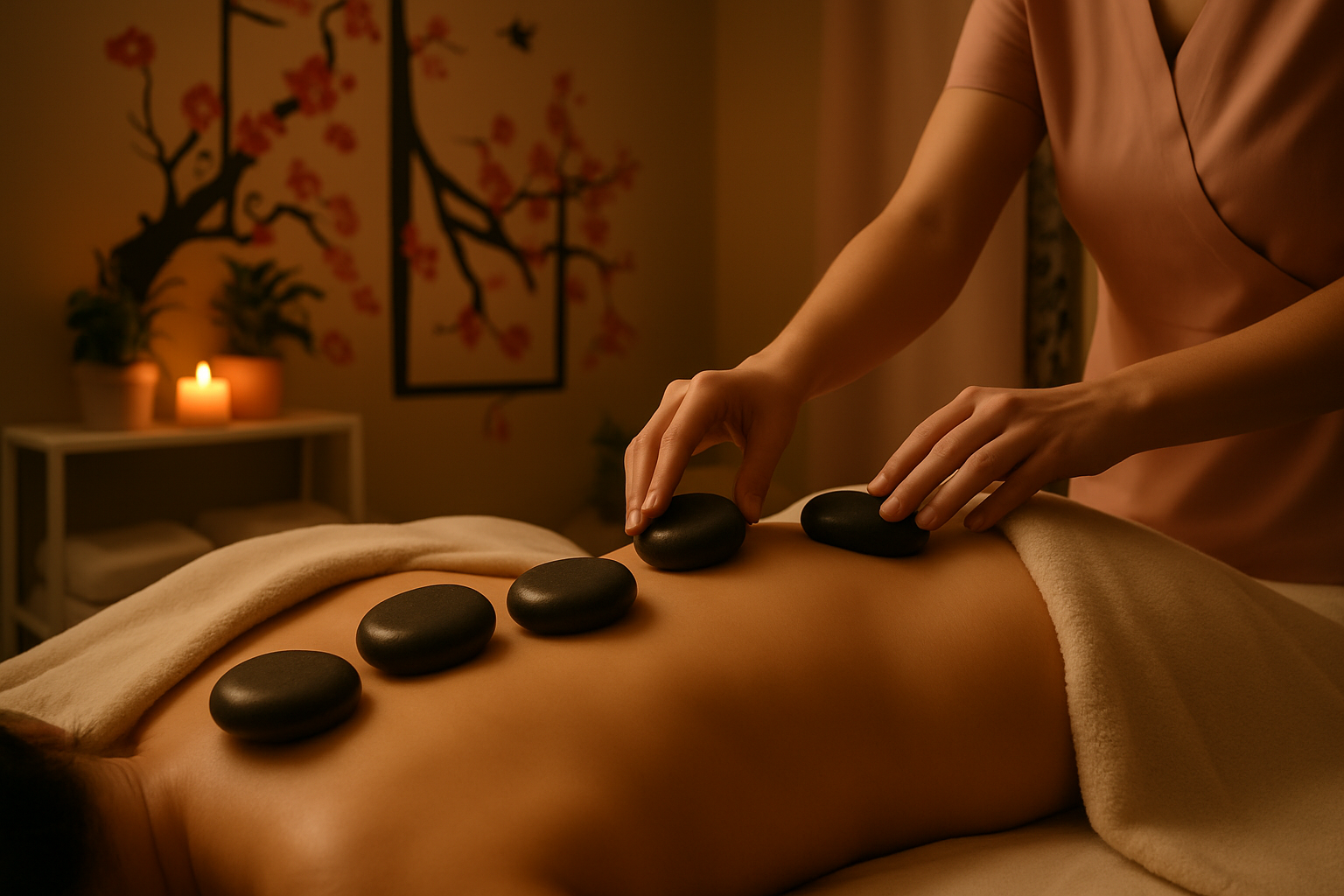
Drita — a different Drita from the one in the earlier therapeutic-massage piece — had been carrying a cold in her right hip for six years. The pain had begun after a winter spent caring for her mother, who was dying. The kind of pain that, in TCM diagnosis, often follows prolonged grief held in the body without release. The hip had become a place where something was being stored, and the storage had become physical.
She had been to orthopaedic specialists. Two MRIs showed mild but not surgically significant arthritic changes. She had been told the pain was probably psychogenic, or possibly the early stages of bursitis, or possibly fibromyalgia. The diagnoses kept changing because none of them quite fit. The pain kept being there because it was being maintained by something the imaging could not see.
She came to me in October of last year, after a friend had described what stone therapy had done for a similar persistent complaint of hers. Drita was sceptical. She had been sceptical of every previous treatment too. She had been disappointed often enough that scepticism had become her baseline emotional setting toward any new attempt.
I told her honestly that I did not know whether the work would help her or not. The presentation was complex. We would do three sessions and then assess. If the work was helping, we would continue. If not, we would stop and I would not waste her time or her money.
The body that stores winter
There is something I have noticed enough times over the years that I have come to trust the pattern, even though I have not seen it described well in any of the books I have read: certain regions of the body, in certain people, become reservoirs for chronic cold. The cold is not always literal — the area is not necessarily lower in temperature than the surrounding tissue, though sometimes it is — but the felt sense of the area is cold to the person carrying it. It is heavier, denser, less responsive to ordinary warming measures than the rest of the body.
These reservoirs tend to form in particular places. The lower back in people who have carried heavy emotional loads. The upper chest in people who have suffered loss. The hips, particularly the right hip in right-handed people, in those who have carried prolonged caregiving stress. The lower abdomen in women after difficult childbirths or in the aftermath of certain kinds of pelvic surgery.
The conventional medical response to these patterns is, understandably, to look for an organic cause. Sometimes one is found and addressed. Often it is not, and the patient is told there is nothing to be done. The patient continues to feel the cold and the heaviness, and the medical system does not have a framework that takes their description seriously.
Volcanic stone therapy is one of the few interventions that addresses these reservoirs directly. The combination of deep penetrating heat and the slow rhythmic movement of the stones can, in clients who respond, gradually dissolve what the body has been holding. The process is slow. The change, when it comes, tends to be lasting.
Skanderbeg’s patience as a model for the work
When Drita described the right hip — six years of carrying it, the failed treatments, the slow loss of trust in the doctors she had seen, the resigned acceptance that this was simply how her body was going to be from now on — I thought, as I often do with this kind of client, of Skanderbeg.
The Albanian historical hero is usually invoked, in popular culture, as a symbol of fierce resistance. But the historical Skanderbeg’s actual military genius was not in fierce confrontation. It was in choosing very carefully when to fight, when to retreat, when to hold a position quietly, and when to attack at the precise moment when the cumulative effect of small skirmishes had weakened the opposition. He won not by overwhelming force but by careful timing across years.
The body’s stored cold responds to the same kind of patience. Direct confrontation — aggressive deep tissue work, forceful manipulation, high-dose pharmaceutical intervention — usually does not resolve it and sometimes makes it worse. The reservoir is too defended, too rooted, to be assaulted directly. What dissolves it is sustained, gentle, well-timed work over enough sessions that the body’s defensive grip eventually loosens.
I told Drita something like this at the intake. Not in those words exactly, but the underlying idea. The work would be patient. We would not be in a hurry. We would not push.
She nodded. She had been pushed too many times to find a slow approach unappealing.
The three sessions
The first session was a full ninety-minute volcanic stone treatment with particular attention to the right hip and lower back. I used larger stones for the hip — palm-sized to slightly larger — placed at the gluteal trigger points and slowly moved through the lateral hip fascia. The stones I rotated through were kept at a consistent working temperature, with three stones in the heating unit at any given time to maintain the rotation.
Drita slept on the table during much of the second half. When she got up, she said the hip was warmer in a way she could not remember it being for years. She did not promise herself that the warmth would last. She had learned not to.
She came back nine days later. The warmth from the first session, she reported, had persisted for about three days at a noticeable level, then gradually faded back to her baseline. The pain itself was perhaps fifteen percent less. Not dramatic. Not nothing.
Second session. Same protocol with small refinements. This time the work extended into the lower lumbar region on the right side, where I had noticed at the first session that the tissue had a similar dense, cold quality to the hip. The session was, like the first, mostly silent. Drita slept.
Third session, two weeks after the second. By now the pattern was clearer. The right hip and right lower back were two parts of a single reservoir, and the work needed to address them as one. The session included some abdominal work — gentle stone placement on the lower abdomen and a slow circular motion that addressed the iliopsoas through the front of the body. This was a piece I had not done in the first two sessions because I had wanted to start with the more directly affected areas. By the third session, the work could go deeper.
When she got off the table after the third session, she stood differently. Her right hip was no longer rotated outward by the slight amount it had been for years. She did not consciously notice this. I did.
The next four sessions
We agreed, after the third session, that the work was helping enough to continue. We did four more sessions across the next two months, with progressively increasing intervals between them. By the seventh session, the pain in the right hip was approximately seventy percent reduced from baseline. The “cold” quality of the hip had largely resolved. Drita could sleep on her right side again, which she had not been able to do since 2024.
I want to be careful in how I describe the outcome. Drita is not pain-free. The arthritic changes in her hip are real and will not be reversed by stone therapy or by anything else short of joint replacement, which she does not need. What has happened is that the stored cold, the reservoir of held grief and physical compensation that had built up over six years, has gradually dissolved. The underlying mild arthritis remains, but the body is no longer amplifying it through chronic muscular guarding and reduced circulation.
This is the realistic outcome for this kind of work. It is not magic. It does not restore the body to a state it has not been in for many years. What it does is remove the additional burden the body has been carrying on top of whatever underlying condition is present. For many clients, the additional burden was the larger part of the daily experience of pain. Removing it changes life in ways that are not visible on any imaging study but that the client feels clearly.
A note on grief
I have not avoided the word grief in this piece, and I do not want to step around it now. Drita lost her mother six years before she came to me. The hip began to hurt during the year of her mother’s dying. The connection between grief and the body is not a metaphor; it is something many practitioners observe in their own clients and something that the wider medical world has only recently begun to take seriously.
The volcanic stone work, in cases like Drita’s, is not psychotherapy. We do not talk about the grief during the sessions. I do not analyse it. But the work creates conditions in which the body can let go of what it has been holding, and the holding sometimes includes residual physical patterns from past emotional events. The release that happens is mostly silent. Sometimes a client cries on the table without quite knowing why. Sometimes they go home and have a vivid dream about a loved one. Sometimes they simply find themselves, weeks later, able to think about a difficult chapter in their life with less weight.
I do not direct any of this. I just do the work. The body, given the right conditions, does its own integration.
What I have come to believe
After many years of doing this work, I have come to believe something that I would not have predicted when I was a young student in Liaoning. I have come to believe that the body holds things, that holding requires effort, that the effort accumulates as physical signs over time, and that the right kind of patient external intervention can sometimes allow the body to put down what it has been carrying.
The volcanic stone therapy is one of several tools that can do this work. Acupuncture is another. Mud moxibustion is a third. Skilled relaxation massage, performed correctly, is a fourth. The right tool depends on the specific pattern of holding and the specific person. (The foundational long-form volcanic stone massage guide covers the modality’s full scope; this piece is one variation among many.)
What the tools share is patience. They do not force. They invite. The body responds, when it is ready, in its own way.
Skanderbeg would have approved.
Yang Wang practises Chinese medicine at Chinese Massage – Tai Chi Tirana. Names in client stories have been changed.
Ready to Feel the Difference?
Book your session today — same-day appointments available.
Book Your Session