Volcanic Stone Massage for Fibromyalgia: 8 Sessions

Alma came to me in the spring after spending the winter unable to leave her apartment for more than short errands. She was forty-four. She had been diagnosed with fibromyalgia six years earlier, after a process of medical investigation that had taken nearly three years and had cost her — financially and emotionally — far more than the diagnosis was worth. By the time she had a name for what was happening to her body, she had stopped trusting that any name would help.

She had tried the standard medications: pregabalin, duloxetine, low-dose amitriptyline. They had taken some edge off the pain at the cost of side effects she found difficult to live with. She had tried physiotherapy, which had been worse than nothing — the standard graded-exercise protocol had triggered week-long flares each time the dose was increased. She had tried cognitive behavioural therapy, which had helped her cope but had not changed the underlying experience. She had tried alternative medicine practitioners of various qualifications, with results that ranged from neutral to mildly harmful.

When she sat across from me at the intake conversation, she was not optimistic. She had been told by a friend that volcanic stone work had helped her cousin’s fibromyalgia, and she had decided to try it more out of a sense that she should keep trying things than out of any real expectation.

I told her, honestly, that fibromyalgia is one of the harder conditions to treat with any intervention, that I had clients who had benefited substantially from volcanic stone work and clients who had not, and that we would need to do at least four sessions before we could meaningfully assess whether this approach was going to help her. If it was not, we would stop.

She agreed. We began.

What I have come to understand about fibromyalgia

Fibromyalgia is a condition I have spent a lot of time trying to understand, because I see clients with it often and the experience they describe is real and difficult. From what I have read, and from what doctors I trust have told me, the picture is roughly this. Patients have widespread pain — usually lasting more than a year and a half, across many parts of the body — together with fatigue, broken sleep, a foggy quality of thinking, and often other complaints like sensitive digestion, sensitivity to sound or light, and frequent headaches. The pattern is recognisable but the cause is not simple.

For a long time, doctors went back and forth on whether the condition was psychological or physical. The current understanding, as I have come across it, is that fibromyalgia is about how the nervous system processes pain signals, rather than about damage in any one part of the body. The pain is real. It is not imagined. But the source of it is in how the brain and spinal cord are reading signals from the body, rather than in any tear or inflammation that an MRI could photograph.

This way of understanding fibromyalgia matters for treatment. Pushing harder on the body — deep pressure, forceful stretching, anything aggressive — tends not to help and can make things worse. What seems to help, in the clients I have seen, is whatever calms the nervous system down: gentle bodywork, careful breathing, certain medicines (for the doctor to decide), and exercise dosed very slowly. Pushing through pain is not the path.

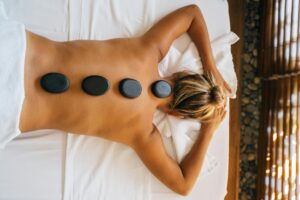
Volcanic stone therapy, in clients who respond well to it, seems to work as one of the calming approaches. The heat is deeply soothing without needing pressure. The session is a long quiet stretch of rest in a state the nervous system has often forgotten. Across several sessions, the body’s baseline of alarm seems to come down. (For readers new to the stone-therapy tradition more generally, I have a longer foundational piece, the volcanic stone massage guide, that covers origin, variations, and contraindications.)

Why stone work specifically, and not other massage

Several characteristics of stone work make it particularly suited to fibromyalgia, compared to other massage modalities.

First, the pressure can be light without losing therapeutic effect. The heat itself does much of the work. A skilled stone therapist can produce significant tissue change with pressure that would be insufficient in any other massage modality. For fibromyalgia patients, who often cannot tolerate moderate to deep pressure, this is essential.

Second, the heat penetrates deeply without requiring deep mechanical pressure. The therapeutic warmth reaches the deep paraspinal muscles, the periarticular tissues, and the small joint capsules without the therapist needing to apply force to those structures. This is the opposite of the “deep tissue” approach, and for fibromyalgia patients it is much more useful.

Third, the predictability of the experience helps the nervous system settle. Fibromyalgia patients often have hypervigilant nervous systems that scan continuously for the next painful input. The slow, predictable rhythm of stone work allows the nervous system to lower its guard. This effect is amplified across multiple sessions as the body learns that this particular treatment is reliably safe.

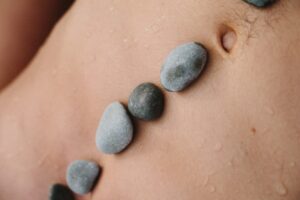
Fourth, the sustained warm-weighted contact of placement stones (on the sacrum, between the shoulders, in the palms) produces a deep proprioceptive grounding effect that fibromyalgia patients often report as profoundly relieving. The experience of feeling consistently safe and supported in their own body is, for many, rare and valuable.

The first four sessions

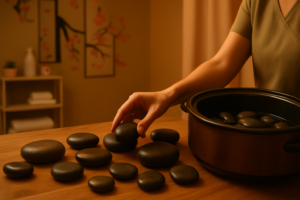
The first session with Alma was deliberately conservative. I used cooler stones than my usual setting — 54 degrees Celsius rather than 58 — and a lighter pressure than standard. The session was 90 minutes. We talked very little. I watched her body carefully throughout.

She had what I would describe as a “guarded” response in the first 30 minutes. Her shoulders did not fully drop. Her breathing remained shallow. She was, I could tell, holding herself slightly braced against the possibility that the work might hurt her — even though it was not hurting her. This is common in fibromyalgia patients in their first session. Their nervous system has been amplifying pain for so long that any new input is treated as a potential threat.

By the 45-minute mark, the bracing began to release. Her breathing deepened. The small muscles around her eyes softened. By the end of the session, she was visibly more relaxed than she had been at intake.

She called me the next day to say that she had slept the night before — seven continuous hours, for the first time in many months. The pain levels had been similar to her baseline, but the sleep had been transformative.

The second session, two weeks later, followed the same protocol with slight refinements. The bracing in the first 30 minutes was less. By the end of the session, she was lightly asleep.

The third session, the deeper integration began. I added gentle work on the cranium and face at the end of the session. Alma reported afterwards that she felt “lighter” in a way she could not specifically describe.

The fourth session was the inflection point. She arrived saying that the week between the third and fourth sessions had been the first week in years where she had not had a significant pain flare. The baseline was still present, but the amplifications had not happened.

This is the point at which I told her that I thought we should continue.

The next four sessions, and what changed

Sessions five through eight were spaced at two-week intervals, then three-week intervals. The work itself did not change dramatically; the protocol had been refined to what was working, and we continued in that direction.

What changed was Alma’s life around the sessions.

She began sleeping more reliably. The improvement was gradual but steady. By the seventh session, she was averaging six to seven hours of continuous sleep most nights.

Her pain levels reduced. Not eliminated — fibromyalgia rarely fully resolves — but the baseline shifted downward. She reported being able to do household tasks without then needing to lie down for the rest of the day. She began walking, slowly and not for long, in her neighbourhood.

The “fibro fog” lifted somewhat. She was able to read books again, which she had not done meaningfully for several years.

She began coming with her own questions about her body rather than the resigned posture of accepting whatever I might say. This shift — from passive recipient to active participant in her own care — is one of the most important markers of progress in fibromyalgia treatment.

By the eighth session, three months after we had begun, Alma was a different person from the woman who had walked into my office in March. The fibromyalgia had not gone away. But she had a life again.

Mamica Kastrioti’s kind of work

I think often, when working with fibromyalgia patients, of Mamica Kastrioti — Skanderbeg’s sister, whose composure under sustained difficulty is one of the qualities I find most admirable in Albanian historical figures. She held what she held without making noise about it. She did not break. She did not become bitter. She continued, in her own way, with the work that was hers to do.

Fibromyalgia patients carry something similar. The pain is constant. The fatigue is constant. The social misunderstanding — the family members and colleagues who do not believe the condition is real, who think it is exaggeration, who suggest you simply need to try harder — is often as exhausting as the physical symptoms. The patients who manage this with grace do so because they have developed a particular quiet strength that does not advertise itself.

Part of what I want this work to offer them is recognition. Recognition that what they are experiencing is real. Recognition that their endurance is honourable. Recognition that something can be done, slowly and carefully, that will reduce the load they are carrying.

The volcanic stones, in this work, are partly the tool and partly the gesture. The warmth they deliver is the warmth the body needs. The slowness of the session is the pace at which fibromyalgia must be addressed. The predictability of the protocol is what the hypervigilant nervous system can finally trust.

A note for fibromyalgia patients considering this

If you have fibromyalgia and have not yet tried volcanic stone therapy, here is what I would suggest:

Find a practitioner experienced with chronic pain conditions, not just any massage therapist. The work needs to be lighter, slower, and more carefully monitored than standard volcanic stone protocols.

Commit to at least four sessions, ideally six, before deciding whether it is helping. The cumulative effect builds; the first session often produces only modest changes.

Be honest with the practitioner about your pain levels, your medications, your other treatments, and any flares you have had recently. Adjustments to the protocol depend on accurate information.

If a session produces a worsening of symptoms for more than a day, communicate this. The pressure or temperature was too much. The next session should be adjusted.

Realistic expectation: meaningful reduction in pain, fatigue, and sleep disturbance, sustained across the weeks between sessions, with cumulative improvement across a course of treatment. Not a cure. Not the elimination of fibromyalgia. But a substantial improvement in daily life.

For Alma, after eight sessions, that has been enough. She continues to come for maintenance once every six weeks. She has built a life around her condition that allows her to do most of what she wants to do. The fibromyalgia is part of her, still. But it is no longer the entirety of her.

This is the work, in this kind of case. It is patient. The results are slow. They are also real.


Yang Wang practises Chinese medicine at Chinese Massage – Tai Chi Tirana. Names in client stories have been changed.
Volcanic Stone Therapy in Winter — Why Tirana’s Cold Snap

Tirana in January is colder than tourists expect. The city sits in a basin, and when the winds come down from Dajti in late afternoon, the temperature in the streets can drop several degrees in an hour. The wet cold that comes with the rain has a specific quality — it does not freeze the body the way the dry Liaoning winter of my childhood did, but it gets into the joints in a way that the dry cold did not. Long-term residents recognise it. New arrivals are usually surprised.

In our parlour, January and February are the two months when volcanic stone therapy bookings outpace everything else. It is not a coincidence. The treatment is specifically suited to the kind of chronic cold-pattern complaint that the Tirana winter produces, and the change clients experience after a session — and the cumulative change after several sessions — is more pronounced in winter than in any other season.

This piece is for the clients who come in with the specific complaint of “the cold has gotten into my bones” and want to know why the stones help when the heating pad at home does not.

What “cold in the bones” actually is

The phrase “cold in the bones” — acari në kocka, in Albanian — is one of the more linguistically accurate descriptions of a physiological state that modern medicine does not have a comparably elegant term for.

When the body is exposed to chronic cold and damp conditions, several things happen at the level of the joints, deep muscles, and connective tissue.

The synovial fluid in the joints becomes slightly more viscous. The fluid that lubricates the joint is sensitive to temperature; at lower temperatures, it flows less smoothly. This is part of why arthritic joints stiffen in cold weather.

The fascia surrounding the muscles loses some of its hydration and elasticity. Cold reduces local blood flow, which reduces the delivery of water and nutrients to the connective tissue. Over weeks of cold exposure, the fascia becomes detectably less pliable.

The deep paraspinal muscles, particularly those around the lower back and the back of the neck, enter a low-grade chronic contraction state. The contraction is protective — it preserves core temperature — but it accumulates tension over the winter.

The peripheral circulation, particularly in the hands and feet, becomes restricted. Even when the person is in a warm room, the small blood vessels in the periphery remain narrowed for some time after the cold exposure has ended.

All of these effects, in combination, produce the sensation of cold having “gotten into” the body in a way that no single warm shower can fully resolve. The body has shifted its baseline. Restoring the previous baseline takes more than transient warmth.

What the stones do that a heating pad does not

The instinct, when one has cold in the bones, is to apply heat. A hot bath, a heating pad on the lower back, an electric blanket overnight. These help. They help temporarily.

The therapeutic difference between this kind of surface heat and a volcanic stone session lies in three factors.

Depth of heat penetration. A hot bath warms the body’s surface and, over time, raises the core temperature slightly. A heating pad warms the area directly under it but the heat does not penetrate more than a centimetre or two into the tissue. Volcanic basalt, applied at the correct temperature (between 55 and 65 degrees Celsius) and moved correctly across the body, transfers heat to a depth of five to seven centimetres — reaching the deep paraspinal muscles, the deep hip rotators, the small muscles around the kidneys, and the periarticular tissues around the joints in a way that surface heat cannot.

Sustained working temperature. A heating pad cools as it transfers heat into the body and tends to be set at temperatures too high to be safe for prolonged contact (which is why most have automatic shut-offs). The basalt stones we use stay within the therapeutic range for fifteen to twenty minutes per stone, and we rotate through multiple stones to maintain even working temperature for the full session. The deep tissue receives sustained warming input rather than the rapid hot-cold-hot cycling of an electric pad.

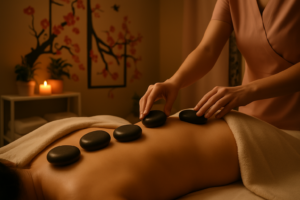
Mechanical work combined with heat. The stones are not only static. A skilled volcanic stone session combines stationary placement (where stones rest on key points for several minutes) with active manipulation (where the stones glide along muscle groups and joint capsules). The combination of heat plus mechanical work addresses both the temperature and the postural-tension components of winter stiffness simultaneously. (For the foundational long-form guide to this technique — origin, variations, contraindications — see the volcanic stone massage guide.)

The Tirana protocol specifically

The volcanic stone work I do in winter differs in specific ways from the protocol used in summer or in other climates. The Tirana-specific adjustments include:

Longer pre-warming of the client. The client lies on a heated table for five to ten minutes before any stone is applied. This raises the surface temperature of the body so the first stone does not produce a startling temperature contrast that recruits the sympathetic nervous system.

More attention to the lumbar region. The lower back is where the wet-cold quality of the Tirana winter accumulates most consistently. We use a larger sacral stone for this region, and the stationary placement time is extended compared to the standard protocol.

Specific work on the hips and outer thighs. The lateral fascia from the iliotibial band to the outer hip becomes particularly tight in winter, and clients often do not notice this tightness until it is released. Stone work along this region in winter consistently produces a “lighter” sensation in walking afterwards.

Attention to the small joints of the hands. Tirana winter cold particularly affects the hands of people who spend time outdoors — walking dogs along Liqeni, commuting on foot, taking children to school. Small stones placed between the fingers and worked along the back of the hand produce significant relief.

Finishing with abdominal stones. Even when the primary complaint is musculoskeletal, finishing with stationary stones on the lower abdomen produces a general systemic warming effect that improves the overall therapeutic outcome.

What a typical winter client looks like

A representative client, from this past January: a woman in her late fifties, retired teacher, lives in a flat in central Tirana with adequate but not generous heating. She walks her grandson to school each morning. She has had mild osteoarthritis in her knees for several years that is generally manageable but flares up in winter to the point where she cannot kneel on the floor to play with the child. She had tried heating pads, knee braces, a magnesium supplement, and one course of physiotherapy that had not produced a substantial change.

She came in for a single ninety-minute volcanic stone session in early January. The protocol was the full winter version described above, with particular attention to the periarticular tissues of the knees.

She called the next day to say that she had slept through the night for the first time in three weeks and had been able to kneel that morning without pain.

This is, by itself, not a study. It is an anecdote. But it is a representative anecdote — the kind of report we hear consistently from winter clients with cold-pattern complaints. The single session produces noticeable improvement; the cumulative effect of several sessions across the winter produces something closer to the body’s normal baseline.

She continued coming once every two weeks through February and into early March. By the time she stopped (in part because the weather had warmed and her knees had stabilised), she had had six sessions across two months. Her knees stayed stable through the rest of the winter and the following spring.

The Liaoning observation

I cannot help observing, when I do this work in winter, the parallel with what my own family did in Liaoning when I was a child. We did not have basalt stones in our village. We had pieces of broken brick from old kilns, smoothed by time, that my grandmother kept in a wooden box near the stove. In the deepest weeks of January she would warm a stone in the stove embers (carefully — too hot would crack it), wrap it in cloth, and apply it to her own lower back or to my mother’s knees.

The principle was identical. The materials were what was locally available. The pattern — warm stone, applied to the lower back or joints, in the deep cold of winter — has been performed in some form in every cold-climate culture that has had access to dense stone and a way to heat it. The fact that we now do it in our parlour in Tirana with carefully sourced basalt and properly heated water does not change the underlying intervention. We have refined the precision; we have not changed the wisdom.

When to consider it, when not to

Volcanic stone therapy in winter is particularly useful for:

Chronic joint stiffness that worsens in cold weather (arthritis of the knees, hips, shoulders, fingers).

Lower back pain with a “cold and damp” quality — pain that responds to heat and worsens in damp weather.

Persistent cold extremities (cold hands, cold feet) that are not improving with the usual measures.

General fatigue and “the cold has gotten into me” feeling that does not lift with adequate sleep and warm clothing.

It is less useful for, or contraindicated in, the conditions listed in the main volcanic stone guide on the parlour website — particularly pregnancy, acute infection, uncontrolled cardiovascular disease, blood-thinning medication, and active DVT.

For winter use specifically, a series of three to six sessions across the cold months produces the most reliable lasting effect. A single session helps for one to two weeks; the cumulative effect builds over the series and produces a body that handles the winter more comfortably overall.

The treatment is, in its way, one of the older interventions for living in a cold climate — warm stone, patient hands, repeated through the worst of the season. In a Tirana January, when the cold comes down off Dajti and settles into the basin for weeks, this is not a small thing.


Yang Wang practises Chinese medicine at Chinese Massage – Tai Chi Tirana.
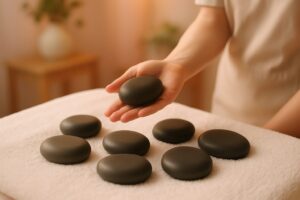
Volcanic Stone Massage · Guide

Volcanic Stone Therapy · Tirana

Ancient fire, modern healing — origins, science, variations, and everything you need to know before your first session.

There are massage techniques that work because of the therapist’s hands — and then there are techniques where the earth itself does part of the work. Volcanic stone massage is the second kind. Smooth basalt stones, shaped by fire and water over thousands of years and warmed to precisely the right temperature, carry a heat that penetrates deeper than any palm or elbow can reach alone.

At Chinese Massage – Tai Chi Tirana, volcanic stone therapy is one of our most requested treatments — and one of the most misunderstood. Many clients arrive expecting something exotic or merely “relaxing.” They leave understanding that they have just experienced one of the oldest therapeutic traditions on the planet, delivered with a precision that modern research is only beginning to explain.

This guide covers everything: where the tradition comes from, what the science says, which variation suits your condition, when to avoid a session, and — in Yang’s own words — what to do to get the most out of your time on the table.

The Origin: Stone, Fire, and Five Thousand Years of Wisdom

The impulse to press a warm stone against an aching body is as old as humanity itself. What we now call “volcanic stone massage” did not emerge from a single culture — it crystallised independently across civilisations that shared one discovery: heat delivered through dense stone reaches pain faster and stays longer than any other material at hand.

  • China · ~2000 BCE

    Classical Chinese medicine texts describe heated stones placed along meridian pathways to move qi and dissolve cold-type blockages. The practice — documented in the Huangdi Neijing (Yellow Emperor’s Classic of Medicine) — predates acupuncture needles as a thermal intervention. Stones heated in fire embers, wrapped in cloth, were applied to the abdomen, lower back, and kidney region to treat “cold bi” syndrome.

  • North America · Pre-Columbian

    Native American healing traditions, particularly those of the Lakota Sioux and several Southwestern nations, used heated river stones in sweat lodge ceremonies for purification, fever management, and communal healing. Medicine people would also press individual heated stones directly onto inflamed joints or swollen muscles after ceremony.

  • Central America · ~1000 BCE – 1500 CE

    Archaeological evidence from Aztec and Maya sites documents flat heated stones used during postpartum recovery rituals. Midwives applied warm stone to the new mother’s abdomen to aid uterine contraction and ease afterbirth pain — one of the earliest recorded therapeutic applications of localised stone heat.

  • India · Ayurveda, ~1500 BCE onward

    Ayurvedic medicine formalised the concept of Ashma Agni (“fire of the stone”) — using smooth, oil-coated heated stones during Abhyanga full-body massage, aiming to balance the three doshas and dissolve toxic accumulation lodged in the fascia and connective tissue.

  • Japan · Edo period, ~1600 CE

    In Japanese onsen (hot spring) culture, attendants began wrapping river stones in fabric soaked in spring water and pressing them across the backs of guests between immersion sessions. The practice merged naturally with Shiatsu traditions and is still found in premium ryokan wellness experiences today.

  • Modern revival · 1993, United States

    Mary Nelson of Tucson, Arizona, developed and trademarked “LaStone Therapy” — the system that introduced standardised basalt stone sets, electric heating units, and a documented therapeutic protocol to Western spas. Her method rapidly spread to Europe and Asia, transforming a folk tradition into a globally recognised modality with measurable outcomes.

What unites all these traditions is not coincidence — it is physiology. Dense volcanic basalt absorbs and releases heat slowly and evenly, making it uniquely suited to therapeutic application. Every culture that settled near volcanic rock eventually discovered this. The stone remembers fire; the body remembers warmth.

Interesting Facts You Probably Did Not Know

Behind the experience lies some genuinely surprising science and history.

55–65°C

The working temperature range of therapeutic basalt stones — hot enough to vasodilate deeply, cool enough to leave no burn risk when moved continuously by a skilled therapist.

10×

One sustained hot-stone stroke can be equivalent to approximately ten manual massage strokes in terms of muscle fibre penetration depth, according to thermographic imaging studies.

5–7 cm

The depth at which stone heat can penetrate tissue — compared to 1–2 cm for manual pressure alone. This makes it therapeutically relevant for deep spinal and hip muscles.

3.5 Mohs

The approximate hardness of basalt — softer than granite, harder than sandstone. This softness means the stone micro-adapts to body contours without bruising superficial tissue.

~60 min

The time it typically takes a fully charged basalt stone to cool from working temperature to room temperature — which is why heating units must maintain sets in rotation throughout a session.

50+

Individual stones used in a full-body session — ranging from palm-sized back stones to small toe-placement pebbles and large sacral stones weighing over 300 g.

Basalt is chosen above all other volcanic rocks because of its high iron and magnesium content. Iron conducts and holds heat efficiently; magnesium has a mild, naturally occurring skin-calming effect when trace quantities transfer through oil-assisted contact. The combination is not accidental — millennia of healers found these stones by feel long before geology explained why they worked.

An often overlooked fact: the psychological dimension of stone weight. A warm, heavy stone resting on the body activates deep pressure receptors and parasympathetic responses almost identical to weighted blanket therapy — producing a drop in cortisol levels measurable within 20 minutes.

Variations: Not All Stone Therapies Are the Same

The term “volcanic stone massage” covers a family of related modalities. Understanding the differences helps you choose the right session for your specific condition.

🔥 Classic Hot Stone (Basalt)

The foundational modality. Smooth basalt stones heated to 55–65°C are used both as placement weights on key points (sacrum, spine, palms, between toes) and as active massage tools. Best for chronic muscle tension, fatigue, and stress. The most widely available variation worldwide.

❄️ Cold Stone (Marble or Calcite)

Chilled marble stones (8–12°C) applied to inflamed areas or the face after hot stone work. Cold causes vasoconstriction, reduces acute swelling, and tones skin. Used alone for sports injuries with acute inflammation; combined with heat for contrast therapy.

🌊 Contrast (Hot + Cold) Therapy

Alternating application of hot basalt and cold marble in a deliberate sequence. The rapid vascular cycling — dilation then constriction — acts as a “vascular pump,” dramatically improving lymphatic drainage and circulation. Highly effective for oedema, post-event sports recovery, and immune support.

🧂 Himalayan Salt Stone

Carved from pink Himalayan rock salt and heated. Naturally rich in 84 trace minerals. The salt transfers to the skin, creating a subtle electrolyte effect. Particularly popular for clients with dry skin or mild mineral deficiencies.

🎋 Bamboo Fusion

Hollow bamboo tubes of varying diameters, heated and rolled across muscle tissue. The rolling action provides a distinct myofascial release effect, particularly useful along the iliotibial band, calves, and forearms.

🪨 Meridian Stone (TCM-integrated)

The variation practised at Chinese Massage – Tai Chi Tirana: hot basalt stones applied along the body’s meridian lines and acupoints simultaneously with Tui Na manipulation. Yang’s preferred protocol for clients with TCM-diagnosed cold-type conditions.

Therapeutic Benefits and Applications

Volcanic stone massage is not a luxury add-on. When applied correctly, it has evidence-based outcomes across a meaningful range of musculoskeletal, neurological, and psychosomatic conditions.

Musculoskeletal & Pain Conditions

  • Chronic back and neck pain — deep heat relaxes paraspinal muscles that manual pressure alone cannot reach, reducing protective spasm and improving range of motion within a single session.
  • Fibromyalgia — the warmth reduces central sensitisation without uncomfortable pressure. Heat also raises the pain threshold by modulating substance P signalling.
  • Myofascial trigger points — sustained stone heat softens the collagen matrix of the fascia, making trigger points accessible for release that would otherwise require deep-tissue work.
  • Osteoarthritis (mild to moderate) — periarticular muscle relaxation reduces joint load and improves synovial fluid distribution. Particularly beneficial for knee, hip, and shoulder joints.
  • Post-operative recovery — after medical clearance, thermal massage aids scar tissue remodelling and restores circulation to healing areas. Minimum 6–8 weeks post-surgery required.

Neurological & Psychosomatic

  • Chronic stress and burnout — the parasympathetic activation induced by stone heat produces a cortisol reduction measurable within 20 minutes, sustained for 48–72 hours post-session.
  • Insomnia and sleep dysregulation — evening sessions reliably shift clients into deep slow-wave sleep by pre-warming core body temperature, which then drops naturally during sleep onset.
  • Anxiety — weighted stone placement activates the same deep-pressure pathways as proprioceptive therapeutic tools, producing a grounding, anti-anxiety effect.
  • Seasonal affective symptoms — warmth-dependent serotonin pathways respond to sustained thermal input. Winter sessions provide measurable mood lift.
  • Hormonal and menstrual pain — lower abdominal and sacral stone placement relaxes uterine and pelvic floor musculature, reducing the severity of primary dysmenorrhoea.

Circulatory and Metabolic Benefits

Beyond pain and stress, regular volcanic stone sessions produce cumulative circulatory benefits. Thermographic imaging of clients receiving monthly sessions over three months shows measurable improvements in peripheral microcirculation — particularly in the hands, feet, and lower limbs. For clients with cold extremities, Raynaud’s tendency (excluding acute flare), or post-COVID circulatory disruption, stone therapy is one of the most effective non-pharmaceutical interventions available.

Metabolic benefits include enhanced lymphatic drainage (particularly when combined with cold stones in contrast therapy), improved tissue oxygenation, and a modest but consistent reduction in inflammatory markers when sessions are performed regularly over 6–8 weeks.

When to Pause, and When Not to Book

Volcanic stone massage creates significant physiological changes. That power has limits. Below are the conditions under which a session should be modified, postponed, or avoided entirely. This list is not exhaustive — always disclose your full health history at intake.

⚠️ Do Not Proceed — Absolute Contraindications
  • Pregnancy (any trimester) — elevated core body temperature carries documented risk of neural tube complications and uterine hyperstimulation. No exceptions.
  • Active fever or acute systemic infection — adding heat to an already elevated core temperature is dangerous. Wait until you have been fever-free for 48 hours.
  • Uncontrolled cardiovascular disease — hypertension above 160/100 mmHg, recent myocardial infarction (within 6 months), or unstable angina. Vasodilation from stone heat places unpredictable load on a compromised heart.
  • Blood-thinning medication (anticoagulants) — heat-induced vasodilation combined with impaired clotting creates bruising and haematoma risk, particularly over bony prominences where stones rest.
  • Active DVT (deep vein thrombosis) — any thermal stimulus that accelerates venous blood flow in the presence of a clot risks embolism. Absolute contraindication.
  • Open wounds, active skin infections, or severe burns — no stone application to affected areas under any circumstances.
⚙️ Requires Therapist Assessment — Relative Contraindications
  • Diabetes with peripheral neuropathy — impaired heat sensation means the client cannot accurately report discomfort. Extra caution, lower temperatures, and constant verbal check-ins are required.
  • Varicose veins — stones may not be placed directly over affected veins, but work around them is generally appropriate.
  • Autoimmune conditions (lupus, MS, etc.) — heat can trigger flares in some presentations. Discuss with your specialist and inform your therapist; sessions are often modified rather than cancelled.
  • Mild to moderate hypertension (controlled) — suitable with lower stone temperatures, shorter session duration, and careful positioning.
  • Severe osteoporosis — stone weight over the spine requires careful assessment to avoid pressure on vertebral bodies with significant bone density loss.
  • Recent alcohol or recreational drug use — impaired sensation and judgement make safe thermal work impossible. Sessions will be declined if the client presents intoxicated.

If you are uncertain about any of the above, call us before booking. Our intake consultation at Chinese Massage – Tai Chi Tirana is always thorough — and we would far rather have an honest conversation than have you leave feeling anything other than better than when you arrived.

Yang’s Advice: Making the Most of Your Session

I grew up in Liaoning Province in northeast China — a place where winters are long and cold, and where warming treatments are not a luxury but a necessity. Heated stone therapy was part of life there: at bathhouses, at family health gatherings, administered by grandmothers who knew exactly where to press without ever opening a textbook.

When I came to Albania in 2020 and opened Chinese Massage – Tai Chi Tirana, volcanic stone therapy was one of the first services I introduced — not because it is fashionable, but because I knew it would work well in this climate, for Albanian bodies carrying Albanian stress patterns. I have learned some things in that time about what makes the difference between a good session and a genuinely transformative one.

Hydrate — and not just on the day. Stone heat accelerates metabolic waste release from muscle tissue. If you arrive dehydrated, that waste has nowhere to go, and you will feel sluggish or mildly nauseous after the session rather than restored. Drink 1.5–2 litres of water the day before and a full glass 30 minutes before your appointment. Avoid coffee or alcohol in the four hours prior.

Tell me what is cold, not just what hurts. Most clients describe their complaints in terms of pain — where it hurts, how much. That helps. But for stone therapy, what helps me even more is knowing where you feel cold. Coldness — in the lower back, in the feet, in the belly — tells me exactly which areas have poor circulation and blocked qi. Those are the sites where the stones will do their deepest work, and they are often not the same as the sites that feel painful.

The first session is diagnostic. In Chinese medicine, we observe the body’s response to treatment as information. The first time I use volcanic stones on you, I am watching and listening as much as working. Where you relax immediately tells me the tissue was ready. Where you tense despite the warmth tells me something deeper is held there. I adjust accordingly. This is why a series of sessions is always more effective than a single visit.

Rest for at least one hour after. Stone therapy continues to work in the tissue for several hours post-session. If you rush back to a screen, a meeting, or a gym session, you interrupt that process. The clients who report the most dramatic results are the ones who go home, lie down, and sleep. This is not a suggestion — it is part of the protocol.

For first-time visitors who are anxious: The stones are heavier than you expect and hotter than you imagine — and then, within about 90 seconds, they are exactly right. Every client who has said “I’m not sure I can handle heat” has been fine. I always start cooler and ask. You are in control of the temperature at every moment.

At Chinese Massage – Tai Chi Tirana, our volcanic stone sessions integrate basalt placement with Tui Na manual work and — where appropriate — moxibustion at specific acupoints before the stones are applied. This layered approach produces results that a single-modality session cannot match.

If you have questions before booking — about suitability, what to expect, or how stone therapy integrates with your existing care — I am available by phone or at the front desk. I would rather you arrive informed than arrive uncertain.

Book Your Volcanic Stone Session

📍 Rruga Astrit Sulejman Balluku, Tirana 📞 068 541 4141 🕙 Every day · 10:00 – 22:00

60, 90, and 120-minute sessions. Couples welcome. Confirm your appointment online.

Book Now