Volcanic Stone for Fibromyalgia: A Story That Took Eight

Alma came to me in the spring after spending the winter unable to leave her apartment for more than short errands. She was forty-four. She had been diagnosed with fibromyalgia six years earlier, after a process of medical investigation that had taken nearly three years and had cost her — financially and emotionally — far more than the diagnosis was worth. By the time she had a name for what was happening to her body, she had stopped trusting that any name would help.

She had tried the standard medications: pregabalin, duloxetine, low-dose amitriptyline. They had taken some edge off the pain at the cost of side effects she found difficult to live with. She had tried physiotherapy, which had been worse than nothing — the standard graded-exercise protocol had triggered week-long flares each time the dose was increased. She had tried cognitive behavioural therapy, which had helped her cope but had not changed the underlying experience. She had tried alternative medicine practitioners of various qualifications, with results that ranged from neutral to mildly harmful.

When she sat across from me at the intake conversation, she was not optimistic. She had been told by a friend that volcanic stone work had helped her cousin’s fibromyalgia, and she had decided to try it more out of a sense that she should keep trying things than out of any real expectation.

I told her, honestly, that fibromyalgia is one of the harder conditions to treat with any intervention, that I had clients who had benefited substantially from volcanic stone work and clients who had not, and that we would need to do at least four sessions before we could meaningfully assess whether this approach was going to help her. If it was not, we would stop.

She agreed. We began.

What I have come to understand about fibromyalgia

Fibromyalgia is a condition I have spent a lot of time trying to understand, because I see clients with it often and the experience they describe is real and difficult. From what I have read, and from what doctors I trust have told me, the picture is roughly this. Patients have widespread pain — usually lasting more than a year and a half, across many parts of the body — together with fatigue, broken sleep, a foggy quality of thinking, and often other complaints like sensitive digestion, sensitivity to sound or light, and frequent headaches. The pattern is recognisable but the cause is not simple.

For a long time, doctors went back and forth on whether the condition was psychological or physical. The current understanding, as I have come across it, is that fibromyalgia is about how the nervous system processes pain signals, rather than about damage in any one part of the body. The pain is real. It is not imagined. But the source of it is in how the brain and spinal cord are reading signals from the body, rather than in any tear or inflammation that an MRI could photograph.

This way of understanding fibromyalgia matters for treatment. Pushing harder on the body — deep pressure, forceful stretching, anything aggressive — tends not to help and can make things worse. What seems to help, in the clients I have seen, is whatever calms the nervous system down: gentle bodywork, careful breathing, certain medicines (for the doctor to decide), and exercise dosed very slowly. Pushing through pain is not the path.

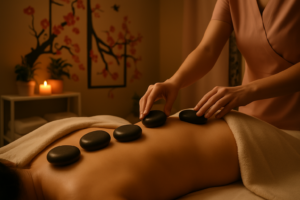
Volcanic stone therapy, in clients who respond well to it, seems to work as one of the calming approaches. The heat is deeply soothing without needing pressure. The session is a long quiet stretch of rest in a state the nervous system has often forgotten. Across several sessions, the body’s baseline of alarm seems to come down. (For readers new to the stone-therapy tradition more generally, I have a longer foundational piece, the volcanic stone massage guide, that covers origin, variations, and contraindications.)

Why stone work specifically, and not other massage

Several characteristics of stone work make it particularly suited to fibromyalgia, compared to other massage modalities.

First, the pressure can be light without losing therapeutic effect. The heat itself does much of the work. A skilled stone therapist can produce significant tissue change with pressure that would be insufficient in any other massage modality. For fibromyalgia patients, who often cannot tolerate moderate to deep pressure, this is essential.

Second, the heat penetrates deeply without requiring deep mechanical pressure. The therapeutic warmth reaches the deep paraspinal muscles, the periarticular tissues, and the small joint capsules without the therapist needing to apply force to those structures. This is the opposite of the “deep tissue” approach, and for fibromyalgia patients it is much more useful.

Third, the predictability of the experience helps the nervous system settle. Fibromyalgia patients often have hypervigilant nervous systems that scan continuously for the next painful input. The slow, predictable rhythm of stone work allows the nervous system to lower its guard. This effect is amplified across multiple sessions as the body learns that this particular treatment is reliably safe.

Fourth, the sustained warm-weighted contact of placement stones (on the sacrum, between the shoulders, in the palms) produces a deep proprioceptive grounding effect that fibromyalgia patients often report as profoundly relieving. The experience of feeling consistently safe and supported in their own body is, for many, rare and valuable.

The first four sessions

The first session with Alma was deliberately conservative. I used cooler stones than my usual setting — 54 degrees Celsius rather than 58 — and a lighter pressure than standard. The session was 90 minutes. We talked very little. I watched her body carefully throughout.

She had what I would describe as a “guarded” response in the first 30 minutes. Her shoulders did not fully drop. Her breathing remained shallow. She was, I could tell, holding herself slightly braced against the possibility that the work might hurt her — even though it was not hurting her. This is common in fibromyalgia patients in their first session. Their nervous system has been amplifying pain for so long that any new input is treated as a potential threat.

By the 45-minute mark, the bracing began to release. Her breathing deepened. The small muscles around her eyes softened. By the end of the session, she was visibly more relaxed than she had been at intake.

She called me the next day to say that she had slept the night before — seven continuous hours, for the first time in many months. The pain levels had been similar to her baseline, but the sleep had been transformative.

The second session, two weeks later, followed the same protocol with slight refinements. The bracing in the first 30 minutes was less. By the end of the session, she was lightly asleep.

The third session, the deeper integration began. I added gentle work on the cranium and face at the end of the session. Alma reported afterwards that she felt “lighter” in a way she could not specifically describe.

The fourth session was the inflection point. She arrived saying that the week between the third and fourth sessions had been the first week in years where she had not had a significant pain flare. The baseline was still present, but the amplifications had not happened.

This is the point at which I told her that I thought we should continue.

The next four sessions, and what changed

Sessions five through eight were spaced at two-week intervals, then three-week intervals. The work itself did not change dramatically; the protocol had been refined to what was working, and we continued in that direction.

What changed was Alma’s life around the sessions.

She began sleeping more reliably. The improvement was gradual but steady. By the seventh session, she was averaging six to seven hours of continuous sleep most nights.

Her pain levels reduced. Not eliminated — fibromyalgia rarely fully resolves — but the baseline shifted downward. She reported being able to do household tasks without then needing to lie down for the rest of the day. She began walking, slowly and not for long, in her neighbourhood.

The “fibro fog” lifted somewhat. She was able to read books again, which she had not done meaningfully for several years.

She began coming with her own questions about her body rather than the resigned posture of accepting whatever I might say. This shift — from passive recipient to active participant in her own care — is one of the most important markers of progress in fibromyalgia treatment.

By the eighth session, three months after we had begun, Alma was a different person from the woman who had walked into my office in March. The fibromyalgia had not gone away. But she had a life again.

Mamica Kastrioti’s kind of work

I think often, when working with fibromyalgia patients, of Mamica Kastrioti — Skanderbeg’s sister, whose composure under sustained difficulty is one of the qualities I find most admirable in Albanian historical figures. She held what she held without making noise about it. She did not break. She did not become bitter. She continued, in her own way, with the work that was hers to do.

Fibromyalgia patients carry something similar. The pain is constant. The fatigue is constant. The social misunderstanding — the family members and colleagues who do not believe the condition is real, who think it is exaggeration, who suggest you simply need to try harder — is often as exhausting as the physical symptoms. The patients who manage this with grace do so because they have developed a particular quiet strength that does not advertise itself.

Part of what I want this work to offer them is recognition. Recognition that what they are experiencing is real. Recognition that their endurance is honourable. Recognition that something can be done, slowly and carefully, that will reduce the load they are carrying.

The volcanic stones, in this work, are partly the tool and partly the gesture. The warmth they deliver is the warmth the body needs. The slowness of the session is the pace at which fibromyalgia must be addressed. The predictability of the protocol is what the hypervigilant nervous system can finally trust.

A note for fibromyalgia patients considering this

If you have fibromyalgia and have not yet tried volcanic stone therapy, here is what I would suggest:

Find a practitioner experienced with chronic pain conditions, not just any massage therapist. The work needs to be lighter, slower, and more carefully monitored than standard volcanic stone protocols.

Commit to at least four sessions, ideally six, before deciding whether it is helping. The cumulative effect builds; the first session often produces only modest changes.

Be honest with the practitioner about your pain levels, your medications, your other treatments, and any flares you have had recently. Adjustments to the protocol depend on accurate information.

If a session produces a worsening of symptoms for more than a day, communicate this. The pressure or temperature was too much. The next session should be adjusted.

Realistic expectation: meaningful reduction in pain, fatigue, and sleep disturbance, sustained across the weeks between sessions, with cumulative improvement across a course of treatment. Not a cure. Not the elimination of fibromyalgia. But a substantial improvement in daily life.

For Alma, after eight sessions, that has been enough. She continues to come for maintenance once every six weeks. She has built a life around her condition that allows her to do most of what she wants to do. The fibromyalgia is part of her, still. But it is no longer the entirety of her.

This is the work, in this kind of case. It is patient. The results are slow. They are also real.


Yang Wang practises Chinese medicine at Chinese Massage – Tai Chi Tirana. Names in client stories have been changed.
Tui Na or Sports Massage — Why It Is Not the Same Question

A young man came in last winter — late twenties, runs three times a week along Liqeni Artificial, had finished a half-marathon in Durrës a month earlier and was preparing for a longer race in Vlora in the spring. His right calf had a hard knot the size of a chicken egg above the soleus. He had been to two sports massage therapists in Tirana. Both had worked the knot directly with thumb pressure for about thirty minutes. Both times the knot was softer for a day and then came back, harder.

“My physio in Bologna,” he said — he had played football in Italy in his early twenties — “always told me deep tissue, deep tissue. The harder the better.”

I asked him whether it had ever fully solved the problem.

“No. But it always felt like it should.”

Most of us here keep one universal first prescription for any ache: do të kalojë — it’ll pass. Often it does. A calf that has been knotted for eight months has simply stopped listening. This is one of the most useful conversations I have in the parlour, and I have it twice a week. The Western reflex — when a muscle is tight, press it hard — is so deeply built into our cultural imagination of what massage is that even experienced therapists do not question it. But it is not the only way the body responds to skilled touch. And on certain presentations, it is not even the best way.

Two traditions, two definitions of “deep”

Tui Na and Western sports massage share a vocabulary they do not always share a meaning for. The word “deep” is the clearest example.

In sports massage, deep means deep pressure: a high vertical force applied through the thumb, elbow, or forearm into the muscle belly. The intention is to mechanically disrupt adhesions in the soft tissue, to break up scar tissue, to physically push through fascial restrictions. It is a force-based intervention. It works, sometimes spectacularly, on certain conditions — particularly acute athletic overuse with localised trigger points.

In Tui Na, deep means deep reach: an intervention that influences not just the muscle being touched but the tissue and structures three or four layers under it. The pressure required to do this is often surprisingly modest. The technique relies on direction, rhythm, the manipulation of fascia in coordinated planes, and a precise understanding of where one muscle’s tension is being held by another muscle’s compensation. A skilled Tui Na practitioner can produce significant tissue change at one-third the apparent pressure a sports therapist would use — because the work is finding the right vector, not the most force.

Both are deep. They mean different things. (For a similar comparison between Tui Na and the Japanese tradition, I have a separate piece on Shiatsu versus Chinese Tui Na — same family of confusion, different details.)

What sports medicine seems to be discovering

I keep an eye, in a casual way, on how Western sports medicine talks about manual therapy, because clients ask me about it. Something I have noticed: the conversation has been quietly shifting over the last decade or so. The picture I get is that the old “deep tissue, the deeper the better” idea is being questioned by people who used to teach it.

For an acute injury in the first few days, both traditions agree — no aggressive pressure. The body is busy and should be left alone.

For an injury that is a few weeks old but not chronic, the newer thinking, as I have come across it in articles and in conversation with physiotherapists, is that lower-force, sustained, well-aimed work usually does more than high-force pressure. Less force, applied in the right direction, gets further.

For chronic compensatory patterns — the kind of complaint that brought the runner to my table — the gap is even wider, at least in what I have read. High-force work on a chronically tight calf releases it for a day. The same calf, addressed through the antagonist muscles, the upstream fascial chain, and the opposite hip, stays released for weeks. The body has a kind of memory. Releasing the wrong place over and over teaches it that the tightness is structural and that it should hold on harder.

I find this satisfying because it lines up with what Tui Na has been doing for a long time without anyone needing to confirm it. We are politely pleased that the newer conversation is arriving at a similar place.

The runner’s calf, in practice

What happened on the table with the young runner from Bologna was almost boring to describe. We did not touch the knot at all in the first session. We worked the contralateral hip — the left side — because his right calf was carrying tension from a slightly weaker left gluteus medius. We worked his right hamstring origin under the gluteal fold. We worked the soleus’s attachment behind the knee, not the belly of it.

He left the session sceptical. He said politely that he would come back, but he was not sure.

Three days later he ran his usual ten kilometres along the lake. The knot — he reported by phone the next morning — was, for the first time in eight months, not where it had been. It had not disappeared. It had migrated to a different position, about four centimetres lower, much smaller.

This is what therapists who do this work mean when they say “the body is talking.” The original knot had been guarding something. When the guarding became unnecessary, the tissue rearranged itself.

We had six sessions. By the third, the knot was gone. By the sixth, he had stopped favouring the right leg in his stride.

He ran the Vlora half-marathon four months later. Personal best.

Why this matters for anyone who is not an athlete

The question is rarely “Tui Na or sports massage?” It is “What is the body actually trying to tell me?”

If the answer is “I have just sprained an ankle and there is acute swelling” — neither modality. Rest, ice, elevation, and a physiotherapist for graded loading.

If the answer is “I have an acute one-spot pain after a single identifiable event, in a young healthy body” — sports massage is often the cleaner intervention. Find a good practitioner; the work is specific and effective.

If the answer is “I have had pain for months and it moves around, or it always comes back to the same place, or it changes character with stress” — this is where Tui Na earns its reputation. The work is slower, less dramatic, and far more likely to resolve the underlying compensation.

If the answer is “I am stressed, exhausted, my whole back feels tight and I do not have one specific complaint” — this is also Tui Na territory, though it overlaps with relaxation massage and the right answer often involves both.

My grandmother’s shelf in Liaoning

There is an image I keep returning to that captures the difference better than the science does.

My grandmother in Liaoning kept a row of small jars on a shelf in the kitchen. Each jar held a dried herb. When someone in the family had a complaint, she would mix three or four of the herbs into hot water and watch you drink it. She did not say much about what she was doing. She had been doing it for forty years, and she had never once measured anything.

She was not choosing the strongest herb. She was choosing the right one for the person in front of her — sometimes one thing, sometimes another, depending on the day. That is the habit I carry to the table. She did not know that what she did would be studied and explained centuries later. She simply paid attention to the body and to what helped.

Tui Na works the same way. So does sports massage, at its best. The question is not which tradition is correct. The question is which one is doing the right work for the body in front of it.

In the parlour, we ask that question every time. The answer is sometimes one thing, sometimes the other, sometimes both, sometimes neither — and the table waits patiently while we work it out.


Yang Wang practises Tui Na and acupuncture at Chinese Massage – Tai Chi Tirana.

The Stubborn Hip: A Story of Six Tuesdays

Drita came in on a Tuesday in late September, the kind of afternoon when the heat had finally let go of Tirana and the air had a thin clean edge to it. She walked carefully. Not limping, not yet — but you could see her right hip carrying her in a way the left one wasn’t. She had a folder under her arm with two X-rays and a printout from a private practice in Pristina. She apologised for the folder before she sat down.

“Sorry. Doctors like papers.”

I told her the papers could wait. I asked her how she’d come up the stairs.

Three years of waiting for a miracle

Drita was sixty-one. She had been a school administrator for thirty-four years and was now two years from retirement. Her hip had started bothering her in the autumn of 2023 — a small ache after long days, dismissed as ordinary tiredness. By spring of 2024 the ache had moved closer to the surface and stayed there. By the time she came to see me, three years had passed.

In those three years she had seen, by her count: two general practitioners, an orthopaedic surgeon, a physiotherapist in Tirana, another physiotherapist in Pristina, a chiropractor in Skopje recommended by a cousin, and a reflexologist in Durrës who had told her the hip was a manifestation of unresolved family conflict. She had taken ibuprofen, naproxen, paracetamol, two short courses of celecoxib, magnesium, vitamin D, and a turmeric tincture from a herbalist in Korça. She had been told she needed surgery and she had been told she absolutely did not need surgery. She had been told to walk more, walk less, swim, not swim, and lose two kilograms.

By the time she sat across from me, what she wanted was not a miracle. What she wanted was someone to tell her honestly what they could and could not do for her.

What the body said when the papers were quiet

The X-rays showed what most hips that age show: mild osteoarthritic changes, joint space slightly narrower on the right than the left, no surgical indication. Nothing dramatic. Nothing that explained three years of progressive pain.

I asked her to lie on her back on the table without doing anything special — just settle. I watched her for about a minute before I touched her at all. The right leg was rotated outward by maybe fifteen degrees more than the left. The right ilium was sitting slightly higher. When I asked her to flex her right knee toward her chest, the range was halved compared to the left, and the stop point came not from the hip joint but from the gluteus medius — the small fan-shaped muscle that runs from the side of the pelvis to the top of the femur — which had become guarded and brittle from three years of compensating.

The hip itself was probably fine. The structure around it had quietly seized up.

This is the part where someone with a longer training might explain at length. In therapeutic Tui Na we have a shorthand for this kind of presentation — what classical texts call cold-damp obstruction in the lesser yang. The translation is not important. What my hands found was straightforward: muscles that have been holding still for too long, fibres that have lost their elasticity, fascia that has begun to behave like dried leather. (Readers whose hip pain travels down into the back may want to look at the related piece on therapeutic massage for back pain as well.)

The treatment is patient.

Mamica’s kind of patience

There is an Albanian word that does not have a direct equivalent in Chinese, though our culture has something close: the patience of someone who weathers a long winter without complaining about the snow. Mamica Kastrioti — Skanderbeg’s sister — had this quality. She is not in the schoolbooks the way her brother is. She moved through the resistance not with force but with composure, holding what she held without making noise about it. The body of a woman in her sixties who has worked the same job for thirty-four years has this kind of dignity built into it. It will not be rushed.

I told Drita the first session was for finding things. Mapping. No promises of dramatic change. She nodded. She did not want dramatic change. She had been promised dramatic change five times.

The protocol — slow, in three layers

We agreed on six weekly sessions, Tuesdays at four in the afternoon. The protocol was the unremarkable Tui Na sequence for chronic gluteal and trochanteric work, layered:

In the first two sessions, all the work was around the hip, not on it. We released the lower lumbar paraspinals on the right side, the quadratus lumborum, the iliopsoas through the abdomen (a manoeuvre many therapists skip because it is awkward to teach, but which makes the difference for these cases), and the lateral thigh fascia down to the knee. The hip itself was barely touched.

In the third and fourth sessions, we began direct work on the gluteus medius and the small external rotators — piriformis, quadratus femoris, the obturators. By the fourth session, Drita could bring her right knee to her chest at the same range as her left, which she had not been able to do for fourteen months.

In the fifth and sixth sessions, we worked the joint capsule with traction-and-release techniques, restored the rotation of the femoral head in the socket, and integrated the new range of motion with simple movement re-education — gentle leg circles on the table, then standing.

What she said on the seventh Tuesday

By the seventh Tuesday — which we had not originally planned, but which she came in for anyway — Drita walked up the stairs without holding the rail. She had not done that since 2024. She set the folder of X-rays down on the chair, and she laughed at it.

“All those papers, and what worked was an hour a week with someone who didn’t read them.”

I told her I had read them, on the second Tuesday, while she was on the table. They confirmed that what we were doing was safe. They did not explain her pain, because her pain had moved out of the joint and into the muscles around it, and X-rays do not photograph muscles.

She has been a regular for fourteen months now. We see her once a month — sometimes a maintenance session, sometimes she has overdone a weekend in Pogradec and needs the hip released again. She drives up from her village forty minutes away. We talk about her grandchildren, the school where she still works two days a week as a consultant, the way the seasons keep changing.

What I learned from her, not the other way around

There is a thing therapists do not often say: every patient teaches the therapist something. Drita taught me how much can be done with how little, if both sides agree on a time horizon. Six Tuesdays is not a long time when you have already waited three years. The body knows how to repair itself when its surroundings are made quiet enough. Our job is mostly to make the surroundings quiet.

When we said six sessions, we meant six. We did not stretch them to ten because we wanted to. We did not cut to four because she felt better at three. We made an agreement and we kept it. Besa, in its modern sense: a word given and honoured.

That is the work, mostly.


Yang Wang practises therapeutic massage and acupuncture at Chinese Massage – Tai Chi Tirana. Names in this story have been changed to protect client privacy; the sequence of sessions is described as it happened.