Mira had been told that her frozen shoulder would either resolve on its own in two years, or not. She was eighteen months into the two years when she came to see me. She could no longer reach behind her back to fasten a bra. She could not lift her right arm above shoulder height. She had stopped wearing the watch her late husband had given her because she could not work the clasp.
She was fifty-three. She had been a nurse for thirty-one years, recently retired, and the irony of being a healthcare professional whose own body was failing in a way no medical intervention was solving was not lost on her. She had been to a physiotherapist twice weekly for nine months. She had received two corticosteroid injections into the shoulder joint. She had done all the exercises. She had been told that frozen shoulder follows its own timeline and that patience is the main treatment.
“I do not have a problem with patience,” she told me. “I have a problem with the dressing of myself.”
I told her that what she had described — capsulite rétractile, adhesive capsulitis, frozen shoulder — was one of the more frustrating conditions in medicine because the conventional treatments only partially work, and the natural history is genuinely long. But I also told her there was a particular sequence of cupping and gua sha interventions that often shortens the timeline considerably, particularly when combined with the work she was already doing in physiotherapy. We could try it for six sessions and see.
She agreed. The shoulder, after all, had nothing to lose.
What frozen shoulder actually is
The shoulder joint is the most mobile joint in the body. This mobility comes from a complex arrangement of muscles, tendons, and a thin capsule of connective tissue that surrounds the ball-and-socket joint itself. In a healthy shoulder, this capsule is loose enough to allow the wide range of arm motion that characterises human movement.
In frozen shoulder, for reasons that are still incompletely understood, this capsule thickens, becomes inflamed, and shrinks. Movements that should be effortless become impossible. The condition typically progresses through three stages: the painful “freezing” stage (when the capsule is actively inflaming and the shoulder hurts intensely), the “frozen” stage (when the pain decreases but the stiffness remains and reaches its peak), and the “thawing” stage (when the capsule slowly relaxes and motion returns).
The whole process, untreated, lasts between eighteen months and three years. Two-thirds of patients recover full motion. The other third are left with some permanent restriction.
The conditions that predispose to frozen shoulder are reasonably well-known: diabetes, thyroid dysfunction, immobility after another shoulder injury, hormonal changes around menopause, and a previously underappreciated factor — chronic generalised inflammation. But the precise trigger in any given case is usually not identifiable.
Why cupping is particularly useful for this condition
The capsule of the shoulder joint is not directly accessible to manual therapy in the way more superficial structures are. It sits deep, under multiple layers of muscle. Direct manipulation requires either surgery (capsular release) or an injection.
But the surrounding tissue — the deltoid, the rotator cuff muscles, the upper trapezius, the muscles around the scapula — is accessible, and the state of this surrounding tissue significantly affects the capsule. When the surrounding muscles are tight, congested, and inflamed, they pull on the capsule, restrict its blood supply, and prolong its inflammatory state. When the surrounding tissue is supple, well-circulated, and properly hydrated, the capsule can resolve its own inflammation more quickly.
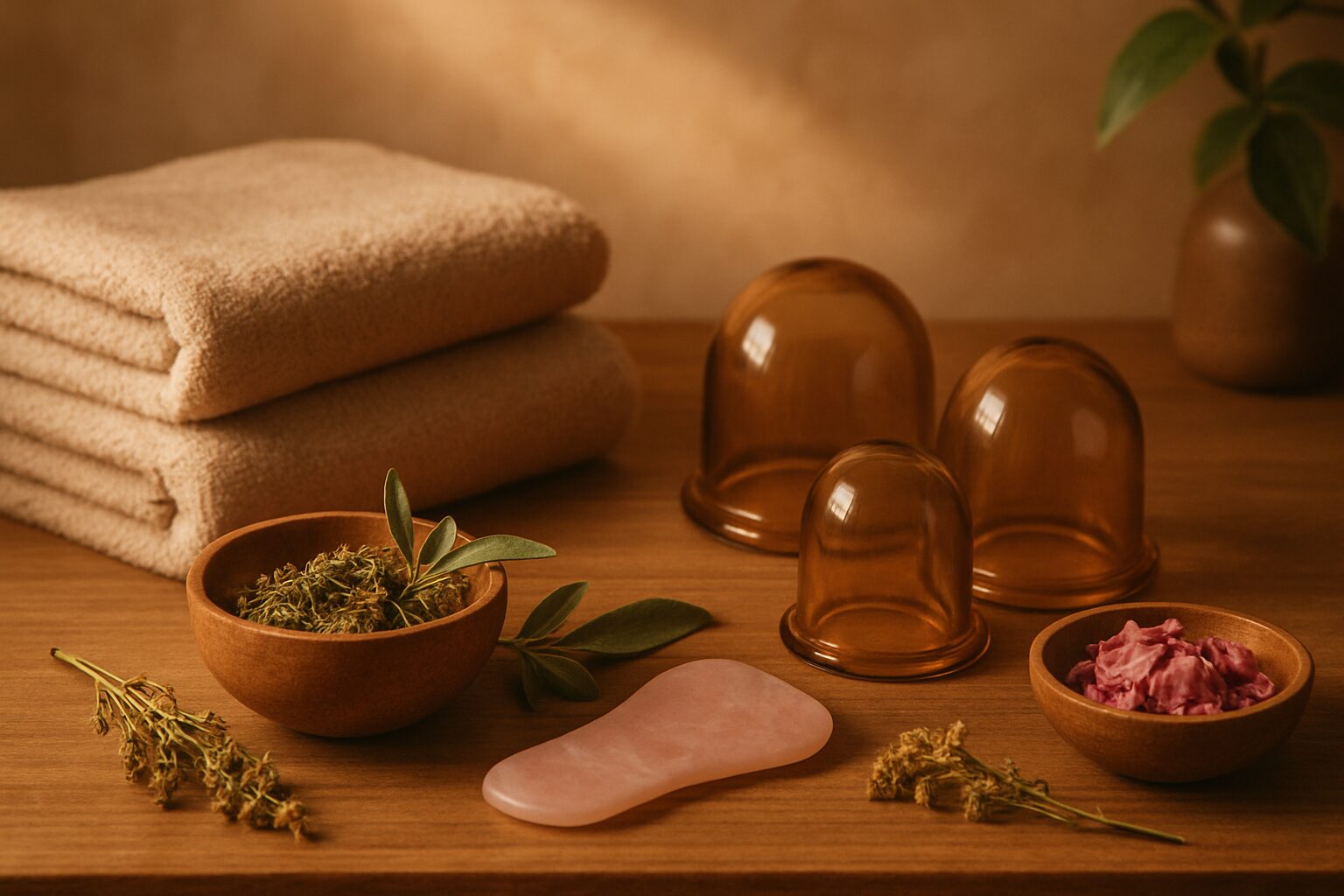
This is where cupping becomes particularly useful. The negative pressure of the cups, applied systematically to the shoulder region, accomplishes several things at once.
First, it produces a pronounced increase in local blood flow that lasts not just for the duration of the treatment but for several days afterwards. This brings inflammation-clearing immune cells and oxygenated blood to the area in a way that ordinary massage cannot match.
Second, it lifts the fascial layers — the thin sheets of connective tissue that hold the muscle groups in their relative positions. In a frozen shoulder, these layers tend to become adhesive to each other, gluing the structures together in ways that restrict motion. The vertical lift of a cup mechanically separates these layers in a way that thumb pressure cannot replicate.
Third — and this is the part most clients find surprising — it seems to quieten the underlying inflammation in the whole shoulder region, including the deep capsule itself. I do not pretend to understand the exact mechanism. What I see in practice is consistent: cupping sessions on the shoulder, performed weekly, seem to shorten how long the frozen shoulder takes to resolve, sometimes by months. (I have an earlier piece, Suela’s acupuncture story for shoulder pain, describing the same complaint approached through needles instead of cups.)
The protocol I used with Mira
We did six sessions across eight weeks. Each session included cupping on the affected shoulder and the surrounding regions, with the cups left in place for ten to twelve minutes; gua sha along specific muscle attachments around the scapula; and at the end of each session, fifteen minutes of acupuncture on points distant from the shoulder, designed to address the underlying inflammatory pattern.
We did not work the shoulder joint directly, in the sense of forcing motion. The mistake that prolongs frozen shoulder is the assumption that aggressive stretching helps. It does not. The capsule responds to aggressive stretching by inflaming further. The work in our parlour was about creating the conditions in which the capsule could relax on its own — and trusting that it would, once those conditions were established.
Between sessions, Mira continued her physiotherapy. Her physiotherapist was excellent and the exercises she was doing were appropriate. What we added was the regulatory work on the surrounding tissue that physiotherapy alone could not produce.
The arc of recovery
First session: no immediate change in motion. Significant cupping marks on the shoulder, fading over five days. Mira reported that the pain at night — which had been waking her — was reduced for the first two nights after the session, then returned.
Second session: night pain reduction persisted longer, about four nights. Range of motion still essentially unchanged.
Third session: small but noticeable change. Mira reported that she could reach about two centimetres higher behind her back than the previous week, which had not happened in months.
Fourth and fifth sessions: more consistent gains. Pain at night reduced significantly. Range of motion increasing about two to three centimetres each week.
Sixth session: substantial change. Mira could reach behind her back to the level of her bra strap (she could not fasten it yet, but she could reach it). She could lift her arm to shoulder height. She had begun to wear her watch again, fastening it with assistance.
We stopped formal treatment at six sessions. She continued physiotherapy. She returned for a maintenance session at three months. By then she had full range of motion. The shoulder had completed its thawing about six months earlier than her physiotherapist had originally estimated.
A patience that Skanderbeg would have understood
There is a quality the body needs from someone with frozen shoulder, and that someone is rarely the patient themselves. The condition tests the patient’s patience constantly. The pain is real, the disability is real, the timeline is real, and the temptation to either give up or push too hard is constant.
I sometimes mention to clients with frozen shoulder that the historical figure who comes to mind for me is Skanderbeg — not for the obvious reason of perseverance, but for a specific quality of his resistance: he did not waste his strength on every confrontation. He chose which battles to fight and which positions to hold and which to yield strategically. The frozen shoulder responds to the same kind of selective patience. Aggressive intervention loses ground. Quiet, sustained, well-chosen intervention wins.
Mira called me about a year after we finished her course of treatment. She wanted to tell me she had bought a new dress with a back zipper, and she had fastened it herself.
This is the part of the work I love most. The slow returns, the quiet phone calls, the things people can do again that they had stopped expecting to do.
When to consider this approach
If you have frozen shoulder — confirmed by your doctor, ideally with imaging to rule out other causes — and you have been progressing slowly with conventional treatment, a course of cupping and gua sha is worth considering. The treatment is most useful in the late freezing phase and the frozen phase; it appears to be less useful in the early acute phase (when the inflammation is at its peak and any additional stimulation is unwelcome) and unnecessary in the late thawing phase (when the condition is already resolving on its own).
A typical course is six sessions across six to eight weeks. About three-quarters of my clients with this condition see meaningful improvement in this timeframe. The other quarter need a different approach or a longer treatment course.
The work does not replace physiotherapy. It complements it. The two together are, in my experience, dramatically more effective than either alone.
Yang Wang practises Chinese medicine at Chinese Massage – Tai Chi Tirana. The parlour is in central Tirana, a short walk from Bulevardi Myslym Shyri. Names in client stories have been changed.
Ready to Feel the Difference?
Book your session today — same-day appointments available.
Book Your Session