Gua Sha for Migraine — Where Hands Often Fail

There is a kind of headache that responds beautifully to a thumb pressed firmly into the trapezius at the base of the skull. Most office workers know this point intuitively — the moment of relief when someone with strong hands works that exact knot, the sense that something has loosened that was about to ruin the afternoon. This works because the headache in question is a tension-type headache, and tension-type headaches respond to mechanical pressure on the muscles whose tightness is generating them.

But there is another kind of headache — and many people who think they have tension headaches actually have this one — that does not respond to thumb pressure at all. In fact, deep pressure on the upper neck can make it worse. This second kind of headache responds to gua sha, the scraping technique, in a way that has surprised many of my clients. It took me a long time to understand why; what follows is the picture I have come to, in plain language.

If you have ever had a headache that started at the base of the skull and crept forward over the top of the head, with a quality that was more “throbbing-pressure” than “tight-band,” and which got worse rather than better when someone tried to massage it — this piece is about why, and what to do instead. (For the same condition approached through needles rather than scraping, see the earlier migraine-relief acupuncture story.)

The two headaches that look the same

The tension-type headache and the cervicogenic migraine are often confused because they begin in similar places. Both start in the upper neck or base of the skull. Both can radiate forward. Both feel, to the person experiencing them, like “neck causing head.”

But they are different things, with different sources.

A tension-type headache comes from muscles in the neck and the head holding on for too long. The squeezing reduces the blood flow to the muscles themselves, the muscles get tired and irritated, and the irritation becomes pain. The feeling is steady, often “a tight band.” It responds to anything that relaxes the muscles: heat, gentle massage, careful stretching.

The other kind — what TCM teachers in my training called a “wind in the neck” headache, and what some Western doctors I have read call a “neck-origin” or “cervicogenic” migraine — comes from irritation of the small nerves in the upper neck. These nerves and the nerves of the face share part of the same pathway in the brain. When the neck nerves are angry, the brain often reads the signal as pain in the forehead and around the eyes. The feeling is more throbbing than tight, sometimes one-sided, sometimes with sensitivity to light or sound or with a little nausea — closer to a migraine, even though the source is in the neck.

The reason pressing the upper neck often makes this kind of headache worse is that the pressure adds irritation where the nerves are already irritated. The therapist is trying to release the muscle, but the muscle is not the real source. The muscle is holding on because the nerve beneath it is angry, and pressing harder makes the nerve angrier.

What gua sha does differently

Gua sha — the technique of scraping the skin with a smooth-edged tool after oiling — works on the body at a quite different level than direct pressure.

When applied to the upper neck and base of the skull, gua sha seems to do several useful things for this kind of headache.

It moves the fluid and blood in the surface layer of the skin and the soft tissue just under it, where things have often become quietly congested. The scraping clears this layer in a way nothing else really does.

It produces a strong but brief sensation — the warm scraping feeling — that the nervous system has to attend to. While it is attending to that, it cannot also amplify the background pain it has been amplifying. This is the same reason a hot shower briefly helps a headache: the nervous system has only so much attention to give.

It cools the tissue afterwards (the warmth of the scraping is followed, in the next minutes, by a slight cooling as the small capillaries settle), and the cooling seems to quieten the nerves further.

All of this happens without any pressure on the inflamed nerves themselves. The work is done on the layer above. That, I think, is why gua sha often helps where direct massage on the neck does not.

This is why gua sha often succeeds where massage fails on this kind of headache. The intervention is gentle in the right place rather than firm in the wrong place.

The protocol I use

For clients with suspected cervicogenic migraine — usually identified through a detailed history-taking that distinguishes their headache pattern from ordinary tension-type — the gua sha protocol is straightforward but specific.

The client lies on their stomach, with the neck and upper back exposed. A small amount of oil — usually a base of jojoba with a few drops of Mentha haplocalyx (Chinese field mint) — is applied to the area.

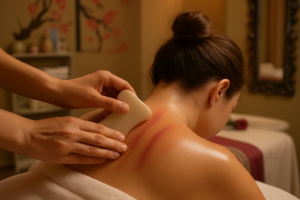
I use a porcelain spoon with a smoothed edge (a traditional gua sha tool that I have used for years and that fits the contours of my hand well). The strokes begin at the very base of the skull, moving downward, with moderate but not heavy pressure. The strokes follow the path of the bladder meridian along the spine, then move laterally to follow the trapezius along its upper border.

The treatment area extends from the occipital ridge down to the upper edge of the shoulder blades, and outward to about the level of the acromion (the bony point at the top of the shoulder). The whole region is treated systematically, with each strip of skin receiving five to ten strokes.

The marks that emerge — the sha — tell the story. In clients with cervicogenic patterns, the deepest sha is almost always in two specific zones: just below the occipital ridge on the affected side, and along the upper trapezius about two finger-widths from the base of the neck. These are the zones where the underlying nerve irritation is generating the surface congestion.

A session takes about twenty-five minutes. The relief, in clients for whom the technique is appropriate, usually begins to be felt within four to six hours after the session and is most pronounced the next day.

A small parallel from my grandmother

My grandmother in Liaoning, when one of us children had a headache that would not go away, used to apply a small piece of cloth dipped in slightly warm sesame oil to the back of the neck, and rub the area firmly in slow downward strokes. She would do this for ten or fifteen minutes. We thought it was a kind of comforting gesture; she was, in fact, performing a household version of gua sha. The cloth was rougher than a porcelain tool but the principle was the same: slow downward stroking of the upper neck and base of the skull.

The technique turns up under many names — the Vietnamese cạo gió, the Indonesian kerokan, and others besides. It seems that almost any culture with access to a little oil and a smooth-edged object eventually discovers that slow scraping of the neck and back eases certain kinds of pain. That so many places arrived at the same gesture independently suggests the underlying mechanism is a robust one.

When to use it, when not to

Gua sha for headache is particularly useful when:

The headache has a cervicogenic quality — it begins in the upper neck, has throbbing rather than tight-band character, and either does not respond to manual massage or worsens with deep neck pressure.

The pattern is recurrent rather than acute. A single severe headache should be evaluated by a doctor to rule out serious causes (sudden onset severe headaches, headaches with neurological symptoms, headaches after head injury, headaches with fever).

The client is otherwise healthy and has no contraindication to the technique. The contraindications are similar to cupping: bleeding disorders, anticoagulant medication, very fragile skin, recent radiotherapy to the area.

It is not the right intervention for: classic migraine without obvious cervical involvement (where the headache is more clearly a central neurological event); cluster headaches (a different condition entirely); medication-overuse headache (where the problem is rebound from frequent painkiller use and gua sha will not address the underlying issue); and acute severe headaches of unknown cause.

For chronic cervicogenic migraine, a typical treatment course is six to eight sessions across two to three months, with progressive reduction in headache frequency over the course of treatment. Most clients see meaningful improvement by the fourth session.

What it feels like the first time

The first gua sha session is, for many clients, an unusual experience. The scraping sensation is firm but not painful. The aromatic oil produces a pleasant cooling effect on the skin. There is often a moment, around the third or fourth stroke in each zone, where the client feels a sudden release — a small ease somewhere in the head or neck that they have not felt in some time.

The post-session feeling is usually one of considerable relaxation, sometimes mild fatigue, occasionally a brief sense of emotional release. Clients often sleep deeply that night.

The marks — the sha — are visible the next morning. They fade over three to seven days. As with cupping, they are not bruises and are not painful to the touch. They are the record of work done.

If your headaches have a cervicogenic quality and you have been frustrated by approaches that have not worked, this is one of the older techniques worth trying. Sometimes the right help is gentle in the right place rather than firm in the wrong one — which, now that I think of it, is also the only sensible way to drive through the roundabout at Zogu i Zi.


Yang Wang practises Chinese medicine at Chinese Massage – Tai Chi Tirana.
Cupping for Frozen Shoulder: A Tirana Story

Mira had been told that her frozen shoulder would either resolve on its own in two years, or not. She was eighteen months into the two years when she came to see me. She could no longer reach behind her back to fasten a bra. She could not lift her right arm above shoulder height. She had stopped wearing the watch her late husband had given her because she could not work the clasp.

She was fifty-three. She had been a nurse for thirty-one years, recently retired, and the irony of being a healthcare professional whose own body was failing in a way no medical intervention was solving was not lost on her. She had been to a physiotherapist twice weekly for nine months. She had received two corticosteroid injections into the shoulder joint. She had done all the exercises. She had been told that frozen shoulder follows its own timeline and that patience is the main treatment.

“I do not have a problem with patience,” she told me. “I have a problem with the dressing of myself.”

I told her that what she had described — capsulite rétractile, adhesive capsulitis, frozen shoulder — was one of the more frustrating conditions in medicine because the conventional treatments only partially work, and the natural history is genuinely long. But I also told her there was a particular sequence of cupping and gua sha interventions that often shortens the timeline considerably, particularly when combined with the work she was already doing in physiotherapy. We could try it for six sessions and see.

She agreed. The shoulder, after all, had nothing to lose.

What frozen shoulder actually is

The shoulder joint is the most mobile joint in the body. This mobility comes from a complex arrangement of muscles, tendons, and a thin capsule of connective tissue that surrounds the ball-and-socket joint itself. In a healthy shoulder, this capsule is loose enough to allow the wide range of arm motion that characterises human movement.

In frozen shoulder, for reasons that are still incompletely understood, this capsule thickens, becomes inflamed, and shrinks. Movements that should be effortless become impossible. The condition typically progresses through three stages: the painful “freezing” stage (when the capsule is actively inflaming and the shoulder hurts intensely), the “frozen” stage (when the pain decreases but the stiffness remains and reaches its peak), and the “thawing” stage (when the capsule slowly relaxes and motion returns).

The whole process, untreated, lasts between eighteen months and three years. Two-thirds of patients recover full motion. The other third are left with some permanent restriction.

The conditions that predispose to frozen shoulder are reasonably well-known: diabetes, thyroid dysfunction, immobility after another shoulder injury, hormonal changes around menopause, and a previously underappreciated factor — chronic generalised inflammation. But the precise trigger in any given case is usually not identifiable.

Why cupping is particularly useful for this condition

The capsule of the shoulder joint is not directly accessible to manual therapy in the way more superficial structures are. It sits deep, under multiple layers of muscle. Direct manipulation requires either surgery (capsular release) or an injection.

But the surrounding tissue — the deltoid, the rotator cuff muscles, the upper trapezius, the muscles around the scapula — is accessible, and the state of this surrounding tissue significantly affects the capsule. When the surrounding muscles are tight, congested, and inflamed, they pull on the capsule, restrict its blood supply, and prolong its inflammatory state. When the surrounding tissue is supple, well-circulated, and properly hydrated, the capsule can resolve its own inflammation more quickly.

This is where cupping becomes particularly useful. The negative pressure of the cups, applied systematically to the shoulder region, accomplishes several things at once.

First, it produces a pronounced increase in local blood flow that lasts not just for the duration of the treatment but for several days afterwards. This brings inflammation-clearing immune cells and oxygenated blood to the area in a way that ordinary massage cannot match.

Second, it lifts the fascial layers — the thin sheets of connective tissue that hold the muscle groups in their relative positions. In a frozen shoulder, these layers tend to become adhesive to each other, gluing the structures together in ways that restrict motion. The vertical lift of a cup mechanically separates these layers in a way that thumb pressure cannot replicate.

Third — and this is the part most clients find surprising — it seems to quieten the underlying inflammation in the whole shoulder region, including the deep capsule itself. I do not pretend to understand the exact mechanism. What I see in practice is consistent: cupping sessions on the shoulder, performed weekly, seem to shorten how long the frozen shoulder takes to resolve, sometimes by months. (I have an earlier piece, Suela’s acupuncture story for shoulder pain, describing the same complaint approached through needles instead of cups.)

The protocol I used with Mira

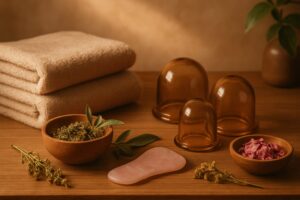
We did six sessions across eight weeks. Each session included cupping on the affected shoulder and the surrounding regions, with the cups left in place for ten to twelve minutes; gua sha along specific muscle attachments around the scapula; and at the end of each session, fifteen minutes of acupuncture on points distant from the shoulder, designed to address the underlying inflammatory pattern.

We did not work the shoulder joint directly, in the sense of forcing motion. The mistake that prolongs frozen shoulder is the assumption that aggressive stretching helps. It does not. The capsule responds to aggressive stretching by inflaming further. The work in our parlour was about creating the conditions in which the capsule could relax on its own — and trusting that it would, once those conditions were established.

Between sessions, Mira continued her physiotherapy. Her physiotherapist was excellent and the exercises she was doing were appropriate. What we added was the regulatory work on the surrounding tissue that physiotherapy alone could not produce.

The arc of recovery

First session: no immediate change in motion. Significant cupping marks on the shoulder, fading over five days. Mira reported that the pain at night — which had been waking her — was reduced for the first two nights after the session, then returned.

Second session: night pain reduction persisted longer, about four nights. Range of motion still essentially unchanged.

Third session: small but noticeable change. Mira reported that she could reach about two centimetres higher behind her back than the previous week, which had not happened in months.

Fourth and fifth sessions: more consistent gains. Pain at night reduced significantly. Range of motion increasing about two to three centimetres each week.

Sixth session: substantial change. Mira could reach behind her back to the level of her bra strap (she could not fasten it yet, but she could reach it). She could lift her arm to shoulder height. She had begun to wear her watch again, fastening it with assistance.

We stopped formal treatment at six sessions. She continued physiotherapy. She returned for a maintenance session at three months. By then she had full range of motion. The shoulder had completed its thawing about six months earlier than her physiotherapist had originally estimated.

A patience that Skanderbeg would have understood

There is a quality the body needs from someone with frozen shoulder, and that someone is rarely the patient themselves. The condition tests the patient’s patience constantly. The pain is real, the disability is real, the timeline is real, and the temptation to either give up or push too hard is constant.

I sometimes mention to clients with frozen shoulder that the historical figure who comes to mind for me is Skanderbeg — not for the obvious reason of perseverance, but for a specific quality of his resistance: he did not waste his strength on every confrontation. He chose which battles to fight and which positions to hold and which to yield strategically. The frozen shoulder responds to the same kind of selective patience. Aggressive intervention loses ground. Quiet, sustained, well-chosen intervention wins.

Mira called me about a year after we finished her course of treatment. She wanted to tell me she had bought a new dress with a back zipper, and she had fastened it herself.

This is the part of the work I love most. The slow returns, the quiet phone calls, the things people can do again that they had stopped expecting to do.

When to consider this approach

If you have frozen shoulder — confirmed by your doctor, ideally with imaging to rule out other causes — and you have been progressing slowly with conventional treatment, a course of cupping and gua sha is worth considering. The treatment is most useful in the late freezing phase and the frozen phase; it appears to be less useful in the early acute phase (when the inflammation is at its peak and any additional stimulation is unwelcome) and unnecessary in the late thawing phase (when the condition is already resolving on its own).

A typical course is six sessions across six to eight weeks. About three-quarters of my clients with this condition see meaningful improvement in this timeframe. The other quarter need a different approach or a longer treatment course.

The work does not replace physiotherapy. It complements it. The two together are, in my experience, dramatically more effective than either alone.


Yang Wang practises Chinese medicine at Chinese Massage – Tai Chi Tirana. The parlour is in central Tirana, a short walk from Bulevardi Myslym Shyri. Names in client stories have been changed.
The Olympic Athlete Marks: What Those Circles on Michael

In the summer of 2016, during the Olympic Games in Rio, photographs of Michael Phelps emerged that showed circular reddish-purple marks across his back and shoulders. The marks were striking — perfectly round, evenly spaced, dark enough to be noticed from across the pool deck. International media, including outlets that had never previously discussed traditional Chinese medicine, devoted considerable airtime to explaining what cupping was and why an Olympic swimmer would be using it.

This was a strange moment in the public history of the technique. Cupping had been practised continuously somewhere in the world for at least three thousand years, with documented use in ancient Egypt (1550 BCE), in classical Greece and Rome (where Hippocrates described it in detail), in Islamic medicine (where the practice was called hijama and was integrated into religious tradition), in Eastern European folk medicine, in Chinese medicine, and across nearly every other regional tradition. In none of these regions did the public consider cupping exotic. It was simply a thing one did when one had certain complaints.

What 2016 demonstrated was that cupping had become, in Western metropolitan settings, sufficiently obscure that an Olympic swimmer using it counted as news. The technique had not gone away; it had simply migrated out of mainstream Western awareness during the twentieth century, even as it continued in other parts of the world without interruption.

This piece is for clients who arrive at our parlour with some awareness that cupping is “an Olympic thing” but who have not encountered the much longer history the technique sits within — three thousand years of people reaching for a cup long before there was a podium to photograph it on.

What is actually happening under the cup

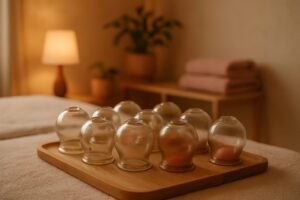
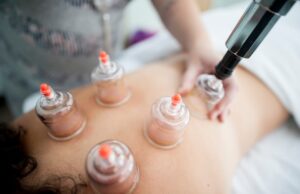
The mechanism is less mysterious than the dark circles make it look. A cup is placed against the skin and a vacuum is created inside it — historically with a brief flame that heats and then cools the trapped air, in our parlour with a small hand pump that does the job more precisely. The lower pressure inside the cup draws the skin and the soft tissue just beneath it gently upward.

That simple lift does several useful things. It pulls capillaries toward the surface and opens local blood flow in a way that lasts for days, not just for the minutes the cup is in place. It separates the thin fascial layers that hold the muscle groups in position — the same layers that, when they grow sticky and congested, quietly restrict movement. And it asks the body to pay attention to the area: to send blood, to clear what has accumulated, to do its housekeeping in a spot that has been neglected.

None of this requires belief. It is mechanics — pressure, circulation, and the body’s own response to being told, politely but firmly, that a particular patch of back needs looking after.

What cupping does for athletic performance

The reason elite athletes have adopted cupping as part of their training preparation is that the technique has measurable effects on muscle recovery that are difficult to achieve through other means.

After hard training, muscle tissue is left with several states that impair the next session: micro-damage to the muscle fibres themselves, accumulation of metabolic waste products, local inflammation, and reduced blood flow in the deeper layers. Standard recovery techniques — stretching, ice baths, foam rolling, massage — address some of these factors but not all.

Cupping addresses the accumulated stagnation in a way no other technique replicates. The negative pressure pulls capillaries open and increases local blood flow for several days after the treatment, which accelerates the clearing of metabolic waste. The lift of the fascial layers — the same effect that helps with frozen shoulder — also addresses the small adhesions that form in heavily trained muscle. And the post-cupping increase in local circulation appears to accelerate the regeneration of muscle fibres themselves.

For an Olympic athlete training twice a day with sessions a few hours apart, the recovery benefit between sessions is meaningful. For an ordinary person training three times a week, the benefit is smaller but still present. For most clients in our parlour, who are not athletes at all, the benefit is most pronounced in chronic conditions where local circulation has been poor for years. (If you want to understand the marks themselves — why some are pale and some nearly black — I have written about reading the marks in more detail.)

The cultural recovery

What has happened since 2016 is interesting beyond the immediate sports angle. The Olympic exposure created a kind of cultural permission for cupping that had not previously existed in Western cities. People who would not have considered visiting a Chinese-medicine practitioner suddenly felt comfortable asking about cupping. Spa centres in Italy, France, and the UK began offering the technique. The conversation around it shifted from “exotic alternative” to “respected old technique that professionals use.”

In Tirana, that permission arrived with its own small comedy. Clients who would once have raised an eyebrow at the words “Chinese medicine” now arrive having already watched a swimmer’s back on television, ready to discuss it as casually as they would a new café on the Bllok. The endorsement that finally landed was not from a textbook or a practitioner. It was from a man winning a medal in a pool in Rio.

This is part of why I find this work meaningful in a way that has little to do with the technique itself. We are caring for the survival and careful refinement of a practice that has been done by hand for thousands of years — and that, for one strange summer, the whole world suddenly noticed at once.

A small story from the table

About a year ago a man in his late thirties came in for his first cupping session — a recreational runner with a back that had been tightening for a decade of desk work and weekend half-marathons. He had booked, he admitted, mostly because he had seen the marks on athletes and wanted to know what the fuss was about.

After the session, while I was cleaning up, he twisted in front of the mirror to study the row of dark circles across his shoulders, turning like a man trying to read a label sewn into the back of his own collar. He was quiet for a moment.

“I thought I was fine,” he said.

I told him most people do, right up until the skin produces the evidence. He laughed, a little ruefully, and booked a second session before he left. The marks faded within the week. The tightness, by then, had begun to as well.

Trying it for the first time

For a client considering their first cupping session, my honest recommendations are:

Come in expecting to spend about an hour from start to finish, with about thirty minutes of cup time. Plan to wear loose clothing afterwards — the cups leave marks, as I have discussed, and tight collared shirts can rub.

If you have a specific complaint (chronic shoulder tension, recurrent back ache, athletic recovery, recurrent cold sensitivity in winter), tell us at intake. The cupping protocol shifts based on the goal.

If you are anxious about the marks, look at a few photographs online beforehand. The reality is generally less dramatic than the imagination.

If you have any of the standard contraindications — blood-thinning medication, pregnancy, recent surgery, significant skin conditions in the treatment area — tell us at intake. There are usually gentler approaches that can ease the same complaint without the technique that does not suit you.

And if you find yourself, a few days later, explaining the circles on your back to a curious colleague over coffee — you will be in good company. For one summer the entire world had the same conversation, and it has not entirely stopped since.


Yang Wang practises Chinese medicine at Chinese Massage – Tai Chi Tirana. The parlour is in central Tirana, near Bulevardi Gjergj Fishta.
Reading the Marks: What Cupping and Gua Sha Bruises Actually Mean

There is a moment of slight panic that visits almost every first-time cupping client about ten minutes after they have left the parlour and looked in a mirror at home. Their back is covered in circular reddish-purple marks, evenly spaced, some darker than others. In the lighting of their bathroom, this looks alarming. They wonder, briefly, whether something has gone wrong.

Nothing has gone wrong. Those marks are the entire point of the treatment, and reading them is one of the more interesting parts of the practice — for both the therapist and, increasingly, for clients who become curious about what their own body is communicating.

This piece is the longer answer to the question I get asked most often: “What do the marks mean?”

The marks are not bruises

The first thing to understand is that the marks left by cupping are not bruises in the conventional sense. A bruise comes from broken capillaries leaking blood into surrounding tissue, usually as a result of blunt force. The pattern is irregular, the pain is localised and worsens for the first day or two, and the surrounding tissue feels tender.

A cupping mark is something different. The negative pressure inside the cup pulls capillaries to the surface and increases their permeability. Some red blood cells and plasma move into the surrounding tissue — not because the capillaries are broken, but because the pressure differential temporarily opens the cell-to-cell junctions. The marks are flat (not raised), generally not tender to the touch by the next day, and resolve over three to seven days without any of the colour-cycling (red to blue to yellow) of a true bruise.

This distinction is not just academic. It matters because the body responds to a cupping mark differently than to a bruise. The marks initiate a local immune and circulatory response that is the actual therapeutic effect of the treatment. The body identifies the area as needing attention, sends additional blood flow, brings local immune cells, and begins clearing whatever metabolic waste had been accumulated in the tissue. This response continues for several days after the cup is removed.

Why the marks differ from person to person

The most useful information in a cupping session is encoded in how dark the marks become and where they appear darkest. A skilled practitioner reads these patterns the way a doctor might read a blood test.

Light pink, fades within an hour or two. The tissue underneath was well-circulated and not particularly stagnant. The treatment is producing a mild beneficial effect but the area was not in acute need of intervention. Common in young, healthy clients receiving a maintenance session.

Pink to red, fades within twenty-four hours. The area had some mild congestion or muscle tension but no significant underlying stagnation. This is the most common reading in clients who come in for stress-related back tension.

Dark red to purple, persists for three to five days. The tissue had significant accumulated stagnation — meaning a combination of poor circulation, retained metabolic waste, and chronic muscle tension. Common in office workers with long-standing upper back complaints, and in clients whose injury or strain happened weeks or months ago but never fully resolved.

Very dark purple, almost black, persists for a week or longer. This indicates either deep chronic stagnation (often associated with chronic pain conditions) or, more rarely, a circulation problem that warrants medical attention. When I see this in a client without an obvious explanation, we have a longer conversation about whether anything else in their health picture might be contributing.

Mark with a yellow or greenish edge. The body is processing the cupping response unusually slowly, often indicating depleted reserves. We adjust the treatment to be gentler in subsequent sessions.

The geography of the back

Where on the back the marks are darkest matters as much as how dark they are.

The classical Chinese mapping of the back uses the bladder meridian and the governor vessel as reference points. Modern Western anatomy uses muscle groups and segmental nerve distribution. The two systems map onto each other reasonably well for practical purposes.

The upper trapezius region — where most office workers carry tension — typically shows darker marks in clients whose work involves desk-bound keyboard use. The pattern often follows a “shoulder yoke” shape, deeper on whichever side carries the dominant hand.

The thoracic paraspinals — the muscle groups running alongside the spine in the upper-to-middle back — show darker marks in clients with chronic stress, particularly stress held in the breathing pattern. Clients with shallow chest breathing almost always have detectable stagnation in this region.

The lower thoracic region (between the shoulder blades and the bottom of the rib cage) corresponds, in TCM, to the liver shu and gallbladder shu points. In clients with chronic frustration, suppressed irritability, or sluggish digestion, this region often shows the deepest marks.

The lumbar region — lower back — shows stagnation patterns related to physical workload, chronic standing, or, in TCM terms, kidney-yang deficiency. Clients with chronic fatigue and cold extremities often show their deepest marks here.

In the parlour, I sometimes show clients a photograph of their own back after the treatment (with their permission, on their phone) and walk them through what the pattern is showing. Most clients find this surprisingly engaging — it is, in a sense, the first time they have seen their own internal stress state mapped onto their skin.

What gua sha shows differently

Gua sha — scraping therapy — leaves a different kind of mark, in a different pattern, that carries different information.

The technique uses a smooth-edged tool (traditionally a piece of polished horn, in modern practice often porcelain or jade) to scrape the surface of the skin with moderate pressure, after oiling the area. The friction causes a similar capillary-to-tissue response as cupping, but the pattern is linear rather than circular, and the marks tend to be more variable across the treated area.

What gua sha shows particularly well is the distribution of sha — the term for the small red spots that emerge in areas of greatest stagnation. In a well-circulated area of tissue, gua sha produces a uniform pink flush that fades in an hour. In a stagnant area, distinct red pinpoint spots emerge that may take days to resolve.

This makes gua sha excellent for diagnosing the specific zones within a larger muscle group that are most in need of intervention. The technique reveals the local pattern in a way cupping cannot, because cupping treats a whole circular area while gua sha can identify a narrow strip of greatest concern within a larger field.

The Albanian grandmother’s version

I mention this in several pieces but it bears repeating in this context: cupping is not a Chinese exclusive. Variations of the technique have existed in Albanian traditional medicine, where the word for it is ventuza. The older women in many Albanian families remember it from their childhoods — small glass cups, heated briefly with a flame to create a vacuum, applied to a child’s back to “draw out the cold” of a winter illness. The technique survived in informal household practice well into the twentieth century, became less common as modern medicine spread, and is now experiencing something of a revival. I have written more about what an Albanian grandmother taught me about cupping, if the parallel between the two traditions interests you.

What is interesting is that the diagnostic principles the Albanian grandmothers used were not as systematised as the Chinese ones, but the underlying observation was the same: where the cup leaves a darker mark, the body had more to release. The grandmothers did not have a written tradition documenting this, but they passed the observation along verbally and acted on it consistently.

A patient of mine — a woman in her sixties from a village in the north — described to me what her own grandmother had said about cupping marks. The translation she offered me was: “Where the skin remembers, there is something the body needs to forget.”

This is, in fact, a reasonable summary of the underlying principle. The marks are the body’s record of what has been held. The treatment is the process of releasing it.

When the marks should make you call us

There are circumstances where unusual cupping marks indicate something needing follow-up, not concern but attention.

Marks that take longer than seven days to resolve, in a client without obvious explanation (heavy training, recent illness, blood-thinning medication). This sometimes indicates underlying circulatory or hormonal factors worth investigating with a doctor.

Marks that are accompanied by significant ongoing pain (cupping should not produce sharp tender pain after the session — only a mild residual feeling of the work having been done).

Marks that recur in the same pattern over multiple sessions despite consistent treatment. This indicates that the underlying pattern is deeper than the cupping is reaching, and the treatment plan needs to be adjusted — sometimes by adding acupuncture or mud moxibustion, sometimes by addressing a lifestyle factor we identify together.

For ordinary cupping marks — pink to dark red, fading over three to five days, with no significant tenderness — there is nothing to worry about. They are the visible record of work done. The body will reabsorb them quickly, and what they were marking will, in most cases, no longer be there to mark.

A small etiquette note for the summer

If you have a cupping session in summer and were planning to wear an open-back top or go to the beach the next day, it is worth saying — the marks will be visible to other people. This is not a problem, but it can be unexpected. We mention it at intake. The marks have become much more recognisable in recent years (Olympic swimmers wearing them in 2016 changed the public conversation considerably), and most people now know what they are. But the first time you wear a sundress with circular marks down your back, the looks at the café can be amusing.

In Tirana, the older generation tends to nod knowingly. The younger ones sometimes ask questions. Either reaction is fine.


Yang Wang practises Chinese medicine at Chinese Massage – Tai Chi Tirana.