Reading the Marks: What Cupping and Gua Sha Bruises Actually Mean

There is a moment of slight panic that visits almost every first-time cupping client about ten minutes after they have left the parlour and looked in a mirror at home. Their back is covered in circular reddish-purple marks, evenly spaced, some darker than others. In the lighting of their bathroom, this looks alarming. They wonder, briefly, whether something has gone wrong.

Nothing has gone wrong. Those marks are the entire point of the treatment, and reading them is one of the more interesting parts of the practice — for both the therapist and, increasingly, for clients who become curious about what their own body is communicating.

This piece is the longer answer to the question I get asked most often: “What do the marks mean?”

The marks are not bruises

The first thing to understand is that the marks left by cupping are not bruises in the conventional sense. A bruise comes from broken capillaries leaking blood into surrounding tissue, usually as a result of blunt force. The pattern is irregular, the pain is localised and worsens for the first day or two, and the surrounding tissue feels tender.

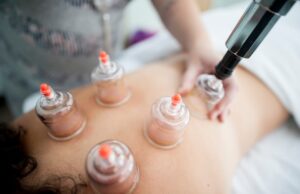
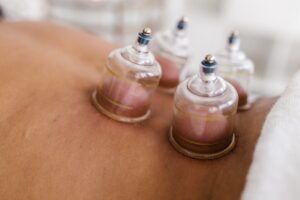
A cupping mark is something different. The negative pressure inside the cup pulls capillaries to the surface and increases their permeability. Some red blood cells and plasma move into the surrounding tissue — not because the capillaries are broken, but because the pressure differential temporarily opens the cell-to-cell junctions. The marks are flat (not raised), generally not tender to the touch by the next day, and resolve over three to seven days without any of the colour-cycling (red to blue to yellow) of a true bruise.

This distinction is not just academic. It matters because the body responds to a cupping mark differently than to a bruise. The marks initiate a local immune and circulatory response that is the actual therapeutic effect of the treatment. The body identifies the area as needing attention, sends additional blood flow, brings local immune cells, and begins clearing whatever metabolic waste had been accumulated in the tissue. This response continues for several days after the cup is removed.

Why the marks differ from person to person

The most useful information in a cupping session is encoded in how dark the marks become and where they appear darkest. A skilled practitioner reads these patterns the way a doctor might read a blood test.

Light pink, fades within an hour or two. The tissue underneath was well-circulated and not particularly stagnant. The treatment is producing a mild beneficial effect but the area was not in acute need of intervention. Common in young, healthy clients receiving a maintenance session.

Pink to red, fades within twenty-four hours. The area had some mild congestion or muscle tension but no significant underlying stagnation. This is the most common reading in clients who come in for stress-related back tension.

Dark red to purple, persists for three to five days. The tissue had significant accumulated stagnation — meaning a combination of poor circulation, retained metabolic waste, and chronic muscle tension. Common in office workers with long-standing upper back complaints, and in clients whose injury or strain happened weeks or months ago but never fully resolved.

Very dark purple, almost black, persists for a week or longer. This indicates either deep chronic stagnation (often associated with chronic pain conditions) or, more rarely, a circulation problem that warrants medical attention. When I see this in a client without an obvious explanation, we have a longer conversation about whether anything else in their health picture might be contributing.

Mark with a yellow or greenish edge. The body is processing the cupping response unusually slowly, often indicating depleted reserves. We adjust the treatment to be gentler in subsequent sessions.

The geography of the back

Where on the back the marks are darkest matters as much as how dark they are.

The classical Chinese mapping of the back uses the bladder meridian and the governor vessel as reference points. Modern Western anatomy uses muscle groups and segmental nerve distribution. The two systems map onto each other reasonably well for practical purposes.

The upper trapezius region — where most office workers carry tension — typically shows darker marks in clients whose work involves desk-bound keyboard use. The pattern often follows a “shoulder yoke” shape, deeper on whichever side carries the dominant hand.

The thoracic paraspinals — the muscle groups running alongside the spine in the upper-to-middle back — show darker marks in clients with chronic stress, particularly stress held in the breathing pattern. Clients with shallow chest breathing almost always have detectable stagnation in this region.

The lower thoracic region (between the shoulder blades and the bottom of the rib cage) corresponds, in TCM, to the liver shu and gallbladder shu points. In clients with chronic frustration, suppressed irritability, or sluggish digestion, this region often shows the deepest marks.

The lumbar region — lower back — shows stagnation patterns related to physical workload, chronic standing, or, in TCM terms, kidney-yang deficiency. Clients with chronic fatigue and cold extremities often show their deepest marks here.

In the parlour, I sometimes show clients a photograph of their own back after the treatment (with their permission, on their phone) and walk them through what the pattern is showing. Most clients find this surprisingly engaging — it is, in a sense, the first time they have seen their own internal stress state mapped onto their skin.

What gua sha shows differently

Gua sha — scraping therapy — leaves a different kind of mark, in a different pattern, that carries different information.

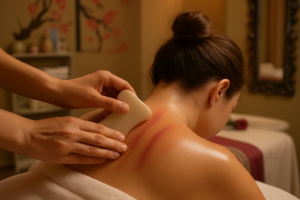
The technique uses a smooth-edged tool (traditionally a piece of polished horn, in modern practice often porcelain or jade) to scrape the surface of the skin with moderate pressure, after oiling the area. The friction causes a similar capillary-to-tissue response as cupping, but the pattern is linear rather than circular, and the marks tend to be more variable across the treated area.

What gua sha shows particularly well is the distribution of sha — the term for the small red spots that emerge in areas of greatest stagnation. In a well-circulated area of tissue, gua sha produces a uniform pink flush that fades in an hour. In a stagnant area, distinct red pinpoint spots emerge that may take days to resolve.

This makes gua sha excellent for diagnosing the specific zones within a larger muscle group that are most in need of intervention. The technique reveals the local pattern in a way cupping cannot, because cupping treats a whole circular area while gua sha can identify a narrow strip of greatest concern within a larger field.

The Albanian grandmother’s version

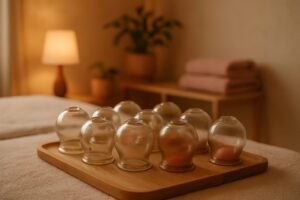
I mention this in several pieces but it bears repeating in this context: cupping is not a Chinese exclusive. Variations of the technique have existed in Albanian traditional medicine, where the word for it is ventuza. The older women in many Albanian families remember it from their childhoods — small glass cups, heated briefly with a flame to create a vacuum, applied to a child’s back to “draw out the cold” of a winter illness. The technique survived in informal household practice well into the twentieth century, became less common as modern medicine spread, and is now experiencing something of a revival. I have written more about what an Albanian grandmother taught me about cupping, if the parallel between the two traditions interests you.

What is interesting is that the diagnostic principles the Albanian grandmothers used were not as systematised as the Chinese ones, but the underlying observation was the same: where the cup leaves a darker mark, the body had more to release. The grandmothers did not have a written tradition documenting this, but they passed the observation along verbally and acted on it consistently.

A patient of mine — a woman in her sixties from a village in the north — described to me what her own grandmother had said about cupping marks. The translation she offered me was: “Where the skin remembers, there is something the body needs to forget.”

This is, in fact, a reasonable summary of the underlying principle. The marks are the body’s record of what has been held. The treatment is the process of releasing it.

When the marks should make you call us

There are circumstances where unusual cupping marks indicate something needing follow-up, not concern but attention.

Marks that take longer than seven days to resolve, in a client without obvious explanation (heavy training, recent illness, blood-thinning medication). This sometimes indicates underlying circulatory or hormonal factors worth investigating with a doctor.

Marks that are accompanied by significant ongoing pain (cupping should not produce sharp tender pain after the session — only a mild residual feeling of the work having been done).

Marks that recur in the same pattern over multiple sessions despite consistent treatment. This indicates that the underlying pattern is deeper than the cupping is reaching, and the treatment plan needs to be adjusted — sometimes by adding acupuncture or mud moxibustion, sometimes by addressing a lifestyle factor we identify together.

For ordinary cupping marks — pink to dark red, fading over three to five days, with no significant tenderness — there is nothing to worry about. They are the visible record of work done. The body will reabsorb them quickly, and what they were marking will, in most cases, no longer be there to mark.

A small etiquette note for the summer

If you have a cupping session in summer and were planning to wear an open-back top or go to the beach the next day, it is worth saying — the marks will be visible to other people. This is not a problem, but it can be unexpected. We mention it at intake. The marks have become much more recognisable in recent years (Olympic swimmers wearing them in 2016 changed the public conversation considerably), and most people now know what they are. But the first time you wear a sundress with circular marks down your back, the looks at the café can be amusing.

In Tirana, the older generation tends to nod knowingly. The younger ones sometimes ask questions. Either reaction is fine.


Yang Wang practises Chinese medicine at Chinese Massage – Tai Chi Tirana.
What an Albanian Grandmother Taught Me About Cupping

A Letter from the Studio · Yang Wang

What an Albanian Grandmother Taught Me About Cupping

A personal reflection on tradition, memory, and what has always been home.

It was a quiet Wednesday afternoon at the studio when I first noticed.

A client — a teacher from Tirana, in her fifties — was lying on the table after her cupping session. The marks were that deep purple kind, the ones that show up on a body that has been carrying tension for too long. She looked at them in the mirror and laughed.

Then she said something that stopped me.

"My grandmother used to do this for us. With glass cups. In the village."

In China, where I am from, this would not have surprised anyone. Every Chinese grandmother knows about 拔罐 — ba guan, "pulling cups". But when I came to Albania in 2020, I had assumed I was bringing something new. Something foreign. A Chinese gift to a curious country.

That afternoon, I started asking questions.

I Started Asking Everyone

In the weeks that followed, I asked everyone. My clients. My neighbors on Rruga Astrit Sulejman Balluku. The man at the fruit stand. The woman who runs the qebaptore around the corner.

The answer was almost always the same. "Ah yes — kupa. Or ventuza. My grandmother. My aunt. In the village."

In nearly every Albanian family, somewhere, there was a memory. Someone's nënë who would warm a glass cup over a candle and place it on a sore back. Always glass cups. Always at home. Always with the same purpose: to pull the badness out of the body.

But here was the thing that puzzled me.

In the villages, the practice was alive — quietly, in kitchens, by grandmothers. In Tirana, in Durrës, in Shkodër, almost no one was doing it anymore. People spoke about it the way you might speak about an old recipe — with affection, but with a small distance.

In China, cupping has never gone away. Every neighborhood has someone who does it. So why, in Albania, had it become a "grandmother's thing"? Why had the cities let go of something the villages had so carefully kept?

What I Found That Night

I am not a historian. I am a practitioner. But that question stayed with me, and one Tuesday night I sat down with my computer, made a cup of tea, and started reading.

What I found surprised me more than anything any client had ever told me.

Hippocrates

The first surprise was Hippocrates of Kos — born around 460 BC, the "father of medicine". He practiced cupping. Not as a curiosity. Not as folk medicine. As one of his main tools. He used it for back pain, neck pain, lung problems, period pain — the same things I treat in sessions today.

I sat there with my tea, thinking: Hippocrates? The Greek? Greece is not far from Tirana. You can drive there in a few hours.

Galen, and a Roman Road Through Illyricum

Galen of Pergamon (129–200 AD) was the most influential doctor in European history before the Renaissance. He treated Roman emperors. He was a passionate practitioner of cupping and bloodletting. He even publicly criticized other doctors who did not practice cupping enough.

And here is what I had not understood: the Roman Empire reached Albania. The province was called Illyricum. Roman doctors trained in Galen's methods walked the same roads I walk now. They cupped patients in the same towns where my clients' grandmothers — centuries later — would cup their grandchildren.

The tradition had not come from somewhere else. It had been here.

The Barbershop Revelation

The third surprise is the one I keep telling everyone about.

In medieval Europe, cupping and bloodletting moved into the monasteries. Monks performed them for centuries — until 1163, when a Church council decided priests should not be drawing blood. So the practice moved to the barbers.

For the next six hundred years, barbers across Europe did not just cut hair. They pulled teeth. They cupped patients. They drew blood. They were known as barber-surgeons.

The Hidden Symbol

When a medieval barber-surgeon performed a bloodletting, he gave the patient a wooden stick to grip. After the procedure, the bloody white bandages were hung outside the shop to dry. White cloth, stained red, twisting in the wind.

Eventually a painted symbol replaced the bandages. A wooden pole. Striped red and white.

That sign never disappeared.

I want every Albanian reading this to do something for me.

The next time you walk through Tirana — or Durrës, or Shkodër, or Korçë — count the barbershops. Look at the spinning red-and-white poles outside them. Every single one is a 900-year-old advertisement for cupping and bloodletting. We just stopped seeing it.

Five Hundred Years of Hijama

For five and a half centuries — from 1385 to 1912 — Albania was part of the Ottoman Empire. Ottoman medicine had a deep tradition of cupping, called hijama. The Turkish surgeon Şerefeddin Sabuncuoğlu wrote in detail about it in the fifteenth century. His techniques were practiced in every major Ottoman city. Tirana. Shkodër. Berat. Gjirokastër.

So when an Albanian grandmother heated a glass cup and placed it on her grandchild's back in 1962, she was doing something her own grandmother had learned from her own grandmother, in an unbroken line going back through Ottoman hijama, Byzantine medicine, Roman doctors, Galen, and Hippocrates.

Two and a half thousand years of practice. On this soil.

I came here in 2020 thinking I was bringing a Chinese gift. I was wrong. I was returning something that had been home all along.

What I Want You to Know

This is what I love most about Albania, and one of the reasons I have stayed.

The country is generous in a way that surprised me when I first arrived. Mikpritja — the welcome you give a guest — is real here. People offered me food before they knew my name. Friendship before I had earned it. They taught me Albanian by repeating words patiently, the way my own grandmother in Liaoning would have taught a child.

But what I did not expect was that Albania would also welcome my work this way — as something familiar. Not strange. Not foreign. As something that fit.

When I sit with a client at the studio and place the cups, I am not introducing anything new. I am continuing a conversation between Albanian bodies and these techniques that started when the Romans built their road through Illyricum. The grandmothers were not wrong to do it. The cities are not wrong to come back to it.

And I am not the one who brought it. I am the one who happens to know its modern Chinese form — the meridian theory, the diagnostic precision, the clean equipment — and I am grateful, every day, that Albania has welcomed me to bring that form back home.

If your grandmother used to do kupa in the village — yes, this is the same thing.

If you have always thought of cupping as something exotic from China — yes, it is also Greek, and Roman, and Ottoman, and Albanian.

If you have a tight neck after too many hours at a screen — well, Hippocrates would have known what to do. So would your grandmother. So do I.

Come and see us, on Rruga Astrit Sulejman Balluku. The tradition is older than the building. And it is yours.

Continue the Tradition

Book a cupping session at Chinese Massage – Tai Chi Tirana

Book a Session Or call: 068 541 4141

Cupping and Bloodletting in Traditional Chinese Medicine

How These Therapies Help in Everyday Health Problems

In my daily centeral practice, many patients ask the same question: “What exactly do cupping and bloodletting do, and how do I know which one I need?”
Both therapies belong to the external treatment methods of Traditional Chinese Medicine (TCM), and while they may look simple, their effects can be deep and precise when applied correctly.

Cupping and bloodletting share a common goal – to restore circulation and remove what the body no longer needs – but they do so in different ways and for different situations. Understanding this difference helps patients feel more confident and involved in their treatment.


Cupping Therapy: Releasing Tension and Restoring Flow

What Cupping Therapy Does

Cupping creates a gentle suction on the skin that draws blood and fluids to the surface. From a TCM perspective, this helps move stagnant Qi and Blood, warm the meridians, and relax contracted tissues.

Many patients describe the feeling after cupping as lighter, warmer, and more flexible – especially in areas that felt tight or blocked before.

Common Symptoms and Conditions Treated with Cupping

In practice, cupping is often helpful for:

  • Chronic neck and shoulder stiffness from desk work

  • Lower back pain that feels heavy or sore rather than sharp

  • Muscle tightness after sports or physical labor

  • Frequent colds with chest tightness or cough

  • Fatigue accompanied by a sense of body heaviness

  • Digestive discomfort linked to stress and tension

For example, patients who sit long hours at a computer often come in with stiff shoulders, headaches, and a feeling of pressure between the shoulder blades. Cupping in these cases helps relax the muscles and improve circulation, often bringing noticeable relief even after one session.


Bloodletting Therapy: Clearing Heat and Stagnation

What Bloodletting Therapy Does

Bloodletting involves releasing a very small amount of blood from specific points or congested areas. In TCM, this is used when there is excess Heat, strong stagnation, or toxicity.

Patients are often surprised by how little blood is involved – and how quickly symptoms can change afterward.

Common Symptoms and Conditions Treated with Bloodletting

Bloodletting may be recommended when patients present with:

  • Sharp or intense headaches, especially with a feeling of pressure or heat

  • Sudden neck or shoulder pain with redness and swelling

  • Acute flare-ups of acne or skin inflammation

  • Migraines accompanied by irritability or facial flushing

  • Pain that feels fixed, stabbing, or burning

For instance, patients with recurring migraines often describe a heavy, tight sensation in the head that worsens with stress or heat. In selected cases, gentle bloodletting can quickly reduce this pressure and calm the system.


When Cupping and Bloodletting Are Combined

There are situations where cupping alone is not enough, and bloodletting alone would be incomplete. This is when combining the two therapies becomes especially effective.

Practical Examples of Combined Therapy

In my experience, combined treatment works well for:

  • Long-standing shoulder or back pain with swelling and heat

  • Sports injuries that remain painful and inflamed for weeks

  • Chronic fatigue with a feeling of heaviness and congestion

  • Recurrent neck pain with visible dark or congested areas

  • Old injuries that flare up with weather changes

In these cases, bloodletting helps release the deep stagnation, while cupping immediately afterward encourages fresh blood flow and faster recovery.


Possible Disadvantages and Temporary Reactions

Both therapies are generally well tolerated, but it is important to know what to expect:

  • Temporary bruising or marks from cupping

  • Mild soreness for one or two days

  • Feeling tired or relaxed after bloodletting

  • Rare skin irritation if aftercare instructions are not followed

These reactions are usually signs that circulation has been activated and tend to resolve on their own.


When These Therapies Should Not Be Used

Safety always comes first. Cupping and bloodletting are not suitable for everyone, and proper assessment is essential.

General Contraindications

  • Pregnancy (especially abdomen and lower back)

  • Severe weakness, exhaustion, or anemia

  • Bleeding disorders or poor clotting

  • Advanced chronic disease without medical supervision

Bloodletting-Specific Contraindications

  • Use of anticoagulant medication

  • Very low blood pressure

  • Severe fear or sensitivity to blood

  • Children and elderly patients (unless strictly indicated)

A personalized diagnosis ensures that treatment supports the body rather than overloading it.

cupping therapy on their back