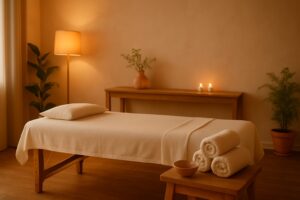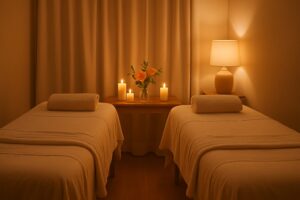
There is a couple who come to the parlour every March, in the second week, for their wedding anniversary. They have been coming for nine years. They will be married twenty years this coming March. The first session they booked with us was their eleventh anniversary, and they have not missed a year since.
I want to write about them because they have, in their quiet way, demonstrated something I have come to think about often — the role that small recurring rituals play in the long arc of a marriage, and the unexpected ways that something as ordinary as an annual massage session can become a marker of time and care.
This piece is for couples considering whether to make a couples massage a recurring practice rather than a one-time experience, and for the much smaller number of clients who have read the other couples massage piece and wondered what the long-term version of the practice looks like. (For the gift-giving register specifically — anniversaries, birthdays, year-end — I have a piece on Tai Chi massage gift cards that may be useful.)
How they started
I asked them once, in passing, how they had come to choose a couples massage as their anniversary tradition. The answer surprised me at the time.
It was not, they said, a romantic choice in any conventional sense. They had been married ten years. Their relationship was solid, but they had reached a point — common in long marriages — where the standard anniversary observances had become rote. The dinner at a nice restaurant. The card. The token gift. They went through these motions every year and they felt slightly performative. There is a particular Tirana restaurant table reserved for anniversaries, and most couples know the quiet weight of sitting at it with nothing new left to say. Neither of them was sure what would feel like a meaningful observance instead.
The wife had received a couples massage as a birthday gift from a friend several months before the eleventh anniversary. She had enjoyed it considerably. She suggested to her husband, half-jokingly, that they book one for their anniversary instead of doing the dinner that year.
He agreed, partly because he was as tired of the dinner as she was, partly because he was curious. They booked a session with us — their first visit to the parlour — and they had what they later described to me as “the most rested two hours we have had in months.”
They walked home together afterwards, stopped at a small restaurant for an unscheduled meal that ended up being more relaxed than any anniversary dinner they could remember. The next morning they both said, more or less independently, “We should do that again next year.”
They have done so for nine years now. It has become the anniversary observance, replacing the previous traditions entirely.
What the practice has evolved into
The original session was a simple couples massage in our standard format. Over the years, the practice has evolved into something slightly more elaborate, mostly through their own preferences rather than any suggestion from us.
They book a longer session now — ninety minutes rather than sixty — to give themselves more time. They schedule it for late afternoon so that they have an unhurried evening afterwards. They book a particular pair of our therapists with whom they have developed an ongoing rapport. They request specific elements they have come to value: a few minutes of synchronised work at the very beginning (a small touch we sometimes offer when both therapists in a couples session have also done four-hands training), an extended foot massage at the end, the same essential oil blend each year.
The session has become specific in the way that any annual tradition becomes specific over time — small accumulated choices that, together, constitute a ritual. The ritual would not look special to an outside observer. To them, it has become deeply familiar and quietly cherished.
After the session, they have a particular small restaurant they go to. It is not anywhere expensive or remarkable; it is a place near the parlour that they discovered the first year and have returned to every year since. The owner, who has come to recognise them after eight years of annual visits, brings them a particular bottle of wine without being asked.
What I have observed across nine years
The interesting thing about seeing a couple once a year for nine years is the long arc that becomes visible. Most of the year, I do not see them. We exchange a brief friendly email occasionally — they sometimes write to me when they have travelled and want to ask about a question they have about something they encountered. But the visits are once a year.
Across the visits, I have seen things I would not have seen at any other observation rate.
I have seen them get older together. The slight changes in posture, the subtle increase in chronic accumulated tension in certain areas, the gradual softening of the body that happens to all of us across our forties and fifties. They have aged side by side, in the same chronological direction, in the way that long marriages produce.
I have seen one of them through a difficult illness in year five — a six-month period when he was recovering from what had been a serious health scare. The session that year, I was particularly careful about, and they were noticeably more present with each other than they had been the year before. The shared experience, in a difficult year, served as a small claim that they were still doing the things they did together.
I have seen them through a family loss in year seven — her mother had died in January, two months before their anniversary session. They considered not coming that year and decided to come anyway. The session that year had a different quality. Quieter. Slower. We did not pretend the loss had not happened.
I have seen them in good years and ordinary years. The visits have, across the nine years, formed a kind of low-resolution photograph of a long marriage. Each year a single frame. Together, the frames make a portrait that is more honest than any annual photograph could be.
What this suggests about the practice
I do not want to suggest that any particular couples ought to make an annual massage session their anniversary observance. Different couples have different rhythms and different ways of marking time. The conventional anniversary dinner works beautifully for many couples and should not be abandoned for the sake of novelty.
What I think this couple’s practice suggests is something more general: the long-term value of small recurring rituals that involve both partners receiving care simultaneously. The ritual matters more than the specific form. A shared bodywork session is one form; there are others. What they have in common is that they create a small annual island in the year where both partners are simultaneously being attended to, not by each other, but together. The shared experience of receiving care is different from the shared experience of providing care, and many long marriages have an excess of the second and a shortage of the first.
For couples reading this who do not currently have such a ritual, the suggestion would be: consider whether there is something you could add to your year that would have this quality. A massage session is one option. A weekend at a guesthouse where neither of you has to do the cooking or the planning. An annual unplugged retreat in a quiet location. The specific form does not matter. The shared receiving of care, in a sustained way, is what does the work.
The besa of returning
There is an Albanian concept I have written about in other pieces — besa, the word given and kept. It usually appears in the context of promises made to others. But there is a smaller, equally important application: the promises one makes implicitly to one’s own marriage, and the keeping of them.
When this couple booked their second session, the year after their first, they were making a small implicit promise to themselves and to each other. They had chosen to do this again. The promise was not articulated. But the booking, repeated the following year, then the year after, gradually became a thing they were committed to.
Across nine years, the implicit promise has become a strong unspoken bond. They will come this year. They will probably come for many years to come. The ritual has acquired its own weight, beyond either of their individual preferences. They have built it together, year by year, and now it carries some of the relationship’s continuity in a quiet way.
This is what small recurring practices can do. They become structures that support the larger thing. The marriage is built of many such structures. The anniversary session is one of theirs.
A practical note for couples considering this
If you have read this and are thinking about establishing some version of this practice with your own partner, a few suggestions that draw on what I have observed in this couple and several other long-term recurring clients.
Choose a date that means something to you. Not necessarily the anniversary itself — they actually chose a date a few days off, because the actual anniversary was sometimes inconvenient. The date should be meaningful but flexible enough to schedule reliably.
Book it as early in the year as possible. Annual rituals fail when they are not scheduled in advance. Block the date a year ahead each time you complete a session.
Build a small surrounding ritual. The session itself is not enough; the dinner afterwards, the walk, the quiet evening — these are what make the day feel like an observance rather than an appointment.
Stick with the same parlour and the same therapists if you find a pair you trust. The continuity adds to the ritual. We have become, across nine years, familiar enough with this couple that the session feels like a small reunion as much as a treatment.
Do not abandon the ritual in difficult years. The years when you feel least like coming are often the years when the practice does the most quiet work for you. They came in the year of his illness and the year of her mother’s death, and they have told me both years were among the most valuable.
The marriage builds itself across many small practices. This is one couple’s version of one of theirs. There are many others worth building.
Yang Wang practises Chinese medicine at Chinese Massage – Tai Chi Tirana. Details have been altered to protect client privacy.