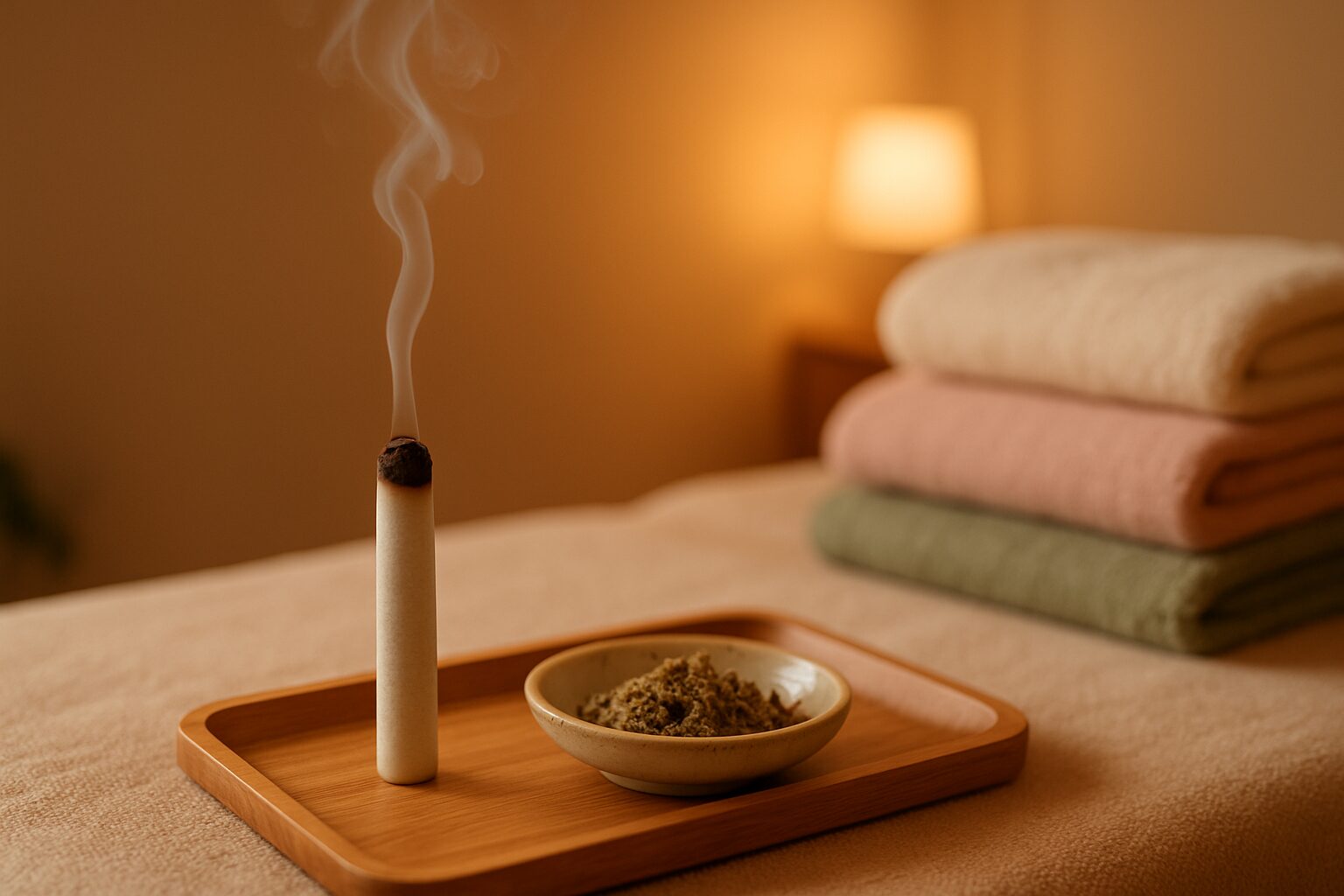
There is a treatment we offer at the parlour that almost no one in Tirana has heard of before they walk in. Most of our long-term clients have tried Tui Na. Many have tried acupuncture, cupping, gua sha, hot stones. But mud moxibustion — ni jiu in Mandarin, 泥灸 — they encounter for the first time when they ask about a treatment for chronic abdominal cold, painful periods that nothing else has touched, or the kind of deep tiredness that sleep does not repair.
This is one of the older treatments in the Chinese pharmacopoeia. It is also, in my opinion, one of the most underrated. It does what acupuncture does — moves stuck qi, warms the deep tissue, addresses cold-type patterns — but it does it through a different mechanism, and for certain clients it is dramatically more effective. (For the acupuncture half of this comparison and how the meridian-point system underlying both treatments is mapped, I have a foundational piece on meridian conditioning.)
What it actually is
Mud moxibustion combines two ancient ingredients: medicinal mud and moxa, the herb Artemisia vulgaris (mugwort, in English; pelin in Albanian, where the plant grows wild on the hillsides outside Tirana — you have probably walked past it a hundred times on a Sunday hike without a second glance).
The mud is not ordinary mud. It is a specific medicinal preparation, traditionally made from a base of fine silt taken from particular river beds, mixed with powdered herbs — typically Artemisia, Angelica sinensis, Cinnamomum cassia (cinnamon bark), and several other warming herbs depending on the formula. The mixture is dried and stored in cakes or sheets. To use it, the practitioner moistens it slightly, warms it to body temperature, and applies it as a layer over a specific area of the body — usually the lower abdomen, the lower back, or along the spine.
Over the layer of warmed mud, a small amount of moxa is burned at a controlled distance. The smoke and heat penetrate down through the mud, which acts as a carrier and a temperature regulator. The result is a deep, even, sustained warming of the underlying tissue and the points beneath it, combined with the topical absorption of the herbal compounds in the mud.
A session lasts thirty to forty-five minutes. The client lies comfortably on the table. The sensation is unlike anything else in TCM — not the brief sharpness of a needle, not the dull pressure of cupping, not the focused heat of a single stone. It is broad, warm, slow, settling. Many clients fall asleep during the second half of the session.
What it helps with — and what it does not
Mud moxibustion is specifically indicated for what TCM calls cold-damp accumulation in the lower body. This is a pattern more than a single condition, but in the people I see it tends to show up as:
Chronic abdominal cold — the sensation of a persistently cool lower belly, often with bloating, sluggish digestion, and frequent loose stools. Many women describe this as feeling “as if my insides are cold from the inside out.”
Painful menstrual periods — particularly the kind that come with low-back ache, cold sensitivity, and pain that responds better to heat than to pain medication.
Chronic lower back pain that worsens in cold weather. Not the acute strain kind; the kind that comes back every winter and lasts until April.
Postpartum recovery, especially for women who feel cold and depleted after giving birth (something Chinese medicine takes very seriously and works with actively, while in the modern medical setting it often gets less attention than it deserves).
Chronic fatigue with a “cold and damp” quality — heavy limbs, low motivation, a body that feels weighed down rather than tense.
It is not the right treatment for: acute injuries, fevers, infections, conditions with a “heat” pattern (red face, easily irritable, dry mouth, insomnia from agitation), or pregnancy (heating the abdomen during pregnancy is contraindicated in classical practice).
A small story about my mother
When I was a child in Liaoning, my mother had what we then called “the winter belly.” Every December, around the time the first snow came, her lower abdomen would become tender and cold to the touch. Cramping that came not with her period but seemingly with the season. She drank ginger tea. She wore extra layers. She felt, in her own words, that her yang was leaking out of her like heat from a poorly built house.
Once a winter, my grandmother would prepare what she called the “mud cake.” She made it herself, from a recipe handed down through several generations. River silt, dried mugwort from the summer harvest, cinnamon bark, ginger, two or three other things I never learned the names of. She would warm the cake on the stove, lay it across my mother’s abdomen, and burn a small bundle of moxa above it for half an hour.
My mother would emerge from this treatment looking like she had taken a long bath in a warm sea. Calm, slightly flushed, the cold gone out of her face. The treatment was an annual event. It always worked.
I did not understand, at the time, that I was watching a thousand-year-old protocol being performed in my grandmother’s kitchen. To me it was just what we did in December.
Why the Western reader rarely encounters this
There are two reasons mud moxibustion has remained obscure outside China, even as acupuncture and cupping have become familiar in European wellness centres.
The first is practical. The mud is difficult to source authentically outside China. The herbal formula is complex and the quality varies considerably. We import ours from a specific manufacturer in Shandong province with multi-generational expertise in the preparation. Many Western practitioners who have heard of the technique substitute generic clay or skip the treatment entirely. The result is, predictably, disappointing, and the technique gets a reputation it does not deserve.
The second is cultural. The treatment is messy, slightly slow, and aesthetically far from the polished image many Western wellness centres want to project. It does not photograph well for Instagram. The mud stains the towels. There is a small amount of smoke from the moxa. Some practitioners who specialise in “clean” modern TCM avoid it precisely because of these unglamorous practicalities.
We do it because it works, and because we have not yet found a substitute that does the same thing.
A few things I have found interesting along the way
When I started looking into the modern explanations of how this treatment works, I came across a few things that I found interesting to share. The smoke from the burning moxa carries small aromatic compounds — the same kinds of compounds that give certain medicinal plants their smell — and these are absorbed through the skin during the session. The mud itself, more than anything else, holds the heat steady at a temperature that the skin would not tolerate from the moxa directly. The three together — heat, smoke, and herb — do something none of them does alone.
For painful menstrual periods especially, I have read that there are studies showing the treatment reduces the pain meaningfully, sometimes more than over-the-counter pain medicine, and that the relief continues into the next cycle without further treatment. I do not pretend to know the studies in detail. What I know is what I see in the parlour, which lines up reasonably well with what I have read.
For chronic digestive discomfort — what Chinese medicine calls a tired or cold “middle warmer,” and what Western medicine often calls IBS or “functional” digestive issues — there is, from what I gather, a similar picture. The body responds; the mechanism is not fully mapped; the practitioners who do the work consistently see results.
When it is the right answer
I do not recommend mud moxibustion as a first treatment for most complaints. For an acute problem, acupuncture or Tui Na is usually faster. For ordinary stress and muscle tension, a relaxation massage is more straightforward.
Mud moxibustion is the right answer when:
The complaint is chronic, has resisted other approaches, and has a clear “cold” quality. The client feels the affected area is cold to their own touch, the pain is worse in winter or with cold exposure, and they instinctively reach for hot water bottles or heating pads.
The complaint involves the lower abdomen or lower back, where the deep penetrating warmth of the mud-moxa combination reaches better than any other modality.
The client has the patience for a slow treatment. This is not a single-session fix. A typical course is three to five sessions, once a week or every two weeks. Improvement is usually noticed by the third session.
The first session feels, to most clients, like a deep rest in a warm place — almost meditative. The therapeutic effect builds in the days afterwards, often most strongly in the second and third night of sleep following the treatment.
It is one of the oldest tools we have. It is also, when used in the right pattern, one of the most effective. That is why it has survived for as long as it has, in spite of everything that has changed around it.
Yang Wang practises Chinese medicine at Chinese Massage – Tai Chi Tirana.
Ready to Feel the Difference?
Book your session today — same-day appointments available.
Book Your Session