People often ask, when I describe mud moxibustion as one of our treatments, “But what does it actually look like?” The descriptions in the classical texts are precise about mechanism but not about the experience. The photographs on the internet are often staged. The reality, when you are lying on the table receiving it, is a particular and surprisingly low-drama experience that I think is worth describing in detail — because the gap between what people expect and what actually happens is large, and the actual experience is, for most clients, much more comfortable than they imagined.
This piece is the one I wish someone had given me to read before my first session, when I was a student in Liaoning and had only seen the treatment performed once. I want to walk you through the whole experience, from arrival to leaving the parlour, so that if you decide to book a session you know exactly what to expect.
Before you arrive
A few small things to do in the day or two before a session, which will improve the experience considerably.
Eat normally. Not on an empty stomach (the treatment is more comfortable with some food in the system), but also not immediately after a large meal. A light lunch one or two hours before an afternoon session is ideal.
Avoid alcohol the day before. The treatment produces vasodilation, and alcohol amplifies this in ways that can leave you slightly light-headed afterwards. Coffee in the morning is fine; coffee within an hour of the session can produce a mild jittery interaction with the relaxation effect, which is uncomfortable.
Wear clothes that you can change out of easily. We provide a treatment robe, but you will undress to the waist at minimum for an abdominal session, and possibly fully for a back session.
Bring a small bottle of water for after. The treatment is dehydrating, gently — your body will appreciate water at room temperature in the hour after the session.
Arriving at the parlour
The parlour is in central Tirana, a short walk from Bulevardi Myslym Shyri. Most clients walk over from somewhere nearby — a café, a meeting, the office. Some drive and park on a side street. There is a small front room where you remove your shoes and one of us welcomes you. If it is your first visit, we will have a longer conversation than usual; if you are a regular, the conversation can be as long or as short as you want.
For a mud moxibustion session specifically, the intake conversation matters more than for some other treatments. I will want to know:
The specific complaint, in your own words.
What it feels like to your own touch, when you press the area with your hand.
Whether warmth or cold makes it better or worse.
Where you are in your menstrual cycle, if you have one.
What you have tried already and what helped or did not help.
How you sleep, generally.
What your bowel pattern is like.
This last set of questions is, I know, less common than in a Western medical visit. The information matters because the treatment is going to address an underlying pattern, not just a single complaint, and the pattern is often visible only when several pieces of information are considered together.
Setting up
After the intake, you change in a private changing area and lie on the table. For an abdominal session, you will be on your back, with the lower abdomen and lower chest exposed. We cover the rest of you with a clean towel and an additional warm blanket — the body cools quickly once it is undressed, and a warm body responds better to the treatment than a cool one.
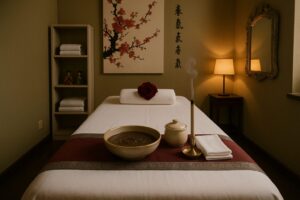
The room is kept warmer than ordinary spa temperature. Around twenty-three or twenty-four degrees Celsius. There is soft natural light, no overhead fluorescent. A small piece of music plays at low volume; if you prefer silence, we turn it off.
I prepare the mud cake in the next room. The cake is warmed gently — never hot enough to burn, around forty to forty-two degrees Celsius — and lightly moistened with warm water and a drop of essential oil. The texture, when ready, is like a slightly stiff but warm and pliable dough.
I bring it to the treatment room and lay it over the area we have agreed to treat. For an abdominal session, the cake covers a band from just below the navel to just above the pubic bone, about fifteen centimetres wide and twenty long. The weight of the cake itself — usually about three hundred grams — is part of the therapeutic effect. The pressure is mild and even, and most clients find it immediately pleasant.
The moxa
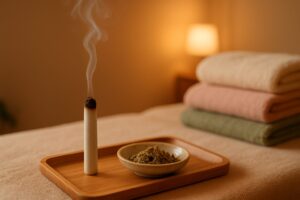
Above the mud cake, I light a small bundle of moxa — dried Artemisia vulgaris — and hold it at a controlled distance above the mud. The moxa burns slowly, like incense, producing a steady stream of warm air and aromatic smoke that descends through the mud to the skin and into the underlying tissue.
The smoke is mild and has a characteristic herbal smell — slightly like burning sage, slightly like dry hay, slightly like nothing else. Most clients find it pleasant. If anyone is sensitive to smoke or smells, we use a smokeless variation of moxa that produces nearly all the therapeutic effect with much less aromatic intensity.
I monitor the temperature constantly during the session. The mud surface should be warm to the touch; the underlying skin should feel pleasant warmth, not heat. If at any point you feel the temperature is too hot, we adjust immediately. The protocol of “more is better” does not apply here — the right temperature is a comfortable warmth, not an intense heat.
The first twenty minutes
For most clients, the first twenty minutes of the session involve a kind of slow settling. The body registers the warmth, the breathing deepens slightly, the shoulders drop into the table. Many clients begin to feel sleepy by the ten-minute mark.
You may notice subtle sensations during this period. A slight warmth radiating from the treatment area outward through the body. Sometimes a feeling of increased peristalsis — small gurgling movements in the digestive tract that are normal and indicate the parasympathetic system is engaging. Sometimes a brief, mild sensation of emotional release, particularly in clients who have been holding stress in the lower abdomen.
You do not need to do anything during this period. There is no special breathing technique, no meditation to maintain, no posture to hold. You simply lie there and let the warmth work.
The second twenty minutes
By the half-hour mark, most clients have entered a kind of light sleep. The breathing has slowed, the muscles have softened completely, the body has accepted the warmth as a stable presence and is no longer reacting to it actively. This is the deep working part of the session.
I am still present in the room during this time, monitoring the moxa, occasionally repositioning my hand to keep the heat even, sometimes adding a fresh moxa bundle as the previous one burns down. Some clients open their eyes occasionally; most do not.
This is the part of the session where, in my experience, most of the long-term effect is generated. The body has settled into a different state of regulation. The autonomic nervous system has shifted into parasympathetic dominance. The deep tissue is receiving a sustained warming input that it does not get in ordinary daily life.
The end of the session
At about the forty-minute mark, I remove the moxa, gently lift the mud cake, and clean the treatment area with warm towels. The skin underneath will be pleasantly pink and warm to the touch. Sometimes there is a faint herbal scent on the skin that persists for an hour or two.
You are not asked to get up immediately. We leave you on the table, covered with a warm blanket, for five or ten minutes. This recovery period matters — getting up too quickly produces light-headedness in some clients.
When you are ready, you change back into your clothes, and we have a brief conversation in the front room about how you are feeling. You should drink water. Some clients want a small cup of warm tea — we usually have çaj mali available in winter, regular green tea in summer.
You are then free to go. The post-session feeling, for most clients, is a kind of deep ease — slightly slowed-down, warm, settled. The full therapeutic effect builds in the days that follow. The night of sleep after a session is, for many clients, the deepest they will have had in some time.
A few honest notes
There are clients for whom mud moxibustion is not the right treatment. Pregnant women, anyone with a fever or acute infection, anyone with significant cardiovascular instability. We screen for these at intake.
There are clients who do not respond to it. This is unusual but it happens. If after three sessions there has been no change, I tell them so, and we discuss whether the underlying pattern was correctly identified or whether a different treatment would serve them better.
There is also a small group of clients who experience what we call a healing reaction — a temporary intensification of symptoms in the day or two after the first session before improvement begins. This is unsettling if you do not expect it, which is why I mention it at intake. It does not happen often, but when it does, it is not a problem; it is a sign that something is shifting.
The treatment is gentle, slow, and quiet. It does not produce dramatic immediate results. What it does — when applied to the right pattern, in the right way, with patience — is help the body return to a deep baseline state of warmth and regulation that it has lost.
That is the work.
Yang Wang practises Chinese medicine at Chinese Massage – Tai Chi Tirana.