Choosing Stones: What Makes a Good Set

Most clients do not think about the stones themselves. They feel the warmth, register that the experience is pleasant, and move on. This is reasonable. The therapist’s job is to make the materials of the work disappear so that the client can simply experience the effect.

But the stones matter. The choice of which stones to use, where to source them, how to maintain them, and how to retire them when they have reached the end of their useful life — these decisions affect what the client receives in ways that are subtle but consistent. A bad stone set produces sessions that feel slightly off in ways most clients cannot articulate. A good set produces sessions where everything falls into place naturally.

This piece is about the stones, and about the small craft decisions that lie behind a volcanic stone therapy session. It is partly for clients who are curious about the materials of their treatment, and partly for the small but growing number of practitioners who write to me asking how we source our stones in Tirana. (The foundational long-form piece on the modality itself — origin, variations, contraindications — is the volcanic stone massage guide.)

What kind of stone

The stones used in volcanic stone therapy are, almost always, basalt. The reasons for this are specific and not interchangeable.

Basalt is a dark, fine-grained igneous rock formed from rapidly cooled volcanic lava. Its specific composition — high in iron, magnesium, silica, and various trace minerals — gives it three properties that make it nearly ideal for therapeutic stone work.

First, it has high thermal mass. A basalt stone of a given size holds significantly more heat than a stone of the same size made of granite, marble, or sedimentary rock. This means a basalt stone, once warmed to working temperature, releases its heat to the body over a longer period and at a more even rate.

Second, its surface — when properly tumbled and polished — has a very specific quality. It is smooth without being slippery. The friction coefficient against oiled skin is in a range where the stone glides predictably without sliding uncontrollably. Marble is too slippery; granite is too rough; sedimentary stones are too soft to retain a usable surface after weeks of work.

Third, its hardness is in a useful range — about 6 on the Mohs scale (where talc is 1 and diamond is 10). Hard enough to retain its shape under daily use, soft enough to absorb the small impacts of being handled without chipping easily. A harder stone (granite, quartz) is more durable but transfers less heat and feels different against the body. A softer stone (sandstone, limestone) feels pleasant but breaks down within months of regular use.

We use stones sourced from a specific volcanic region in central Italy where the basalt has a particular fineness of grain and trace mineral profile that produces what experienced therapists describe as a “warm” rather than “hot” thermal quality — a difficult-to-quantify property that nonetheless makes a real difference in the client’s experience of the session.

What size, what shape

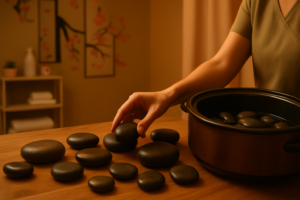
A working stone set for parlour use contains stones of carefully graded sizes. Our standard set has fifty-four stones across eight size categories.

The largest stones — about the size of a flattened pear, roughly 250 to 320 grams — are placement stones for the sacrum and the upper back. These are not moved during the session; they sit on key points and provide sustained warm-weighted contact.

The medium-large stones — about palm-sized, 150 to 200 grams — are the primary working stones for the back, hips, and large muscle groups. They are oval, slightly flattened, with one edge slightly more rounded than the other for different stroke types.

The medium stones — fitting in the curve of the fingers, 80 to 120 grams — are for the shoulders, calves, and forearms.

The smaller stones — 40 to 70 grams — are for the face, hands, and the spaces between the toes.

The smallest stones — under 30 grams, about the size of a small almond — are for very specific point work and for placement between the fingers and toes.

Each size has a specific shape developed for its use. The placement stones are flatter on the side that will rest against the body. The working stones have a particular curvature that fits the natural shape of the human hand and produces a comfortable grip when the therapist is working. The smallest stones have rounded surfaces with no edges that could catch on small structures.

The grading of the set matters more than people realise. A set with too few stones in a given size category forces the therapist to use stones that are not quite right for the work, and the session feels subtly clumsy. A well-graded set means the therapist always has the right stone within reach for what the moment requires.

How the stones are heated

The heating of the stones, in a modern parlour like ours, is done in a dedicated heating unit — a thermostatically controlled water bath that holds the stones at the working temperature between uses. Our unit is set at 58 degrees Celsius, which is at the lower end of the working range but produces what I consider the safest and most comfortable temperature.

The water in the heating unit is changed between every client and treated with a small amount of mild disinfectant. The stones themselves are cleaned with a brush after each use and given a deeper cleaning weekly.

The temperature matters. Too low (below 50°C) and the heat does not penetrate adequately into deep tissue. Too high (above 65°C) and the stones become uncomfortable on the skin, particularly during the active stroke portions of the session. The therapeutic window is, in practice, between 55 and 62 degrees, with most clients comfortable around 58.

For clients with reduced heat sensation — particularly those with diabetic neuropathy or other peripheral nerve conditions — we use stones at the lower end of the range and increase the verbal check-ins during the session. Heat that the client cannot accurately feel is heat that can cause harm without warning.

How a stone wears out

A working basalt stone has a life of several years if treated well. The stone does not “wear out” in a dramatic way; it gradually changes character.

After about two years of regular use, the surface develops a slight microscopic roughening that reduces its glide quality. Most therapists do not notice this consciously; they begin to compensate by using slightly more oil, or by altering their stroke pressure.

After about three years, the stone may develop small surface fissures that, while not visible to the casual observer, change the thermal conduction pattern of the stone. The heat transfer becomes less even.

After about four to five years, the stone has aged enough that it is time to retire it from working use. We use retired stones for other purposes — sometimes as decorative pieces, sometimes for training new therapists, sometimes given as gifts to long-term clients who have asked about them.

The replacement cycle is staggered so that we are not retiring an entire set at once. Each year, a portion of the set is renewed, which means the working set always has stones of various ages — some new and brilliantly polished, some well-broken-in and familiar, some near the end of their useful life. The variety, in fact, produces a more flexible set than a uniformly aged set would.

A small story about a particular stone

There is one stone in our current working set that I have a particular attachment to. It is a medium-large oval, well-polished, perfectly weighted at about 175 grams. It came in our most recent batch from Italy about three years ago and has been one of my primary working stones since the day it arrived.

The reason I like it is difficult to describe. It fits my hand in a way that other stones of similar size do not quite. The thermal release feels right under my palm. When I am working a stubborn area of a client’s back, this is the stone I reach for first. The others are good. This one is, for my work, slightly better.

Most therapists who do this work for long develop similar attachments to particular stones in their sets. The phenomenon is partly individual variation in the stones themselves (no two are identical), partly the gradual mutual adjustment of stone and hand over years of use, partly something harder to articulate.

When this particular stone eventually retires from working use, I will keep it. Not for any particular practical reason. Some objects accumulate enough association with good work that retiring them all the way feels wrong.

The Liaoning footnote

I mentioned in another piece that my grandmother used pieces of brick — smoothed by time, kept in a wooden box near the stove — for the household version of warm-stone application she performed on my mother and aunts in winter. The bricks were not basalt. They were kiln-fired clay. The thermal properties were different. The effect, by all reports, was satisfactory for the household-medical purposes for which the bricks were used.

The lesson I take from this is not that basalt is unnecessary — for the professional version of the work, the precision of basalt matters — but that the underlying principle of stone-and-warmth is robust enough to survive considerable variation in materials. Different cultures, different centuries, different available rocks. The body responds, in its essentials, to the same intervention.

What the professional version adds — the carefully sourced basalt, the steady heating, the graded set, the trained hands — is precision. The same intervention, performed more reliably, with better outcomes across a broader range of complaints. This is worth paying for. But the underlying wisdom of the technique does not depend on the precision; the precision sharpens something that was already valuable.

This is, in a sense, the answer to clients who ask whether they could get the same effect at home with a smooth river stone heated in warm water. Yes, in part. You will get something. The session at the parlour offers more of it, more reliably, with the safety of a trained pair of hands. But the underlying impulse — to use warm stone to address the body’s chronic cold — is one you can trust regardless of the source.

The grandmothers, again, knew.


Yang Wang practises Chinese medicine at Chinese Massage – Tai Chi Tirana.
Volcanic Stone Therapy in Winter — Why Tirana’s Cold Snap

Tirana in January is colder than tourists expect. The city sits in a basin, and when the winds come down from Dajti in late afternoon, the temperature in the streets can drop several degrees in an hour. The wet cold that comes with the rain has a specific quality — it does not freeze the body the way the dry Liaoning winter of my childhood did, but it gets into the joints in a way that the dry cold did not. Long-term residents recognise it. New arrivals are usually surprised.

In our parlour, January and February are the two months when volcanic stone therapy bookings outpace everything else. It is not a coincidence. The treatment is specifically suited to the kind of chronic cold-pattern complaint that the Tirana winter produces, and the change clients experience after a session — and the cumulative change after several sessions — is more pronounced in winter than in any other season.

This piece is for the clients who come in with the specific complaint of “the cold has gotten into my bones” and want to know why the stones help when the heating pad at home does not.

What “cold in the bones” actually is

The phrase “cold in the bones” — acari në kocka, in Albanian — is one of the more linguistically accurate descriptions of a physiological state that modern medicine does not have a comparably elegant term for.

When the body is exposed to chronic cold and damp conditions, several things happen at the level of the joints, deep muscles, and connective tissue.

The synovial fluid in the joints becomes slightly more viscous. The fluid that lubricates the joint is sensitive to temperature; at lower temperatures, it flows less smoothly. This is part of why arthritic joints stiffen in cold weather.

The fascia surrounding the muscles loses some of its hydration and elasticity. Cold reduces local blood flow, which reduces the delivery of water and nutrients to the connective tissue. Over weeks of cold exposure, the fascia becomes detectably less pliable.

The deep paraspinal muscles, particularly those around the lower back and the back of the neck, enter a low-grade chronic contraction state. The contraction is protective — it preserves core temperature — but it accumulates tension over the winter.

The peripheral circulation, particularly in the hands and feet, becomes restricted. Even when the person is in a warm room, the small blood vessels in the periphery remain narrowed for some time after the cold exposure has ended.

All of these effects, in combination, produce the sensation of cold having “gotten into” the body in a way that no single warm shower can fully resolve. The body has shifted its baseline. Restoring the previous baseline takes more than transient warmth.

What the stones do that a heating pad does not

The instinct, when one has cold in the bones, is to apply heat. A hot bath, a heating pad on the lower back, an electric blanket overnight. These help. They help temporarily.

The therapeutic difference between this kind of surface heat and a volcanic stone session lies in three factors.

Depth of heat penetration. A hot bath warms the body’s surface and, over time, raises the core temperature slightly. A heating pad warms the area directly under it but the heat does not penetrate more than a centimetre or two into the tissue. Volcanic basalt, applied at the correct temperature (between 55 and 65 degrees Celsius) and moved correctly across the body, transfers heat to a depth of five to seven centimetres — reaching the deep paraspinal muscles, the deep hip rotators, the small muscles around the kidneys, and the periarticular tissues around the joints in a way that surface heat cannot.

Sustained working temperature. A heating pad cools as it transfers heat into the body and tends to be set at temperatures too high to be safe for prolonged contact (which is why most have automatic shut-offs). The basalt stones we use stay within the therapeutic range for fifteen to twenty minutes per stone, and we rotate through multiple stones to maintain even working temperature for the full session. The deep tissue receives sustained warming input rather than the rapid hot-cold-hot cycling of an electric pad.

Mechanical work combined with heat. The stones are not only static. A skilled volcanic stone session combines stationary placement (where stones rest on key points for several minutes) with active manipulation (where the stones glide along muscle groups and joint capsules). The combination of heat plus mechanical work addresses both the temperature and the postural-tension components of winter stiffness simultaneously. (For the foundational long-form guide to this technique — origin, variations, contraindications — see the volcanic stone massage guide.)

The Tirana protocol specifically

The volcanic stone work I do in winter differs in specific ways from the protocol used in summer or in other climates. The Tirana-specific adjustments include:

Longer pre-warming of the client. The client lies on a heated table for five to ten minutes before any stone is applied. This raises the surface temperature of the body so the first stone does not produce a startling temperature contrast that recruits the sympathetic nervous system.

More attention to the lumbar region. The lower back is where the wet-cold quality of the Tirana winter accumulates most consistently. We use a larger sacral stone for this region, and the stationary placement time is extended compared to the standard protocol.

Specific work on the hips and outer thighs. The lateral fascia from the iliotibial band to the outer hip becomes particularly tight in winter, and clients often do not notice this tightness until it is released. Stone work along this region in winter consistently produces a “lighter” sensation in walking afterwards.

Attention to the small joints of the hands. Tirana winter cold particularly affects the hands of people who spend time outdoors — walking dogs along Liqeni, commuting on foot, taking children to school. Small stones placed between the fingers and worked along the back of the hand produce significant relief.

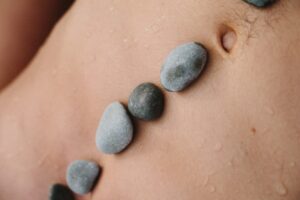
Finishing with abdominal stones. Even when the primary complaint is musculoskeletal, finishing with stationary stones on the lower abdomen produces a general systemic warming effect that improves the overall therapeutic outcome.

What a typical winter client looks like

A representative client, from this past January: a woman in her late fifties, retired teacher, lives in a flat in central Tirana with adequate but not generous heating. She walks her grandson to school each morning. She has had mild osteoarthritis in her knees for several years that is generally manageable but flares up in winter to the point where she cannot kneel on the floor to play with the child. She had tried heating pads, knee braces, a magnesium supplement, and one course of physiotherapy that had not produced a substantial change.

She came in for a single ninety-minute volcanic stone session in early January. The protocol was the full winter version described above, with particular attention to the periarticular tissues of the knees.

She called the next day to say that she had slept through the night for the first time in three weeks and had been able to kneel that morning without pain.

This is, by itself, not a study. It is an anecdote. But it is a representative anecdote — the kind of report we hear consistently from winter clients with cold-pattern complaints. The single session produces noticeable improvement; the cumulative effect of several sessions across the winter produces something closer to the body’s normal baseline.

She continued coming once every two weeks through February and into early March. By the time she stopped (in part because the weather had warmed and her knees had stabilised), she had had six sessions across two months. Her knees stayed stable through the rest of the winter and the following spring.

The Liaoning observation

I cannot help observing, when I do this work in winter, the parallel with what my own family did in Liaoning when I was a child. We did not have basalt stones in our village. We had pieces of broken brick from old kilns, smoothed by time, that my grandmother kept in a wooden box near the stove. In the deepest weeks of January she would warm a stone in the stove embers (carefully — too hot would crack it), wrap it in cloth, and apply it to her own lower back or to my mother’s knees.

The principle was identical. The materials were what was locally available. The pattern — warm stone, applied to the lower back or joints, in the deep cold of winter — has been performed in some form in every cold-climate culture that has had access to dense stone and a way to heat it. The fact that we now do it in our parlour in Tirana with carefully sourced basalt and properly heated water does not change the underlying intervention. We have refined the precision; we have not changed the wisdom.

When to consider it, when not to

Volcanic stone therapy in winter is particularly useful for:

Chronic joint stiffness that worsens in cold weather (arthritis of the knees, hips, shoulders, fingers).

Lower back pain with a “cold and damp” quality — pain that responds to heat and worsens in damp weather.

Persistent cold extremities (cold hands, cold feet) that are not improving with the usual measures.

General fatigue and “the cold has gotten into me” feeling that does not lift with adequate sleep and warm clothing.

It is less useful for, or contraindicated in, the conditions listed in the main volcanic stone guide on the parlour website — particularly pregnancy, acute infection, uncontrolled cardiovascular disease, blood-thinning medication, and active DVT.

For winter use specifically, a series of three to six sessions across the cold months produces the most reliable lasting effect. A single session helps for one to two weeks; the cumulative effect builds over the series and produces a body that handles the winter more comfortably overall.

The treatment is, in its way, one of the older interventions for living in a cold climate — warm stone, patient hands, repeated through the worst of the season. In a Tirana January, when the cold comes down off Dajti and settles into the basin for weeks, this is not a small thing.


Yang Wang practises Chinese medicine at Chinese Massage – Tai Chi Tirana.