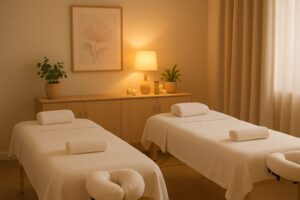
There is a particular image of couples massage in popular culture that bears almost no resemblance to what the experience actually is. The image involves rose petals on the table, candles arranged in clusters, soft jazz, two glasses of champagne waiting for the end of the session, and a kind of glamorous romantic intimacy that exists more in advertising than in any real spa I have visited or worked in.
The reality is simultaneously more ordinary and more interesting. Two people in the same room, on two tables, receiving professional bodywork in parallel. The room is warm, comfortable, well-lit but not bright. There is no champagne; most couples here would rather have a strong coffee afterwards anyway. The therapists are present and focused. The couple, depending on their preference, either talks quietly during the early part of the session or remains silent throughout. There are no rose petals.
The interesting part is what the shared experience actually does for the couple, which is often different from what people expect when they book the session for the first time. This piece is for couples considering booking a session and trying to figure out what to expect, and for anyone receiving the session as a gift and wondering what they have signed up for. (There is an earlier short piece, a growing trend in Tirana — couples discovering Chinese massage together, which sketches the broader context.)
What it is, and what it is not
A couples massage at our parlour is two simultaneous individual sessions performed in the same room by two therapists. The therapists work independently of each other — this is not four-hands work, where the therapists coordinate. Each therapist focuses on their own client. The clients are next to each other but are receiving separate treatments.
The choices we make about pressure, technique, and protocol are determined individually for each client at intake. If one partner wants firm pressure on a specific complaint and the other wants gentle relaxation work, we deliver these different sessions in parallel. The fact of being in the same room does not require the two sessions to be identical.
What couples massage is not: a romantic experience designed to produce intimacy. Romance is the client’s business, not ours. We provide professional bodywork. If the shared experience produces a quality of connection between the partners, that is welcome, but we do not engineer it. Our job is to deliver excellent sessions to each person on the table.
What couples massage is also not: a discount for booking two. The pricing reflects the use of two simultaneous therapists and the dedicated room. We do not offer a discount for the couples format. If price is the deciding factor, two separate single-therapist sessions on the same day are often more economical.
Why people book it
There are several reasons couples choose this format over individual sessions, and the reasons matter because they affect what kind of session is most appropriate.
Convenience. The couple has a single window of time available — a Sunday afternoon, a weekend in Tirana, a wedding anniversary on a specific evening — and they want to share the experience rather than each go separately. The couples session lets them book one appointment instead of two.
Comfort with the unfamiliar. One partner has never had a professional massage and is nervous about the experience. Having the other partner in the room reduces the anxiety considerably. We see this frequently — a partner who has been getting regular sessions for years brings the other partner in for the first time, and the shared format makes the introduction much smoother.
Shared rhythm. Some couples have built a regular practice of receiving sessions together as part of their ongoing relationship. The shared time is a touchstone in the week or month. They have decided, deliberately, that the parallel experience is part of how they care for themselves together.
Special occasions. Anniversaries, birthdays, milestones in the relationship. The session marks an event in a particular way that individual sessions would not.
Discharge after travel. A couple has just arrived in Tirana — sometimes from abroad, sometimes after a difficult drive — and wants to recover together before the rest of their trip begins.
The booking pattern that works less well, in my experience, is the booking pattern that approaches the session as a substitute for difficult conversation or accumulated relationship tension. The session itself cannot resolve relationship strain. It can sometimes create conditions in which strain becomes more workable, but it is not a therapeutic intervention for relationships. We are massage therapists, not couples counsellors.
The intake conversation
The intake before a couples session is slightly different from the intake before an individual session. We ask each partner the same questions we would ask any individual client — about their physical complaints, their history with massage, their preferences for pressure and technique — but we do these intakes separately. Each partner has their own brief private conversation with their therapist before the session begins.
The reason for the separate intakes is practical. People are sometimes reluctant to mention certain things in front of their partner. A specific medical condition they have not yet disclosed. A particular area of pain they prefer not to discuss. A psychological context (recent grief, anxiety about something) that they would rather their therapist know about quietly. The separate intakes allow each client to give us the full information we need without performing it for the partner.
The therapists then briefly coordinate between themselves before the session begins, agreeing on the overall rhythm and ambient temperature and which protocols each will use. The clients lie on their tables. The session begins.
The early minutes
The first minutes of a couples session have a particular quality that is different from individual sessions. Both clients are slightly aware of the other’s presence. The room has more sensory input than a single-client room would. There is a small ongoing recalibration as each partner registers that the other is also being attended to.
For many couples, this awareness gradually fades over the first ten to fifteen minutes. The partners settle into their own experiences. By the twenty-minute mark, most couples have entered what is essentially a parallel rather than shared experience — they are both receiving sessions in the same physical space, but their attention has turned inward.
For some couples, the awareness of the other persists throughout the session and is actually part of what they value about the format. They like knowing that the other is also being cared for at the same time. The parallel experience, even without explicit interaction, has a quality of shared time that they appreciate.
Neither pattern is more correct. The session works either way.
A small parlour observation
I have been doing this work for many years, and I have observed an interesting pattern in couples sessions that I do not entirely have an explanation for.
Couples who have been together for more than five or six years tend to develop a kind of breathing synchronisation during a couples session that does not happen in individual sessions. About twenty minutes in, the breathing patterns of the two partners begin to align. They are not visible to the partners themselves — neither of them is consciously coordinating — but if I watch the rise and fall of both chests, I can usually see the synchronisation begin to emerge around the twenty-minute mark.
This is not, as far as I can tell, the same phenomenon as the breath-matching that occurs between trained therapy partners (which I described in a piece about four-hands work). The therapist breath-matching is the result of deliberate training. The couple breath-matching seems to emerge spontaneously, perhaps because the partners’ nervous systems have, over years of intimate cohabitation, developed an unconscious responsiveness to each other.
I have begun, when I notice this happening, to think of it as evidence that the relationship is in a state of basic regulation. The two nervous systems are speaking to each other quietly. The session is providing the conditions in which this normally invisible communication becomes briefly observable.
When the synchronisation does not happen — which is rare, but it occurs — it sometimes points to a couple that is going through a more difficult period. I do not comment on this to the clients. It is not my business and might be misleading anyway. But it is, for me, one of the small interesting features of the work.
What to expect afterwards
The post-session experience for couples is often slightly different from individual sessions in one specific way: many couples report that the conversations they have in the hour after the session have a different quality than usual.
The parasympathetic state produced by the session shifts the nervous system into a more open, less defended mode. Combined with the shared experience just completed, this often makes whatever conversation arises between the partners more relaxed, more honest, less reactive. Couples often go out for a meal afterwards and find that the conversation flows easily, that small irritations from the past week feel less important, that they can talk about something that has been weighing on them without it becoming a problem.
This is not the session’s purpose. It is a useful side effect.
The effect is usually best preserved by not planning an immediate high-stimulation activity after the session. A quiet meal at a small restaurant near the parlour, a walk, an unhurried afternoon — these honour the post-session state. A loud event, a difficult social situation, a stressful conversation — these tend to override the effect quickly.
When this is the right choice
A couples massage session is particularly appropriate when:
The two partners both want a professional bodywork session and find it more pleasant to share the timing.
One partner is new to massage and the other’s presence helps with comfort.
The relationship has a regular self-care rhythm and the session fits into it as part of the broader pattern.
A special occasion calls for a shared experience that is not strictly romantic in the conventional sense.
It is a less appropriate choice when:
The partners have significantly different bodywork needs that would be better served by different therapists or different types of sessions.
One partner wants to discuss their physical complaints in detail and the other partner does not want to hear about them.
The relationship is in a stressed period and the session is being booked as an attempt to repair the strain.
The booking is being made primarily for the romantic-package aesthetics rather than for the therapeutic value.
For couples who have not yet tried it, my honest recommendation is to come once, see what the actual experience is like, and decide afterwards whether the format suits you. Some couples discover that they prefer it. Others discover they prefer individual sessions. Either answer is fine, and the discovery is the value of the first try.
Yang Wang practises Chinese medicine at Chinese Massage – Tai Chi Tirana. The parlour is in central Tirana, near Bulevardi Gjergj Fishta.