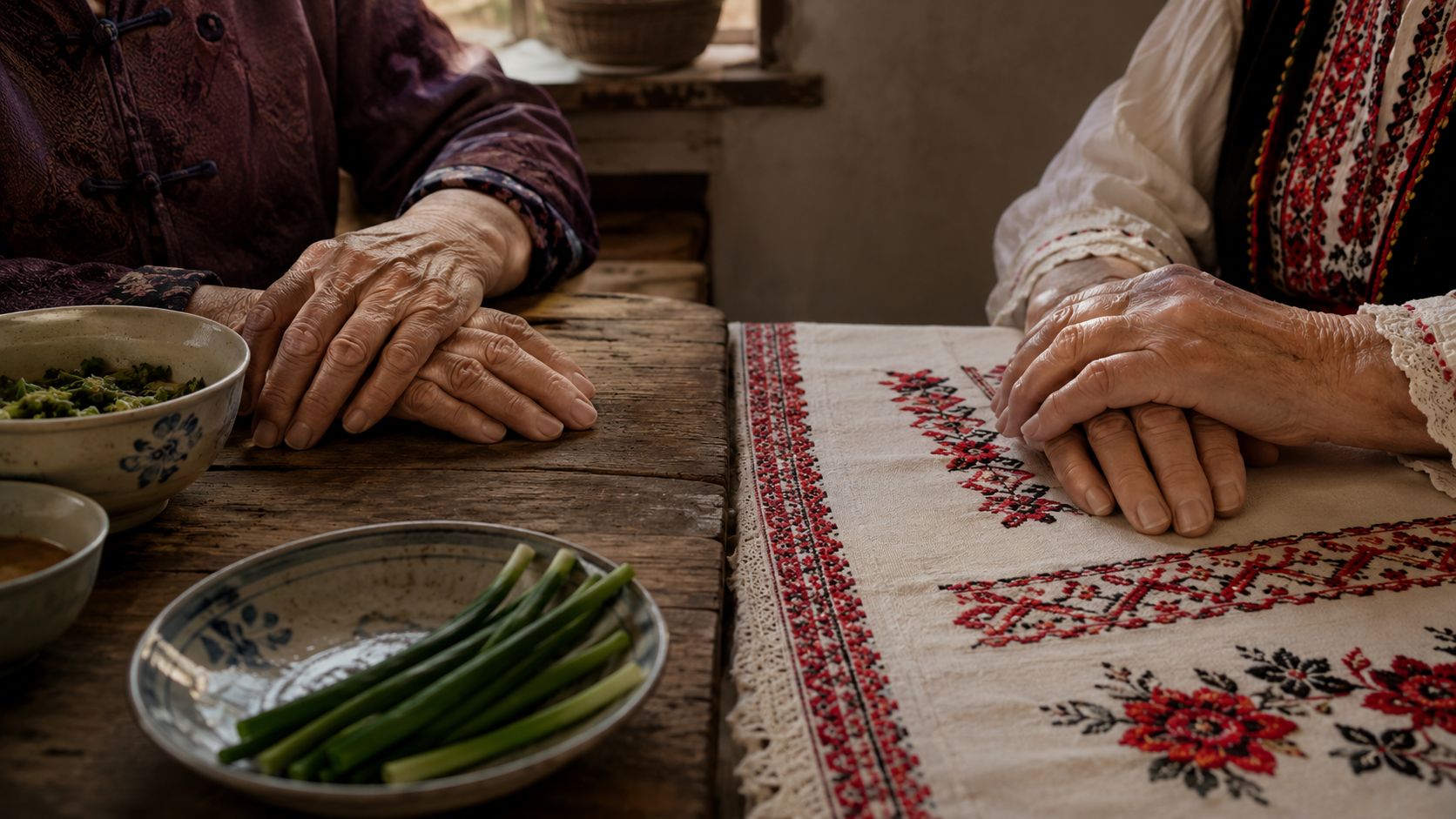
There were three older women in my family in Liaoning whose lives stayed in the background of our family memory, while the louder lives of the men around them were the ones that got told. This piece is about them — my three aunts — and about the kind of quiet steady work that women have done across many generations that does not get recorded but without which nothing else would have held together.
This is a personal piece. It is not a treatment guide. But it sits behind a lot of how I think about the older women who come into the parlour, and writing it down has been on my mind for a while.
What I know about my aunts
I had three aunts on my father’s side in Liaoning. The eldest, born in 1928, was my grandfather’s first daughter. The middle, born in 1933, was a year older than my father. The youngest, born in 1940, was the only sibling in their generation who got past primary school in any meaningful way — she trained as a schoolteacher and taught in a small town outside Shenyang for forty years.
The eldest aunt died in 2007. The middle aunt died in 2018. The youngest is still alive, in her mid-eighties, living quietly in the same town where she taught.
They lived long lives, the three of them. They were the kind of women who watched their families grow up around them, made the meals, kept the bedding aired, fed the chickens, remembered every birthday, knew which cousin was angry with which other cousin, kept the small disputes from becoming large ones.
What I remember most about them, from the few visits we made when I was a child, is the kitchen of the eldest aunt. It was a long narrow room with a kang along one wall — the traditional brick bed-platform heated from underneath by the cooking fire. In winter, all the women in the family sat on the kang in the late afternoon, peeling vegetables, chopping garlic, drinking strong tea. The conversation was constant and never about anything in particular. It was the steady murmur that I now associate with how my aunts spent most of their adult lives.
The eldest aunt was the cook. She made a Liaoning cabbage stew with pork that, in my memory, is the food I have spent twenty years in Europe trying to find equivalents for. The middle aunt was the one who kept the accounts of who owed what to whom — not in money, but in favours, in eggs, in the borrowed jar of fermented bean paste that needed to be returned. The youngest, the schoolteacher, was the one who handled anything that required reading or writing. They divided the work without ever explicitly negotiating it.
None of them held any visible position outside the household. The eldest worked as a textile factory worker for thirty-eight years. The middle worked as an administrative assistant in a state agricultural office. The youngest, the schoolteacher, was the most publicly active. Their visible lives were ordinary. Their interior lives, and the family network they managed between them, were the larger thing.
The work that does not get recorded
I have come to see, with the perspective of distance and time, what my three aunts actually did across their long lives. None of it produced dramatic events. None of it generated biographies. But it was the work without which the events that do get recorded could not have happened.
The work of holding family together, across generations, falls disproportionately to women whose names do not appear in any chronicle. The wars and the careers and the public achievements are credited to visible people whose names enter the histories. The continuity — the meals, the mended quarrels, the remembered birthdays, the kang kept warm — is maintained by mostly-invisible women whose names rarely do.
I have come to think that one of the small useful things we can do, as people who notice what happens around us, is to give some attention to these women specifically. Not to over-romanticise them — my aunts were ordinary women doing necessary work, not saints — but to give them the kind of attention that the larger world did not. Naming them, in the small writing I do, is a way of saying that this kind of work matters, even when no one is keeping a record of it. (For another small piece on how Chinese calendar time shapes my year, I have written about the Chinese zodiac and what each cycle quietly carries.)
How this connects to the work I do
I work with many women in their forties, fifties, and sixties. They are the demographic that comes most often to the parlour. They come in carrying the accumulated weight of having held things together for decades. Family, careers, ageing parents, children growing up, complicated relationships, the practical running of households and small businesses.
The pattern of their bodies, when they come in, is recognisable. The upper back tension from carrying. The lower back tension from constant low-grade vigilance. The neck and shoulder restrictions from years of compromise postures. The chronic fatigue of having been responsible for too much for too long. Many of them will still insist, settling onto the table, that they are fine — do të kalojë, it’ll pass. The shoulders, when I reach them, tell a longer story.
I do not talk about any of this during the sessions. The sessions are quiet, focused on the work that needs to be done. But the parallels are present in my mind. I am working on a body that has been doing, for many years, the kind of work my aunts did in their Liaoning kitchen. The work is not recognised by the larger world. The body remembers it. Part of what bodywork can offer, in the right register, is a small acknowledgement that the body has been carrying something significant and that it is allowed, briefly, to put it down.
That is a small thing. It is, I think, also a real thing.
The youngest aunt, the one still alive
My youngest aunt is the one who is still here. She is now eighty-five. We speak by phone roughly once a month. The phone calls are mostly about ordinary things — what she ate, what she read, who came to visit, the weather in Liaoning. She does not have many strong opinions about large matters. She has the calm, settled register of someone who has lived a long time and seen enough not to be in a hurry.
The last time we spoke, a few weeks ago, she asked me about Tirana. She has never been to Albania and never will go — she is not in a condition to travel — but she likes to hear small details about my life here.
I told her about the parlour. About the clients who come every week. About a particular older Albanian woman who has been a regular for several years and who reminds me, in some way I cannot quite name, of her.
My aunt asked what the Albanian woman looked like.
I described her — the careful posture, the practical clothes, the warm but reserved manner, the way she sometimes sits in our front room after a session and seems to be thinking about things she does not put into words.
My aunt was quiet for a moment. Then she said, “She sounds like one of us.”
I told her she was probably right.
This is, in the end, what I think my aunts and the older clients at the parlour share. They are the women who hold things together. They have been doing this work for many generations, in Liaoning kitchens and in Tirana front rooms alike. They will, presumably, continue to do it. The least I can do, in the small writing I send out into the world, is to notice them.
Yang Wang practises Chinese medicine at Chinese Massage – Tai Chi Tirana.
Ready to Feel the Difference?
Book your session today — same-day appointments available.
Book Your Session