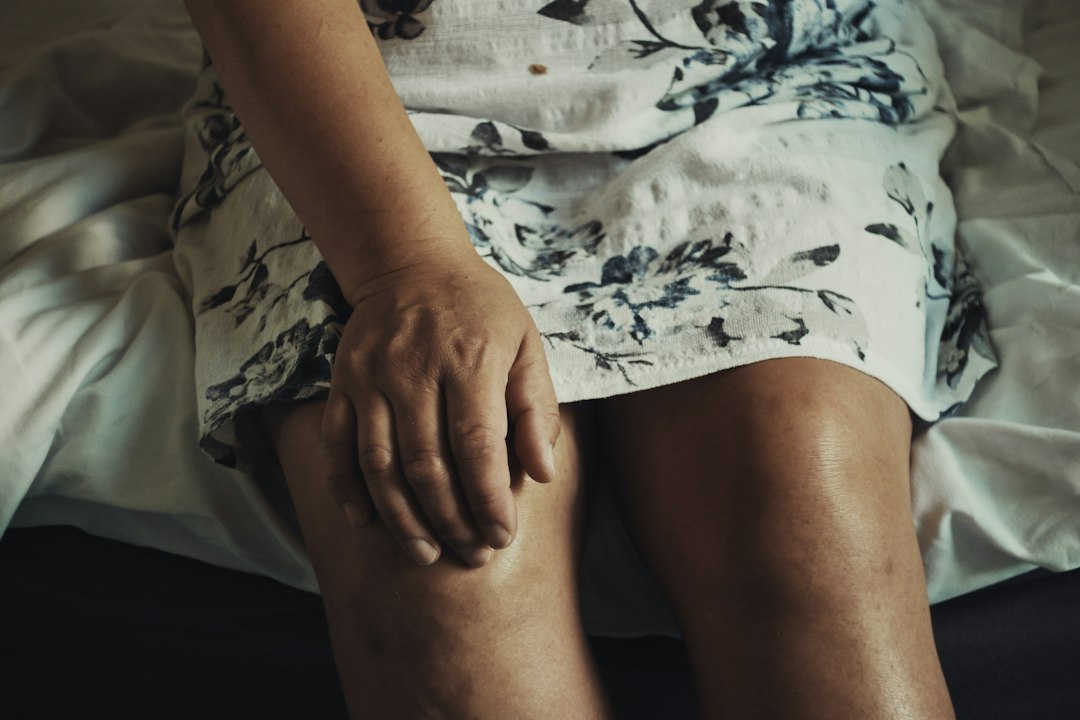
You went and did the sensible thing. You got the scan. Maybe an X-ray, maybe an MRI, maybe both. The radiologist found nothing significant. The orthopaedic surgeon said the joint looks fine. And then you walked down a flight of stairs and your knee reminded you, firmly, that something is definitely not fine.
This particular situation lands in my parlour more often than almost any other. The person has done everything right and arrived at an impasse. What I find helpful is explaining what a clear scan actually tells us — and what it cannot.
What a clean scan does (and does not) tell you
A clear scan is genuinely good news. It means there is nothing structurally wrong: no significant cartilage loss, no torn meniscus requiring a surgeon’s attention, no fracture. That rules out a long list of serious things.
What imaging does not capture is the behaviour of the tissue — how blood is moving (or not moving) through the joint, how the surrounding muscles are holding themselves, and whether the nervous system has developed a low-level pain habit. Pain that has been going on for months often takes on a life of its own, separate from whatever originally triggered it. The alarm keeps ringing even after the fire is out.
Why knees in particular
Knees are joints under near-constant mechanical load. When a knee has been sore for a while, the muscles around it tighten slightly as a protective measure, circulation through the joint decreases, and the local tissue stays in a low-grade state of guarding. The knee becomes a little cold and a little stiff, especially in the morning or after sitting. That stiffness is not imaginary — it is a real, physical state that does not show on a scan because a scan is a picture, not a measurement of function.
In Chinese medicine we would describe this as stagnation in the channel — qi and blood no longer moving freely through the area. In plainer language: the joint has stopped refreshing itself the way it should.
What the needles do, practically
Fine needles placed around the knee do two quiet things at once. First, they drive a small increase in local circulation — the tissue that has been running tight and undernourished gets a little more blood, and with it, a little more warmth. Second, they interrupt the pain-signal loop. The nervous system receives a new kind of input, which gives it an opening to turn down the background alarm rather than leave it running.
I usually place points around the knee itself, sometimes at a distance point along the channel that runs through the joint, and occasionally at Dubi (ST-35, a point that sits just beside the kneecap) and Yanglingquan (GB-34, below the outer knee). The session is quiet. Most people feel a mild spreading warmth, a brief tingle, or nothing in particular. About thirty minutes, then the needles come out.
A woman who climbed three flights every morning
She had been doing it for two years before she came to see me — climbing the stairs to her office with one hand on the rail, not because she was unsteady but because her knee hurt enough each morning that she wanted something to hold. Scans: clear. Physio: helped a little, then stopped helping. Anti-inflammatories: took the edge off but she did not want to take them indefinitely.
We did eight sessions over four weeks. After the third she said the morning stiffness was shorter. After the sixth she had stopped thinking about the rail. At the eighth I asked how the stairs were. She laughed and said she had forgotten they were a problem.
Eight sessions is not a magic number — stubborn knees that have been sore for a year or more rarely settle in two visits. But a short, consistent course is usually enough to break the loop, and many people find they need far fewer sessions than they expected.
When to come, and when to pause
If your knee pain is recent (a few days after a long hike, a new exercise programme, a minor fall), rest and time may be all you need. If something is swollen, hot to the touch, or the result of a clear trauma, see a doctor first — we work well alongside that, not instead of it.
Acupuncture is most useful for the in-between situation: pain that has outlasted its original cause, stiffness that has settled in, a joint that imaging has declared normal but that still has its own opinion every morning. That is exactly the gap it is designed for.
You can read more about what a session involves on the acupuncture page.
Yang Wang practises acupuncture at Chinese Massage – Tai Chi Tirana. The parlour is in central Tirana, a short walk from Bulevardi Myslym Shyri. Names in client stories have been changed.
Ready to Feel the Difference?
Book your session today — same-day appointments available.
Book Your Session