Cold Hands: Circulation, Raynaud’s, and Five Points

There are some clients who come to the parlour in January wearing two pairs of gloves. They take the outer pair off in the waiting area, but they keep the inner pair on until the very last moment, sometimes during the intake conversation. When they finally remove them, their hands are not just cool — they are blueish at the fingertips, mottled across the back of the knuckles, sometimes white at the nail beds. The skin temperature is several degrees below the rest of their body.

This is more common than people realise. About one in eight adults — more women than men, more after the age of forty — has measurably impaired peripheral circulation that makes their hands and feet uncomfortably cold even at room temperatures other people find pleasant. A smaller subset, perhaps one in twenty, has Raynaud’s phenomenon: episodes where the small blood vessels in the fingers spasm in response to cold or stress, cutting off circulation for several minutes at a time, sometimes painfully.

Both groups respond well, in my experience, to a particular kind of TCM intervention. The work is slow — circulation patterns do not change in a single session — but it is reliable. The grandmothers in northern China have been doing some version of it for a very long time, and from what I have read more recently, the way it works lines up reasonably well with what modern doctors know about how the small blood vessels behave.

What is happening in cold hands

Hands and feet are at the end of the circulatory road. They are also the parts of the body the autonomic nervous system is most willing to sacrifice when it perceives a threat. In a cold environment, in a stressed state, or after a long period of poor sleep, the sympathetic nervous system narrows the small arteries in the periphery to preserve core temperature for the vital organs. This is a sensible adaptation. The problem arises when the nervous system gets stuck in the constricted state and does not release it when the threat has passed.

For most people with cold hands, this stuck state has multiple contributors: chronic stress, dietary patterns that produce low-grade inflammation, sometimes a thyroid that is functioning at the lower edge of normal, sometimes — increasingly common since 2022 — a lingering effect of COVID-19 on small blood vessels.

For people with Raynaud’s, the same mechanism is operating in a more extreme form. The vessels do not just narrow — they spasm, often in response to stimuli that would not bother most people (a draught from an open refrigerator, holding a cold drink, mild emotional stress).

The conventional medical approach is, in most cases, to manage symptoms: keep warm, avoid triggers, sometimes vasodilator medications for severe cases. This is reasonable as far as it goes. It does not speak to the underlying nervous-system pattern — the stuck, over-guarded state — which is where, in my experience, acupuncture gently helps the body settle.

Five points for cold hands

The protocol I use for cold-hands clients is built around five points. Not used all at once — the combination shifts based on the individual presentation — but drawn from a core set.

Hegu (LI-4) — in the web between thumb and index finger. The classical “command point” for the hand and face. Needling here produces measurable vasodilation in the hand within ten to fifteen minutes. The effect is local but reliable, and the point has the added benefit of being easy to self-massage between sessions.

Laogong (PC-8) — in the centre of the palm. Translated as “labour palace.” Used in TCM to clear excess heat from the heart channel; from a vascular perspective, it directly affects palmar arterial flow. This is the point I use most often for clients whose cold hands are accompanied by mild anxiety — there is an interesting overlap between hand circulation and emotional state that this point seems to address.

Quchi (LI-11) — at the outer end of the elbow crease. Treats the entire forearm and acts as a relay station for circulation moving outward into the hand. Useful in clients whose poor circulation is part of a wider pattern of cold-type symptoms.

Zusanli (ST-36) — about four finger-widths below the kneecap. Not a hand point, but a foundational point for building underlying qi and warming the whole body. For clients whose cold hands are part of a deeper deficiency — chronic fatigue, low appetite, frequent colds — this point is almost always included.

Mingmen (GV-4) — on the lower back between the second and third lumbar vertebrae. “Gate of life.” A warming point that affects the body’s deep reserve. For severe cases, often combined with moxa (warming the point with the smouldering herb Artemisia vulgaris) rather than only with needling.

A standard protocol uses three or four of these points per session, sometimes alternating between sessions to cover the full range. We rarely use all five at once. (For more on how the body’s meridian map underlies these point choices, I have a longer piece on meridian conditioning that lays out the framework.)

The Liaoning grandmother method

There is something I learned from my own grandmother in Liaoning that is not in any acupuncture textbook, but which I use with cold-hands clients because it works.

She kept a small bowl of warm water on the table, and after meals — particularly in winter — she would place her hands in the bowl for two or three minutes. Not hot water. Warm. Around the temperature of a comfortable bath. The water reached past her wrists. She called it wenshou — warming the hands.

What this does, physiologically, is exactly what it sounds like: it provides a sustained, gentle warmth that allows the small blood vessels to dilate without the rebound vasoconstriction that comes from going abruptly between cold and hot. Cold hands held under hot tap water often feel worse afterwards, because the rapid warming causes a defensive over-reaction. Two minutes in warm water — slowly, with patience — teaches the vessels to relax.

I have recommended this practice to many cold-hands clients in the parlour. It is so unremarkable that some of them think I am joking. They go home, they try it, they come back two weeks later saying it has been the single most useful change they have made.

A word on the Tirana cold

People here are sure their hands will be fine because the radiators are good and the winter is short. A Tirana winter does not care how good your radiator is; the wet cold finds the hands first, on the walk to the car, and keeps them an hour after you are indoors. The warm-water habit is a small daily kindness for fingers that the season treats unkindly.

What to expect from a course of treatment

For ordinary cold hands (without Raynaud’s), a typical course is six to eight weekly sessions, followed by a maintenance session every six to eight weeks through the cold months. Most clients notice clearer improvement by the third or fourth session — hands that warm up faster after coming in from the cold, fewer episodes of needing gloves indoors, an overall reduction in the time spent feeling chilled.

For Raynaud’s specifically, the work is slower and the results are less complete. Realistic expectation: a meaningful reduction in the frequency and severity of episodes, often to the point where they become rare and brief, but not necessarily a full elimination. Clients with primary Raynaud’s (the form without an underlying autoimmune cause) respond better than clients with secondary Raynaud’s (where the cause is something like scleroderma or lupus). Acupuncture should not replace medical monitoring for the autoimmune form, but it can be a useful adjunct that reduces dependence on vasodilator medication.

A particular note for post-COVID circulation problems: these have become common in the parlour. The pattern is usually a relatively young, otherwise healthy adult who developed cold hands or feet after a COVID infection and has not seen them resolve months later. I read once that small blood-vessel changes after COVID are well-known to doctors now and that they sometimes take a long time to settle. In my own practice, acupuncture seems to help in about three cases out of four — slower than for ordinary cold hands, often needing twelve sessions or more — but the hands do come back.

The honest summary

If your hands are cold for no obvious reason, the first thing to do is see a general practitioner to rule out the conditions that mimic poor peripheral circulation: thyroid trouble, anaemia, autoimmune conditions. Once those are excluded — or being treated — acupuncture is one of the better-known traditional approaches for this complaint, and the doctors I have spoken with tend to recognise it as a sensible thing to try. Combined with the warm-water practice the grandmothers knew, daily gentle hand exercises, and (if appropriate for you) certain warming herbs in your diet, the change can be substantial.

You should not expect miracles in the first week. You should expect the hands to start remembering how to be warm by about the fourth week. By the third month, most clients are out of gloves indoors.

The body learns these things back if it is shown how.


Yang Wang practises acupuncture and Tui Na at Chinese Massage – Tai Chi Tirana.

Relaxation Massage After a Long Flight — A Diaspora Story

Erion called from Rinas airport on a Wednesday morning. He had landed forty minutes earlier on a flight from London via Vienna. Twelve hours of travel, two airports, three time zones, and a long overnight layover in a Vienna terminal that had not been kind to anyone. He was in Tirana for his grandfather’s funeral on Friday and he had a meeting Thursday afternoon with the lawyer handling the estate. He had two and a half days to be functional in a city he had not lived in for fourteen years.

“Can I come at three?” he asked. “My back is one solid piece.”

I knew Erion’s family — they had been clients for years — though I had only met him once before, briefly, on a previous visit. I told him to come at three, that we would do a ninety-minute relaxation session, and that he should drink a litre of water between now and then.

He arrived looking exactly as I remembered the diaspora returnees of his generation. Late thirties, tired, slightly displaced in his own physical body, carrying a familiar particular kind of fatigue that is not exactly jet lag and not exactly grief but partakes of both.

This piece is for him and for the many clients like him — the diaspora returning to Tirana for family events, the business travellers spending three days in the city, the visitors who arrive having travelled too long and need their body to catch up before they can do what they came here to do.

What a long flight actually does to the body

Air travel is harder on the body than most people give it credit for. The combination of factors — low cabin humidity, low cabin pressure, prolonged sitting, disrupted circadian rhythms, the dehydration that even moderate drinkers do not fully compensate for, the mild low-grade stress of being in a confined space surrounded by strangers — produces a specific physiological state that is reliably present after any flight longer than four hours.

The state has several components.

Mild dehydration affecting fascia and joint mobility. Cabin humidity is typically below twenty percent (compared to the forty-to-fifty percent of a comfortable room). Twelve hours in this environment leaves connective tissue noticeably stiffer. Many travellers experience this as a generalised body ache they cannot localise.

Sluggish circulation in the lower body. Prolonged sitting reduces venous return from the legs. Even without the rare but serious risk of deep vein thrombosis, most long-haul travellers arrive with mild lower-extremity edema, calf tightness, and slight cognitive fogginess from the reduced peripheral circulation.

Shallow breathing pattern. Aircraft seats are designed in a way that compresses the diaphragm slightly. Twelve hours of slightly compromised breathing produces a measurable shift in the chest mechanics that takes hours to resolve.

A body still on alert from cumulative low-grade stress. Even for experienced travellers, the small ongoing stressors of airports — security lines, departure board anxiety, the discomfort of close quarters — accumulate. The body arrives at the destination braced in a way that is rarely felt consciously but is plainly there once you settle on the table.

Circadian disruption. Even a single time zone shift produces measurable disruption to the body’s hormonal rhythms. Three time zones, with overnight layover in the wrong direction, produces a particular kind of disorientation that affects mood, sleep, and basic cognitive function for several days.

What a relaxation massage addresses, and what it does not

A well-designed post-travel relaxation massage can address most of these factors in a single session, though not all to the same degree.

Hydration of fascia and connective tissue. The massage strokes themselves do not add water to the body, but the work mechanically distributes fluid through the connective tissue layers and improves the local circulation that allows the body to rehydrate the affected areas effectively. Combined with adequate water intake, this can resolve most of the air-travel stiffness within the first session.

Lower body circulation. Lymphatic-style strokes in the legs, calves, and feet — performed as part of the standard relaxation protocol — mobilise the accumulated fluid and restore normal venous return. Most clients report visible reduction in lower-leg swelling within an hour of the session.

Breathing depth. The work on the upper back, shoulders, and chest restores the rib cage mobility that the airline seat compressed. Clients usually notice their breath has descended within the first thirty minutes of the session.

Sympathetic activation. The parasympathetic shift that a sustained relaxation session produces directly counteracts the accumulated low-grade stress of travel. For many travellers, this is the most subjectively important effect.

What the massage does not address is the circadian disruption itself. The body’s hormonal rhythms will reset on their own timeline (typically one day per time zone), and no amount of bodywork can speed this up. But by addressing the other components of post-flight fatigue, the massage allows the traveller to feel functional during the days that the circadian rhythm is still resetting in the background. (Travellers arriving for the December family-visit window may want to read the related piece on the particular Tirana fatigue of the holiday season.)

The protocol for post-travel clients

The session I gave Erion is one I have refined over many years of treating travellers, and it differs in specific ways from a standard relaxation session.

The first portion focuses on the legs, calves, and feet — earlier and longer than usual, because the lower-body congestion is what most post-flight clients feel most acutely. Long, slow, ascending strokes that mobilise fluid back toward the trunk. About fifteen minutes.

The second portion addresses the lower and upper back, with particular attention to the area between the shoulder blades that takes the brunt of airline-seat compression. About twenty minutes.

The third portion works the shoulders, neck, and base of the skull. This is where the cumulative travel tension becomes most accessible. About fifteen minutes.

The client then turns over. We work the chest and ribs gently to restore breathing mobility, then the abdomen lightly to support digestion (which often shuts down during travel and benefits from gentle stimulation), then the arms and hands, then return to the legs from the front. About twenty minutes.

The final ten minutes are spent on the face, scalp, and ears — partly for the deep relaxation effects, partly to address the specific tension that accumulates in the small facial muscles during a long flight when one is trying to sleep in an upright position.

The total session is ninety minutes. Sixty minutes is not enough for a post-travel session; the body needs the longer protocol to fully address the multiple components.

Erion, that Wednesday afternoon

Erion fell asleep about forty minutes into the session, which is normal and often a sign that the body has decided it is safe to do the recovery work. He woke up briefly when I asked him to turn over, and again, more fully, at the end of the session.

He did not say much. He sat up slowly, drank the glass of water I gave him, looked at his hands as if he was rediscovering them.

“I forgot what my back was supposed to feel like,” he said eventually.

He drove to his family’s house after the session. He told me later that he slept twelve hours that night — much longer than he had planned, but his body needed it — and that he felt clear-headed for the meeting on Thursday and able to be fully present at the funeral on Friday. He came back for a second session before flying out the following Tuesday.

This is the part of post-travel work that I find most quietly satisfying. The traveller arrives in Tirana with too little time to do everything they need to do, and the small intervention of a single ninety-minute session shifts the entire trajectory of their visit. They can be present for the family. They can be present for the meetings. They can sleep when they need to sleep.

A note for the diaspora specifically

The diaspora returnee carries a particular kind of travel fatigue that is not just physical. The flight from London or Frankfurt or Milan brings with it a parallel emotional adjustment: returning to a city that is and is not home, to a language that is and is not the daily language, to family members who have aged in ways that one has not seen happening in real time.

This emotional layer is not something a massage can directly address. But the parasympathetic state that the massage produces creates the conditions in which the emotional adjustment becomes easier. The body, in a regulated state, supports the heart and mind in their own work.

I have come to think of post-travel massage for the diaspora as a kind of bridge. The traveller arrives at the airport in one mode — international transit, distant from the place they have just landed in. The session at the parlour, ideally within the first twenty-four hours of arrival, helps the body actually arrive in Tirana, rather than remain in the airport-and-aircraft mode for the first several days of the visit. The visit becomes, in a useful sense, a real visit rather than a transit through.

Practical suggestions for travellers planning ahead

A few small things make the post-travel session more effective.

Drink water aggressively in the twenty-four hours before and after the session. The body needs the fluid to fully benefit from the work.

Avoid alcohol on the day of arrival. The temptation, after a long flight, is to celebrate arriving with a glass of something. Wait until the next day; the body has too much recovery to do to also process alcohol.

Schedule the session for late afternoon or early evening on the day of arrival, not first thing in the morning of the second day. The first night’s sleep after the massage is when much of the integration happens.

Plan for a quiet evening after the session. The deep relaxation effect makes social events feel forced; a slow meal at home or with very close family is the right register.

If you have travelled with significant time-zone change, also plan for an early bedtime on the night of the session. Your body will be ready for sleep sooner than usual.


Yang Wang practises massage and Chinese medicine at Chinese Massage – Tai Chi Tirana. Names in client stories have been changed.
Reading the Marks: What Cupping and Gua Sha Bruises Actually Mean

There is a moment of slight panic that visits almost every first-time cupping client about ten minutes after they have left the parlour and looked in a mirror at home. Their back is covered in circular reddish-purple marks, evenly spaced, some darker than others. In the lighting of their bathroom, this looks alarming. They wonder, briefly, whether something has gone wrong.

Nothing has gone wrong. Those marks are the entire point of the treatment, and reading them is one of the more interesting parts of the practice — for both the therapist and, increasingly, for clients who become curious about what their own body is communicating.

This piece is the longer answer to the question I get asked most often: “What do the marks mean?”

The marks are not bruises

The first thing to understand is that the marks left by cupping are not bruises in the conventional sense. A bruise comes from broken capillaries leaking blood into surrounding tissue, usually as a result of blunt force. The pattern is irregular, the pain is localised and worsens for the first day or two, and the surrounding tissue feels tender.

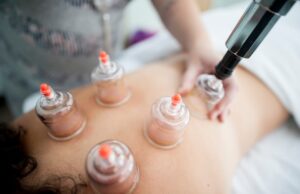
A cupping mark is something different. The negative pressure inside the cup pulls capillaries to the surface and increases their permeability. Some red blood cells and plasma move into the surrounding tissue — not because the capillaries are broken, but because the pressure differential temporarily opens the cell-to-cell junctions. The marks are flat (not raised), generally not tender to the touch by the next day, and resolve over three to seven days without any of the colour-cycling (red to blue to yellow) of a true bruise.

This distinction is not just academic. It matters because the body responds to a cupping mark differently than to a bruise. The marks initiate a local immune and circulatory response that is the actual therapeutic effect of the treatment. The body identifies the area as needing attention, sends additional blood flow, brings local immune cells, and begins clearing whatever metabolic waste had been accumulated in the tissue. This response continues for several days after the cup is removed.

Why the marks differ from person to person

The most useful information in a cupping session is encoded in how dark the marks become and where they appear darkest. A skilled practitioner reads these patterns the way a doctor might read a blood test.

Light pink, fades within an hour or two. The tissue underneath was well-circulated and not particularly stagnant. The treatment is producing a mild beneficial effect but the area was not in acute need of intervention. Common in young, healthy clients receiving a maintenance session.

Pink to red, fades within twenty-four hours. The area had some mild congestion or muscle tension but no significant underlying stagnation. This is the most common reading in clients who come in for stress-related back tension.

Dark red to purple, persists for three to five days. The tissue had significant accumulated stagnation — meaning a combination of poor circulation, retained metabolic waste, and chronic muscle tension. Common in office workers with long-standing upper back complaints, and in clients whose injury or strain happened weeks or months ago but never fully resolved.

Very dark purple, almost black, persists for a week or longer. This indicates either deep chronic stagnation (often associated with chronic pain conditions) or, more rarely, a circulation problem that warrants medical attention. When I see this in a client without an obvious explanation, we have a longer conversation about whether anything else in their health picture might be contributing.

Mark with a yellow or greenish edge. The body is processing the cupping response unusually slowly, often indicating depleted reserves. We adjust the treatment to be gentler in subsequent sessions.

The geography of the back

Where on the back the marks are darkest matters as much as how dark they are.

The classical Chinese mapping of the back uses the bladder meridian and the governor vessel as reference points. Modern Western anatomy uses muscle groups and segmental nerve distribution. The two systems map onto each other reasonably well for practical purposes.

The upper trapezius region — where most office workers carry tension — typically shows darker marks in clients whose work involves desk-bound keyboard use. The pattern often follows a “shoulder yoke” shape, deeper on whichever side carries the dominant hand.

The thoracic paraspinals — the muscle groups running alongside the spine in the upper-to-middle back — show darker marks in clients with chronic stress, particularly stress held in the breathing pattern. Clients with shallow chest breathing almost always have detectable stagnation in this region.

The lower thoracic region (between the shoulder blades and the bottom of the rib cage) corresponds, in TCM, to the liver shu and gallbladder shu points. In clients with chronic frustration, suppressed irritability, or sluggish digestion, this region often shows the deepest marks.

The lumbar region — lower back — shows stagnation patterns related to physical workload, chronic standing, or, in TCM terms, kidney-yang deficiency. Clients with chronic fatigue and cold extremities often show their deepest marks here.

In the parlour, I sometimes show clients a photograph of their own back after the treatment (with their permission, on their phone) and walk them through what the pattern is showing. Most clients find this surprisingly engaging — it is, in a sense, the first time they have seen their own internal stress state mapped onto their skin.

What gua sha shows differently

Gua sha — scraping therapy — leaves a different kind of mark, in a different pattern, that carries different information.

The technique uses a smooth-edged tool (traditionally a piece of polished horn, in modern practice often porcelain or jade) to scrape the surface of the skin with moderate pressure, after oiling the area. The friction causes a similar capillary-to-tissue response as cupping, but the pattern is linear rather than circular, and the marks tend to be more variable across the treated area.

What gua sha shows particularly well is the distribution of sha — the term for the small red spots that emerge in areas of greatest stagnation. In a well-circulated area of tissue, gua sha produces a uniform pink flush that fades in an hour. In a stagnant area, distinct red pinpoint spots emerge that may take days to resolve.

This makes gua sha excellent for diagnosing the specific zones within a larger muscle group that are most in need of intervention. The technique reveals the local pattern in a way cupping cannot, because cupping treats a whole circular area while gua sha can identify a narrow strip of greatest concern within a larger field.

The Albanian grandmother’s version

I mention this in several pieces but it bears repeating in this context: cupping is not a Chinese exclusive. Variations of the technique have existed in Albanian traditional medicine, where the word for it is ventuza. The older women in many Albanian families remember it from their childhoods — small glass cups, heated briefly with a flame to create a vacuum, applied to a child’s back to “draw out the cold” of a winter illness. The technique survived in informal household practice well into the twentieth century, became less common as modern medicine spread, and is now experiencing something of a revival. I have written more about what an Albanian grandmother taught me about cupping, if the parallel between the two traditions interests you.

What is interesting is that the diagnostic principles the Albanian grandmothers used were not as systematised as the Chinese ones, but the underlying observation was the same: where the cup leaves a darker mark, the body had more to release. The grandmothers did not have a written tradition documenting this, but they passed the observation along verbally and acted on it consistently.

A patient of mine — a woman in her sixties from a village in the north — described to me what her own grandmother had said about cupping marks. The translation she offered me was: “Where the skin remembers, there is something the body needs to forget.”

This is, in fact, a reasonable summary of the underlying principle. The marks are the body’s record of what has been held. The treatment is the process of releasing it.

When the marks should make you call us

There are circumstances where unusual cupping marks indicate something needing follow-up, not concern but attention.

Marks that take longer than seven days to resolve, in a client without obvious explanation (heavy training, recent illness, blood-thinning medication). This sometimes indicates underlying circulatory or hormonal factors worth investigating with a doctor.

Marks that are accompanied by significant ongoing pain (cupping should not produce sharp tender pain after the session — only a mild residual feeling of the work having been done).

Marks that recur in the same pattern over multiple sessions despite consistent treatment. This indicates that the underlying pattern is deeper than the cupping is reaching, and the treatment plan needs to be adjusted — sometimes by adding acupuncture or mud moxibustion, sometimes by addressing a lifestyle factor we identify together.

For ordinary cupping marks — pink to dark red, fading over three to five days, with no significant tenderness — there is nothing to worry about. They are the visible record of work done. The body will reabsorb them quickly, and what they were marking will, in most cases, no longer be there to mark.

A small etiquette note for the summer

If you have a cupping session in summer and were planning to wear an open-back top or go to the beach the next day, it is worth saying — the marks will be visible to other people. This is not a problem, but it can be unexpected. We mention it at intake. The marks have become much more recognisable in recent years (Olympic swimmers wearing them in 2016 changed the public conversation considerably), and most people now know what they are. But the first time you wear a sundress with circular marks down your back, the looks at the café can be amusing.

In Tirana, the older generation tends to nod knowingly. The younger ones sometimes ask questions. Either reaction is fine.


Yang Wang practises Chinese medicine at Chinese Massage – Tai Chi Tirana.