
Mud Moxibustion for Women’s Cycle Pain: What Three

There is a kind of period pain that no painkiller fully reaches. It begins in the lower back, wraps around through the lower abdomen, and settles deep behind the pubic bone. Heat helps for an hour. Ibuprofen takes the sharpest edge off. But the underlying ache stays, a heavy gripping presence, sometimes for two or three days each month. Women who have lived with this for years often describe it not as pain exactly but as an exhausting hostage situation — the body holding the rest of life captive until the cycle releases it.

About one in three women experiences cycle pain severe enough to interfere with daily activities at least one day a month. About one in eight experiences it severely enough that it shapes how they plan their work, their social life, their travel. Some of these cases have an identifiable medical cause — endometriosis, fibroids, adenomyosis — for which the correct first step is gynaecological investigation. But many do not. The medical workup comes back unremarkable. The pain persists. The woman is told it is “normal.”

This pattern, in Chinese medicine, is one of the most clearly described conditions in the classical texts. The diagnosis is usually some variation of xuhan tongjing — cold-deficiency painful periods — and the treatment has not changed substantially in eight hundred years, because what was developed eight hundred years ago worked, and continues to.

What the body is doing during a painful period

The uterus is a muscle. During menstruation, it contracts to expel its lining. In most women these contractions are mild enough to be barely noticeable; the cervix has dilated slightly, blood flow to the uterine wall is adequate, the contractions are coordinated.

In dysmenorrhoea, the contractions are either too strong, too sustained, or insufficiently coordinated. The uterine muscle goes into something close to a localised cramp state. Blood flow into the muscle itself can be temporarily reduced, which causes the muscle to release more pain-signalling chemicals (prostaglandins), which causes more contraction, which further reduces blood flow. The cycle perpetuates itself until the menstrual flow runs its course.

There are several reasons this can happen. In some women, there is simply a higher baseline level of inflammatory signalling. In others, the issue is hormonal — the relative balance of oestrogen and progesterone, particularly in the days before the period begins. In others — and this is the group where mud moxibustion is most effective — the pattern is one of insufficient warmth and movement in the pelvic region, a chronic baseline of poor circulation that becomes acutely problematic when the uterus is asked to work hard during menstruation. (For women approaching pregnancy or post-partum, there is a related piece on Chinese massage in pregnancy and fertility that sits in the same broader picture.)

Why warmth changes the picture

The single best home thing a woman can do for cycle pain — and this is something every traditional culture I have ever read about figured out long ago — is to apply heat to the lower belly and lower back. Hot water bottles, warm towels, heated wheat bags, sitting close to the stove. Doctors I have spoken with say that heat works about as well as ibuprofen for this kind of pain, with no side effects. Grandmothers knew this, of course, without anyone needing to confirm it for them.

But heat from a hot water bottle is shallow and brief. It addresses the symptom for the duration of the contact, and then the body returns to its previous state.

Mud moxibustion does what a hot water bottle does, but at three different levels at once.

Surface and middle-layer warmth: similar to but more even than a hot water bottle, sustained for forty-five minutes, deep enough to relax the abdominal wall and influence underlying tissue.

Deep penetrating warmth: through the moxa smoke and volatile herbal compounds, reaching the underlying pelvic organs and nervous structures in a way that surface heat cannot.

Cumulative effect over a treatment course: the changes produced by a single session do not vanish when the session ends. Over three to five treatments, the baseline pelvic blood flow improves, the autonomic regulation of uterine function shifts toward better coordination, and the inflammatory baseline drops. The next several cycles tend to be progressively less painful.

This is the part conventional treatment cannot easily replicate. Painkillers treat the episode. Hormonal contraception suppresses the cycle entirely. Heat helps for an hour. Mud moxibustion is one of the few interventions that addresses the underlying pattern in a way that produces persistent improvement.

A small case from last spring

A young woman — twenty-six, working in tourism in Tirana — came in last March. Severe cycle pain for ten years, becoming worse rather than better as she had moved through her twenties. Her gynaecologist had ruled out endometriosis with ultrasound and clinical examination. She had been on a low-dose combined contraceptive pill for three years, which had reduced but not eliminated the pain, and which she wanted to come off because she was hoping to start a family within the next two years.

Her cycle pain was, in TCM terms, almost a textbook cold-stagnation presentation. Cold hands and feet generally. Pain that responded to heat much more than to medication. Pain that was worse when she had been working long days standing up (she was in retail tourism). Pain that was worse in winter than in summer.

We did five sessions of mud moxibustion across two cycles. Once per week for three weeks, then a gap, then twice more in the second cycle, timed to the days before her period began.

First cycle after starting treatment: pain still present, but the worst day was a six out of ten instead of a nine, and she did not need to take time off work.

Second cycle: worst day a four, two days of mild discomfort instead of the usual four.

Third cycle (no treatment that month, to see if the changes held): worst day a five, but the pattern of discomfort had shortened from four days to two.

She continues to come in for a single maintenance session every other cycle, in the week before the period begins. She came off the contraceptive pill six months ago. Her cycles have been manageable since.

This is a typical course of treatment for this presentation. Not all women respond this well; some respond better, some less well. The response rate, in my own practice, is about three women out of four, with full responders (significant lasting improvement) and partial responders (some improvement, less dramatic) roughly evenly split.

Mamica’s quiet endurance

There is something I find moving about treating cycle pain. Most women who walk into the parlour with this complaint have been carrying it for years, sometimes decades. They have learned to manage it, to plan around it, to hide it at work, to be reliable in their lives despite a recurring physical event that costs them something every single month. This is a quiet kind of endurance.

The Albanian historical figure I find myself thinking of when I work with these clients is Mamica Kastrioti — Skanderbeg’s sister, whose name appears far less often in schoolbooks than her brother’s but whose composure in difficult circumstances was, in the chronicles, equally remarkable. She held what she held without making noise about it.

Women with chronic cycle pain do the same. They hold something heavy every month, often without making noise about it, often without even being fully heard when they describe it. Part of what I want this treatment to offer is the simple acknowledgement that the pain is real, that there is a coherent explanation for it, and that something can be done.

A practical note on timing

For best results, the first treatment in a course should be scheduled about a week before the period is due to begin. The subsequent treatments are usually scheduled in the same window relative to the cycle. This timing allows the warming and circulatory effects of the treatment to be present during the days when the body most needs them.

I always combine the in-parlour treatment with a few simple home practices: drinking warm rather than iced liquids in the week before the period, avoiding sitting on cold surfaces for long periods, and a small warm-water foot bath in the evenings during the days before menstruation. These small practices amplify the effect of the in-parlour sessions considerably.

For women who have tried everything and found nothing that works well, mud moxibustion is worth a real attempt. Five sessions across two cycles is usually enough to know whether your particular pattern is going to respond.

The grandmothers, after all, had been doing some version of this for centuries before we brought it into a parlour like ours. They knew what they were doing.


Yang Wang practises Chinese medicine at Chinese Massage – Tai Chi Tirana. Names and details in client stories have been changed.
Reading the Marks: What Cupping and Gua Sha Bruises Actually

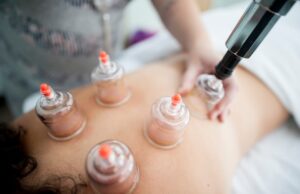
There is a moment of slight panic that visits almost every first-time cupping client about ten minutes after they have left the parlour and looked in a mirror at home. Their back is covered in circular reddish-purple marks, evenly spaced, some darker than others. In the lighting of their bathroom, this looks alarming. They wonder, briefly, whether something has gone wrong.

Nothing has gone wrong. Those marks are the entire point of the treatment, and reading them is one of the more interesting parts of the practice — for both the therapist and, increasingly, for clients who become curious about what their own body is communicating.

This piece is the longer answer to the question I get asked most often: “What do the marks mean?”

The marks are not bruises

The first thing to understand is that the marks left by cupping are not bruises in the conventional sense. A bruise comes from broken capillaries leaking blood into surrounding tissue, usually as a result of blunt force. The pattern is irregular, the pain is localised and worsens for the first day or two, and the surrounding tissue feels tender.

A cupping mark is something different. The negative pressure inside the cup pulls capillaries to the surface and increases their permeability. Some red blood cells and plasma move into the surrounding tissue — not because the capillaries are broken, but because the pressure differential temporarily opens the cell-to-cell junctions. The marks are flat (not raised), generally not tender to the touch by the next day, and resolve over three to seven days without any of the colour-cycling (red to blue to yellow) of a true bruise.

This distinction is not just academic. It matters because the body responds to a cupping mark differently than to a bruise. The marks initiate a local immune and circulatory response that is the actual therapeutic effect of the treatment. The body identifies the area as needing attention, sends additional blood flow, brings local immune cells, and begins clearing whatever metabolic waste had been accumulated in the tissue. This response continues for several days after the cup is removed.

Why the marks differ from person to person

The most useful information in a cupping session is encoded in how dark the marks become and where they appear darkest. A skilled practitioner reads these patterns the way a doctor might read a blood test.

Light pink, fades within an hour or two. The tissue underneath was well-circulated and not particularly stagnant. The treatment is producing a mild beneficial effect but the area was not in acute need of intervention. Common in young, healthy clients receiving a maintenance session.

Pink to red, fades within twenty-four hours. The area had some mild congestion or muscle tension but no significant underlying stagnation. This is the most common reading in clients who come in for stress-related back tension.

Dark red to purple, persists for three to five days. The tissue had significant accumulated stagnation — meaning a combination of poor circulation, retained metabolic waste, and chronic muscle tension. Common in office workers with long-standing upper back complaints, and in clients whose injury or strain happened weeks or months ago but never fully resolved.

Very dark purple, almost black, persists for a week or longer. This indicates either deep chronic stagnation (often associated with chronic pain conditions) or, more rarely, a circulation problem that warrants medical attention. When I see this in a client without an obvious explanation, we have a longer conversation about whether anything else in their health picture might be contributing.

Mark with a yellow or greenish edge. The body is processing the cupping response unusually slowly, often indicating depleted reserves. We adjust the treatment to be gentler in subsequent sessions.

The geography of the back

Where on the back the marks are darkest matters as much as how dark they are.

The classical Chinese mapping of the back uses the bladder meridian and the governor vessel as reference points. Modern Western anatomy uses muscle groups and segmental nerve distribution. The two systems map onto each other reasonably well for practical purposes.

The upper trapezius region — where most office workers carry tension — typically shows darker marks in clients whose work involves desk-bound keyboard use. The pattern often follows a “shoulder yoke” shape, deeper on whichever side carries the dominant hand.

The thoracic paraspinals — the muscle groups running alongside the spine in the upper-to-middle back — show darker marks in clients with chronic stress, particularly stress held in the breathing pattern. Clients with shallow chest breathing almost always have detectable stagnation in this region.

The lower thoracic region (between the shoulder blades and the bottom of the rib cage) corresponds, in TCM, to the liver shu and gallbladder shu points. In clients with chronic frustration, suppressed irritability, or sluggish digestion, this region often shows the deepest marks.

The lumbar region — lower back — shows stagnation patterns related to physical workload, chronic standing, or, in TCM terms, kidney-yang deficiency. Clients with chronic fatigue and cold extremities often show their deepest marks here.

In the parlour, I sometimes show clients a photograph of their own back after the treatment (with their permission, on their phone) and walk them through what the pattern is showing. Most clients find this surprisingly engaging — it is, in a sense, the first time they have seen their own internal stress state mapped onto their skin.

What gua sha shows differently

Gua sha — scraping therapy — leaves a different kind of mark, in a different pattern, that carries different information.

The technique uses a smooth-edged tool (traditionally a piece of polished horn, in modern practice often porcelain or jade) to scrape the surface of the skin with moderate pressure, after oiling the area. The friction causes a similar capillary-to-tissue response as cupping, but the pattern is linear rather than circular, and the marks tend to be more variable across the treated area.

What gua sha shows particularly well is the distribution of sha — the term for the small red spots that emerge in areas of greatest stagnation. In a well-circulated area of tissue, gua sha produces a uniform pink flush that fades in an hour. In a stagnant area, distinct red pinpoint spots emerge that may take days to resolve.

This makes gua sha excellent for diagnosing the specific zones within a larger muscle group that are most in need of intervention. The technique reveals the local pattern in a way cupping cannot, because cupping treats a whole circular area while gua sha can identify a narrow strip of greatest concern within a larger field.

The Albanian grandmother’s version

I mention this in several pieces but it bears repeating in this context: cupping is not a Chinese exclusive. Variations of the technique have existed in Albanian traditional medicine, where the word for it is ventuza. The older women in many Albanian families remember it from their childhoods — small glass cups, heated briefly with a flame to create a vacuum, applied to a child’s back to “draw out the cold” of a winter illness. The technique survived in informal household practice well into the twentieth century, became less common as modern medicine spread, and is now experiencing something of a revival. I have written more about what an Albanian grandmother taught me about cupping, if the parallel between the two traditions interests you.

What is interesting is that the diagnostic principles the Albanian grandmothers used were not as systematised as the Chinese ones, but the underlying observation was the same: where the cup leaves a darker mark, the body had more to release. The grandmothers did not have a written tradition documenting this, but they passed the observation along verbally and acted on it consistently.

A patient of mine — a woman in her sixties from a village in the north — described to me what her own grandmother had said about cupping marks. The translation she offered me was: “Where the skin remembers, there is something the body needs to forget.”

This is, in fact, a reasonable summary of the underlying principle. The marks are the body’s record of what has been held. The treatment is the process of releasing it.

When the marks should make you call us

There are circumstances where unusual cupping marks indicate something needing follow-up, not concern but attention.

Marks that take longer than seven days to resolve, in a client without obvious explanation (heavy training, recent illness, blood-thinning medication). This sometimes indicates underlying circulatory or hormonal factors worth investigating with a doctor.

Marks that are accompanied by significant ongoing pain (cupping should not produce sharp tender pain after the session — only a mild residual feeling of the work having been done).

Marks that recur in the same pattern over multiple sessions despite consistent treatment. This indicates that the underlying pattern is deeper than the cupping is reaching, and the treatment plan needs to be adjusted — sometimes by adding acupuncture or mud moxibustion, sometimes by addressing a lifestyle factor we identify together.

For ordinary cupping marks — pink to dark red, fading over three to five days, with no significant tenderness — there is nothing to worry about. They are the visible record of work done. The body will reabsorb them quickly, and what they were marking will, in most cases, no longer be there to mark.

A small etiquette note for the summer

If you have a cupping session in summer and were planning to wear an open-back top or go to the beach the next day, it is worth saying — the marks will be visible to other people. This is not a problem, but it can be unexpected. We mention it at intake. The marks have become much more recognisable in recent years (Olympic swimmers wearing them in 2016 changed the public conversation considerably), and most people now know what they are. But the first time you wear a sundress with circular marks down your back, the looks at the café can be amusing.

In Tirana, the older generation tends to nod knowingly. The younger ones sometimes ask questions. Either reaction is fine.


Yang Wang practises Chinese medicine at Chinese Massage – Tai Chi Tirana.