Alma came to me in the spring after spending the winter unable to leave her apartment for more than short errands. She was forty-four. She had been diagnosed with fibromyalgia six years earlier, after a process of medical investigation that had taken nearly three years and had cost her — financially and emotionally — far more than the diagnosis was worth. By the time she had a name for what was happening to her body, she had stopped trusting that any name would help.
She had tried the standard medications: pregabalin, duloxetine, low-dose amitriptyline. They had taken some edge off the pain at the cost of side effects she found difficult to live with. She had tried physiotherapy, which had been worse than nothing — the standard graded-exercise protocol had triggered week-long flares each time the dose was increased. She had tried cognitive behavioural therapy, which had helped her cope but had not changed the underlying experience. She had tried alternative medicine practitioners of various qualifications, with results that ranged from neutral to mildly harmful.
When she sat across from me at the intake conversation, she was not optimistic. She had been told by a friend that volcanic stone work had helped her cousin’s fibromyalgia, and she had decided to try it more out of a sense that she should keep trying things than out of any real expectation.
I told her, honestly, that fibromyalgia is one of the harder conditions to treat with any intervention, that I had clients who had benefited substantially from volcanic stone work and clients who had not, and that we would need to do at least four sessions before we could meaningfully assess whether this approach was going to help her. If it was not, we would stop.
She agreed. We began.
What I have come to understand about fibromyalgia
Fibromyalgia is a condition I have spent a lot of time trying to understand, because I see clients with it often and the experience they describe is real and difficult. From what I have read, and from what doctors I trust have told me, the picture is roughly this. Patients have widespread pain — usually lasting more than a year and a half, across many parts of the body — together with fatigue, broken sleep, a foggy quality of thinking, and often other complaints like sensitive digestion, sensitivity to sound or light, and frequent headaches. The pattern is recognisable but the cause is not simple.
For a long time, doctors went back and forth on whether the condition was psychological or physical. The current understanding, as I have come across it, is that fibromyalgia is about how the nervous system processes pain signals, rather than about damage in any one part of the body. The pain is real. It is not imagined. But the source of it is in how the brain and spinal cord are reading signals from the body, rather than in any tear or inflammation that an MRI could photograph.
This way of understanding fibromyalgia matters for treatment. Pushing harder on the body — deep pressure, forceful stretching, anything aggressive — tends not to help and can make things worse. What seems to help, in the clients I have seen, is whatever calms the nervous system down: gentle bodywork, careful breathing, certain medicines (for the doctor to decide), and exercise dosed very slowly. Pushing through pain is not the path.
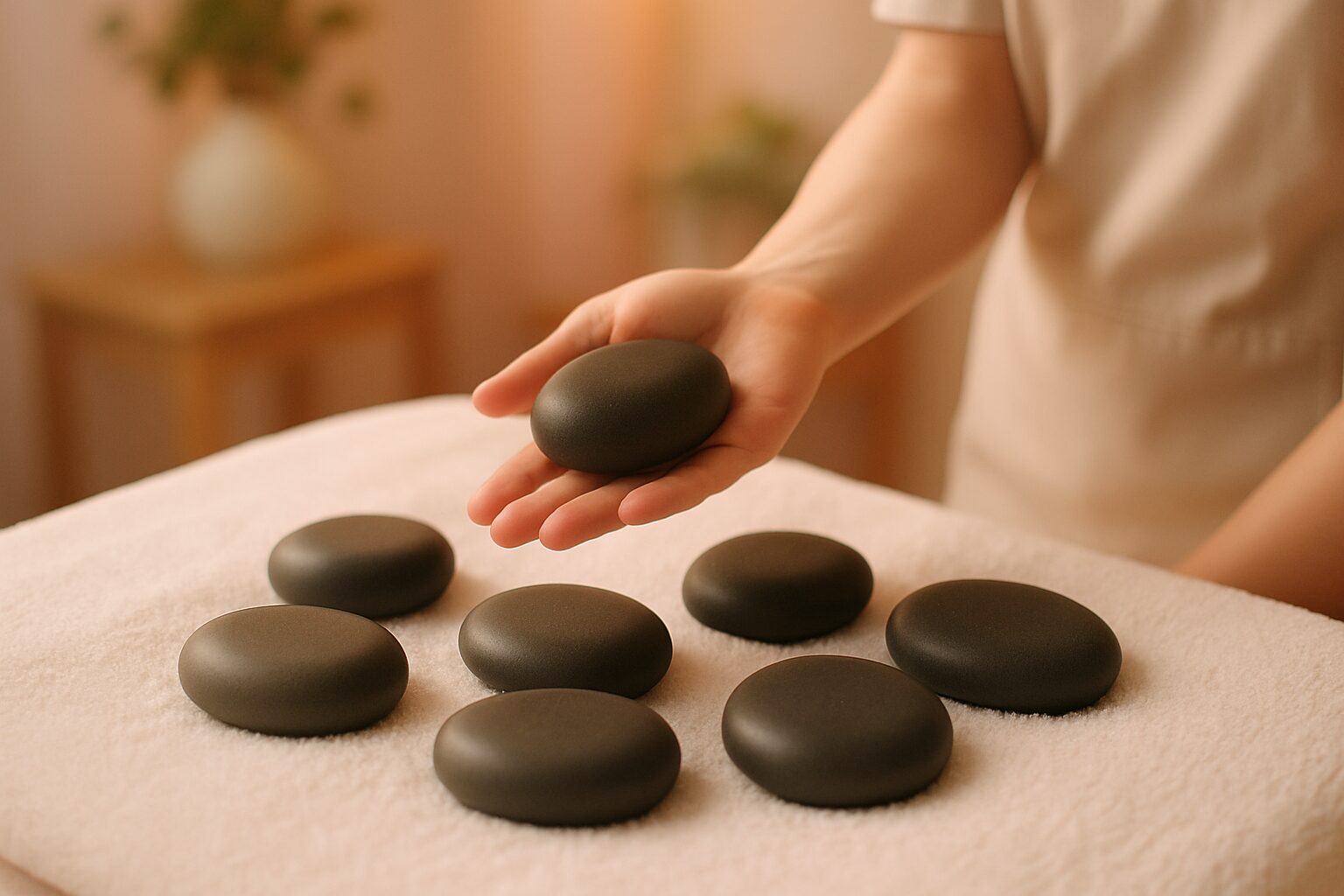
Volcanic stone therapy, in clients who respond well to it, seems to work as one of the calming approaches. The heat is deeply soothing without needing pressure. The session is a long quiet stretch of rest in a state the nervous system has often forgotten. Across several sessions, the body’s baseline of alarm seems to come down. (For readers new to the stone-therapy tradition more generally, I have a longer foundational piece, the volcanic stone massage guide, that covers origin, variations, and contraindications.)
Why stone work specifically, and not other massage
Several characteristics of stone work make it particularly suited to fibromyalgia, compared to other massage modalities.
First, the pressure can be light without losing therapeutic effect. The heat itself does much of the work. A skilled stone therapist can produce significant tissue change with pressure that would be insufficient in any other massage modality. For fibromyalgia patients, who often cannot tolerate moderate to deep pressure, this is essential.
Second, the heat penetrates deeply without requiring deep mechanical pressure. The therapeutic warmth reaches the deep paraspinal muscles, the periarticular tissues, and the small joint capsules without the therapist needing to apply force to those structures. This is the opposite of the “deep tissue” approach, and for fibromyalgia patients it is much more useful.
Third, the predictability of the experience helps the nervous system settle. Fibromyalgia patients often have hypervigilant nervous systems that scan continuously for the next painful input. The slow, predictable rhythm of stone work allows the nervous system to lower its guard. This effect is amplified across multiple sessions as the body learns that this particular treatment is reliably safe.
Fourth, the sustained warm-weighted contact of placement stones (on the sacrum, between the shoulders, in the palms) produces a deep proprioceptive grounding effect that fibromyalgia patients often report as profoundly relieving. The experience of feeling consistently safe and supported in their own body is, for many, rare and valuable.
The first four sessions
The first session with Alma was deliberately conservative. I used cooler stones than my usual setting — 54 degrees Celsius rather than 58 — and a lighter pressure than standard. The session was 90 minutes. We talked very little. I watched her body carefully throughout.
She had what I would describe as a “guarded” response in the first 30 minutes. Her shoulders did not fully drop. Her breathing remained shallow. She was, I could tell, holding herself slightly braced against the possibility that the work might hurt her — even though it was not hurting her. This is common in fibromyalgia patients in their first session. Their nervous system has been amplifying pain for so long that any new input is treated as a potential threat.
By the 45-minute mark, the bracing began to release. Her breathing deepened. The small muscles around her eyes softened. By the end of the session, she was visibly more relaxed than she had been at intake.
She called me the next day to say that she had slept the night before — seven continuous hours, for the first time in many months. The pain levels had been similar to her baseline, but the sleep had been transformative.
The second session, two weeks later, followed the same protocol with slight refinements. The bracing in the first 30 minutes was less. By the end of the session, she was lightly asleep.
The third session, the deeper integration began. I added gentle work on the cranium and face at the end of the session. Alma reported afterwards that she felt “lighter” in a way she could not specifically describe.
The fourth session was the inflection point. She arrived saying that the week between the third and fourth sessions had been the first week in years where she had not had a significant pain flare. The baseline was still present, but the amplifications had not happened.
This is the point at which I told her that I thought we should continue.
The next four sessions, and what changed
Sessions five through eight were spaced at two-week intervals, then three-week intervals. The work itself did not change dramatically; the protocol had been refined to what was working, and we continued in that direction.
What changed was Alma’s life around the sessions.
She began sleeping more reliably. The improvement was gradual but steady. By the seventh session, she was averaging six to seven hours of continuous sleep most nights.
Her pain levels reduced. Not eliminated — fibromyalgia rarely fully resolves — but the baseline shifted downward. She reported being able to do household tasks without then needing to lie down for the rest of the day. She began walking, slowly and not for long, in her neighbourhood.
The “fibro fog” lifted somewhat. She was able to read books again, which she had not done meaningfully for several years.
She began coming with her own questions about her body rather than the resigned posture of accepting whatever I might say. This shift — from passive recipient to active participant in her own care — is one of the most important markers of progress in fibromyalgia treatment.
By the eighth session, three months after we had begun, Alma was a different person from the woman who had walked into my office in March. The fibromyalgia had not gone away. But she had a life again.
Mamica Kastrioti’s kind of work
I think often, when working with fibromyalgia patients, of Mamica Kastrioti — Skanderbeg’s sister, whose composure under sustained difficulty is one of the qualities I find most admirable in Albanian historical figures. She held what she held without making noise about it. She did not break. She did not become bitter. She continued, in her own way, with the work that was hers to do.
Fibromyalgia patients carry something similar. The pain is constant. The fatigue is constant. The social misunderstanding — the family members and colleagues who do not believe the condition is real, who think it is exaggeration, who suggest you simply need to try harder — is often as exhausting as the physical symptoms. The patients who manage this with grace do so because they have developed a particular quiet strength that does not advertise itself.
Part of what I want this work to offer them is recognition. Recognition that what they are experiencing is real. Recognition that their endurance is honourable. Recognition that something can be done, slowly and carefully, that will reduce the load they are carrying.
The volcanic stones, in this work, are partly the tool and partly the gesture. The warmth they deliver is the warmth the body needs. The slowness of the session is the pace at which fibromyalgia must be addressed. The predictability of the protocol is what the hypervigilant nervous system can finally trust.
A note for fibromyalgia patients considering this
If you have fibromyalgia and have not yet tried volcanic stone therapy, here is what I would suggest:
Find a practitioner experienced with chronic pain conditions, not just any massage therapist. The work needs to be lighter, slower, and more carefully monitored than standard volcanic stone protocols.
Commit to at least four sessions, ideally six, before deciding whether it is helping. The cumulative effect builds; the first session often produces only modest changes.
Be honest with the practitioner about your pain levels, your medications, your other treatments, and any flares you have had recently. Adjustments to the protocol depend on accurate information.
If a session produces a worsening of symptoms for more than a day, communicate this. The pressure or temperature was too much. The next session should be adjusted.
Realistic expectation: meaningful reduction in pain, fatigue, and sleep disturbance, sustained across the weeks between sessions, with cumulative improvement across a course of treatment. Not a cure. Not the elimination of fibromyalgia. But a substantial improvement in daily life.
For Alma, after eight sessions, that has been enough. She continues to come for maintenance once every six weeks. She has built a life around her condition that allows her to do most of what she wants to do. The fibromyalgia is part of her, still. But it is no longer the entirety of her.
This is the work, in this kind of case. It is patient. The results are slow. They are also real.
Yang Wang practises Chinese medicine at Chinese Massage – Tai Chi Tirana. Names in client stories have been changed.
Ready to Feel the Difference?
Book your session today — same-day appointments available.
Book Your Session