What a Real Relaxation Massage Does to Your Vagus Nerve

There is a common misconception, even among people who book massages regularly, that relaxation massage is the lighter, less serious version of therapeutic massage. The “spa version.” Nice, but somehow not real treatment. Therapeutic massage works on a specific complaint; relaxation massage is just a treat.

I have come to think this framing has it almost backwards. A relaxation massage, done well, does real things to the body — to the breath, to the heart’s rhythm, to how deeply someone sleeps for the next several nights, to how the body holds tension during the days that follow. These effects are not subtle, they are not “just relaxation,” and they do not happen from a quick fifteen-minute thumb-pressure session. They emerge from a sustained sixty or ninety minutes of careful full-body work, of a kind the modern world rarely makes time for.

This piece is the longer answer to clients who ask, slightly apologetically, whether they “really need” the longer relaxation session, or whether they would be better off with something shorter and more targeted. For most people who have been chronically stressed for years, the longer session is — and this surprises them — the more important one.

A nerve I think about a lot — the vagus

There is one nerve in the body I find myself thinking about more than any other. It is called the vagus nerve, and it is the long quiet wire that connects the brain to most of the organs in the chest and belly. When this nerve is doing its job well, the heart slows down a little, the breath drops deeper, the stomach gets on with digesting, the body settles into rest mode. When it is not — and in most people who have been stressed for years, it is not — the body stays in a slightly alert, slightly braced state, all day, every day, for years.

I read once that doctors measure how well the vagus nerve is working by looking at small variations in the timing between heartbeats. A relaxed, well-regulated body has more variation. A chronically stressed body has a more rigid, less-varying rhythm. That little detail stays with me — the body’s internal music has more notes when it is well.

What interests me is that, from what I have read and from what I have seen on the table over many years, relaxation massage done well is one of the more reliable things a person can do to bring this nerve back into good working order. Not the only thing — slow breathing helps, time outdoors helps, certain kinds of singing and humming help — but a sustained session of careful slow touch is one of them.

How the work seems to settle the vagus

A few different things appear to be happening at once during a well-performed relaxation session. I will describe them in the order they happen, as I understand them.

The first is the slow steady pressure on the belly during the front-of-body portion of the session. The vagus nerve has feeler-branches in the belly wall and around the organs. Slow, sustained contact in this region — which not every therapist actually does, because some are uncomfortable working the abdomen — seems to settle the nerve quickly.

The second is the small amount of work we do around the outer ear. There is a branch of the vagus that comes up through the ear, and gentle work in the curve of the ear seems to produce an immediate quietening effect. The first time a teacher pointed this out to me, in my training, I did not believe it. Then I tried it on a fidgety client and watched her settle within a minute. I have used it ever since.

The third is harder to put my finger on, but I have read that scientists have looked at what the brain does during sustained gentle touch and they see particular regions calming down — the parts that scan for threat — while other regions, the ones associated with feeling safe with another person, become more active. The body’s stress hormones drop. The body’s bonding hormones rise. None of this is mystical. It is, as far as I can tell, what touch has always done; we just have better names for it now.

The fourth is the breathing itself. Lying face down on a warm table, with someone moving slowly in a steady rhythm, the breath naturally drops lower in the body. And deeper breathing, in turn, nudges the body further out of fight-or-flight and into rest, so the effect builds on itself across the session.

The cumulative effect of all of this over sixty or ninety minutes is, in my experience, much larger than people expect from a single session. I have seen clients whose heart rate visibly slows. Their face changes colour slightly as the blood pressure comes down. After regular sessions, many tell me they sleep differently for two or three nights afterwards. I cannot promise these effects to anyone — bodies respond differently — but I see them often enough that I take the work seriously.

What this looks like in the parlour

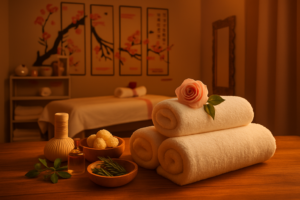
A standard relaxation massage in our parlour takes sixty or ninety minutes (we recommend ninety for first-time clients, sixty for regulars who know what they need). The session unfolds in a specific sequence — one that has been refined over decades of patient work, generation by generation, by therapists in the Tui Na tradition.

The first ten minutes are about settling. The client lies face down on the table. We use slow, broad, sweeping strokes across the back — work that produces almost no specific therapeutic effect on the muscles but which signals to the nervous system that a sustained period of touch is beginning. The body uses this period to commit to the session. The breathing slows. The shoulders drop into the table.

The middle forty to seventy minutes are the working portion. Specific regions are addressed in sequence: back, shoulders, neck, scalp, arms, hands, then (after the client turns over) abdomen, legs, feet. The pressure is medium — neither the deep work of therapeutic massage nor the light feathery touch some spas use. Medium pressure is what helps the body settle into rest most reliably; lighter pressure is sometimes perceived as ticklish or as not enough, and deeper pressure tends to keep the body on alert.

The last ten minutes are integration. The strokes become slower and broader again, signalling to the body that the session is ending. We give the client several minutes lying still on the table at the end of the work, often with a warm towel across the eyes, before asking them to sit up. This integration period matters: getting up too quickly truncates the cumulative parasympathetic effect.

A common observation from clients

There is a particular response that emerges in clients who come for relaxation massage regularly. The first session, they often describe as “very relaxing.” The second session, “I slept the best I have slept in months.” The third or fourth session, they begin to notice something they had not expected: a change in how they handle stressful situations in daily life.

The change is not dramatic. It is more that they have, at some level, a memory of what the parasympathetic state feels like. When a difficult moment arises — a stressful meeting, a frustrating commute, a difficult conversation — there is now a different reference point to return to. The body remembers there is another way to be. The recovery from the stress moment is faster, and the residual tension that used to accumulate over the day accumulates less.

This effect is what makes regular relaxation massage a genuine intervention rather than a luxury. It is not just about feeling good during the hour on the table. It is about teaching the nervous system, over weeks and months, what its own non-stressed baseline actually feels like.

Why an hour is not the same as ninety minutes

A point that surprises many clients: the difference between a sixty-minute and a ninety-minute relaxation session is not proportional to the extra thirty minutes.

The first thirty minutes of a session are largely spent in the settling phase. The body is committing to the work, the breathing is deepening, the shoulders are dropping. The therapeutic effects on the autonomic nervous system are beginning but have not yet reached their peak.

The middle thirty minutes are where most of the parasympathetic activation happens. Heart rate variability begins to improve. Cortisol begins to drop. The brain regions associated with default-mode rumination quiet down.

The last thirty minutes — the ones that are absent from a sixty-minute session — are where the deepest effects accumulate. The integration of the parasympathetic state into the body’s regulatory baseline happens during this period. Clients who have ninety-minute sessions report substantially deeper and longer-lasting effects than clients who have sixty-minute sessions, even though the difference in time is only fifty percent.

For chronic stress, anxiety, or insomnia, the ninety-minute session is meaningfully more therapeutic. For maintenance once the underlying state has improved, sixty minutes can be sufficient. (I have written separately about the one-hour March wellness session in Tirana, which sketches a regular maintenance rhythm.)

A note on what relaxation massage is not

Relaxation massage is not appropriate for: acute injury (the work would either be too gentle to help, or risk aggravating the area); active inflammatory conditions (fever, acute illness); pregnancy without specific prenatal training (we have therapists trained for prenatal work; the general relaxation protocol is modified during pregnancy); and certain specific medical conditions that require a more targeted approach.

Relaxation massage is appropriate for, and particularly useful for: chronic stress, mild to moderate anxiety, insomnia not caused by an underlying medical condition, recovery from prolonged work periods, the support of grief and emotional adjustment, and as a regular maintenance intervention for general wellbeing.

It is not, despite the casual way it is often described, the “less serious” version of massage. It is a different kind of work, with real effects, and for many people in the modern world it is exactly what the nervous system has been quietly asking for.


Yang Wang practises massage and Chinese medicine at Chinese Massage – Tai Chi Tirana. The parlour is in central Tirana, by the Lana.

Volcanic Stone Massage for Fibromyalgia: 8 Sessions

Alma came to me in the spring after spending the winter unable to leave her apartment for more than short errands. She was forty-four. She had been diagnosed with fibromyalgia six years earlier, after a process of medical investigation that had taken nearly three years and had cost her — financially and emotionally — far more than the diagnosis was worth. By the time she had a name for what was happening to her body, she had stopped trusting that any name would help.

She had tried the standard medications: pregabalin, duloxetine, low-dose amitriptyline. They had taken some edge off the pain at the cost of side effects she found difficult to live with. She had tried physiotherapy, which had been worse than nothing — the standard graded-exercise protocol had triggered week-long flares each time the dose was increased. She had tried cognitive behavioural therapy, which had helped her cope but had not changed the underlying experience. She had tried alternative medicine practitioners of various qualifications, with results that ranged from neutral to mildly harmful.

When she sat across from me at the intake conversation, she was not optimistic. She had been told by a friend that volcanic stone work had helped her cousin’s fibromyalgia, and she had decided to try it more out of a sense that she should keep trying things than out of any real expectation.

I told her, honestly, that fibromyalgia is one of the harder conditions to treat with any intervention, that I had clients who had benefited substantially from volcanic stone work and clients who had not, and that we would need to do at least four sessions before we could meaningfully assess whether this approach was going to help her. If it was not, we would stop.

She agreed. We began.

What I have come to understand about fibromyalgia

Fibromyalgia is a condition I have spent a lot of time trying to understand, because I see clients with it often and the experience they describe is real and difficult. From what I have read, and from what doctors I trust have told me, the picture is roughly this. Patients have widespread pain — usually lasting more than a year and a half, across many parts of the body — together with fatigue, broken sleep, a foggy quality of thinking, and often other complaints like sensitive digestion, sensitivity to sound or light, and frequent headaches. The pattern is recognisable but the cause is not simple.

For a long time, doctors went back and forth on whether the condition was psychological or physical. The current understanding, as I have come across it, is that fibromyalgia is about how the nervous system processes pain signals, rather than about damage in any one part of the body. The pain is real. It is not imagined. But the source of it is in how the brain and spinal cord are reading signals from the body, rather than in any tear or inflammation that an MRI could photograph.

This way of understanding fibromyalgia matters for treatment. Pushing harder on the body — deep pressure, forceful stretching, anything aggressive — tends not to help and can make things worse. What seems to help, in the clients I have seen, is whatever calms the nervous system down: gentle bodywork, careful breathing, certain medicines (for the doctor to decide), and exercise dosed very slowly. Pushing through pain is not the path.

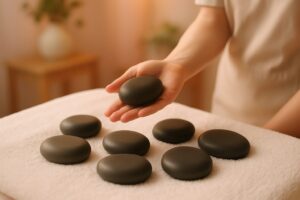
Volcanic stone therapy, in clients who respond well to it, seems to work as one of the calming approaches. The heat is deeply soothing without needing pressure. The session is a long quiet stretch of rest in a state the nervous system has often forgotten. Across several sessions, the body’s baseline of alarm seems to come down. (For readers new to the stone-therapy tradition more generally, I have a longer foundational piece, the volcanic stone massage guide, that covers origin, variations, and contraindications.)

Why stone work specifically, and not other massage

Several characteristics of stone work make it particularly suited to fibromyalgia, compared to other massage modalities.

First, the pressure can be light without losing therapeutic effect. The heat itself does much of the work. A skilled stone therapist can produce significant tissue change with pressure that would be insufficient in any other massage modality. For fibromyalgia patients, who often cannot tolerate moderate to deep pressure, this is essential.

Second, the heat penetrates deeply without requiring deep mechanical pressure. The therapeutic warmth reaches the deep paraspinal muscles, the periarticular tissues, and the small joint capsules without the therapist needing to apply force to those structures. This is the opposite of the “deep tissue” approach, and for fibromyalgia patients it is much more useful.

Third, the predictability of the experience helps the nervous system settle. Fibromyalgia patients often have hypervigilant nervous systems that scan continuously for the next painful input. The slow, predictable rhythm of stone work allows the nervous system to lower its guard. This effect is amplified across multiple sessions as the body learns that this particular treatment is reliably safe.

Fourth, the sustained warm-weighted contact of placement stones (on the sacrum, between the shoulders, in the palms) produces a deep proprioceptive grounding effect that fibromyalgia patients often report as profoundly relieving. The experience of feeling consistently safe and supported in their own body is, for many, rare and valuable.

The first four sessions

The first session with Alma was deliberately conservative. I used cooler stones than my usual setting — 54 degrees Celsius rather than 58 — and a lighter pressure than standard. The session was 90 minutes. We talked very little. I watched her body carefully throughout.

She had what I would describe as a “guarded” response in the first 30 minutes. Her shoulders did not fully drop. Her breathing remained shallow. She was, I could tell, holding herself slightly braced against the possibility that the work might hurt her — even though it was not hurting her. This is common in fibromyalgia patients in their first session. Their nervous system has been amplifying pain for so long that any new input is treated as a potential threat.

By the 45-minute mark, the bracing began to release. Her breathing deepened. The small muscles around her eyes softened. By the end of the session, she was visibly more relaxed than she had been at intake.

She called me the next day to say that she had slept the night before — seven continuous hours, for the first time in many months. The pain levels had been similar to her baseline, but the sleep had been transformative.

The second session, two weeks later, followed the same protocol with slight refinements. The bracing in the first 30 minutes was less. By the end of the session, she was lightly asleep.

The third session, the deeper integration began. I added gentle work on the cranium and face at the end of the session. Alma reported afterwards that she felt “lighter” in a way she could not specifically describe.

The fourth session was the inflection point. She arrived saying that the week between the third and fourth sessions had been the first week in years where she had not had a significant pain flare. The baseline was still present, but the amplifications had not happened.

This is the point at which I told her that I thought we should continue.

The next four sessions, and what changed

Sessions five through eight were spaced at two-week intervals, then three-week intervals. The work itself did not change dramatically; the protocol had been refined to what was working, and we continued in that direction.

What changed was Alma’s life around the sessions.

She began sleeping more reliably. The improvement was gradual but steady. By the seventh session, she was averaging six to seven hours of continuous sleep most nights.

Her pain levels reduced. Not eliminated — fibromyalgia rarely fully resolves — but the baseline shifted downward. She reported being able to do household tasks without then needing to lie down for the rest of the day. She began walking, slowly and not for long, in her neighbourhood.

The “fibro fog” lifted somewhat. She was able to read books again, which she had not done meaningfully for several years.

She began coming with her own questions about her body rather than the resigned posture of accepting whatever I might say. This shift — from passive recipient to active participant in her own care — is one of the most important markers of progress in fibromyalgia treatment.

By the eighth session, three months after we had begun, Alma was a different person from the woman who had walked into my office in March. The fibromyalgia had not gone away. But she had a life again.

Mamica Kastrioti’s kind of work

I think often, when working with fibromyalgia patients, of Mamica Kastrioti — Skanderbeg’s sister, whose composure under sustained difficulty is one of the qualities I find most admirable in Albanian historical figures. She held what she held without making noise about it. She did not break. She did not become bitter. She continued, in her own way, with the work that was hers to do.

Fibromyalgia patients carry something similar. The pain is constant. The fatigue is constant. The social misunderstanding — the family members and colleagues who do not believe the condition is real, who think it is exaggeration, who suggest you simply need to try harder — is often as exhausting as the physical symptoms. The patients who manage this with grace do so because they have developed a particular quiet strength that does not advertise itself.

Part of what I want this work to offer them is recognition. Recognition that what they are experiencing is real. Recognition that their endurance is honourable. Recognition that something can be done, slowly and carefully, that will reduce the load they are carrying.

The volcanic stones, in this work, are partly the tool and partly the gesture. The warmth they deliver is the warmth the body needs. The slowness of the session is the pace at which fibromyalgia must be addressed. The predictability of the protocol is what the hypervigilant nervous system can finally trust.

A note for fibromyalgia patients considering this

If you have fibromyalgia and have not yet tried volcanic stone therapy, here is what I would suggest:

Find a practitioner experienced with chronic pain conditions, not just any massage therapist. The work needs to be lighter, slower, and more carefully monitored than standard volcanic stone protocols.

Commit to at least four sessions, ideally six, before deciding whether it is helping. The cumulative effect builds; the first session often produces only modest changes.

Be honest with the practitioner about your pain levels, your medications, your other treatments, and any flares you have had recently. Adjustments to the protocol depend on accurate information.

If a session produces a worsening of symptoms for more than a day, communicate this. The pressure or temperature was too much. The next session should be adjusted.

Realistic expectation: meaningful reduction in pain, fatigue, and sleep disturbance, sustained across the weeks between sessions, with cumulative improvement across a course of treatment. Not a cure. Not the elimination of fibromyalgia. But a substantial improvement in daily life.

For Alma, after eight sessions, that has been enough. She continues to come for maintenance once every six weeks. She has built a life around her condition that allows her to do most of what she wants to do. The fibromyalgia is part of her, still. But it is no longer the entirety of her.

This is the work, in this kind of case. It is patient. The results are slow. They are also real.


Yang Wang practises Chinese medicine at Chinese Massage – Tai Chi Tirana. Names in client stories have been changed.

When Migraines Stop Coming on Tuesday

Erjona’s migraines used to arrive on Tuesday afternoons, between three and five o’clock, with a regularity that had made her stop scheduling client meetings for that window. She had tracked them for nearly a year before she came to see me — a small notebook with dates, weather, sleep hours, what she had eaten, what she had drunk, where she had been in her cycle. The notebook was the kind of document a person keeps when they have stopped expecting doctors to solve their problem and have decided to solve it themselves.

She was thirty-four. She worked in marketing for a logistics company with an office near Bllok. The migraines had started in 2024, six months after she moved back from Milan to take care of her mother through a long illness. They had outlasted her mother’s recovery by two years.

The neurologist she had seen — a kind, competent specialist at a private practice in Tirana — had given her sumatriptan for the acute episodes and propranolol as a preventive. The sumatriptan worked. The propranolol made her tired without reducing the frequency. She had tried magnesium, riboflavin, coenzyme Q10, the elimination of nightshades, the elimination of dairy, the elimination of red wine. The migraines kept arriving on Tuesday afternoons.

When she sat down in my office and showed me the notebook, I asked her one question.

“What happens on Monday evenings?”

She paused. She had not asked herself that question.

The pattern under the pattern

Migraines have a reputation for being unpredictable, but a careful look at the data — one’s own data, kept in a notebook — almost always reveals a pattern. The body does not produce a fifteen-hour vascular and neurological event at random. Something precedes it, sometimes by hours, sometimes by a full day. The trick is to find the upstream signal.

In Erjona’s case, the answer turned out to be small but consistent. Monday evenings, after work, she met three friends at a café in Bllok for what they called the catch-up. Two glasses of wine, often three, conversation that ran late. The wine she had eliminated once and then re-introduced after the migraines kept coming anyway. She had concluded the wine was not the trigger. She was wrong, but in a more interesting way than she had assumed.

The wine was not triggering the migraine. The wine was triggering a small, predictable disruption of her sleep architecture, which combined with elevated cortisol on Tuesday morning meetings, which combined with the late lunch she usually skipped on Tuesdays because of those meetings, which combined with — the actual immediate trigger — a small drop in blood sugar around three in the afternoon.

It was a stack of four small factors, none of them sufficient on its own. The pattern was visible only if you looked at all four together.

What acupuncture seems to do for migraine

I have read, over the years, that acupuncture is one of the better-tested traditional treatments for migraine, and that some European countries now suggest it for migraine sufferers when the usual medicines have not worked. The mechanism is still being worked out, as far as I understand it, but the broad picture goes something like this — and here I am simplifying what doctors much more qualified than me have written.

Migraine is, very roughly, a kind of over-reactive event in the brain. Something — stress, a hormonal shift, a missed meal, a glass of wine the night before — pushes the system over a threshold, and the migraine arrives. The brain of a migraine sufferer sits closer to that threshold than the average brain.

Acupuncture, done well and consistently, seems to raise the threshold by a small but useful amount. The needles work, as I understand it, partly on the nerves of the face and head, partly by quietening down inflammation, and partly through the nervous system as a whole — bringing the over-alert “fight or flight” mode back to a calmer baseline.

It is not a cure. It does not eliminate migraines for most patients. What it reliably does, in clients who respond, is reduce the frequency by between thirty and sixty percent and reduce the severity of the episodes that still occur. For someone having eight migraines a month, this means three or four migraines a month. The change is significant. It is also rarely dramatic enough to convince a sceptic in a single session.

What we did

I told Erjona the truth: her notebook had already done eighty percent of the work. The single most useful intervention she could make, before any needle touched her, was to address the Monday evening pattern. Not eliminate the friends. Not eliminate the wine. Reduce the wine to one glass, eat a real lunch on Tuesday before any meeting, carry a small protein snack for the three-o’clock window. She agreed to try this for six weeks.

In parallel, we began acupuncture. Twice a week for the first three weeks, then once a week. Points: Taiyang (the extra point at the temples), Fengchi (the gallbladder-20 point at the base of the skull), Hegu (large-intestine-4, in the hand), Taichong (liver-3, between the toes), and a rotating selection of secondary points based on what her pulse and tongue showed at each visit. A familiar pattern for migraine prevention, the kind of protocol many TCM practitioners have used for many years. Nothing experimental.

The first two weeks: no change. She had two migraines, both on Tuesday.

The third week: one migraine, on Wednesday rather than Tuesday. We discussed whether this was meaningful or coincidence. I told her honestly that I did not know yet.

The fourth week: no migraine.

The fifth week: no migraine.

The sixth week: no migraine.

She came in on the Tuesday of the seventh week, smiling for the first time since I had met her.

“I think I have not had a Tuesday afternoon in three years.”

What I told her, and what I tell anyone with a similar story

Erjona’s migraines have not vanished. She had one in the eighth week, mild, lifted with rest and a single dose of sumatriptan. She has had three more in the eleven months since. Three migraines in eleven months, compared with the previous frequency of two to three per month, is a meaningful change. It is not perfection. It is enough that she has her Tuesdays back.

The lesson I take from her case — and I have seen variations of it many times — is that acupuncture rarely fixes migraine on its own. It works best as part of an honest investigation into what the body is reacting to. The needles raise the threshold. The lifestyle changes lower the load. Together, the gap between threshold and load opens up enough that the migraines do not arrive. There is a short earlier piece on a different migraine-relief acupuncture story, if you want a second example.

If you are reading this and considering acupuncture for your own migraines, the suggestion I would make is this: keep a notebook for at least three months before your first session. Write down everything that seems irrelevant. Hours of sleep, what you drank the day before, where you were in your cycle if you have one, the weather, whether you ate breakfast. The patterns will surface. The acupuncturist’s job is then to help you address what the patterns are showing.

The needles are useful. They are not the whole story.

A small footnote about the diaspora

I notice in my practice that the migraine clients who improve the most are often those who have moved between countries — diaspora returnees, expatriates, people whose nervous systems have adapted twice or three times to new climates, new schedules, new languages. The migrating nervous system seems to be more sensitive to small ongoing disruptions. It also seems to respond particularly well to interventions that respect its complexity rather than trying to override it with a single drug.

I do not have data to back this up, only an impression from many client conversations. But it matches something I notice in myself, having moved from Liaoning to Tirana a few years ago: a body that has crossed borders carries a different kind of attention.

The work is to give it the right kind of quiet.


Yang Wang practises acupuncture at Chinese Massage – Tai Chi Tirana. The parlour is in central Tirana, near Bulevardi Gjergj Fishta. Names in client stories have been changed.