Liaoning province, in the northeast of China, is cold. Not the Mediterranean kind of cold that Tirana has in February, where you can walk outdoors in a wool coat and feel pleasantly chilled. The Liaoning winter is a serious matter. Temperatures drop to minus twenty in January. The wind off the sea finds every gap in every wall. For most of the year, daily life is built around the management of cold.
In the village where my grandmother lived — about an hour outside Tieling — winter preparation began in October. The cellar filled with cabbage, daikon, sweet potatoes, dried mushrooms. The thick quilted bedding came out of the storage chests. The braziers were checked. And, in many households, the mud cakes were prepared.
I want to write about this practice because I think it explains something important about how a treatment we now offer in our parlour in Tirana originally lived in ordinary kitchens, ordinary winters, ordinary families — long before anyone thought to put it on a price list.
How the mud cakes came to be in the house
My grandmother’s mud cakes — the ones she used on my mother every December when her winter belly started — were not bought. They were made.
The recipe had been passed down in the family from at least my great-grandmother, possibly earlier. The ingredients were ordinary, mostly local, and combined according to a sequence my grandmother performed without thinking, the way an experienced cook makes dumplings.
The base was a particular kind of clay sourced from a river bank about twenty kilometres from the village. Once a year, in late summer, one of my uncles would drive out with a shovel and a few canvas sacks to collect the year’s supply. The clay was washed several times, dried on flat boards in the sun, ground in a stone mill, and stored in a sealed jar in the pantry.
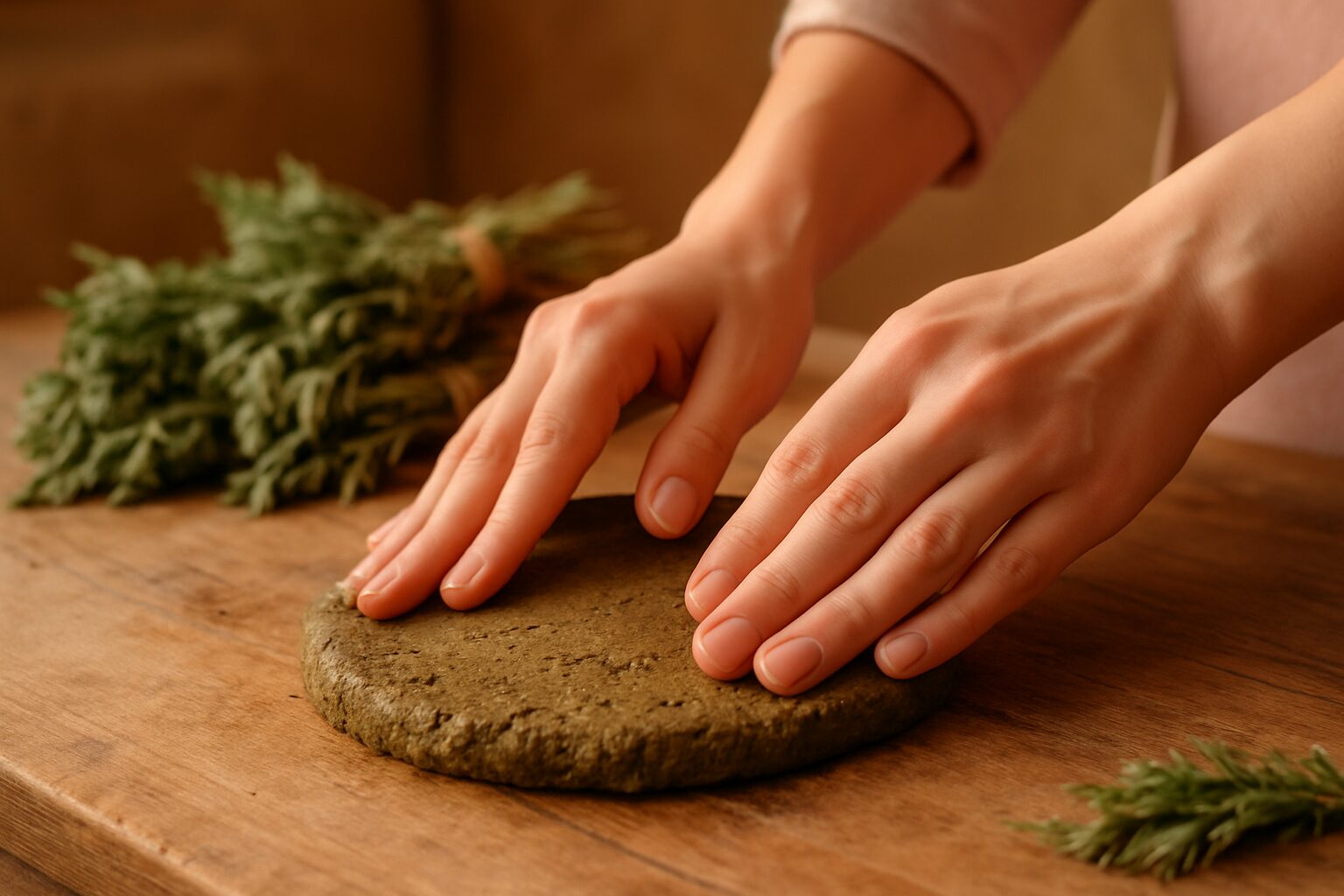
In autumn, the mugwort was harvested from the hills above the village. The plants were cut, hung upside down in bundles in the attic, dried for a month, and the leaves were then stripped from the stems and ground to a coarse powder.
When the cakes were to be made — usually in late November, in time for the coldest months — the powdered clay was mixed with the mugwort, with cinnamon bark purchased from the herbalist in town, with a little dried ginger, and with one or two other ingredients I never fully learned because the recipe was somewhat closely held even within the family. The mixture was moistened with warm water, kneaded like a dough, and formed into flat cakes about the size of a hand and half a centimetre thick. The cakes were dried slowly on a warm stone near the stove, then wrapped in cloth and stored in a wooden box near the chimney.
By the time the winter cold-belly season arrived, the cakes were ready.
Who used them, and how
My grandmother used them on my mother, her daughter-in-law, when the winter belly came on her every year. She also used them on herself, on her own lower back, when the cold weather brought out the joint pain she had developed in her sixties.
The cake was warmed on the stove — never directly on the heat, but on a metal tray placed above the heat, slowly, until it was warm to the touch but not hot. It was then placed on the affected area, and a small bundle of moxa was lit above it. The treatment took about half an hour. My grandmother would sit in the chair next to the bed, knitting or talking quietly, watching the moxa carefully so that the heat was always the right intensity.
When the treatment was over, the cake was wrapped back in its cloth and returned to the box. The same cake could be used many times over the winter — only when it had crumbled and lost integrity would a new one be made.
This was not, in our family, a medical treatment in the modern sense. It was a household practice. It was as ordinary as making chicken broth for a cold or applying a hot compress to a stiff neck. The grandmothers did it. The mothers learned to do it. The daughters watched, and eventually learned themselves.
That this practice corresponds, almost exactly, to a treatment described in the Huangdi Neijing — the foundational text of Chinese medicine, compiled around the second century BCE — is something I only learned much later, in medical school. The connection between my grandmother’s hands and an ancient text was not something she would have considered relevant. She knew what she was doing because her mother had shown her.
From a village kitchen to a treatment room
I moved to Tirana in 2020, carrying this memory of my grandmother’s kitchen with me. What struck me, over the years since, was how strange it felt to take something that had simply been there — as ordinary in our house as a pot of broth on the stove — and one day write it on a treatment menu with a duration and a price beside it.
There is a particular Tirana feeling I have come to know well: the friend who hears what I do for a living, waves a hand, and says her cousin “knows someone” for everything. A plumber, a notary, a man with a van, and now, apparently, mud and moxa. The instinct to keep these things in the family, off the books, between people who trust each other, is not so different from how my grandmother kept her recipe — somewhat closely held, passed by hand rather than written down. (I have written elsewhere about the year of the Fire Horse and the small Chinese-calendar markers of my year — these family practices live alongside that bigger seasonal rhythm.)
Why this still matters
I do not bring up these old practices because I want to romanticise them. There are things modern medicine does that traditional practices cannot. Insulin saves lives. Antibiotics save lives. The MRI scanner sees inside the body in ways no pair of hands ever could.
But there are also things that modern medicine, in its rush toward measurement and intervention, has stopped being good at. The slow work of restoring a body that has been chronically depleted. The treatment of patterns rather than single diagnostic codes. The understanding that warmth, applied thoughtfully and over time, changes the body in ways that no pill can replicate.
Mud moxibustion is one of those slow treatments. We offer it in our parlour in Tirana because it works for the patterns it is designed to address — patterns my grandmother in Liaoning would have recognised at a glance, and which she certainly never needed a research trial to confirm.
When I prepare a mud cake for a client now — using mud and herbs imported from a producer in Shandong rather than collected from a river bank, prepared in our treatment room rather than a kitchen — I am performing, with small adjustments, the same intervention my grandmother performed decades ago in a village in Liaoning. The technology has not changed. The body has not changed. What works still works.
A small ritual I have started
I have begun, with first-time mud moxibustion clients, mentioning this history briefly during the intake. Not as a sales pitch — the treatment will work or not work on its own merits — but as context. Several clients have told me afterwards that knowing the treatment came from grandmothers, in real homes, made it feel more meaningful to them than something handed over in a cold consulting room.
I think they are right. Some kinds of healing belong to a longer tradition than a single profession or a single century. To offer them well, we have to remember where they came from.
That is part of why we offer this treatment in Tirana. Not because it is exotic, but because it is, in its origins, much closer to home than people might think.
Yang Wang practises mud moxibustion and other Chinese medicine modalities at Chinese Massage – Tai Chi Tirana. The parlour is in central Tirana, a short walk from Bulevardi Myslym Shyri.
Ready to Feel the Difference?
Book your session today — same-day appointments available.
Book Your Session