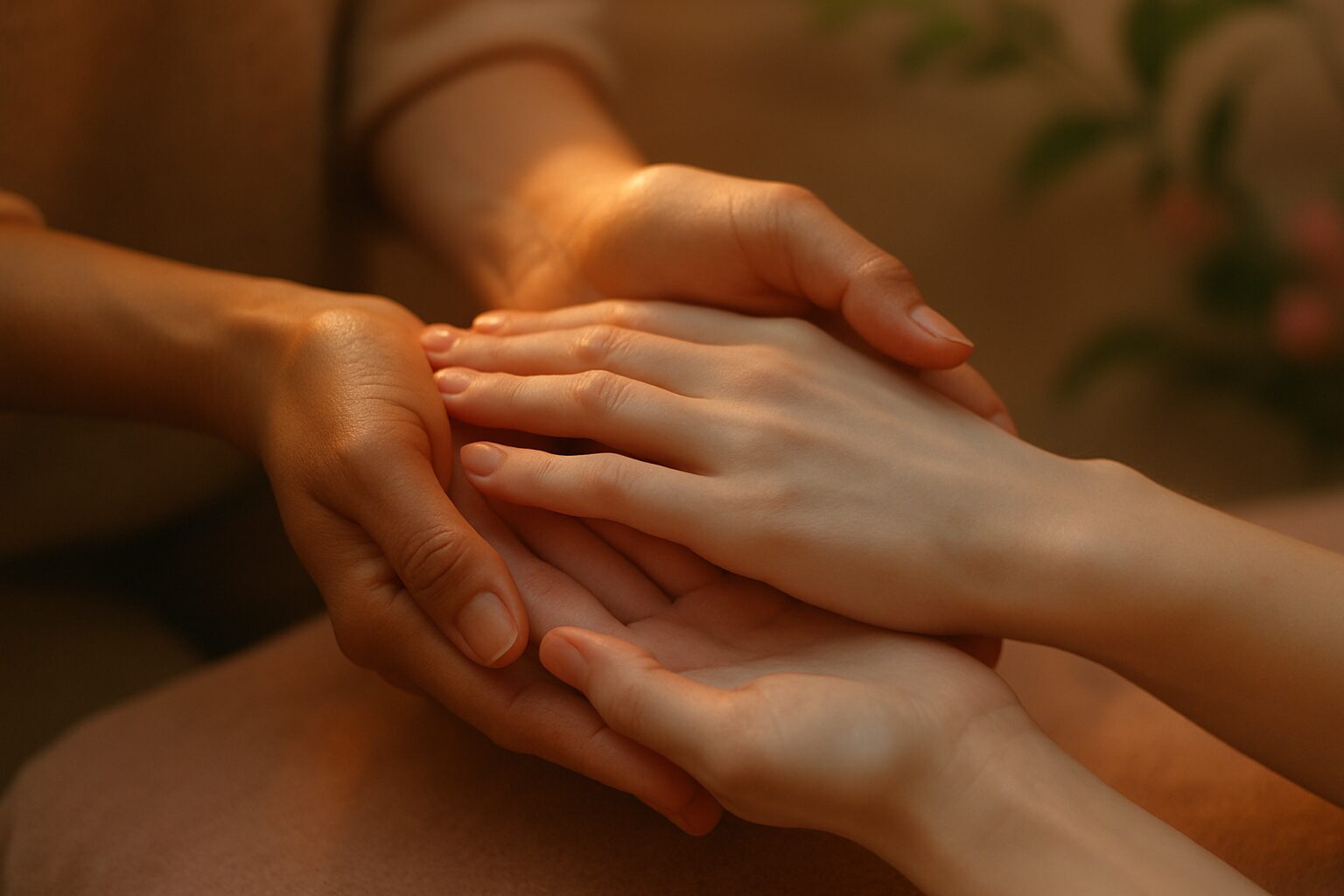
There are some clients who come to the parlour in January wearing two pairs of gloves. They take the outer pair off in the waiting area, but they keep the inner pair on until the very last moment, sometimes during the intake conversation. When they finally remove them, their hands are not just cool — they are blueish at the fingertips, mottled across the back of the knuckles, sometimes white at the nail beds. The skin temperature is several degrees below the rest of their body.
This is more common than people realise. About one in eight adults — more women than men, more after the age of forty — has measurably impaired peripheral circulation that makes their hands and feet uncomfortably cold even at room temperatures other people find pleasant. A smaller subset, perhaps one in twenty, has Raynaud’s phenomenon: episodes where the small blood vessels in the fingers spasm in response to cold or stress, cutting off circulation for several minutes at a time, sometimes painfully.
Both groups respond well, in my experience, to a particular kind of TCM intervention. The work is slow — circulation patterns do not change in a single session — but it is reliable. The grandmothers in northern China have been doing some version of it for a very long time, and from what I have read more recently, the way it works lines up reasonably well with what modern doctors know about how the small blood vessels behave.
What is happening in cold hands
Hands and feet are at the end of the circulatory road. They are also the parts of the body the autonomic nervous system is most willing to sacrifice when it perceives a threat. In a cold environment, in a stressed state, or after a long period of poor sleep, the sympathetic nervous system narrows the small arteries in the periphery to preserve core temperature for the vital organs. This is a sensible adaptation. The problem arises when the nervous system gets stuck in the constricted state and does not release it when the threat has passed.
For most people with cold hands, this stuck state has multiple contributors: chronic stress, dietary patterns that produce low-grade inflammation, sometimes a thyroid that is functioning at the lower edge of normal, sometimes — increasingly common since 2022 — a lingering effect of COVID-19 on small blood vessels.
For people with Raynaud’s, the same mechanism is operating in a more extreme form. The vessels do not just narrow — they spasm, often in response to stimuli that would not bother most people (a draught from an open refrigerator, holding a cold drink, mild emotional stress).
The conventional medical approach is, in most cases, to manage symptoms: keep warm, avoid triggers, sometimes vasodilator medications for severe cases. This is reasonable as far as it goes. It does not speak to the underlying nervous-system pattern — the stuck, over-guarded state — which is where, in my experience, acupuncture gently helps the body settle.
Five points for cold hands
The protocol I use for cold-hands clients is built around five points. Not used all at once — the combination shifts based on the individual presentation — but drawn from a core set.
Hegu (LI-4) — in the web between thumb and index finger. The classical “command point” for the hand and face. Needling here produces measurable vasodilation in the hand within ten to fifteen minutes. The effect is local but reliable, and the point has the added benefit of being easy to self-massage between sessions.
Laogong (PC-8) — in the centre of the palm. Translated as “labour palace.” Used in TCM to clear excess heat from the heart channel; from a vascular perspective, it directly affects palmar arterial flow. This is the point I use most often for clients whose cold hands are accompanied by mild anxiety — there is an interesting overlap between hand circulation and emotional state that this point seems to address.
Quchi (LI-11) — at the outer end of the elbow crease. Treats the entire forearm and acts as a relay station for circulation moving outward into the hand. Useful in clients whose poor circulation is part of a wider pattern of cold-type symptoms.
Zusanli (ST-36) — about four finger-widths below the kneecap. Not a hand point, but a foundational point for building underlying qi and warming the whole body. For clients whose cold hands are part of a deeper deficiency — chronic fatigue, low appetite, frequent colds — this point is almost always included.
Mingmen (GV-4) — on the lower back between the second and third lumbar vertebrae. “Gate of life.” A warming point that affects the body’s deep reserve. For severe cases, often combined with moxa (warming the point with the smouldering herb Artemisia vulgaris) rather than only with needling.
A standard protocol uses three or four of these points per session, sometimes alternating between sessions to cover the full range. We rarely use all five at once. (For more on how the body’s meridian map underlies these point choices, I have a longer piece on meridian conditioning that lays out the framework.)
The Liaoning grandmother method
There is something I learned from my own grandmother in Liaoning that is not in any acupuncture textbook, but which I use with cold-hands clients because it works.
She kept a small bowl of warm water on the table, and after meals — particularly in winter — she would place her hands in the bowl for two or three minutes. Not hot water. Warm. Around the temperature of a comfortable bath. The water reached past her wrists. She called it wenshou — warming the hands.
What this does, physiologically, is exactly what it sounds like: it provides a sustained, gentle warmth that allows the small blood vessels to dilate without the rebound vasoconstriction that comes from going abruptly between cold and hot. Cold hands held under hot tap water often feel worse afterwards, because the rapid warming causes a defensive over-reaction. Two minutes in warm water — slowly, with patience — teaches the vessels to relax.
I have recommended this practice to many cold-hands clients in the parlour. It is so unremarkable that some of them think I am joking. They go home, they try it, they come back two weeks later saying it has been the single most useful change they have made.
A word on the Tirana cold
People here are sure their hands will be fine because the radiators are good and the winter is short. A Tirana winter does not care how good your radiator is; the wet cold finds the hands first, on the walk to the car, and keeps them an hour after you are indoors. The warm-water habit is a small daily kindness for fingers that the season treats unkindly.
What to expect from a course of treatment
For ordinary cold hands (without Raynaud’s), a typical course is six to eight weekly sessions, followed by a maintenance session every six to eight weeks through the cold months. Most clients notice clearer improvement by the third or fourth session — hands that warm up faster after coming in from the cold, fewer episodes of needing gloves indoors, an overall reduction in the time spent feeling chilled.
For Raynaud’s specifically, the work is slower and the results are less complete. Realistic expectation: a meaningful reduction in the frequency and severity of episodes, often to the point where they become rare and brief, but not necessarily a full elimination. Clients with primary Raynaud’s (the form without an underlying autoimmune cause) respond better than clients with secondary Raynaud’s (where the cause is something like scleroderma or lupus). Acupuncture should not replace medical monitoring for the autoimmune form, but it can be a useful adjunct that reduces dependence on vasodilator medication.
A particular note for post-COVID circulation problems: these have become common in the parlour. The pattern is usually a relatively young, otherwise healthy adult who developed cold hands or feet after a COVID infection and has not seen them resolve months later. I read once that small blood-vessel changes after COVID are well-known to doctors now and that they sometimes take a long time to settle. In my own practice, acupuncture seems to help in about three cases out of four — slower than for ordinary cold hands, often needing twelve sessions or more — but the hands do come back.
The honest summary
If your hands are cold for no obvious reason, the first thing to do is see a general practitioner to rule out the conditions that mimic poor peripheral circulation: thyroid trouble, anaemia, autoimmune conditions. Once those are excluded — or being treated — acupuncture is one of the better-known traditional approaches for this complaint, and the doctors I have spoken with tend to recognise it as a sensible thing to try. Combined with the warm-water practice the grandmothers knew, daily gentle hand exercises, and (if appropriate for you) certain warming herbs in your diet, the change can be substantial.
You should not expect miracles in the first week. You should expect the hands to start remembering how to be warm by about the fourth week. By the third month, most clients are out of gloves indoors.
The body learns these things back if it is shown how.
Yang Wang practises acupuncture and Tui Na at Chinese Massage – Tai Chi Tirana.
Ready to Feel the Difference?
Book your session today — same-day appointments available.
Book Your Session