My life in a comic strip

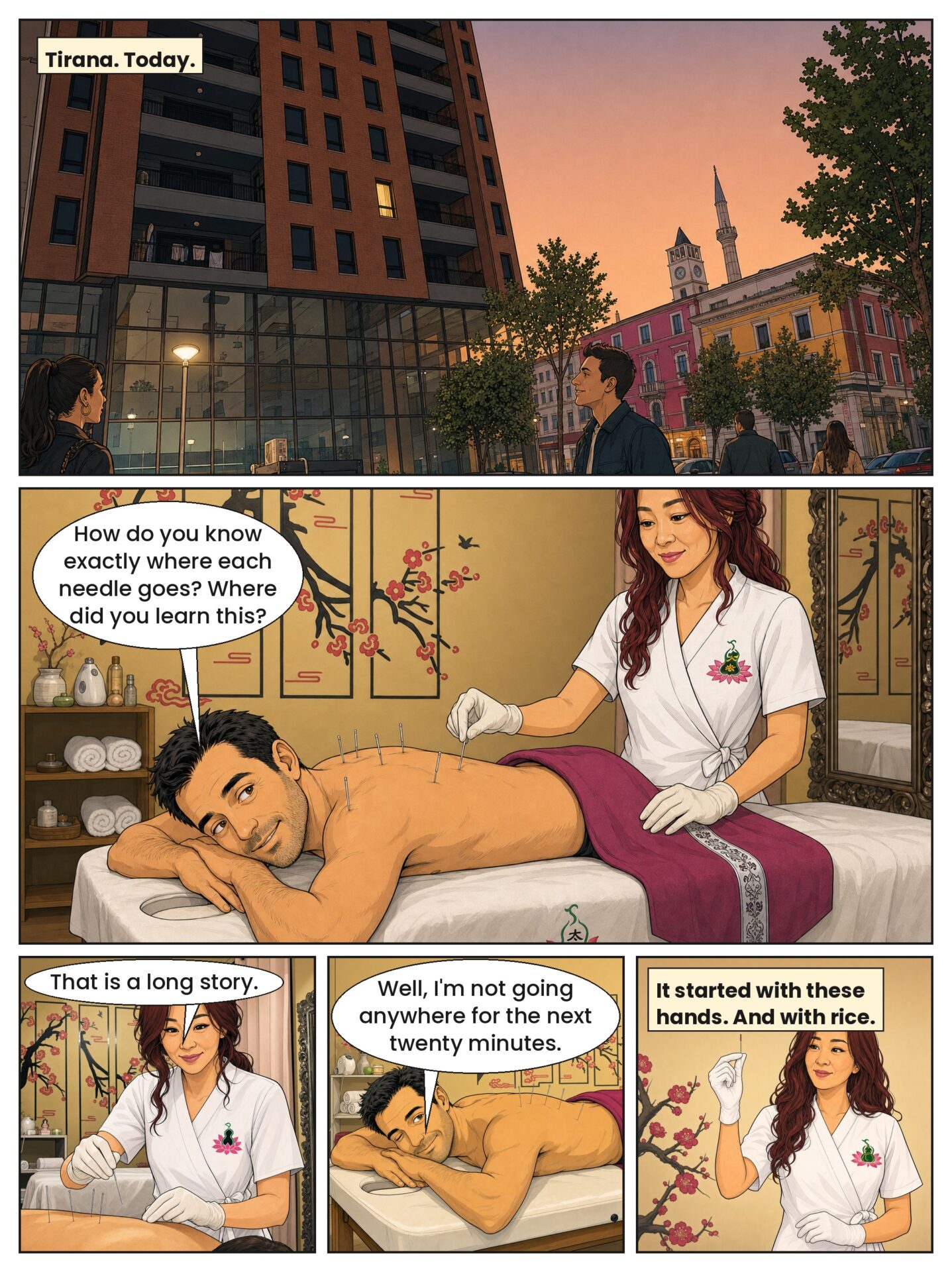
A patient once asked me, halfway through an acupuncture session, how I know exactly where each needle goes and where I learned it. I told him it was a long story. He said he wasn’t going anywhere for the next twenty minutes.

So here it is – the long story, in eight pages.

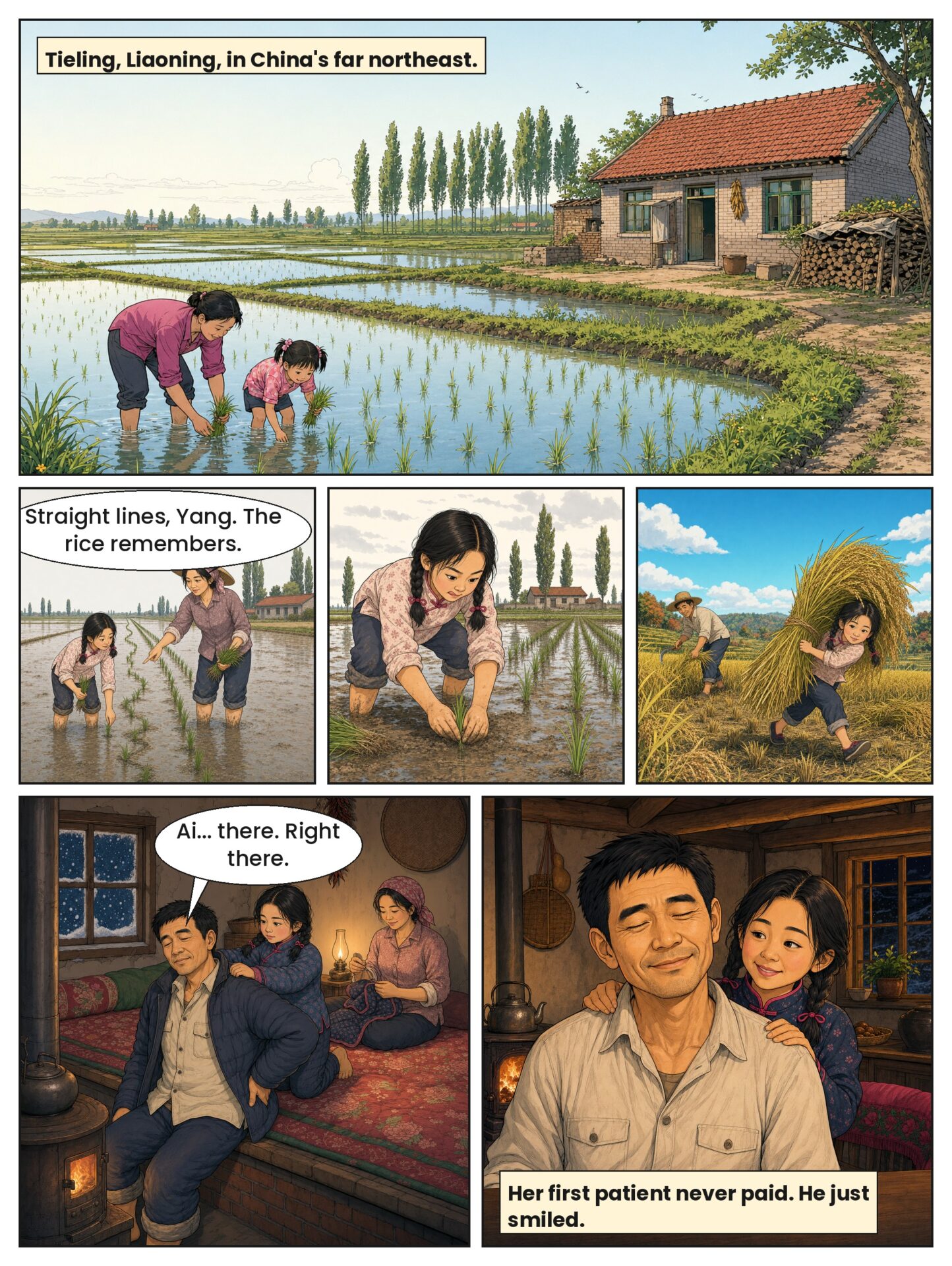
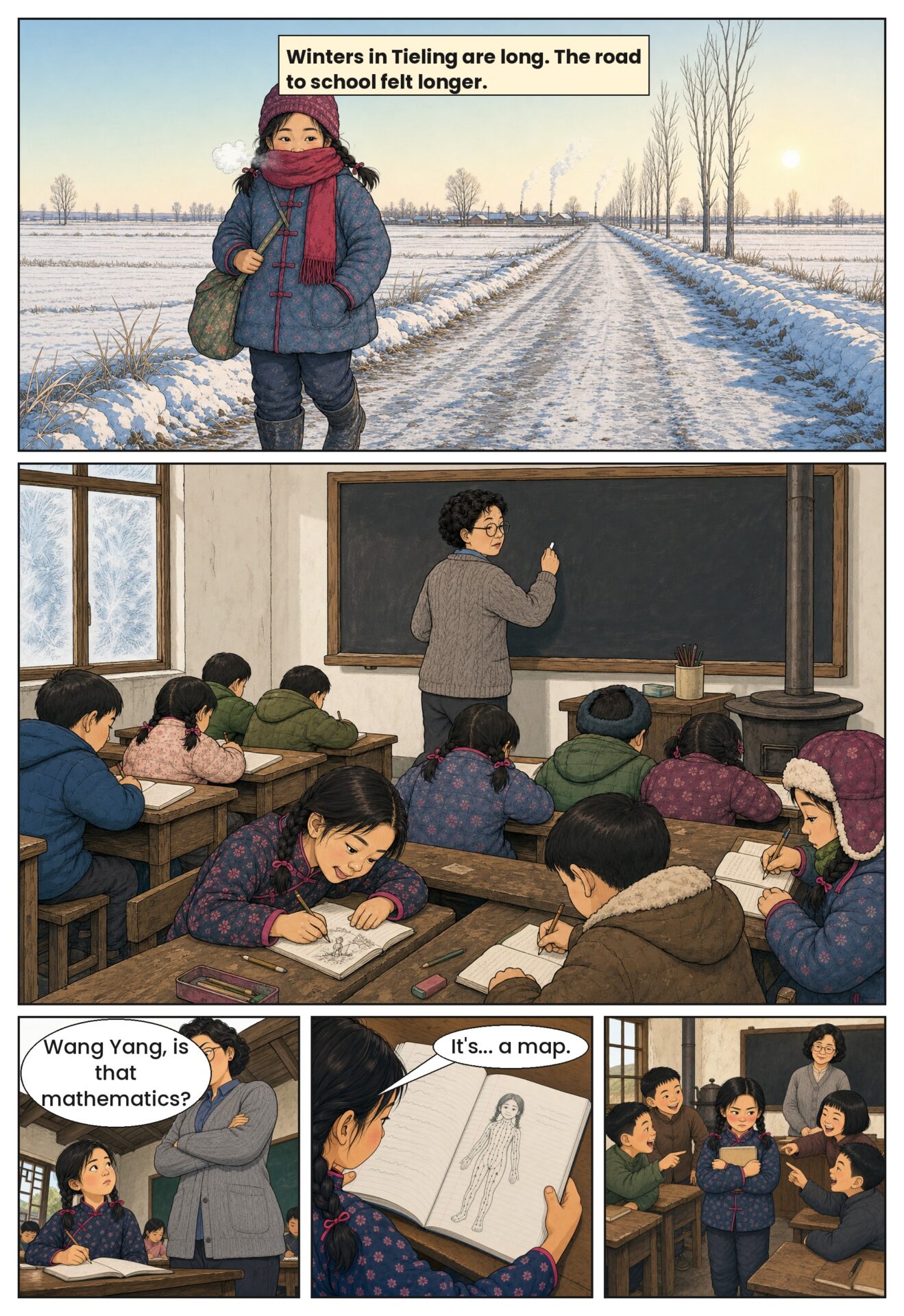
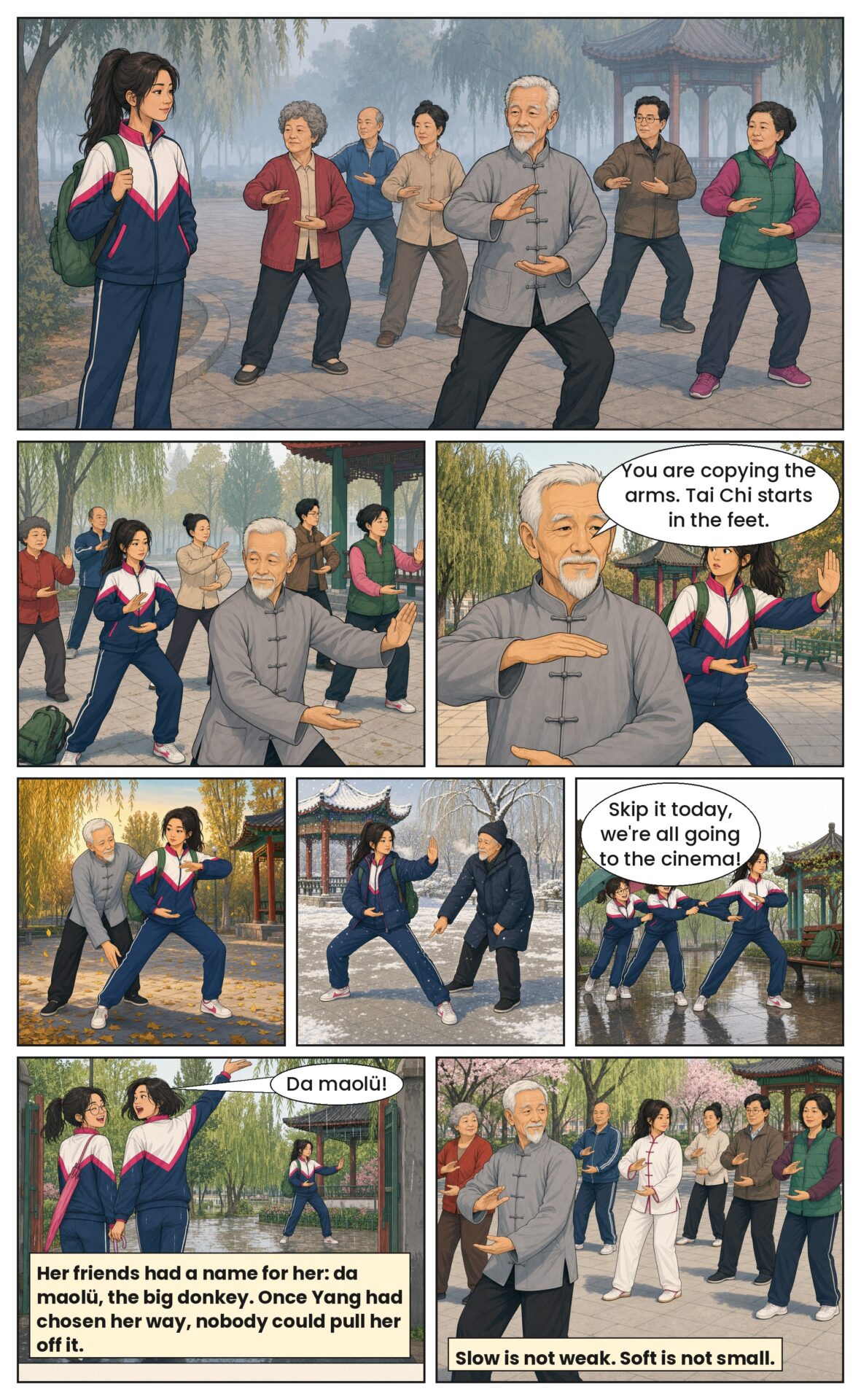
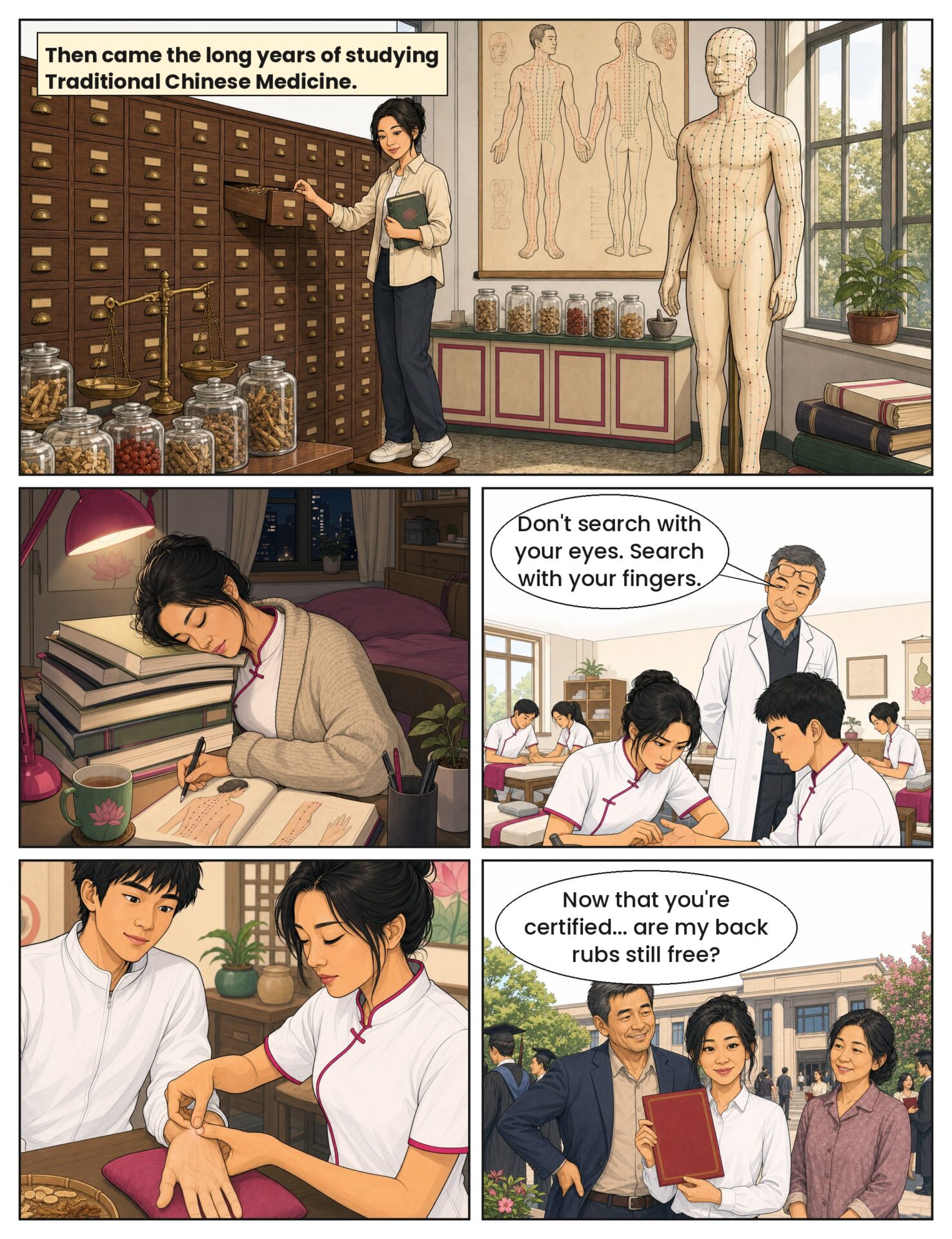
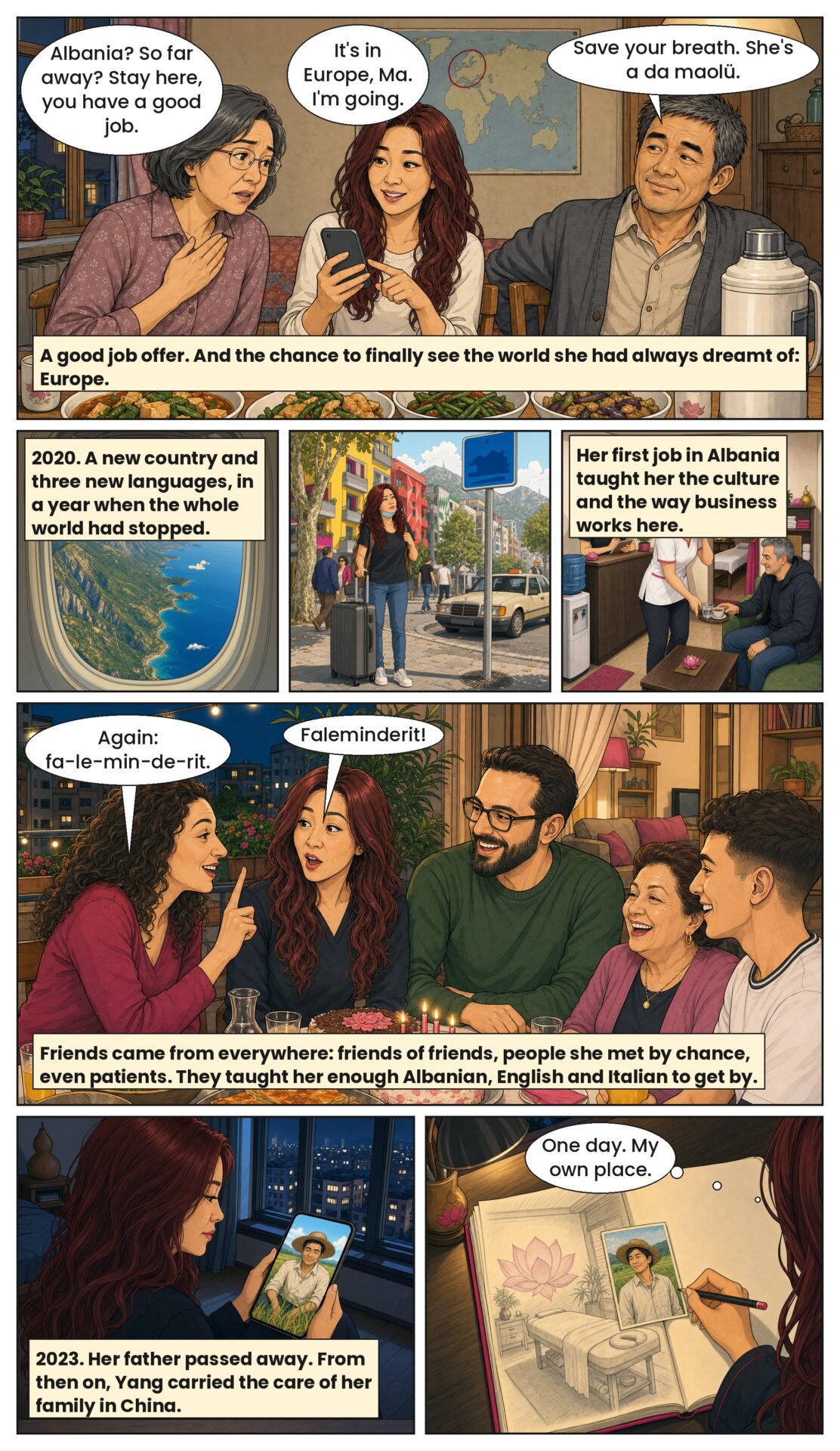
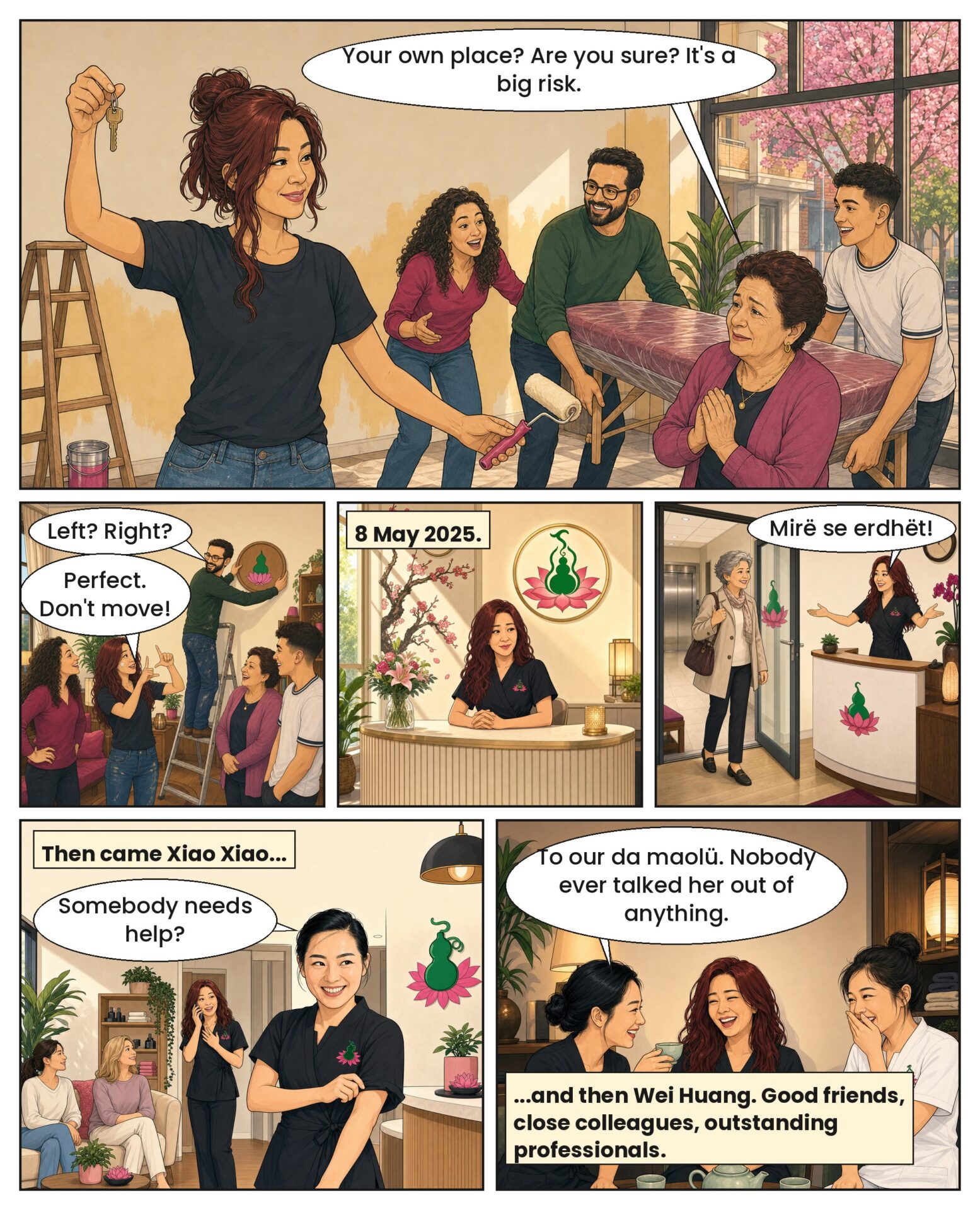
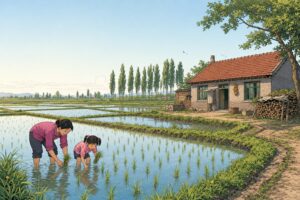
It starts in Tieling, in China’s far northeast, on my parents’ farm, where I learned to plant rice in straight lines. It goes on through a long road to school in winter, a misty park where an old teacher showed me that Tai Chi starts in the feet, and the long years of studying Traditional Chinese Medicine. Then come a job offer, a flight to Albania in 2020, new friends who taught me Albanian, English and Italian, and, on 8 May 2025, the door of my own parlour in Tirana.

Page 1: Tirana today – a patient asks Yang where she learned acupuncture

Page 2: the rice fields of Tieling and Yang's first patient, her father

Page 3: the long winter road to school and a notebook full of body maps

Page 4: learning Tai Chi in the park, through every season

Page 5: the years of studying Traditional Chinese Medicine

Page 6: a job offer, Albania in 2020, new friends and a dream of her own place

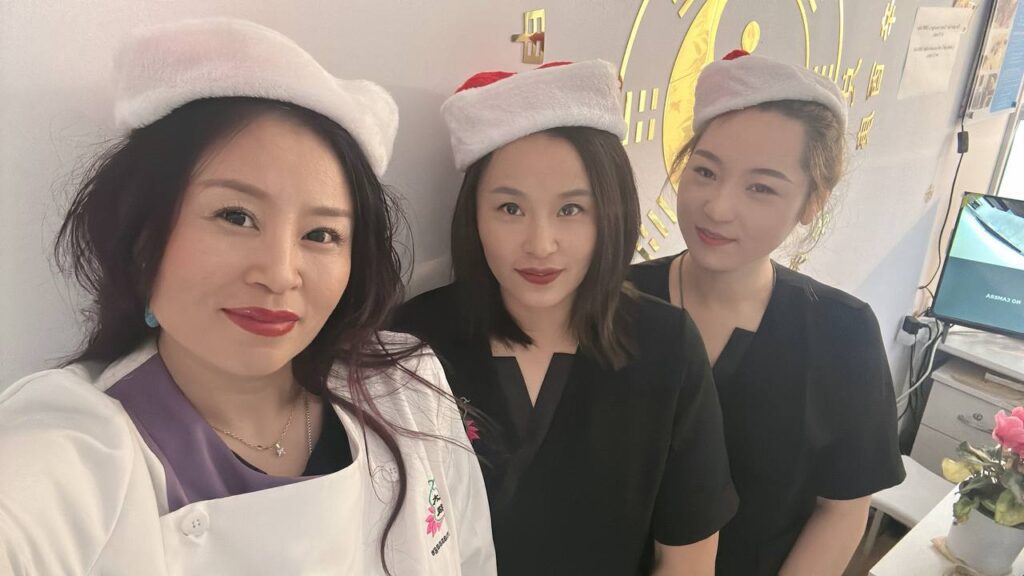
Page 7: opening day, 8 May 2025, and the team with Xiao Xiao and Wei Huang

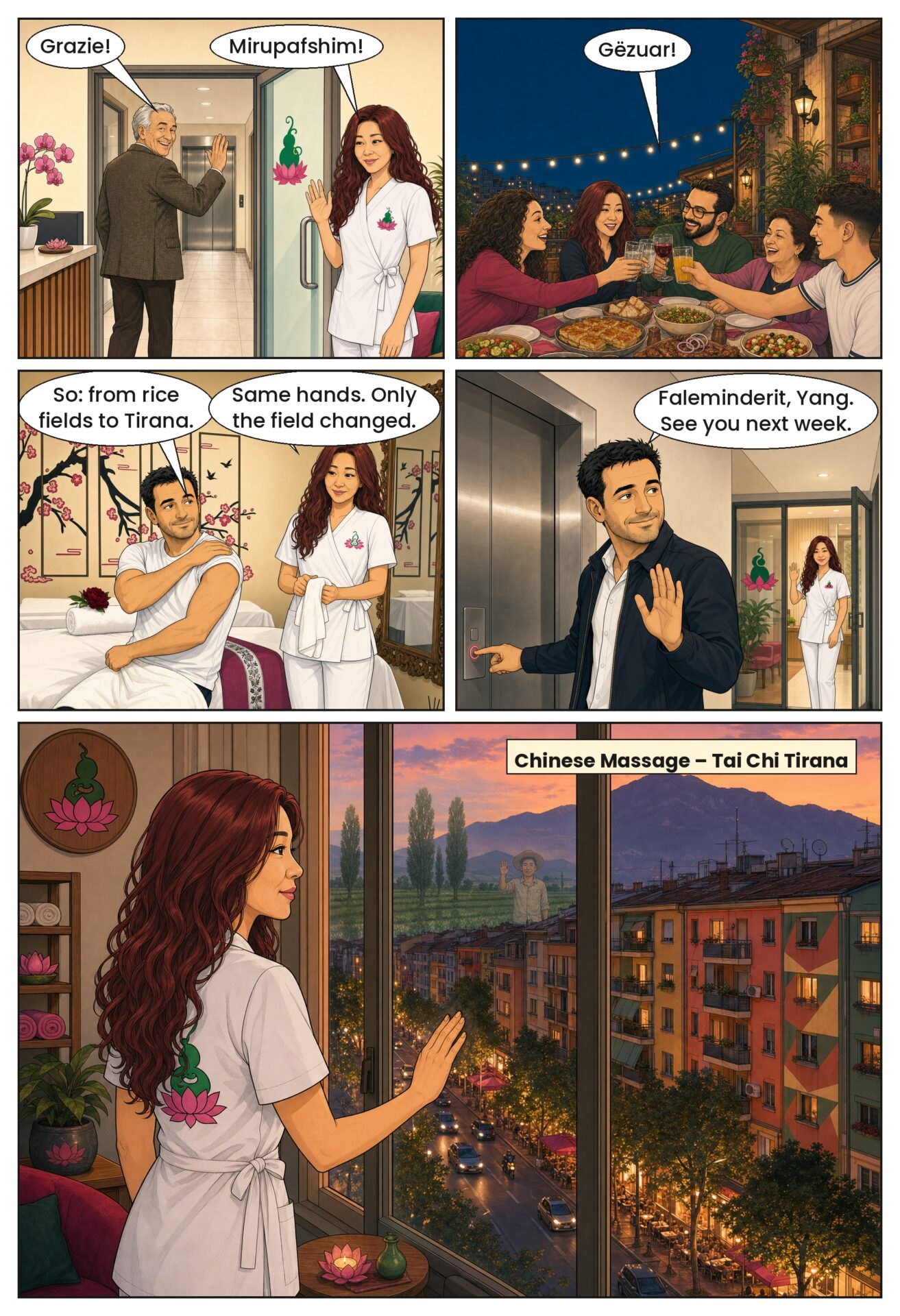
Page 8: grateful goodbyes and dusk over Tirana

A few words about how it was made. The drawings were created with the help of AI, starting from real photos. Xiao Xiao, Wei Huang and I all agreed to appear. The patients and the friends in the story are drawn from many real people, but none of them is a portrait of anyone.

My friends in China call me da maolü – the big donkey – because once I have chosen my way, nobody can talk me out of it. Looking at these pages, I think they were right.

Thank you to everyone who has been part of this story, and to everyone who walks through our door. To meet the team and see how we work today, have a look at our About page.

I dedicate this story to a Big Bear (da xiong) – you know who you are.

Yang Wang practises acupuncture and therapeutic massage at Chinese Massage – Tai Chi Tirana, in central Tirana.

Don’t Judge a Therapist by Her Size

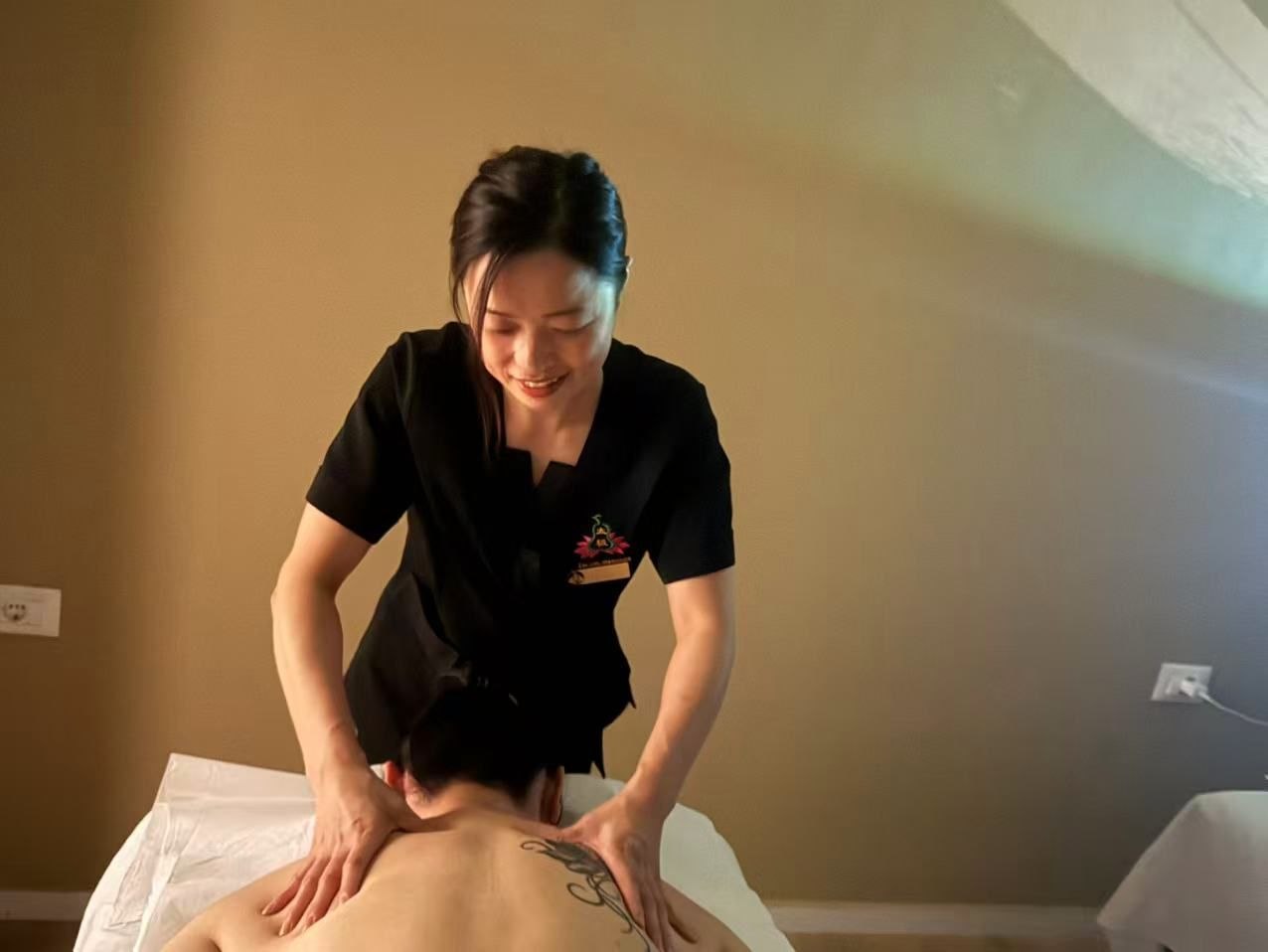
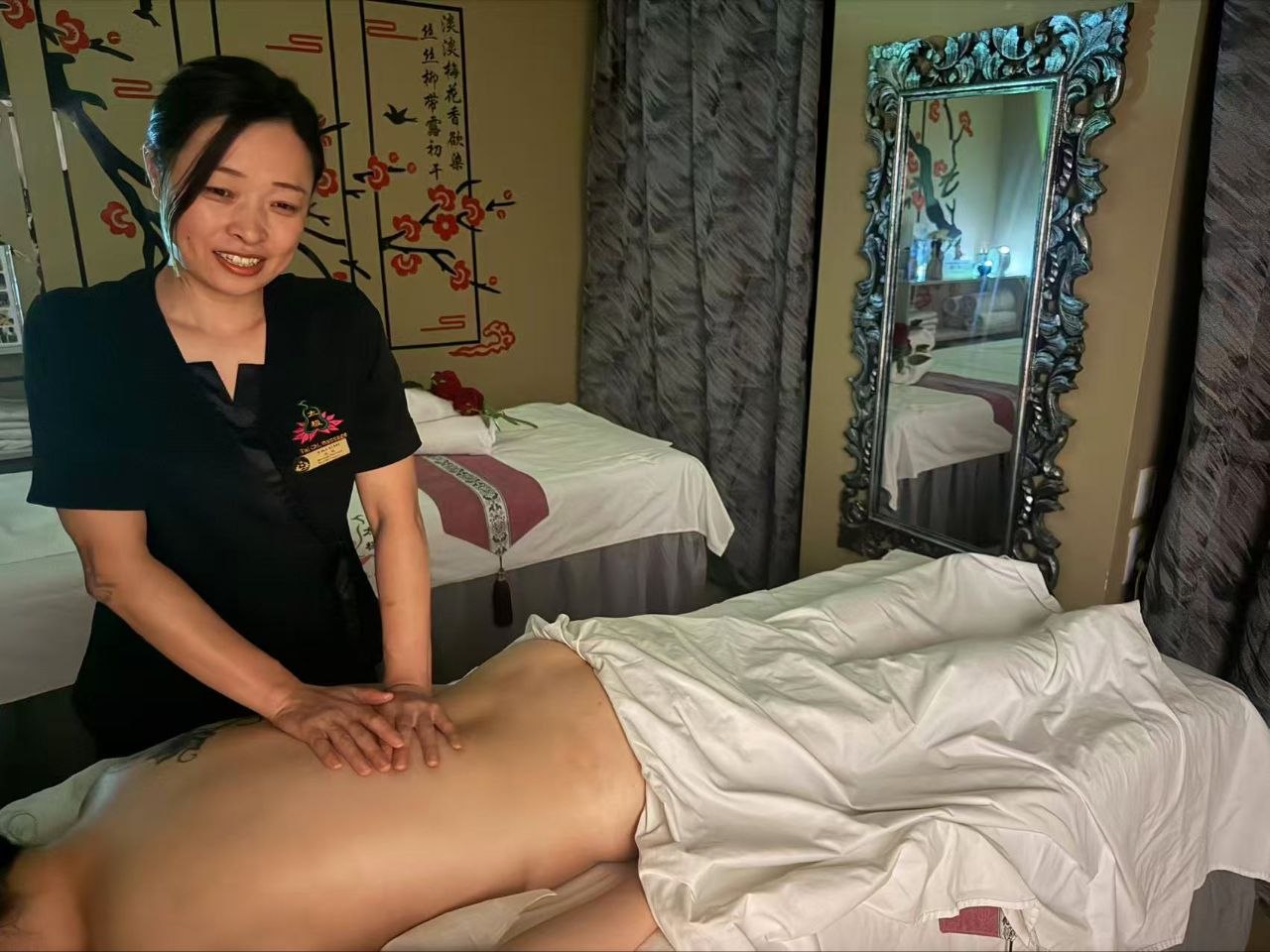
Wei Huang walks into a room the way a cat crosses a kitchen: you only notice when she is already there. She is petite, softly spoken and elegant in a way that makes you straighten your posture without knowing why. If you met her over tea, you would guess calligraphy teacher. Or a very good librarian.

You would not guess that she can find the one knot in your shoulder that you have been politely ignoring for months.

I did not guess it either, not properly. I am the boss. I plan the rooms, I check the towels, and until last week I had only watched Wei work from the corridor. So I did what any sensible owner should do and asked her to give me a massage. Here is my report.

Quiet is not the same as gentle

A lot of people assume that a small, soft-spoken therapist means a light touch. In my experience it is the other way round. Wei’s work looks calm from the outside and is very precise underneath.

We have an old Chinese idea for this: 以柔克刚, softness overcoming hardness. It is the same thinking that sits behind Tai Chi. You do not win by pushing harder. You win by being in exactly the right place, at exactly the right angle, at exactly the right speed.

Don't Judge a Therapist by Her Size

Why small hands do the job so well

Tui Na is not a contest of muscle. It is leverage, rhythm and listening. The therapist rolls, presses, kneads and pushes along the body’s pathways, and a skilled one uses body weight and angle instead of raw force.

That is how a petite therapist reaches real depth without hurting you. It is also why she can work a full day and still be gentle at six in the evening. Strength you cannot see is the kind that lasts.

Don't Judge a Therapist by Her Size

The boss on the table

I lay down fully intending to supervise. I had a plan: mental notes on the temperature of the towel, the pace of the room, the way she greeted me. I lasted about four minutes.

Wei started with my back and shoulders. Then her thumb found a spot between my shoulder blade and my spine – the spot I had blamed on my laptop, my chair and the traffic on the boulevard. She said one word, in that soft voice: “Here?”

Yes. Here.

The rest of the hour passed in near silence. No small talk, no advice, no performance. Just steady pressure that arrived slowly, stayed exactly as long as it was needed, and left without fuss. When I finally sat up, my shoulders were sitting a good two fingers lower than when I came in. I had not realised how tense I was until it stopped. Many of our clients say the same sentence at the end of a session, and now I have said it too.

I also forgot every note I had meant to take. For a boss, that is the highest compliment I can give a colleague.

Don't Judge a Therapist by Her Size

What this says about the parlour

We are a small business. We do not have a pool or a sauna, and we do not pretend to. The money goes into the massage itself, into clean rooms, and into people whose hands you can trust. People trust the best hands, not the flashiest lobby – in China and in Albania alike. The same goes for my other colleagues, Xia Xiao among them: the hands you can trust are rarely the loudest ones in the room.

Wei will blush when she reads this. She will read it through Google Translate, which means a small misunderstanding is likely and a smile is guaranteed. That is how we work: a little humour, a lot of care, nobody left stuck.

I am lucky to work with colleagues like Wei and Xia Xiao, and I say so with only one exclamation mark: thank you both!

If you would like to try it

A one-hour Therapeutic Massage (Tui Na) is the natural place to start. Tell your therapist how firm you like the pressure, and tell her about any sore spot, new or old. She will adjust, quietly. If you have a recent injury or sharp, sudden pain, see a doctor first – we work alongside that, not instead of it.

You can read more about the session on the Therapeutic Massage (Tui Na) page.

Yang Wang practises Therapeutic Massage (Tui Na) and acupuncture at Chinese Massage – Tai Chi Tirana. The parlour is in central Tirana, a short walk from Bulevardi Myslym Shyri.

International Women’s Day at Chinese Massage – Tai Chi Tirana

International Women’s Day at Chinese Massage – Tai Chi Tirana

🌸 we protect the unique you


✨ You’re used to taking care of your family’s well-being, but you often forget to take care of your own body.
🌸 This International Women’s Day, we protect the unique you.
🌿 Special treatments for you
  • 🌿 Relaxation Massage
  • 🌿 Deep Stress Release
  • 🌿 Balance your body and mind
💆‍♀️ Your relaxation moment book now
🇦🇱 Albanian
Book now
🇬🇧 English
Book now
#InternationalWomensDay #RelaxationMassage #Wellness #SelfCare #taichitcm #acupuncture
Chinese Massage – Tai Chi Tirana · March 8

Women deserve care and tenderness

You give so much to everyone else. Now, it is time for you. Take a breath and let your body relax. You deserve to feel pampered and cared for in a peaceful space.

At Tai Chi, we understand exactly what you need. Our massage is a gentle touch to help you recharge. It is a simple way to find your calm and feel beautiful again.

👉 Experience a delicate touch, from women to women, designed for your comfort. Visit www.taichi.al/book-now/ and book your time with us.

December in Tirana: A Beautiful Month That Quietly Exhausts Us

Every December, as I walk through Tirana on my way to the center, I can feel the city transforming around me. Lights appear on every street corner, cafés dress up their windows, and Skanderbeg Square becomes a little universe of music, color, and warmth. Families stroll together, children run around with glowing balloons, and the whole city vibrates with a kind of festive joy that is impossible to ignore.

Even after many years in Albania, these sights still make me smile and, on a different scale remind me of what we do at home, in China, to celebrate the Lunar New Year.

But at the same time, in hDecember I notice something else — something quieter, hidden behind the sparkle: people getting more and more tired.

December’s Hidden Pace

December looks magical, but it moves fast. Too fast.

Traffic becomes unpredictable, the malls feel like airports during holiday season, and everyone seems to be carrying more bags, more to-do lists, more obligations.

My patients often arrive and sit down with a sigh:

“I’ve been running around all day.”

“I still haven’t finished buying gifts.”

“I need to prepare the house for guests.”

“I’m cooking every day now.”

“I can’t sleep well lately.”

It’s the month when joy and pressure walk hand in hand.

The Holidays Are Beautiful — But the Body Pays a Price

Then come the celebrations. Christmas dinners, New Year parties, late nights, heavy meals, family gatherings, planning, cleaning, cooking again… All wonderful moments — but also physically intense.

By the time January begins, most people realize that the holiday season didn’t give them much rest at all.

But something I always remind my patients is this:

the tiredness doesn’t start in January — it starts in December. And that means the care for your body should begin in December too.

Why Massage Helps During December

During December, the body is already under constant pressure:

  • heavy holiday preparations
  • long hours standing, cooking, cleaning
  • rushing through crowded stores
  • poor sleep from stress and late evenings
  • cold weather tightening the muscles

A massage during December works like putting the brakes on an engine that’s overheating.

It prevents tension from accumulating, helps you sleep better, supports your immune system, and clears your mind so you can actually enjoy the holidays instead of just surviving them.

Many people wait until January to take care of themselves — but by then, the stress has already settled deep.

And Why You Still Need It in January

Then, when the decorations come down and normal life starts again, the fatigue becomes more noticeable. I often hear:

“I thought I would rest during the holidays, but I’m even more tired now.”

January is the perfect moment to reset, to allow the body to release everything it carried through the last month.

A massage in January:

  • melts the tension accumulated during December
  • improves circulation after weeks of heavy meals and little movement
  • restores energy for work and daily routines
  • lifts mood and clears mental fog

Your body needs care both during the holiday rush and after it.
My “Jingle Bells” Gift Card

Because I see how challenging this season is every year, I created something to help you take care of yourself or someone you love.

The “Jingle Bells” Gift Card

  • 5 massage sessions
  • 60 minutes each
  • with a 14% discount

It’s a beautiful way to support your wellbeing throughout December and into January — a small gift with a big impact. Moreover, you are not limited to massage, the 5 sessions can combine massage, acupuncture, cupping, moxibustion and gua sha, depending on your specific needs. Did I say this a beautiful gift to show you care for the ones you love?

December in Tirana is charming, emotional, and full of light. But it’s also a month that demands a lot from us. If you feel the weight of it — in your body, in your sleep, in your energy — you are not alone.

Give yourself permission to pause, to breathe, to reset.

Whether in the middle of December or at the start of the new year, your body will thank you.

Meanwhile, Merry Christmas and a Happy New Year to all you!

Love,
TaiChi team
Discover the Harmonizing Touch of Chinese Massage – Deep Relaxation for Body and Mind

In our studio, Traditional Chinese Massage brings tranquility to every muscle and vitality to every energy flow.

With millennia-old techniques, tension is naturally released, stress is reduced, and your body regains the lightness it was missing.

Every session aims to open blockages, soothe the mind, and restore your body’s inner harmony.

Enjoy an experience where relaxation becomes part of your day — a pure moment of well-being that belongs to you.

Allow our hands to guide you towards balance and renewed energy.

Book now and experience the serenity you deserve.

Discover the Healing Art of Chinese Massage – A Moment of Relaxation in Our Massage Studio

Through the ancient techniques of Traditional Chinese Massage, tension vanishes, energy flows freely, and your body rediscovers its natural balance.

Every movement is designed to relieve stress, improve circulation, and restore your inner vitality. Experience a therapy that connects body and mind — a moment of tranquility in your busy day.

Let us guide you toward your harmony and rediscover your balance.

Book your session now and allow us to bring you the quiet energy your body and mind deserve.

How Burek and Dumplings Conspired to Teach Me to Relax

When I first arrived in Albania, everyone insisted I try burek.
Not suggested.
Insisted.

One day someone practically placed it in my hand and said,
“Eat. If you don’t eat, we cannot continue this friendship.”

So I took a bite.
And instantly I understood why this pastry has national-level respect.
Golden, flaky, warm… it felt like being hugged by a very confident grandmother.

And at that exact moment I said to myself:

“Wait… this is dumpling energy.”

Because in China, dumplings do the same thing.
You eat them and suddenly all your problems shrink down to a manageable size.

The Cooking Process: Two Cultures, Same Drama

Making burek:

  • Stretch dough across an entire table,
  • Hold your breath,
  • Pray to at least three ancestors.

Making dumplings:

  • Fold small circles for three hours,
  • Pretend your fingers don’t hurt,
  • Grandma judges your folding technique silently.

Both come with:

  • Family,
  • Opinions,
  • And one person who believes their way is the only correct way.

So yes — Albania and China? Cousins.
Spiritual cousins.
Flour-based cousins.

But Life Doesn’t Stop So We Can Eat Forever (unfortunately)

Between work, family, appointments, WhatsApp messages, remembering birthdays, solving small emergencies, and politely pretending we are relaxed…

Our shoulders become tighter than bakllava layers.
Our backs start sounding like old wooden chairs.
Our minds run like Google Chrome with 42 tabs open.

One day I was eating burek and I realized: My neck was so stiff it could qualify as a weapon.

That Was My Moment of Enlightenment (Without Meditation)

In China, when we are stressed, we go for massage and acupuncture.
Not because we are fancy.
But because we would like to continue living without sounding like a door hinge.

Here in Albania, I discovered people also have stress —
but many just say:

“Eh, do kalojë.”
(Translation: I shall simply ignore my suffering.)

No.
Your body is not a fridge.
You cannot just close the door and hope the problem disappears.

This Is Why I Do What I Do

I treat pain, yes.
But more importantly, I treat the consequences of pretending we are fine.

Sometimes the back pain comes from:

    • lifting heavy things,
    • working too much,
    • or thinking too much (very serious condition).

Sometimes it comes from having one cousin with strong opinions.
I understand.

Massage and acupuncture do not just fix muscles — they return peace to the system.


They let your body say:

“Finally… thank you… I have been waiting since 2019.”

So Here Is My Official Recommendation from One Human to Another

Eat burek with joy.
Eat dumplings with the same joy.
(Preferably not both at midnight — trust me.)

But also:

Rest.
Breathe.
Let someone take care of you for once.

Your back will not file a complaint.
Your muscles will not protest.
Your mind will probably applaud.

I’ll be here — with warm hands, herbal oil, and no judgment.

Yang Wang

A Street with a Story

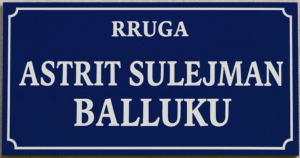
When I first opened Chinese Massage – Tai Chi Tirana here in Tirana, one of the first things that caught my attention was the name of the street — Rruga Astrit Sulejman Balluku. It’s a long name, melodic and unfamiliar to me at first, and I used to wonder who this person was. Every time I wrote down the address for a new client or looked up at the street sign, I felt a quiet curiosity. Streets carry stories, I thought — and this one, surely, must too.

At the beginning, I tried to look for information online, but it was not easy to find much. Later, through conversations over coffee, some of my Albanian friends told me that Astrit Sulejman Balluku was a trade-union leader in Tirana who lived during the country’s difficult years of transition after the fall of communism. He was killed in October 1998, at a time when Albania was facing unrest and political violence.

For someone who arrived in Tirana decades later, it’s hard to imagine what those days were like. My friends described a city filled with uncertainty — protests, fear, and the feeling that the future was not yet secure. It was a time when courage and loss often went hand in hand.
When I walk along this same street today, it feels like another world. The air hums with the sound of construction; cafés spill laughter onto the sidewalks; people talk about their children studying abroad, about tourism, about business, and about Albania’s European future. The transformation is visible everywhere — in the new buildings, in the energy of young people, and even in the small details of daily life.

Of course, not everything is perfect. Like every growing city, Tirana still faces challenges — traffic, rising prices, moments of impatience, and the fast rhythm that modern life brings. But beneath it all, there is a strong sense of movement and possibility. People care deeply about their city. They are proud of how far it has come, and they keep working toward something better.

For me, coming from China and living here for six years, Tirana has become more than just a place of work — it feels like a community. I walk to the market and see familiar faces, I hear greetings in three different languages, and I feel safe walking home even late in the evening. There is a quiet trust in everyday life that I appreciate very much.
Sometimes, as I stand outside our center and look at the sign that says Rruga Astrit Sulejman Balluku, I think about how time transforms pain into memory, and memory into meaning. This street, once named after a man who lost his life in troubled times, is now a place where people come to rest, heal, and find balance. That feels symbolic — as if the city itself is breathing more peacefully now.

When I talk to my Albanian friends about the past, they often say the same thing: “We have been through worse. Now we want to live better.” And I believe they are doing just that.
So whenever I see the evening light fall softly on this street — the children playing, the trees whispering, the city slowly calming down after a busy day — I think of how far Tirana has come. The journey from unrest to peace is not simple, but it is beautiful.

And perhaps, in our own quiet ways, each of us can take a moment to slow down, to breathe, and to appreciate the calm we now enjoy — both within ourselves and around us.

“Mysafir” in Albania

When I first arrived in Tirana six years ago, I knew very little about Albania. I came with curiosity, open eyes, and an open heart – but I never imagined how deeply I would be touched by the warmth and hospitality of its people.

Albania has a wordless kindness that you can feel in daily life – in a neighbor’s smile, in the kind waiters from the coffee shop at the corner of my street who remember me, my favorite drink, and even how I like it served. This generosity of spirit is not just habit – it is part of an ancient tradition.

The roots of Albanian hospitality run deep, connected to Kanuni i Lekë Dukagjinit – the traditional code of honor that has guided Albanian life for centuries. One of its most famous rules says, “The house of the Albanian belongs to God and the guest.” This means that every guest, even a stranger, must be treated with the highest respect and care, as if sent by heaven itself. Though modern life has changed, this principle still lives strongly in the Albanian heart.

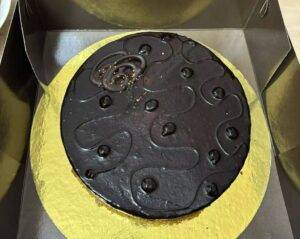
As a Chinese woman living in Tirana, I have always felt this kindness personally. From the very first day, people made me feel not like a foreigner, but like a friend. Whether I was trying to find an address and someone offered not only to show me the way but to walk with me, or when clients at my massage parlour show small gestures of friendship – it always warms my heart. One of my long-time guests, for example, often brings me my favorite cake, asks about my family, and sincerely cares for my well-being. It is a kind of human connection that goes far beyond business – it feels like friendship, like belonging.

What also surprises many foreigners is how safe Albania feels – especially for women. When occasionally I had to walk alone at night through the lively streets of Blloku or near Skanderbeg Square, I never felt threatened or uncomfortable. Respect runs deep in this culture; when you treat Albanians with kindness and dignity, they respond with genuine care and protection.

Tirana today is a beautiful mix of tradition and modern energy – full of cafés, laughter, and life. But beneath this modern face still beats the heart of an old world value: the sacred duty to welcome and protect the guest.

I often tell my friends back in China and other countries: Come to Albania, visit Tirana, and feel this warmth yourself. You will not only discover mountains, sea, and history – you will discover a nation that still believes that friendship begins with an open door and a full heart.

After six years, Tirana has become more than where I live – it has become my home.


— Yang Wang