When Liaoning Mothers Used Mud Cakes in Winter

Liaoning province, in the northeast of China, is cold. Not the Mediterranean kind of cold that Tirana has in February, where you can walk outdoors in a wool coat and feel pleasantly chilled. The Liaoning winter is a serious matter. Temperatures drop to minus twenty in January. The wind off the sea finds every gap in every wall. For most of the year, daily life is built around the management of cold.

In the village where my grandmother lived — about an hour outside Tieling — winter preparation began in October. The cellar filled with cabbage, daikon, sweet potatoes, dried mushrooms. The thick quilted bedding came out of the storage chests. The braziers were checked. And, in many households, the mud cakes were prepared.

I want to write about this practice because I think it explains something important about how a treatment we now offer in our parlour in Tirana originally lived in ordinary kitchens, ordinary winters, ordinary families — long before anyone thought to put it on a price list.

How the mud cakes came to be in the house

My grandmother’s mud cakes — the ones she used on my mother every December when her winter belly started — were not bought. They were made.

The recipe had been passed down in the family from at least my great-grandmother, possibly earlier. The ingredients were ordinary, mostly local, and combined according to a sequence my grandmother performed without thinking, the way an experienced cook makes dumplings.

The base was a particular kind of clay sourced from a river bank about twenty kilometres from the village. Once a year, in late summer, one of my uncles would drive out with a shovel and a few canvas sacks to collect the year’s supply. The clay was washed several times, dried on flat boards in the sun, ground in a stone mill, and stored in a sealed jar in the pantry.

In autumn, the mugwort was harvested from the hills above the village. The plants were cut, hung upside down in bundles in the attic, dried for a month, and the leaves were then stripped from the stems and ground to a coarse powder.

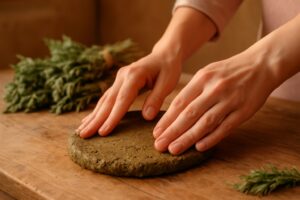
When the cakes were to be made — usually in late November, in time for the coldest months — the powdered clay was mixed with the mugwort, with cinnamon bark purchased from the herbalist in town, with a little dried ginger, and with one or two other ingredients I never fully learned because the recipe was somewhat closely held even within the family. The mixture was moistened with warm water, kneaded like a dough, and formed into flat cakes about the size of a hand and half a centimetre thick. The cakes were dried slowly on a warm stone near the stove, then wrapped in cloth and stored in a wooden box near the chimney.

By the time the winter cold-belly season arrived, the cakes were ready.

Who used them, and how

My grandmother used them on my mother, her daughter-in-law, when the winter belly came on her every year. She also used them on herself, on her own lower back, when the cold weather brought out the joint pain she had developed in her sixties.

The cake was warmed on the stove — never directly on the heat, but on a metal tray placed above the heat, slowly, until it was warm to the touch but not hot. It was then placed on the affected area, and a small bundle of moxa was lit above it. The treatment took about half an hour. My grandmother would sit in the chair next to the bed, knitting or talking quietly, watching the moxa carefully so that the heat was always the right intensity.

When the treatment was over, the cake was wrapped back in its cloth and returned to the box. The same cake could be used many times over the winter — only when it had crumbled and lost integrity would a new one be made.

This was not, in our family, a medical treatment in the modern sense. It was a household practice. It was as ordinary as making chicken broth for a cold or applying a hot compress to a stiff neck. The grandmothers did it. The mothers learned to do it. The daughters watched, and eventually learned themselves.

That this practice corresponds, almost exactly, to a treatment described in the Huangdi Neijing — the foundational text of Chinese medicine, compiled around the second century BCE — is something I only learned much later, in medical school. The connection between my grandmother’s hands and an ancient text was not something she would have considered relevant. She knew what she was doing because her mother had shown her.

From a village kitchen to a treatment room

I moved to Tirana in 2020, carrying this memory of my grandmother’s kitchen with me. What struck me, over the years since, was how strange it felt to take something that had simply been there — as ordinary in our house as a pot of broth on the stove — and one day write it on a treatment menu with a duration and a price beside it.

There is a particular Tirana feeling I have come to know well: the friend who hears what I do for a living, waves a hand, and says her cousin “knows someone” for everything. A plumber, a notary, a man with a van, and now, apparently, mud and moxa. The instinct to keep these things in the family, off the books, between people who trust each other, is not so different from how my grandmother kept her recipe — somewhat closely held, passed by hand rather than written down. (I have written elsewhere about the year of the Fire Horse and the small Chinese-calendar markers of my year — these family practices live alongside that bigger seasonal rhythm.)

Why this still matters

I do not bring up these old practices because I want to romanticise them. There are things modern medicine does that traditional practices cannot. Insulin saves lives. Antibiotics save lives. The MRI scanner sees inside the body in ways no pair of hands ever could.

But there are also things that modern medicine, in its rush toward measurement and intervention, has stopped being good at. The slow work of restoring a body that has been chronically depleted. The treatment of patterns rather than single diagnostic codes. The understanding that warmth, applied thoughtfully and over time, changes the body in ways that no pill can replicate.

Mud moxibustion is one of those slow treatments. We offer it in our parlour in Tirana because it works for the patterns it is designed to address — patterns my grandmother in Liaoning would have recognised at a glance, and which she certainly never needed a research trial to confirm.

When I prepare a mud cake for a client now — using mud and herbs imported from a producer in Shandong rather than collected from a river bank, prepared in our treatment room rather than a kitchen — I am performing, with small adjustments, the same intervention my grandmother performed decades ago in a village in Liaoning. The technology has not changed. The body has not changed. What works still works.

A small ritual I have started

I have begun, with first-time mud moxibustion clients, mentioning this history briefly during the intake. Not as a sales pitch — the treatment will work or not work on its own merits — but as context. Several clients have told me afterwards that knowing the treatment came from grandmothers, in real homes, made it feel more meaningful to them than something handed over in a cold consulting room.

I think they are right. Some kinds of healing belong to a longer tradition than a single profession or a single century. To offer them well, we have to remember where they came from.

That is part of why we offer this treatment in Tirana. Not because it is exotic, but because it is, in its origins, much closer to home than people might think.

Yang Wang practises mud moxibustion and other Chinese medicine modalities at Chinese Massage – Tai Chi Tirana. The parlour is in central Tirana, a short walk from Bulevardi Myslym Shyri.
Volcanic Stone Therapy in Winter — Why Tirana’s Cold Snap

Tirana in January is colder than tourists expect. The city sits in a basin, and when the winds come down from Dajti in late afternoon, the temperature in the streets can drop several degrees in an hour. The wet cold that comes with the rain has a specific quality — it does not freeze the body the way the dry Liaoning winter of my childhood did, but it gets into the joints in a way that the dry cold did not. Long-term residents recognise it. New arrivals are usually surprised.

In our parlour, January and February are the two months when volcanic stone therapy bookings outpace everything else. It is not a coincidence. The treatment is specifically suited to the kind of chronic cold-pattern complaint that the Tirana winter produces, and the change clients experience after a session — and the cumulative change after several sessions — is more pronounced in winter than in any other season.

This piece is for the clients who come in with the specific complaint of “the cold has gotten into my bones” and want to know why the stones help when the heating pad at home does not.

What “cold in the bones” actually is

The phrase “cold in the bones” — acari në kocka, in Albanian — is one of the more linguistically accurate descriptions of a physiological state that modern medicine does not have a comparably elegant term for.

When the body is exposed to chronic cold and damp conditions, several things happen at the level of the joints, deep muscles, and connective tissue.

The synovial fluid in the joints becomes slightly more viscous. The fluid that lubricates the joint is sensitive to temperature; at lower temperatures, it flows less smoothly. This is part of why arthritic joints stiffen in cold weather.

The fascia surrounding the muscles loses some of its hydration and elasticity. Cold reduces local blood flow, which reduces the delivery of water and nutrients to the connective tissue. Over weeks of cold exposure, the fascia becomes detectably less pliable.

The deep paraspinal muscles, particularly those around the lower back and the back of the neck, enter a low-grade chronic contraction state. The contraction is protective — it preserves core temperature — but it accumulates tension over the winter.

The peripheral circulation, particularly in the hands and feet, becomes restricted. Even when the person is in a warm room, the small blood vessels in the periphery remain narrowed for some time after the cold exposure has ended.

All of these effects, in combination, produce the sensation of cold having “gotten into” the body in a way that no single warm shower can fully resolve. The body has shifted its baseline. Restoring the previous baseline takes more than transient warmth.

What the stones do that a heating pad does not

The instinct, when one has cold in the bones, is to apply heat. A hot bath, a heating pad on the lower back, an electric blanket overnight. These help. They help temporarily.

The therapeutic difference between this kind of surface heat and a volcanic stone session lies in three factors.

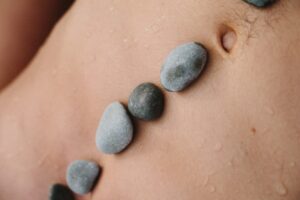
Depth of heat penetration. A hot bath warms the body’s surface and, over time, raises the core temperature slightly. A heating pad warms the area directly under it but the heat does not penetrate more than a centimetre or two into the tissue. Volcanic basalt, applied at the correct temperature (between 55 and 65 degrees Celsius) and moved correctly across the body, transfers heat to a depth of five to seven centimetres — reaching the deep paraspinal muscles, the deep hip rotators, the small muscles around the kidneys, and the periarticular tissues around the joints in a way that surface heat cannot.

Sustained working temperature. A heating pad cools as it transfers heat into the body and tends to be set at temperatures too high to be safe for prolonged contact (which is why most have automatic shut-offs). The basalt stones we use stay within the therapeutic range for fifteen to twenty minutes per stone, and we rotate through multiple stones to maintain even working temperature for the full session. The deep tissue receives sustained warming input rather than the rapid hot-cold-hot cycling of an electric pad.

Mechanical work combined with heat. The stones are not only static. A skilled volcanic stone session combines stationary placement (where stones rest on key points for several minutes) with active manipulation (where the stones glide along muscle groups and joint capsules). The combination of heat plus mechanical work addresses both the temperature and the postural-tension components of winter stiffness simultaneously. (For the foundational long-form guide to this technique — origin, variations, contraindications — see the volcanic stone massage guide.)

The Tirana protocol specifically

The volcanic stone work I do in winter differs in specific ways from the protocol used in summer or in other climates. The Tirana-specific adjustments include:

Longer pre-warming of the client. The client lies on a heated table for five to ten minutes before any stone is applied. This raises the surface temperature of the body so the first stone does not produce a startling temperature contrast that recruits the sympathetic nervous system.

More attention to the lumbar region. The lower back is where the wet-cold quality of the Tirana winter accumulates most consistently. We use a larger sacral stone for this region, and the stationary placement time is extended compared to the standard protocol.

Specific work on the hips and outer thighs. The lateral fascia from the iliotibial band to the outer hip becomes particularly tight in winter, and clients often do not notice this tightness until it is released. Stone work along this region in winter consistently produces a “lighter” sensation in walking afterwards.

Attention to the small joints of the hands. Tirana winter cold particularly affects the hands of people who spend time outdoors — walking dogs along Liqeni, commuting on foot, taking children to school. Small stones placed between the fingers and worked along the back of the hand produce significant relief.

Finishing with abdominal stones. Even when the primary complaint is musculoskeletal, finishing with stationary stones on the lower abdomen produces a general systemic warming effect that improves the overall therapeutic outcome.

What a typical winter client looks like

A representative client, from this past January: a woman in her late fifties, retired teacher, lives in a flat in central Tirana with adequate but not generous heating. She walks her grandson to school each morning. She has had mild osteoarthritis in her knees for several years that is generally manageable but flares up in winter to the point where she cannot kneel on the floor to play with the child. She had tried heating pads, knee braces, a magnesium supplement, and one course of physiotherapy that had not produced a substantial change.

She came in for a single ninety-minute volcanic stone session in early January. The protocol was the full winter version described above, with particular attention to the periarticular tissues of the knees.

She called the next day to say that she had slept through the night for the first time in three weeks and had been able to kneel that morning without pain.

This is, by itself, not a study. It is an anecdote. But it is a representative anecdote — the kind of report we hear consistently from winter clients with cold-pattern complaints. The single session produces noticeable improvement; the cumulative effect of several sessions across the winter produces something closer to the body’s normal baseline.

She continued coming once every two weeks through February and into early March. By the time she stopped (in part because the weather had warmed and her knees had stabilised), she had had six sessions across two months. Her knees stayed stable through the rest of the winter and the following spring.

The Liaoning observation

I cannot help observing, when I do this work in winter, the parallel with what my own family did in Liaoning when I was a child. We did not have basalt stones in our village. We had pieces of broken brick from old kilns, smoothed by time, that my grandmother kept in a wooden box near the stove. In the deepest weeks of January she would warm a stone in the stove embers (carefully — too hot would crack it), wrap it in cloth, and apply it to her own lower back or to my mother’s knees.

The principle was identical. The materials were what was locally available. The pattern — warm stone, applied to the lower back or joints, in the deep cold of winter — has been performed in some form in every cold-climate culture that has had access to dense stone and a way to heat it. The fact that we now do it in our parlour in Tirana with carefully sourced basalt and properly heated water does not change the underlying intervention. We have refined the precision; we have not changed the wisdom.

When to consider it, when not to

Volcanic stone therapy in winter is particularly useful for:

Chronic joint stiffness that worsens in cold weather (arthritis of the knees, hips, shoulders, fingers).

Lower back pain with a “cold and damp” quality — pain that responds to heat and worsens in damp weather.

Persistent cold extremities (cold hands, cold feet) that are not improving with the usual measures.

General fatigue and “the cold has gotten into me” feeling that does not lift with adequate sleep and warm clothing.

It is less useful for, or contraindicated in, the conditions listed in the main volcanic stone guide on the parlour website — particularly pregnancy, acute infection, uncontrolled cardiovascular disease, blood-thinning medication, and active DVT.

For winter use specifically, a series of three to six sessions across the cold months produces the most reliable lasting effect. A single session helps for one to two weeks; the cumulative effect builds over the series and produces a body that handles the winter more comfortably overall.

The treatment is, in its way, one of the older interventions for living in a cold climate — warm stone, patient hands, repeated through the worst of the season. In a Tirana January, when the cold comes down off Dajti and settles into the basin for weeks, this is not a small thing.


Yang Wang practises Chinese medicine at Chinese Massage – Tai Chi Tirana.