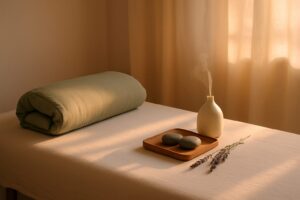
Pregnancy massage. Gentle, careful, and worth it.

A friend walked in one afternoon at about twenty-two weeks. She had been sleeping badly for a month — not from worry, just from the simple fact that the body she had lived in for thirty-something years had quietly rearranged itself around another person, and no position felt quite right anymore. She sat down, listed her usual complaints — the pull along the lower side, the shoulders that had crept up toward her ears — and then added, almost as an afterthought: “But I suppose there’s not much you can do, is there?”

There is quite a lot, actually. Pregnancy massage is one of the more nuanced things we do, and it is worth explaining what makes it different and why that difference matters.

Why it is not the same as a regular massage

The short answer is: the body has changed, so the approach must change with it. Circulation is working harder than usual. Certain pressure points that ordinarily speed up circulation or stimulate the uterus are avoided entirely in the first trimester and used with great care thereafter — in Traditional Chinese Medicine (TCM), these include specific points on the lower leg and ankle that are powerful precisely because pregnancy is not the right moment for that kind of stimulation. Positioning changes completely: after the first trimester we work with the mother on her side, supported by bolsters, never flat on her stomach and almost never flat on her back for extended periods. The pressure is lighter in some areas, firmer where chronic tension has built up — the upper back, the area between the shoulder blades, the base of the skull.

None of this makes the massage timid. It makes it precise.

What the mother gains

The most immediate thing most mothers notice is sleep. Not dramatic, just — better. The nervous system has been running at a higher baseline; one hour of steady, attentive, warm hands brings it down. Cortisol drops. The shoulders finally remember how to hang. Swelling in the legs and ankles, a near-universal complaint from the second trimester onward, eases as circulation moves more freely through tissue that has been under extra pressure.

There is also something less measurable: the feeling of being attended to. Pregnancy puts a great deal of attention on the baby — rightly so — but the mother’s body is doing extraordinary, invisible work, and an hour of quiet acknowledgement of that work is not a luxury. It is maintenance.

What reaches the baby

This is where TCM has always been quietly ahead. When the mother’s nervous system settles — heart rate slower, breathing longer, muscles letting go — the baby feels exactly that. Cortisol is shared; so is calm. Research in perinatal care has been confirming for decades what traditional Chinese practitioners took as given: a relaxed mother creates a gentler environment for the child developing inside her. There is nothing mystical about it. The baby is living in the mother’s body. The mother’s state is the baby’s immediate world.

Some mothers also notice that the baby moves differently during or after a session — quieter during, a little livelier after, as if responding to the shift in the room.

When a partner joins: the couple session

This is the part I find myself recommending more and more. A couple massage during pregnancy is not simply two people having massages in the same room — though that is pleasant enough. It is something bigger than that.

The partner is also navigating a change they cannot feel directly. They are watching, supporting, sometimes not quite sure what to do. Being present for a massage session — receiving their own treatment while their partner does the same, in the same room, at the same pace — is a physical way of saying we are in this together. Many couples tell me afterward that the quiet of the room, the parallel experience, opened something between them. Not words. Just presence.

But there is another layer that I think matters just as much. This is not only a couple experience — it is the beginning of a family one. The baby is already there, already part of the room, already part of the equation. When both parents arrive together, rest together, and let their nervous systems slow down in the same space, they are doing something quietly profound: they are practising, as a family, what calm looks like. The baby, living inside the mother’s body, is part of that moment. It is an early form of bonding — not symbolic, but physiological.

The benefits deepen for the mother, too. There is something specifically calming about receiving care alongside someone who loves you. The nervous system knows the difference.

A few honest notes on timing and limits

Pregnancy massage is generally considered safe from the second trimester onward; in the first trimester, when the risk of miscarriage is highest and the body is undergoing its most rapid changes, we take extra care and prefer to wait unless the mother’s doctor has specifically said otherwise. If there is a history of preterm labour, placenta praevia, or any pregnancy complication, we ask to know first — not to refuse, but to adapt. And if anything feels wrong at any point during the session, we stop.

It is also worth saying: this is not medical care. It is skilled supportive care. For any concern, your obstetrician is the right person.

We have written a fuller practical guide — covering positions, trimester-by-trimester detail, and what to tell your therapist before you arrive — in our piece on pregnancy massage: what you need to know before you book.

You can read more about how the therapeutic massage works on the Therapeutic Massage (Tui Na) page.

Yang Wang practises therapeutic massage and acupuncture at Chinese Massage – Tai Chi Tirana. The parlour is in central Tirana, a short walk from Bulevardi Myslym Shyri. Names in client stories have been changed.

Pregnancy & IUI Benefits of Chinese Massage

Chinese medicine has supported women’s reproductive health for thousands of years. One of its most nurturing and accessible tools is Chinese massage therapy, especially Tuina (推拿)—a traditional form of therapeutic bodywork that stimulates the flow of energy (Qi), balances internal systems, and promotes reproductive well-being. In today’s holistic wellness landscape, Chinese massage is increasingly embraced by women preparing for pregnancy and undergoing IUI (intrauterine insemination) treatments.

Supporting Fertility and IUI Success

Chinese massage can help prepare the body for conception by creating an optimal internal environment for implantation and pregnancy. This is especially helpful for those undergoing fertility treatments such as IUI.

1. Enhancing Blood Flow to the Uterus and Ovaries

One of the core goals of Chinese massage is to stimulate healthy blood circulation. Increased blood flow to the reproductive organs improves nourishment of the ovaries, helps thicken the endometrial lining, and creates a more receptive environment for implantation.

A 2020 review published in Integrative Medicine Research noted that abdominal massage techniques, including Tuina, can significantly enhance uterine blood flow and improve reproductive function.
(Shin et al., 2020. Integr Med Res. 9(4): 100435)

2. Regulating Hormonal Imbalances

Chinese massage therapy works through the meridian system to balance internal organs such as the liver, spleen, and kidneys—all of which play a key role in reproductive hormone regulation.

In Traditional Chinese Medicine (TCM), the Kidney system governs fertility and reproduction. Tuina targeting Kidney and Spleen meridians helps regulate cycles, stimulate ovulation, and improve overall fertility.
(Li et al., 2016. Chinese Medicine. 11:15)

3. Reducing Stress and Cortisol Levels

Fertility treatments can be emotionally challenging. Chinese massage induces deep relaxation, calms the nervous system, and reduces levels of cortisol—the stress hormone known to interfere with hormonal balance and implantation success.

A centeral trial published in Complementary Therapies in Clinical Practice found that women undergoing fertility treatments who received massage therapy reported significantly lower levels of stress and anxiety.
(Field et al., 2009. Complement Ther Clin Pract. 15(3): 143–147)


Chinese Massage During Pregnancy: Gentle Support for Every Stage

While massage during pregnancy requires careful techniques, Chinese massage—when provided by trained professionals—offers safe and effective relief from common discomforts, especially in the second and third trimesters.

1. Alleviating Back and Pelvic Pain

As pregnancy progresses, many women experience back pain, hip tension, and sciatic discomfort. Tuina’s gentle manipulations help release tight muscles, realign posture, and reduce lower back pain.

A study published in the Journal of Clinical Nursing found that pregnant women who received massage therapy had significantly reduced pain in the lower back and legs.
(Field et al., 2012. J Clin Nurs. 21(11-12): 1525–1533)

2. Improving Sleep and Reducing Fatigue

Fatigue and insomnia are common pregnancy complaints. Chinese massage calms the mind and supports the flow of Qi, which helps regulate sleep cycles and restore energy.

In a study published in Sleep Medicine, massage therapy improved sleep quality and decreased fatigue in pregnant women.
(Li et al., 2010. Sleep Med. 11(8): 743–748)

3. Reducing Swelling (Edema)

Fluid retention during pregnancy often causes swelling in the feet and legs. Chinese massage stimulates lymphatic drainage and supports the Spleen and Kidney meridians, helping to reduce edema naturally.


When to Receive Chinese Massage

  • For fertility and IUI: Massage is best done before ovulation to improve circulation and balance hormones. Light massage may also be used after IUI, but should be paused for 48 hours post-insemination to support implantation.
  • During pregnancy: Massage is safe and recommended starting from week 13 of pregnancy, provided it’s performed by a trained prenatal therapist.

⚠️ Always consult with your doctor and ensure you work with certified Chinese medicine practitioners experienced in fertility and prenatal care.


Final Thoughts

Chinese massage is more than a relaxing treatment—it’s a powerful therapeutic method that supports both physical and emotional health. Whether you’re navigating the emotional challenges of fertility treatments like IUI or the physical changes of pregnancy, Chinese massage provides natural, holistic support that enhances your journey toward motherhood.

At Chinese Massage – Tai Chi Tirana, we offer personalized massage treatments rooted in authentic Chinese medicine, designed specifically for fertility support, pregnancy wellness, and women’s health.

👉 To book your custom treatment session, call or visit us today. We are here to support your health and wellbeing with skilled hands and heartfelt care.

📞 +355+355 68 541 4141


📍 Chinese Massage – Tai Chi Tirana, Tirana


References

  1. Shin, M. S., et al. (2020). Effectiveness of abdominal massage for fertility: A systematic review. Integrative Medicine Research, 9(4), 100435.
  2. Li, H., et al. (2016). Traditional Chinese Medicine and Fertility: Review and Future Directions. Chinese Medicine, 11, 15.
  3. Field, T., et al. (2009). Massage therapy effects on anxiety and depression during IVF. Complement Ther Clin Pract, 15(3), 143–147.
  4. Field, T., et al. (2012). Massage therapy reduces pain in pregnant women. J Clin Nurs, 21(11-12), 1525–1533.
  5. Li, C., et al. (2010). The effect of massage therapy on sleep quality in pregnant women. Sleep Med, 11(8), 743–748.