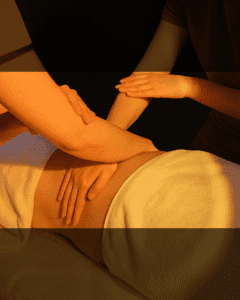
Pregnancy massage. Gentle, careful, and worth it.

A friend walked in one afternoon at about twenty-two weeks. She had been sleeping badly for a month — not from worry, just from the simple fact that the body she had lived in for thirty-something years had quietly rearranged itself around another person, and no position felt quite right anymore. She sat down, listed her usual complaints — the pull along the lower side, the shoulders that had crept up toward her ears — and then added, almost as an afterthought: “But I suppose there’s not much you can do, is there?”

There is quite a lot, actually. Pregnancy massage is one of the more nuanced things we do, and it is worth explaining what makes it different and why that difference matters.

Why it is not the same as a regular massage

The short answer is: the body has changed, so the approach must change with it. Circulation is working harder than usual. Certain pressure points that ordinarily speed up circulation or stimulate the uterus are avoided entirely in the first trimester and used with great care thereafter — in Traditional Chinese Medicine (TCM), these include specific points on the lower leg and ankle that are powerful precisely because pregnancy is not the right moment for that kind of stimulation. Positioning changes completely: after the first trimester we work with the mother on her side, supported by bolsters, never flat on her stomach and almost never flat on her back for extended periods. The pressure is lighter in some areas, firmer where chronic tension has built up — the upper back, the area between the shoulder blades, the base of the skull.

None of this makes the massage timid. It makes it precise.

What the mother gains

The most immediate thing most mothers notice is sleep. Not dramatic, just — better. The nervous system has been running at a higher baseline; one hour of steady, attentive, warm hands brings it down. Cortisol drops. The shoulders finally remember how to hang. Swelling in the legs and ankles, a near-universal complaint from the second trimester onward, eases as circulation moves more freely through tissue that has been under extra pressure.

There is also something less measurable: the feeling of being attended to. Pregnancy puts a great deal of attention on the baby — rightly so — but the mother’s body is doing extraordinary, invisible work, and an hour of quiet acknowledgement of that work is not a luxury. It is maintenance.

What reaches the baby

This is where TCM has always been quietly ahead. When the mother’s nervous system settles — heart rate slower, breathing longer, muscles letting go — the baby feels exactly that. Cortisol is shared; so is calm. Research in perinatal care has been confirming for decades what traditional Chinese practitioners took as given: a relaxed mother creates a gentler environment for the child developing inside her. There is nothing mystical about it. The baby is living in the mother’s body. The mother’s state is the baby’s immediate world.

Some mothers also notice that the baby moves differently during or after a session — quieter during, a little livelier after, as if responding to the shift in the room.

When a partner joins: the couple session

This is the part I find myself recommending more and more. A couple massage during pregnancy is not simply two people having massages in the same room — though that is pleasant enough. It is something bigger than that.

The partner is also navigating a change they cannot feel directly. They are watching, supporting, sometimes not quite sure what to do. Being present for a massage session — receiving their own treatment while their partner does the same, in the same room, at the same pace — is a physical way of saying we are in this together. Many couples tell me afterward that the quiet of the room, the parallel experience, opened something between them. Not words. Just presence.

But there is another layer that I think matters just as much. This is not only a couple experience — it is the beginning of a family one. The baby is already there, already part of the room, already part of the equation. When both parents arrive together, rest together, and let their nervous systems slow down in the same space, they are doing something quietly profound: they are practising, as a family, what calm looks like. The baby, living inside the mother’s body, is part of that moment. It is an early form of bonding — not symbolic, but physiological.

The benefits deepen for the mother, too. There is something specifically calming about receiving care alongside someone who loves you. The nervous system knows the difference.

A few honest notes on timing and limits

Pregnancy massage is generally considered safe from the second trimester onward; in the first trimester, when the risk of miscarriage is highest and the body is undergoing its most rapid changes, we take extra care and prefer to wait unless the mother’s doctor has specifically said otherwise. If there is a history of preterm labour, placenta praevia, or any pregnancy complication, we ask to know first — not to refuse, but to adapt. And if anything feels wrong at any point during the session, we stop.

It is also worth saying: this is not medical care. It is skilled supportive care. For any concern, your obstetrician is the right person.

We have written a fuller practical guide — covering positions, trimester-by-trimester detail, and what to tell your therapist before you arrive — in our piece on pregnancy massage: what you need to know before you book.

You can read more about how the therapeutic massage works on the Therapeutic Massage (Tui Na) page.

Yang Wang practises therapeutic massage and acupuncture at Chinese Massage – Tai Chi Tirana. The parlour is in central Tirana, a short walk from Bulevardi Myslym Shyri. Names in client stories have been changed.

She Was Crying — and Everything Was Fine

I have learned, since opening the parlour, that you cannot always tell the difference between something going wrong and something going very, very right. Last month, I learned it again — this time with a selfie at the end.

A guest came in for a session of therapeutic massage (Tui Na). She was kind and warm — the sort of person who walks through the door and immediately makes the whole room feel a little warmer. She had been carrying pain for a long time: the kind that becomes background noise, that you stop mentioning because you have already stopped expecting it to change.

She spoke English. This detail will matter shortly.

The call from Ying

About ten minutes after her session ended, my phone rang. It was Ying, one of our Chinese therapists. She called me in Chinese — which is how she always reaches me when something urgent is happening — and the word I would use to describe her voice is panicked.

“Yang — Yang — she is crying. I don’t know what she’s saying. Please come.”

I ran. That is not a metaphor. I actually ran to reception, my mind already sprinting through every possible explanation for what had gone wrong. Did something hurt? Did I miss something in the intake? Had she—

I arrived. I looked at the guest.

She was crying, yes. But she was also smiling. The kind of smile that takes up the whole face.

Here is what had happened in that reception room while I was not there. Ying does not speak English. The guest spoke English. So for the previous ten minutes, a very kind, very emotional guest had apparently been trying to explain something important — in English — and Ying, dear hardworking Ying, had understood approximately zero percent of it and had therefore concluded that something was terribly wrong.

In fairness to Ying: a crying person you cannot understand does look a lot like a problem.

What had actually happened

Nothing had gone wrong. Everything had gone right.

The guest told us — between tears, between gestures, between the three of us pointing at things and nodding with enormous sincerity — that she had not felt this way in a very long time. The pain that had become her background noise had, for the first time in months, gone quiet. She had not expected it. She had almost given up expecting it.

That is the thing about held pain: when it releases, it does not leave quietly. Sometimes the body has so much relief to express that it comes out the only way it knows how.

Once Ying understood — through my translation, between the two of us switching between Chinese — that the guest was not injured, not distressed, not demanding anything at all, but was in fact happy, Ying started crying too. I am not sure I was entirely dry-eyed either. We were at this point three women standing in a reception in central Tirana, communicating across three languages with no shared one between all of us, and completely in agreement about what had just happened.

The selfie

She asked if she could take a photo with us. We said yes before she finished the sentence.

There is a picture somewhere — I do not know what she did with it — of three women in a massage parlour reception, all of them slightly pink in the face, all of them beaming. Ying looks like she has just survived something. The guest looks like she has just been freed from something. I look like I sprinted here, because I did. It is not a professional photograph. It is a very good one.

Why this is the whole point

I trained for years to understand how Tui Na works: the meridians, the pressure, the movement of what has been sitting still too long. I believe in all of it. But what I believed in first, before any of it, was that people deserve to feel better in their bodies — and that when they finally do, after a long time of not, it is worth celebrating.

Even if nobody in the room shares the same language. Maybe especially then.

Yang Wang practises therapeutic massage (Tui Na) and other TCM treatments at Chinese Massage – Tai Chi Tirana. The parlour is in central Tirana, a short walk from Bulevardi Myslym Shyri. Names and identifying details in guest stories have been changed.

The Right Time for a Four Hands Massage

We all know those nights. You get in bed early, ready to sleep, and suddenly your brain opens a to-do list from hell: work, money, family, even that weird comment you made years ago. It doesn’t stop.

That’s the new normal for many of us—always “on,” rarely resting, running on empty. You wake up tired, move through the day like a zombie, and your body feels like it’s carrying the weight of it all.

This is where four hands come in. Not as a treat, but as a real reset button for your body and mind.

What Is Four Hands Massage?

It’s exactly what it sounds like—two therapists working on you at the same time. But it’s not just “double massage.” It’s a coordinated rhythm, a mirrored flow of movement that covers your body evenly.

Picture this: you’re lying down, the room is calm, and two sets of skilled hands move in sync to release tension, boost circulation, and calm your nervous system.

It feels good, yes. But there’s also solid science behind why it works so deeply and effective.

Why Your Brain Loves It

Here’s the twist: your brain can’t keep up with two identical streams of touch at once. It stops trying to analyze or predict.

Instead, it lets go.

That endless loop of thinking, worrying, planning? It finally hits pause. Your body shifts out of stress mode and into true rest mode—the place where real healing and recovery happen.

Why It Hits Different Right Now

Life speeds up around seasonal changes, deadlines, and stress spikes. You may not even notice how much it’s weighing on you—until your shoulders lock up, your energy drops, or your stomach rebels.

Traditional Chinese Medicine calls this blocked energy, or Qi. Four-hand massage helps open the flow again. It calms down the nervous system, reconnects body and mind, and leaves you feeling more balanced than you thought it possible.

Like Meditation, Without the Effort

Meditation is hard when your head won’t stop spinning. But during a four-hand massage, your brain simply can’t hold on to all the input.

It’s like white noise for your nervous system. You stop waiting for the next move, stop planning, stop fixing.

You just exist in the moment. And that’s where calm settles.

Who Benefits Most?

If you:

  • Struggle to fall asleep or wake up groggy
  • Can’t stop replaying work or future worries
  • Feel weighed down or mentally foggy
  • Are going through a stressful change
  • Or simply forgot what deep relaxation feels like…

…then four hands might be exactly what your system is looking for.

Not Just Relaxation – A Reset

The effects go beyond a clear head. This treatment also tackles:

  • Muscle tension
  • Poor circulation
  • Low energy
  • Chronic fatigue

By working both sides of the body at once, it balances your whole system. Many walk out feeling lighter, clearer, and more grounded – like the noise finally turned down.

Final Word

A four-hand massage isn’t just “an hour of calm.” It’s the after-effect: better sleep, sharper focus, a steadier mood, and more energy to live your life.

So if you’re wired, tired, or stuck in your head, maybe the fix isn’t to push harder.

Maybe it’s letting go—while four hands do the work for you.

Double the care, double the healing."