A summer reset, together

August in Tirana empties out slowly. The city thins, the office grows quiet, half the people you know message you from a beach somewhere. And in that lull, the couples who stay behind – or who come home from the coast more tired than when they left – start looking for something small to reset with. Not a holiday. Just an hour where nobody needs anything from them.

There’s a couple I’ve seen a few times now who book exactly for this. They don’t arrive with a crisis. They have jobs, a car that needs something, the ordinary weight two people carry when the summer has been long and hot. They come in, take the double room, and leave looking like they’ve each put down a bag they’d been holding without noticing.

Rest is easier in company

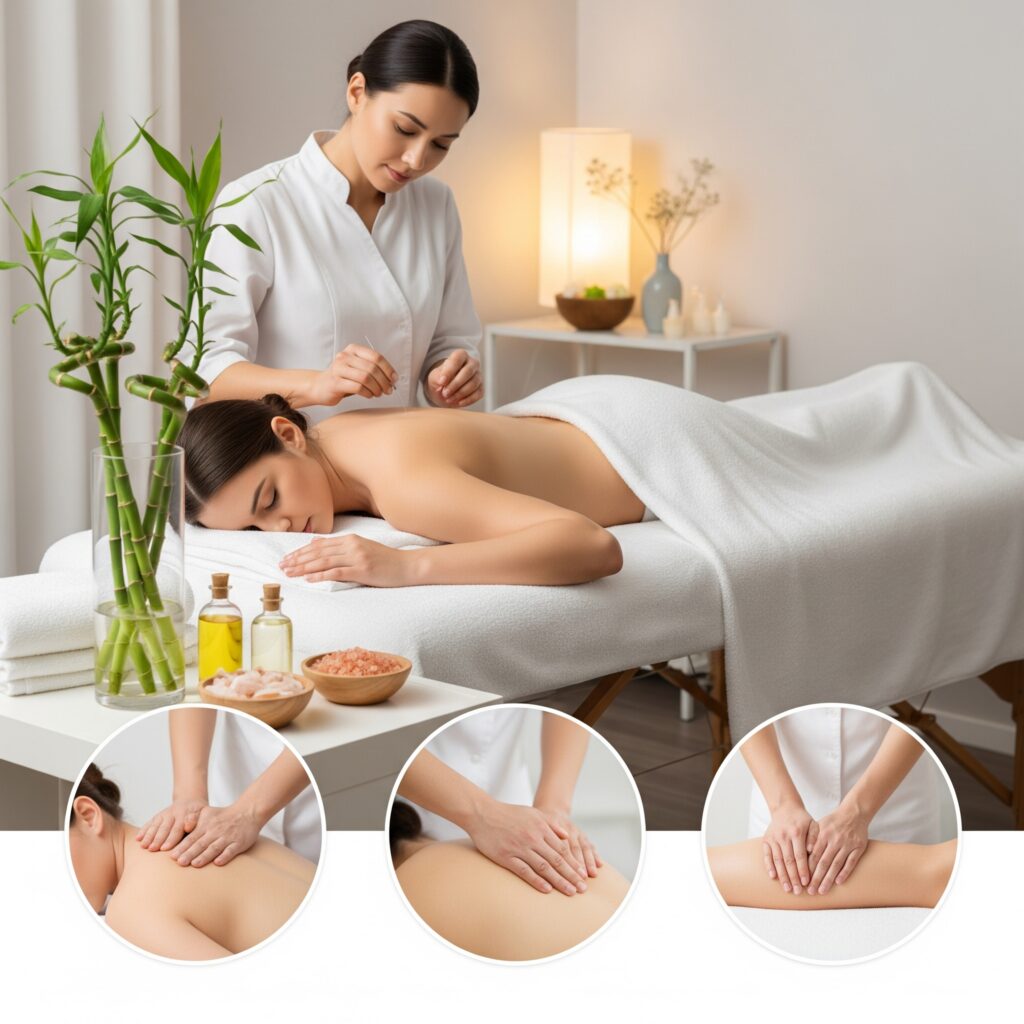
There’s a quiet thing that happens when two people relax in the same room. Breathing slows and drifts into the same rhythm; the body reads the calm next to it and lets go a little faster. It’s the same reason a hard week feels lighter the moment you finally sit down with someone instead of alone. In the double room, with two therapists working at the same unhurried pace, that shared settling is the whole point – not a luxury add-on, just what happens when two tired people stop at the same time.

The summer that quietly wears you down

Heat is sneaky. You don’t feel it as tension the way you feel a cold-weather ache, but it’s there: shorter sleep, less water than you think, a low background irritation that tightens shoulders and shortens tempers. By the end of August most people are running on a reserve they’ve stopped topping up. A shared hour on the table won’t change the weather, but it resets the dial – the two of you leave a little kinder to each other, which across a long summer is worth more than it sounds.

What you’re actually booking

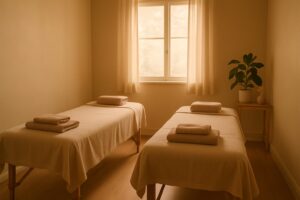
I’ll be plain about it. We’re a small place – two single rooms and one double, kept spotlessly clean, run by people who care more about the hour on the table than the decor around it. No sauna, no pool, none of the expensive extras that make a spa feel grand and charge you for the privilege. Just a warm, quiet room and a full hour where the two of you are the only thing on the schedule.

A good week for it

You don’t need an anniversary or an excuse. A slow August evening is reason enough. Book the double room, leave your phones in your bags, and let the summer lift off both your shoulders at once. That’s the whole idea – a reset you take together, and then carry back out into the heat a little lighter.

Yang Wang practises therapeutic and relaxation massage at Chinese Massage – Tai Chi Tirana. The parlour is in central Tirana, a short walk from Bulevardi Myslym Shyri.

Couple massage. Why the both of you need it urgently.

There’s a particular silence that settles over the double room about ten minutes in. Two people walk in still finishing the argument they started in the car – the parking, the in-laws, whose turn it was to call the plumber – and then, quietly, nobody is talking anymore. Not because they’ve made peace. Because their shoulders have.

I notice it most in summer. Tirana in August is its own kind of tired. The heat sits on you by eleven, the traffic is shorter-tempered than usual, and everyone you love is slightly damp and slightly irritated. When people feel like that, they don’t think massage. They think a holiday we can’t book, or we just need one quiet weekend. But an hour on two tables, side by side, often does what the weekend doesn’t.

Two tables beat one sofa

When you relax next to someone, your bodies quietly borrow calm from each other – slower breathing, a heart rate that drifts down to meet theirs. On a shared sofa that almost never happens, because one of you is on a phone and the other is already thinking about dinner. In the double room there are no phones and nothing to decide. Two therapists, working at the same unhurried pace, and the two of you finally still in the same place at the same time. It sounds like a small thing. Couples tell me afterwards that it wasn’t.

The summer version of “we’re fine”

Heat tightens people in ways they don’t notice. You drink less water than you think, you sleep a little worse, and your neck and lower back clench quietly through every hot afternoon. “We’re fine” is what you say once you’ve stopped noticing. The couples I see in July and August usually book for a reason that isn’t really the reason – before a trip, after guests finally leave, the week the children go to their grandparents. They come for the excuse. They come back for how the evening felt afterwards.

What the double room actually is

Let me be honest about what we are, because it’s the point. We’re a small parlour – two single rooms and one double. We are not a spa with a sauna and an infinity pool, and we’ve never wanted to be; that kind of place charges you for the marble, not the massage. What we put the money into is the hour itself, and into keeping the room spotless and the welcome warm. So the double room is simple: soft light, clean linen, two therapists who know exactly what they’re doing, and the two of you, undisturbed, for a full hour.

When to book it – and when not

Book it when you’re both running on empty at the same time, which in a Tirana summer is most weeks. Book it before the long drive to the coast, not after a heavy lunch. Don’t book it expecting it to settle an argument – it won’t referee anything. It simply gives you both a quiet hour in the same room, which, far more often than people expect, turns out to be the thing you were actually missing.

The both of you don’t need it urgently the way a headache needs a tablet. You need it the way two tired people need to sit down together and stop, before they forget how. This week is a good week for that.

Yang Wang practises therapeutic and relaxation massage at Chinese Massage – Tai Chi Tirana. The parlour is in central Tirana, a short walk from Bulevardi Myslym Shyri.

Pregnancy massage. Gentle, careful, and worth it.

A friend walked in one afternoon at about twenty-two weeks. She had been sleeping badly for a month — not from worry, just from the simple fact that the body she had lived in for thirty-something years had quietly rearranged itself around another person, and no position felt quite right anymore. She sat down, listed her usual complaints — the pull along the lower side, the shoulders that had crept up toward her ears — and then added, almost as an afterthought: “But I suppose there’s not much you can do, is there?”

There is quite a lot, actually. Pregnancy massage is one of the more nuanced things we do, and it is worth explaining what makes it different and why that difference matters.

Why it is not the same as a regular massage

The short answer is: the body has changed, so the approach must change with it. Circulation is working harder than usual. Certain pressure points that ordinarily speed up circulation or stimulate the uterus are avoided entirely in the first trimester and used with great care thereafter — in Traditional Chinese Medicine (TCM), these include specific points on the lower leg and ankle that are powerful precisely because pregnancy is not the right moment for that kind of stimulation. Positioning changes completely: after the first trimester we work with the mother on her side, supported by bolsters, never flat on her stomach and almost never flat on her back for extended periods. The pressure is lighter in some areas, firmer where chronic tension has built up — the upper back, the area between the shoulder blades, the base of the skull.

None of this makes the massage timid. It makes it precise.

What the mother gains

The most immediate thing most mothers notice is sleep. Not dramatic, just — better. The nervous system has been running at a higher baseline; one hour of steady, attentive, warm hands brings it down. Cortisol drops. The shoulders finally remember how to hang. Swelling in the legs and ankles, a near-universal complaint from the second trimester onward, eases as circulation moves more freely through tissue that has been under extra pressure.

There is also something less measurable: the feeling of being attended to. Pregnancy puts a great deal of attention on the baby — rightly so — but the mother’s body is doing extraordinary, invisible work, and an hour of quiet acknowledgement of that work is not a luxury. It is maintenance.

What reaches the baby

This is where TCM has always been quietly ahead. When the mother’s nervous system settles — heart rate slower, breathing longer, muscles letting go — the baby feels exactly that. Cortisol is shared; so is calm. Research in perinatal care has been confirming for decades what traditional Chinese practitioners took as given: a relaxed mother creates a gentler environment for the child developing inside her. There is nothing mystical about it. The baby is living in the mother’s body. The mother’s state is the baby’s immediate world.

Some mothers also notice that the baby moves differently during or after a session — quieter during, a little livelier after, as if responding to the shift in the room.

When a partner joins: the couple session

This is the part I find myself recommending more and more. A couple massage during pregnancy is not simply two people having massages in the same room — though that is pleasant enough. It is something bigger than that.

The partner is also navigating a change they cannot feel directly. They are watching, supporting, sometimes not quite sure what to do. Being present for a massage session — receiving their own treatment while their partner does the same, in the same room, at the same pace — is a physical way of saying we are in this together. Many couples tell me afterward that the quiet of the room, the parallel experience, opened something between them. Not words. Just presence.

But there is another layer that I think matters just as much. This is not only a couple experience — it is the beginning of a family one. The baby is already there, already part of the room, already part of the equation. When both parents arrive together, rest together, and let their nervous systems slow down in the same space, they are doing something quietly profound: they are practising, as a family, what calm looks like. The baby, living inside the mother’s body, is part of that moment. It is an early form of bonding — not symbolic, but physiological.

The benefits deepen for the mother, too. There is something specifically calming about receiving care alongside someone who loves you. The nervous system knows the difference.

A few honest notes on timing and limits

Pregnancy massage is generally considered safe from the second trimester onward; in the first trimester, when the risk of miscarriage is highest and the body is undergoing its most rapid changes, we take extra care and prefer to wait unless the mother’s doctor has specifically said otherwise. If there is a history of preterm labour, placenta praevia, or any pregnancy complication, we ask to know first — not to refuse, but to adapt. And if anything feels wrong at any point during the session, we stop.

It is also worth saying: this is not medical care. It is skilled supportive care. For any concern, your obstetrician is the right person.

We have written a fuller practical guide — covering positions, trimester-by-trimester detail, and what to tell your therapist before you arrive — in our piece on pregnancy massage: what you need to know before you book.

You can read more about how the therapeutic massage works on the Therapeutic Massage (Tui Na) page.

Yang Wang practises therapeutic massage and acupuncture at Chinese Massage – Tai Chi Tirana. The parlour is in central Tirana, a short walk from Bulevardi Myslym Shyri. Names in client stories have been changed.
Acupuncture: The Day the Needles Changed Her Mind

Acupuncture: The Day the Needles Changed Her Mind

Acupuncture: The Day the Needles Changed Her Mind

When people hear the word acupuncture, they often react the same way:

“Needles? I’m not sure…”

I understand that hesitation. Even though I grew up in China, where acupuncture is part of everyday healthcare, I remember when I truly understood its power.

Today in Tirana, I see that same uncertainty in new clients.

And then I see the change.

• • •

She came with chronic headaches. Long office hours. A tight jaw from stress. Sleep that never felt restorative.

“I’ve tried everything,” she said. “Maybe this… but I’m afraid of needles.”

I smiled gently.

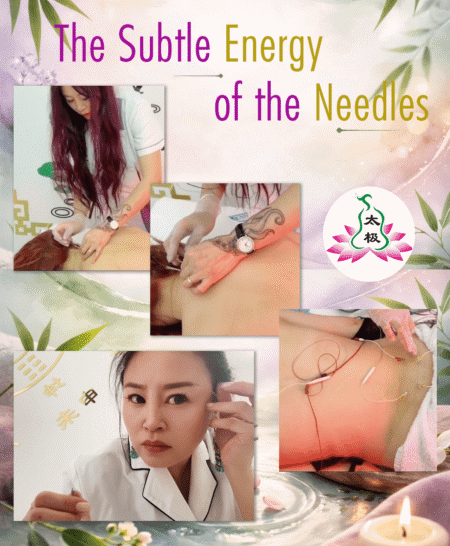
Acupuncture needles are extremely thin — almost like a strand of hair. Most people are surprised by how little they feel.

We began slowly.

The room was quiet. The city faded. I placed the first needle on her hand.

“That’s it?” she asked.

That’s it.

• • •

An Ancient Medicine

In Chinese, acupuncture is called 针灸 (Zhēn Jiǔ) — “needle and moxibustion.” It is one of the pillars of Traditional Chinese Medicine.

There is an old saying:

“通则不痛,痛则不通.”

“If there is free flow, there is no pain. If there is pain, there is no free flow.”

Vital energy, Qi (气), flows through meridians in the body. When it becomes blocked, discomfort appears — headaches, tension, anxiety, fatigue.

Acupuncture stimulates precise points to restore that flow.

From a modern perspective, it activates the nervous system, improves circulation, reduces inflammation, and releases endorphins.

• • •

The Quiet Shift

Within minutes, her breathing changed.

Her shoulders softened.

Her forehead relaxed.

The body stopped fighting.

Acupuncture is quiet medicine. There is no force. Yet inside, the body recalibrates.

When the session ended, she opened her eyes slowly.

“My head feels clear,” she said. “It’s quiet.”

• • •

The needles are small.

But the effect can be profound.

Sometimes healing does not need to be loud.
It only needs to be precise.

acupuncture-21-Feb-2026

Therapeutical Escape

A moment away from the daily noise – Relaxation and Energy in one place. This video takes you right inside our center, where traditional Chinese techniques work for your well-being.

From deep tissue massage to energy rebalancing techniques, the best place to help you reconnect.


➡️ Book your session now!

Acupuncture worked for me

I have lived and worked in Tirana for many years, building my career in a bank. My days are spent in front of a computer, long hours of meetings and reports, with little time left for movement. Over time, this lifestyle left me with a constant, stubborn pain in my right shoulder.


I did the sensible thing and went to a doctor. An X-ray was taken, but nothing unusual showed up. The advice was to rest and to take painkillers. I tried for a while, but I didn’t want to become dependent on medication just to get through daily life. The thought of carrying this pain indefinitely, or relying on pills, felt discouraging.
That’s when I decided to visit Yang’s salon. I originally booked a massage, which was wonderful, but when I shared my story about the shoulder pain, Yang suggested something I had never considered: a course of acupuncture, ten sessions in total.


I was skeptical at first. Acupuncture was unfamiliar to me, but Yang’s calm explanation and the confidence she inspired convinced me to try. From the very beginning, I felt her professionalism in the way she worked—each needle placed with care and purpose. Gradually, the tension in my shoulder started to ease. After a few sessions, I noticed real improvement. By the tenth session, the pain that had followed me for months was gone.

When I wanted to thank Yang, she told me that the best way would be to write down my experience so others in Tirana might benefit from it too. So here I am, sharing my story.

What stays with me most is not only the fact that my pain disappeared, but also the way Yang guided me through a method I had never thought of trying. Her mastery of acupuncture gave me a real alternative to medication and showed me that relief is possible—even when the usual medical tests say everything is “normal.”
For anyone in Tirana who spends too many hours sitting at a desk and struggles with unexplained pain, I would say this: don’t ignore it, and don’t give up. Sometimes the solution is closer than you think.

 Suela

[ story source: www.facebook.com/permalink.php?story_fbid=pfbid02cCELTC8KX7UnbzNgDYxXG8NtqFftXRdB1SrgkwxzshQTWd66oJiUDnZ4AiU3yEHkl&id=61581331277081 ]

What a headache!

Yesterday evening, just as we were getting ready to close, one of our neighbors knocked on the door. She looked pale, her hand pressing against her temple, and she told me she was suffering from a terrible migraine.

Migraines are not just headaches — they can be so intense that the world feels too bright, every sound is too loud, and even simple movement becomes exhausting. I could see how much she was struggling. She had already taken painkillers earlier in the day, but the pain wasn’t easing.

I invited her in and suggested we try a short acupuncture session. After a few minutes of rest, I gently placed thin needles in specific points: LI4 (Hegu) on her hand to release tension, GB20 (Fengchi) at the base of her skull to calm the pounding pain, and Taiyang near her temples. I also added LR3 (Taichong) on the foot to smooth the flow of Liver Qi, which in TCM is often linked to migraines.

At first, she was a little nervous — she had never tried acupuncture before. But within minutes, her breathing slowed, her shoulders relaxed, and I could feel the shift in her body’s energy. By the end of the session, she opened her eyes, surprised. The heavy pressure in her head had lightened, and the sharp pain had faded to something much more bearable. She smiled for the first time that evening and said, “It feels like a weight has been lifted.”

Moments like this remind me why I practice Traditional Chinese Medicine. Modern science may not fully explain how acupuncture works, but time and again, I see how it helps people — easing pain, calming the mind, and restoring balance.

For my neighbor, it wasn’t just about needles. It was about being cared for, about knowing there is a natural way to find relief when nothing else seems to work.

Serenity Full body massage

The Right Time for a Four Hands Massage

We all know those nights. You get in bed early, ready to sleep, and suddenly your brain opens a to-do list from hell: work, money, family, even that weird comment you made years ago. It doesn’t stop.

That’s the new normal for many of us—always “on,” rarely resting, running on empty. You wake up tired, move through the day like a zombie, and your body feels like it’s carrying the weight of it all.

This is where four hands come in. Not as a treat, but as a real reset button for your body and mind.

What Is Four Hands Massage?

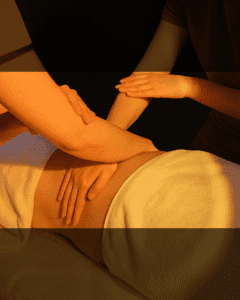
It’s exactly what it sounds like—two therapists working on you at the same time. But it’s not just “double massage.” It’s a coordinated rhythm, a mirrored flow of movement that covers your body evenly.

Picture this: you’re lying down, the room is calm, and two sets of skilled hands move in sync to release tension, boost circulation, and calm your nervous system.

It feels good, yes. But there’s also solid science behind why it works so deeply and effective.

Why Your Brain Loves It

Here’s the twist: your brain can’t keep up with two identical streams of touch at once. It stops trying to analyze or predict.

Instead, it lets go.

That endless loop of thinking, worrying, planning? It finally hits pause. Your body shifts out of stress mode and into true rest mode—the place where real healing and recovery happen.

Why It Hits Different Right Now

Life speeds up around seasonal changes, deadlines, and stress spikes. You may not even notice how much it’s weighing on you—until your shoulders lock up, your energy drops, or your stomach rebels.

Traditional Chinese Medicine calls this blocked energy, or Qi. Four-hand massage helps open the flow again. It calms down the nervous system, reconnects body and mind, and leaves you feeling more balanced than you thought it possible.

Like Meditation, Without the Effort

Meditation is hard when your head won’t stop spinning. But during a four-hand massage, your brain simply can’t hold on to all the input.

It’s like white noise for your nervous system. You stop waiting for the next move, stop planning, stop fixing.

You just exist in the moment. And that’s where calm settles.

Who Benefits Most?

If you:

  • Struggle to fall asleep or wake up groggy
  • Can’t stop replaying work or future worries
  • Feel weighed down or mentally foggy
  • Are going through a stressful change
  • Or simply forgot what deep relaxation feels like…

…then four hands might be exactly what your system is looking for.

Not Just Relaxation – A Reset

The effects go beyond a clear head. This treatment also tackles:

  • Muscle tension
  • Poor circulation
  • Low energy
  • Chronic fatigue

By working both sides of the body at once, it balances your whole system. Many walk out feeling lighter, clearer, and more grounded – like the noise finally turned down.

Final Word

A four-hand massage isn’t just “an hour of calm.” It’s the after-effect: better sleep, sharper focus, a steadier mood, and more energy to live your life.

So if you’re wired, tired, or stuck in your head, maybe the fix isn’t to push harder.

Maybe it’s letting go—while four hands do the work for you.

Double the care, double the healing."

Relaxation and recovery massage

Your body has always supported you, no matter the challenges. Now it’s time to give back! Discover how massage and Traditional Chinese Medicine can soothe tired legs and restore your energy.


The Hidden Highways of Health: Understanding Meridians and Meridian Conditioning in TCM

When I first studied Traditional Chinese Medicine (TCM), one of the most fascinating discoveries for me was the idea of meridians—the invisible pathways that carry energy through the body. They don’t appear in anatomy textbooks, and modern Western medicine does not recognize them as physical structures. And yet, for thousands of years, they have been central to how Chinese medicine understands health, balance, and healing.

What is interesting is that, even today, many patients who try treatments based on meridian work describe feeling lighter, more balanced, and more at ease. Whether it is through acupuncture, massage, or other techniques, they often notice changes that are difficult to explain in purely physical terms.

What Are Meridians?

Meridians can be thought of as energy highways. Instead of blood or nerves, they carry Qi (life energy) and influence how well our organs, muscles, and even emotions function. There are 12 main meridians, each linked to a specific organ system—like the lung, heart, liver, or kidneys.

When these pathways are open and flowing, the body feels alive, energetic, and in balance. When they are blocked or stagnant, problems may show up as pain, fatigue, mood swings, or other discomforts.

massage therapy

Signs of Imbalance

Many common complaints can be understood in TCM as signs of meridian imbalance:

  • Stiff muscles or aching joints
  • Constant tiredness or low energy
  • Stress, anxiety, or irritability
  • Digestive troubles
  • Poor sleep or frequent headaches

In practice, I often see that once the meridians are gently “opened,” these issues begin to improve naturally.

Manual Therapy:

What Is Meridian Conditioning?

Meridian conditioning is a way of keeping these pathways healthy and open. It is less about fixing a single symptom and more about maintaining the body’s overall balance. Some of the techniques include:

  • Acupuncture or acupressure – stimulating precise points along the meridians
  • Tui Na massage – using touch, pressure, and movement to free blocked energy
  • Cupping or gua sha – promoting circulation and removing stagnation
  • Gentle movement and breathing – such as Tai Chi or Qi Gong, to strengthen the natural flow of energy

I like to think of meridian conditioning as the equivalent of maintaining the roads in a city—if they are clear and well-kept, life moves smoothly.

Woman Suffers Medical Emergency

Why It Matters Today

Modern life is full of stress, poor posture, long hours in front of screens, and irregular routines. All of these can disrupt the body’s natural balance. That is why so many people today are turning to TCM approaches—not to replace modern medicine, but to complement it and support their own well-being.

Even though science has not yet mapped meridians the way it has blood vessels or nerves, what matters most is how people feel. And the truth is, many patients report a deep sense of relaxation, reduced pain, and renewed energy after meridian-based therapies.

cupping therapy on their back

A Personal Reflection

Over the years, I have seen people arrive tired, stressed, or in pain—and leave with a calm smile and lighter step. It’s not magic. It’s simply the body responding when the energy begins to flow again.

For me, this work is not just about easing discomfort, but about helping people reconnect with their natural vitality. Whether you see it as energy, circulation, or simply relaxation, the result is often the same: the body feels freer, and the mind feels clearer.

Frequently Asked Questions

  1. Are meridians scientifically proven?

Modern medicine does not recognize meridians as physical structures. They are not visible under a microscope or in medical imaging. However, many people find that therapies working on meridians bring real relief and improved well-being.

  1. Can meridian conditioning replace modern medical treatment?

No. TCM should not be seen as a replacement for necessary medical care. Instead, it can be a complementary approach that supports balance, relaxation, and the body’s natural healing processes.

  1. How many sessions are usually needed?

This varies from person to person. Some people feel noticeable changes after just one or two sessions, while others may benefit from regular treatments to maintain balance.

  1. Is meridian conditioning safe?

Yes, when performed by a trained professional. Techniques like acupuncture, massage, and cupping are generally safe and have been used for centuries.

  1. Who can benefit from it?

People of all ages may find benefit—from those with chronic stress or muscle pain to those who simply want to improve their energy and overall balance.

Final Thought

Meridians may not be visible under a microscope, but their effects are real to those who experience them. Meridian conditioning is about nurturing balance, preventing blockages before they turn into bigger problems, and giving the body the chance to heal itself.

As a practitioner, I see it as an invitation—to listen more closely to the body, to care for it gently, and to trust in its natural ability to restore harmony.