There is a kind of headache that responds beautifully to a thumb pressed firmly into the trapezius at the base of the skull. Most office workers know this point intuitively — the moment of relief when someone with strong hands works that exact knot, the sense that something has loosened that was about to ruin the afternoon. This works because the headache in question is a tension-type headache, and tension-type headaches respond to mechanical pressure on the muscles whose tightness is generating them.
But there is another kind of headache — and many people who think they have tension headaches actually have this one — that does not respond to thumb pressure at all. In fact, deep pressure on the upper neck can make it worse. This second kind of headache responds to gua sha, the scraping technique, in a way that has surprised many of my clients. It took me a long time to understand why; what follows is the picture I have come to, in plain language.
If you have ever had a headache that started at the base of the skull and crept forward over the top of the head, with a quality that was more “throbbing-pressure” than “tight-band,” and which got worse rather than better when someone tried to massage it — this piece is about why, and what to do instead. (For the same condition approached through needles rather than scraping, see the earlier migraine-relief acupuncture story.)
The two headaches that look the same
The tension-type headache and the cervicogenic migraine are often confused because they begin in similar places. Both start in the upper neck or base of the skull. Both can radiate forward. Both feel, to the person experiencing them, like “neck causing head.”
But they are different things, with different sources.
A tension-type headache comes from muscles in the neck and the head holding on for too long. The squeezing reduces the blood flow to the muscles themselves, the muscles get tired and irritated, and the irritation becomes pain. The feeling is steady, often “a tight band.” It responds to anything that relaxes the muscles: heat, gentle massage, careful stretching.
The other kind — what TCM teachers in my training called a “wind in the neck” headache, and what some Western doctors I have read call a “neck-origin” or “cervicogenic” migraine — comes from irritation of the small nerves in the upper neck. These nerves and the nerves of the face share part of the same pathway in the brain. When the neck nerves are angry, the brain often reads the signal as pain in the forehead and around the eyes. The feeling is more throbbing than tight, sometimes one-sided, sometimes with sensitivity to light or sound or with a little nausea — closer to a migraine, even though the source is in the neck.
The reason pressing the upper neck often makes this kind of headache worse is that the pressure adds irritation where the nerves are already irritated. The therapist is trying to release the muscle, but the muscle is not the real source. The muscle is holding on because the nerve beneath it is angry, and pressing harder makes the nerve angrier.
What gua sha does differently
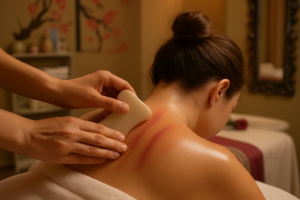
Gua sha — the technique of scraping the skin with a smooth-edged tool after oiling — works on the body at a quite different level than direct pressure.
When applied to the upper neck and base of the skull, gua sha seems to do several useful things for this kind of headache.
It moves the fluid and blood in the surface layer of the skin and the soft tissue just under it, where things have often become quietly congested. The scraping clears this layer in a way nothing else really does.
It produces a strong but brief sensation — the warm scraping feeling — that the nervous system has to attend to. While it is attending to that, it cannot also amplify the background pain it has been amplifying. This is the same reason a hot shower briefly helps a headache: the nervous system has only so much attention to give.
It cools the tissue afterwards (the warmth of the scraping is followed, in the next minutes, by a slight cooling as the small capillaries settle), and the cooling seems to quieten the nerves further.
All of this happens without any pressure on the inflamed nerves themselves. The work is done on the layer above. That, I think, is why gua sha often helps where direct massage on the neck does not.
This is why gua sha often succeeds where massage fails on this kind of headache. The intervention is gentle in the right place rather than firm in the wrong place.
The protocol I use
For clients with suspected cervicogenic migraine — usually identified through a detailed history-taking that distinguishes their headache pattern from ordinary tension-type — the gua sha protocol is straightforward but specific.
The client lies on their stomach, with the neck and upper back exposed. A small amount of oil — usually a base of jojoba with a few drops of Mentha haplocalyx (Chinese field mint) — is applied to the area.
I use a porcelain spoon with a smoothed edge (a traditional gua sha tool that I have used for years and that fits the contours of my hand well). The strokes begin at the very base of the skull, moving downward, with moderate but not heavy pressure. The strokes follow the path of the bladder meridian along the spine, then move laterally to follow the trapezius along its upper border.
The treatment area extends from the occipital ridge down to the upper edge of the shoulder blades, and outward to about the level of the acromion (the bony point at the top of the shoulder). The whole region is treated systematically, with each strip of skin receiving five to ten strokes.
The marks that emerge — the sha — tell the story. In clients with cervicogenic patterns, the deepest sha is almost always in two specific zones: just below the occipital ridge on the affected side, and along the upper trapezius about two finger-widths from the base of the neck. These are the zones where the underlying nerve irritation is generating the surface congestion.
A session takes about twenty-five minutes. The relief, in clients for whom the technique is appropriate, usually begins to be felt within four to six hours after the session and is most pronounced the next day.
A small parallel from my grandmother
My grandmother in Liaoning, when one of us children had a headache that would not go away, used to apply a small piece of cloth dipped in slightly warm sesame oil to the back of the neck, and rub the area firmly in slow downward strokes. She would do this for ten or fifteen minutes. We thought it was a kind of comforting gesture; she was, in fact, performing a household version of gua sha. The cloth was rougher than a porcelain tool but the principle was the same: slow downward stroking of the upper neck and base of the skull.
The technique turns up under many names — the Vietnamese cạo gió, the Indonesian kerokan, and others besides. It seems that almost any culture with access to a little oil and a smooth-edged object eventually discovers that slow scraping of the neck and back eases certain kinds of pain. That so many places arrived at the same gesture independently suggests the underlying mechanism is a robust one.
When to use it, when not to
Gua sha for headache is particularly useful when:
The headache has a cervicogenic quality — it begins in the upper neck, has throbbing rather than tight-band character, and either does not respond to manual massage or worsens with deep neck pressure.
The pattern is recurrent rather than acute. A single severe headache should be evaluated by a doctor to rule out serious causes (sudden onset severe headaches, headaches with neurological symptoms, headaches after head injury, headaches with fever).
The client is otherwise healthy and has no contraindication to the technique. The contraindications are similar to cupping: bleeding disorders, anticoagulant medication, very fragile skin, recent radiotherapy to the area.
It is not the right intervention for: classic migraine without obvious cervical involvement (where the headache is more clearly a central neurological event); cluster headaches (a different condition entirely); medication-overuse headache (where the problem is rebound from frequent painkiller use and gua sha will not address the underlying issue); and acute severe headaches of unknown cause.
For chronic cervicogenic migraine, a typical treatment course is six to eight sessions across two to three months, with progressive reduction in headache frequency over the course of treatment. Most clients see meaningful improvement by the fourth session.
What it feels like the first time
The first gua sha session is, for many clients, an unusual experience. The scraping sensation is firm but not painful. The aromatic oil produces a pleasant cooling effect on the skin. There is often a moment, around the third or fourth stroke in each zone, where the client feels a sudden release — a small ease somewhere in the head or neck that they have not felt in some time.
The post-session feeling is usually one of considerable relaxation, sometimes mild fatigue, occasionally a brief sense of emotional release. Clients often sleep deeply that night.
The marks — the sha — are visible the next morning. They fade over three to seven days. As with cupping, they are not bruises and are not painful to the touch. They are the record of work done.
If your headaches have a cervicogenic quality and you have been frustrated by approaches that have not worked, this is one of the older techniques worth trying. Sometimes the right help is gentle in the right place rather than firm in the wrong one — which, now that I think of it, is also the only sensible way to drive through the roundabout at Zogu i Zi.
Yang Wang practises Chinese medicine at Chinese Massage – Tai Chi Tirana.