There is a common misconception, even among people who book massages regularly, that relaxation massage is the lighter, less serious version of therapeutic massage. The “spa version.” Nice, but somehow not real treatment. Therapeutic massage works on a specific complaint; relaxation massage is just a treat.
I have come to think this framing has it almost backwards. A relaxation massage, done well, does real things to the body — to the breath, to the heart’s rhythm, to how deeply someone sleeps for the next several nights, to how the body holds tension during the days that follow. These effects are not subtle, they are not “just relaxation,” and they do not happen from a quick fifteen-minute thumb-pressure session. They emerge from a sustained sixty or ninety minutes of careful full-body work, of a kind the modern world rarely makes time for.
This piece is the longer answer to clients who ask, slightly apologetically, whether they “really need” the longer relaxation session, or whether they would be better off with something shorter and more targeted. For most people who have been chronically stressed for years, the longer session is — and this surprises them — the more important one.
A nerve I think about a lot — the vagus
There is one nerve in the body I find myself thinking about more than any other. It is called the vagus nerve, and it is the long quiet wire that connects the brain to most of the organs in the chest and belly. When this nerve is doing its job well, the heart slows down a little, the breath drops deeper, the stomach gets on with digesting, the body settles into rest mode. When it is not — and in most people who have been stressed for years, it is not — the body stays in a slightly alert, slightly braced state, all day, every day, for years.
I read once that doctors measure how well the vagus nerve is working by looking at small variations in the timing between heartbeats. A relaxed, well-regulated body has more variation. A chronically stressed body has a more rigid, less-varying rhythm. That little detail stays with me — the body’s internal music has more notes when it is well.
What interests me is that, from what I have read and from what I have seen on the table over many years, relaxation massage done well is one of the more reliable things a person can do to bring this nerve back into good working order. Not the only thing — slow breathing helps, time outdoors helps, certain kinds of singing and humming help — but a sustained session of careful slow touch is one of them.
How the work seems to settle the vagus
A few different things appear to be happening at once during a well-performed relaxation session. I will describe them in the order they happen, as I understand them.
The first is the slow steady pressure on the belly during the front-of-body portion of the session. The vagus nerve has feeler-branches in the belly wall and around the organs. Slow, sustained contact in this region — which not every therapist actually does, because some are uncomfortable working the abdomen — seems to settle the nerve quickly.
The second is the small amount of work we do around the outer ear. There is a branch of the vagus that comes up through the ear, and gentle work in the curve of the ear seems to produce an immediate quietening effect. The first time a teacher pointed this out to me, in my training, I did not believe it. Then I tried it on a fidgety client and watched her settle within a minute. I have used it ever since.
The third is harder to put my finger on, but I have read that scientists have looked at what the brain does during sustained gentle touch and they see particular regions calming down — the parts that scan for threat — while other regions, the ones associated with feeling safe with another person, become more active. The body’s stress hormones drop. The body’s bonding hormones rise. None of this is mystical. It is, as far as I can tell, what touch has always done; we just have better names for it now.
The fourth is the breathing itself. Lying face down on a warm table, with someone moving slowly in a steady rhythm, the breath naturally drops lower in the body. And deeper breathing, in turn, nudges the body further out of fight-or-flight and into rest, so the effect builds on itself across the session.
The cumulative effect of all of this over sixty or ninety minutes is, in my experience, much larger than people expect from a single session. I have seen clients whose heart rate visibly slows. Their face changes colour slightly as the blood pressure comes down. After regular sessions, many tell me they sleep differently for two or three nights afterwards. I cannot promise these effects to anyone — bodies respond differently — but I see them often enough that I take the work seriously.
What this looks like in the parlour
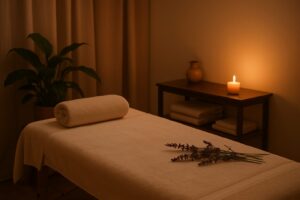
A standard relaxation massage in our parlour takes sixty or ninety minutes (we recommend ninety for first-time clients, sixty for regulars who know what they need). The session unfolds in a specific sequence — one that has been refined over decades of patient work, generation by generation, by therapists in the Tui Na tradition.
The first ten minutes are about settling. The client lies face down on the table. We use slow, broad, sweeping strokes across the back — work that produces almost no specific therapeutic effect on the muscles but which signals to the nervous system that a sustained period of touch is beginning. The body uses this period to commit to the session. The breathing slows. The shoulders drop into the table.
The middle forty to seventy minutes are the working portion. Specific regions are addressed in sequence: back, shoulders, neck, scalp, arms, hands, then (after the client turns over) abdomen, legs, feet. The pressure is medium — neither the deep work of therapeutic massage nor the light feathery touch some spas use. Medium pressure is what helps the body settle into rest most reliably; lighter pressure is sometimes perceived as ticklish or as not enough, and deeper pressure tends to keep the body on alert.
The last ten minutes are integration. The strokes become slower and broader again, signalling to the body that the session is ending. We give the client several minutes lying still on the table at the end of the work, often with a warm towel across the eyes, before asking them to sit up. This integration period matters: getting up too quickly truncates the cumulative parasympathetic effect.
A common observation from clients
There is a particular response that emerges in clients who come for relaxation massage regularly. The first session, they often describe as “very relaxing.” The second session, “I slept the best I have slept in months.” The third or fourth session, they begin to notice something they had not expected: a change in how they handle stressful situations in daily life.
The change is not dramatic. It is more that they have, at some level, a memory of what the parasympathetic state feels like. When a difficult moment arises — a stressful meeting, a frustrating commute, a difficult conversation — there is now a different reference point to return to. The body remembers there is another way to be. The recovery from the stress moment is faster, and the residual tension that used to accumulate over the day accumulates less.
This effect is what makes regular relaxation massage a genuine intervention rather than a luxury. It is not just about feeling good during the hour on the table. It is about teaching the nervous system, over weeks and months, what its own non-stressed baseline actually feels like.
Why an hour is not the same as ninety minutes
A point that surprises many clients: the difference between a sixty-minute and a ninety-minute relaxation session is not proportional to the extra thirty minutes.
The first thirty minutes of a session are largely spent in the settling phase. The body is committing to the work, the breathing is deepening, the shoulders are dropping. The therapeutic effects on the autonomic nervous system are beginning but have not yet reached their peak.
The middle thirty minutes are where most of the parasympathetic activation happens. Heart rate variability begins to improve. Cortisol begins to drop. The brain regions associated with default-mode rumination quiet down.
The last thirty minutes — the ones that are absent from a sixty-minute session — are where the deepest effects accumulate. The integration of the parasympathetic state into the body’s regulatory baseline happens during this period. Clients who have ninety-minute sessions report substantially deeper and longer-lasting effects than clients who have sixty-minute sessions, even though the difference in time is only fifty percent.
For chronic stress, anxiety, or insomnia, the ninety-minute session is meaningfully more therapeutic. For maintenance once the underlying state has improved, sixty minutes can be sufficient. (I have written separately about the one-hour March wellness session in Tirana, which sketches a regular maintenance rhythm.)
A note on what relaxation massage is not
Relaxation massage is not appropriate for: acute injury (the work would either be too gentle to help, or risk aggravating the area); active inflammatory conditions (fever, acute illness); pregnancy without specific prenatal training (we have therapists trained for prenatal work; the general relaxation protocol is modified during pregnancy); and certain specific medical conditions that require a more targeted approach.
Relaxation massage is appropriate for, and particularly useful for: chronic stress, mild to moderate anxiety, insomnia not caused by an underlying medical condition, recovery from prolonged work periods, the support of grief and emotional adjustment, and as a regular maintenance intervention for general wellbeing.
It is not, despite the casual way it is often described, the “less serious” version of massage. It is a different kind of work, with real effects, and for many people in the modern world it is exactly what the nervous system has been quietly asking for.
Yang Wang practises massage and Chinese medicine at Chinese Massage – Tai Chi Tirana. The parlour is in central Tirana, by the Lana.