What a Real Relaxation Massage Does to Your Vagus Nerve

There is a common misconception, even among people who book massages regularly, that relaxation massage is the lighter, less serious version of therapeutic massage. The “spa version.” Nice, but somehow not real treatment. Therapeutic massage works on a specific complaint; relaxation massage is just a treat.

I have come to think this framing has it almost backwards. A relaxation massage, done well, does real things to the body — to the breath, to the heart’s rhythm, to how deeply someone sleeps for the next several nights, to how the body holds tension during the days that follow. These effects are not subtle, they are not “just relaxation,” and they do not happen from a quick fifteen-minute thumb-pressure session. They emerge from a sustained sixty or ninety minutes of careful full-body work, of a kind the modern world rarely makes time for.

This piece is the longer answer to clients who ask, slightly apologetically, whether they “really need” the longer relaxation session, or whether they would be better off with something shorter and more targeted. For most people who have been chronically stressed for years, the longer session is — and this surprises them — the more important one.

A nerve I think about a lot — the vagus

There is one nerve in the body I find myself thinking about more than any other. It is called the vagus nerve, and it is the long quiet wire that connects the brain to most of the organs in the chest and belly. When this nerve is doing its job well, the heart slows down a little, the breath drops deeper, the stomach gets on with digesting, the body settles into rest mode. When it is not — and in most people who have been stressed for years, it is not — the body stays in a slightly alert, slightly braced state, all day, every day, for years.

I read once that doctors measure how well the vagus nerve is working by looking at small variations in the timing between heartbeats. A relaxed, well-regulated body has more variation. A chronically stressed body has a more rigid, less-varying rhythm. That little detail stays with me — the body’s internal music has more notes when it is well.

What interests me is that, from what I have read and from what I have seen on the table over many years, relaxation massage done well is one of the more reliable things a person can do to bring this nerve back into good working order. Not the only thing — slow breathing helps, time outdoors helps, certain kinds of singing and humming help — but a sustained session of careful slow touch is one of them.

How the work seems to settle the vagus

A few different things appear to be happening at once during a well-performed relaxation session. I will describe them in the order they happen, as I understand them.

The first is the slow steady pressure on the belly during the front-of-body portion of the session. The vagus nerve has feeler-branches in the belly wall and around the organs. Slow, sustained contact in this region — which not every therapist actually does, because some are uncomfortable working the abdomen — seems to settle the nerve quickly.

The second is the small amount of work we do around the outer ear. There is a branch of the vagus that comes up through the ear, and gentle work in the curve of the ear seems to produce an immediate quietening effect. The first time a teacher pointed this out to me, in my training, I did not believe it. Then I tried it on a fidgety client and watched her settle within a minute. I have used it ever since.

The third is harder to put my finger on, but I have read that scientists have looked at what the brain does during sustained gentle touch and they see particular regions calming down — the parts that scan for threat — while other regions, the ones associated with feeling safe with another person, become more active. The body’s stress hormones drop. The body’s bonding hormones rise. None of this is mystical. It is, as far as I can tell, what touch has always done; we just have better names for it now.

The fourth is the breathing itself. Lying face down on a warm table, with someone moving slowly in a steady rhythm, the breath naturally drops lower in the body. And deeper breathing, in turn, nudges the body further out of fight-or-flight and into rest, so the effect builds on itself across the session.

The cumulative effect of all of this over sixty or ninety minutes is, in my experience, much larger than people expect from a single session. I have seen clients whose heart rate visibly slows. Their face changes colour slightly as the blood pressure comes down. After regular sessions, many tell me they sleep differently for two or three nights afterwards. I cannot promise these effects to anyone — bodies respond differently — but I see them often enough that I take the work seriously.

What this looks like in the parlour

A standard relaxation massage in our parlour takes sixty or ninety minutes (we recommend ninety for first-time clients, sixty for regulars who know what they need). The session unfolds in a specific sequence — one that has been refined over decades of patient work, generation by generation, by therapists in the Tui Na tradition.

The first ten minutes are about settling. The client lies face down on the table. We use slow, broad, sweeping strokes across the back — work that produces almost no specific therapeutic effect on the muscles but which signals to the nervous system that a sustained period of touch is beginning. The body uses this period to commit to the session. The breathing slows. The shoulders drop into the table.

The middle forty to seventy minutes are the working portion. Specific regions are addressed in sequence: back, shoulders, neck, scalp, arms, hands, then (after the client turns over) abdomen, legs, feet. The pressure is medium — neither the deep work of therapeutic massage nor the light feathery touch some spas use. Medium pressure is what helps the body settle into rest most reliably; lighter pressure is sometimes perceived as ticklish or as not enough, and deeper pressure tends to keep the body on alert.

The last ten minutes are integration. The strokes become slower and broader again, signalling to the body that the session is ending. We give the client several minutes lying still on the table at the end of the work, often with a warm towel across the eyes, before asking them to sit up. This integration period matters: getting up too quickly truncates the cumulative parasympathetic effect.

A common observation from clients

There is a particular response that emerges in clients who come for relaxation massage regularly. The first session, they often describe as “very relaxing.” The second session, “I slept the best I have slept in months.” The third or fourth session, they begin to notice something they had not expected: a change in how they handle stressful situations in daily life.

The change is not dramatic. It is more that they have, at some level, a memory of what the parasympathetic state feels like. When a difficult moment arises — a stressful meeting, a frustrating commute, a difficult conversation — there is now a different reference point to return to. The body remembers there is another way to be. The recovery from the stress moment is faster, and the residual tension that used to accumulate over the day accumulates less.

This effect is what makes regular relaxation massage a genuine intervention rather than a luxury. It is not just about feeling good during the hour on the table. It is about teaching the nervous system, over weeks and months, what its own non-stressed baseline actually feels like.

Why an hour is not the same as ninety minutes

A point that surprises many clients: the difference between a sixty-minute and a ninety-minute relaxation session is not proportional to the extra thirty minutes.

The first thirty minutes of a session are largely spent in the settling phase. The body is committing to the work, the breathing is deepening, the shoulders are dropping. The therapeutic effects on the autonomic nervous system are beginning but have not yet reached their peak.

The middle thirty minutes are where most of the parasympathetic activation happens. Heart rate variability begins to improve. Cortisol begins to drop. The brain regions associated with default-mode rumination quiet down.

The last thirty minutes — the ones that are absent from a sixty-minute session — are where the deepest effects accumulate. The integration of the parasympathetic state into the body’s regulatory baseline happens during this period. Clients who have ninety-minute sessions report substantially deeper and longer-lasting effects than clients who have sixty-minute sessions, even though the difference in time is only fifty percent.

For chronic stress, anxiety, or insomnia, the ninety-minute session is meaningfully more therapeutic. For maintenance once the underlying state has improved, sixty minutes can be sufficient. (I have written separately about the one-hour March wellness session in Tirana, which sketches a regular maintenance rhythm.)

A note on what relaxation massage is not

Relaxation massage is not appropriate for: acute injury (the work would either be too gentle to help, or risk aggravating the area); active inflammatory conditions (fever, acute illness); pregnancy without specific prenatal training (we have therapists trained for prenatal work; the general relaxation protocol is modified during pregnancy); and certain specific medical conditions that require a more targeted approach.

Relaxation massage is appropriate for, and particularly useful for: chronic stress, mild to moderate anxiety, insomnia not caused by an underlying medical condition, recovery from prolonged work periods, the support of grief and emotional adjustment, and as a regular maintenance intervention for general wellbeing.

It is not, despite the casual way it is often described, the “less serious” version of massage. It is a different kind of work, with real effects, and for many people in the modern world it is exactly what the nervous system has been quietly asking for.


Yang Wang practises massage and Chinese medicine at Chinese Massage – Tai Chi Tirana. The parlour is in central Tirana, by the Lana.
Couple massage. Why the both of you need it urgently.

There’s a particular silence that settles over the double room about ten minutes in. Two people walk in still finishing the argument they started in the car – the parking, the in-laws, whose turn it was to call the plumber – and then, quietly, nobody is talking anymore. Not because they’ve made peace. Because their shoulders have.

I notice it most in summer. Tirana in August is its own kind of tired. The heat sits on you by eleven, the traffic is shorter-tempered than usual, and everyone you love is slightly damp and slightly irritated. When people feel like that, they don’t think massage. They think a holiday we can’t book, or we just need one quiet weekend. But an hour on two tables, side by side, often does what the weekend doesn’t.

Two tables beat one sofa

When you relax next to someone, your bodies quietly borrow calm from each other – slower breathing, a heart rate that drifts down to meet theirs. On a shared sofa that almost never happens, because one of you is on a phone and the other is already thinking about dinner. In the double room there are no phones and nothing to decide. Two therapists, working at the same unhurried pace, and the two of you finally still in the same place at the same time. It sounds like a small thing. Couples tell me afterwards that it wasn’t.

The summer version of “we’re fine”

Heat tightens people in ways they don’t notice. You drink less water than you think, you sleep a little worse, and your neck and lower back clench quietly through every hot afternoon. “We’re fine” is what you say once you’ve stopped noticing. The couples I see in July and August usually book for a reason that isn’t really the reason – before a trip, after guests finally leave, the week the children go to their grandparents. They come for the excuse. They come back for how the evening felt afterwards.

What the double room actually is

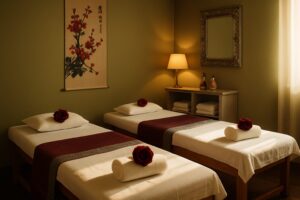
Let me be honest about what we are, because it’s the point. We’re a small parlour – two single rooms and one double. We are not a spa with a sauna and an infinity pool, and we’ve never wanted to be; that kind of place charges you for the marble, not the massage. What we put the money into is the hour itself, and into keeping the room spotless and the welcome warm. So the double room is simple: soft light, clean linen, two therapists who know exactly what they’re doing, and the two of you, undisturbed, for a full hour.

When to book it – and when not

Book it when you’re both running on empty at the same time, which in a Tirana summer is most weeks. Book it before the long drive to the coast, not after a heavy lunch. Don’t book it expecting it to settle an argument – it won’t referee anything. It simply gives you both a quiet hour in the same room, which, far more often than people expect, turns out to be the thing you were actually missing.

The both of you don’t need it urgently the way a headache needs a tablet. You need it the way two tired people need to sit down together and stop, before they forget how. This week is a good week for that.

Yang Wang practises therapeutic and relaxation massage at Chinese Massage – Tai Chi Tirana. The parlour is in central Tirana, a short walk from Bulevardi Myslym Shyri.
Sleep Pressure, Cortisol, and the Sunday Session

We see a particular pattern in our weekend booking calendar that has held steady for years. Saturdays are mixed: couples on dates, post-work-week treats, occasional first-timers using a free afternoon to try something new. Sundays — particularly Sunday afternoons between three and six — book up earliest, and the clients who come in these slots are almost always the same kind of client: working professionals, mostly in their thirties and forties, mostly women, mostly with the same pattern of complaint when we ask why they are coming in.

“I sleep badly Sunday night. I want to start the week feeling rested. I have tried everything.”

The phrase “tried everything” usually refers to: blackout curtains, melatonin, magnesium, no screens after nine, herbal teas, a strict bedtime, a relaxation app, sometimes pharmaceutical sleep aids on the worst nights. None of it produces the clean refreshing sleep these clients remember from earlier in their lives.

What is happening, in most of these cases, is a small but specific pattern in how the body manages alertness and rest across the week. I have read a little about it, and the picture that I have come to find useful is this. Two things in the body, between them, govern sleep: the daily clock that lifts you up in the morning and lets you down in the evening, and the slow build of tiredness across the day. When both line up, you fall asleep easily. When they drift apart — and that is what happens after a stressful week — sleep becomes a problem.

How sleep seems to work, as I understand it

There are two systems in the body, working alongside each other, that decide whether you can sleep. They are usually talked about separately, but they work together. A problem in one often looks like a problem in the other.

The first is the body’s daily clock — the roughly twenty-four-hour cycle that lifts you up in the morning and lets you down in the evening. It is driven by light, by certain hormones, and by the small daily rise and fall of your body’s core temperature. A healthy clock gives you alertness in the late morning, a small natural dip in early afternoon, more steady focus through late afternoon, and an easy descent into sleepiness in the evening.

The second is what doctors I have spoken with call “sleep pressure” — the slow build of tiredness in the brain across the day. The longer you have been awake, the more it builds, and the stronger the pull toward sleep. Coffee, as I understand it, does not remove this tiredness; it just hides it for a few hours. When the coffee wears off, the hidden tiredness comes back, sometimes harder than before.

When you are well, these two systems line up. The evening clock turns down at roughly the same time the tiredness reaches its peak. You fall asleep easily, you sleep deeply, you wake well. When you are stressed for weeks at a time, the two systems drift apart in a way I have come to recognise.

What stress seems to do to all of this

A chronically stressful week — a demanding job, ageing parents, a long commute, the small constant load of modern life — does several things to these systems, as far as I have read and as I have watched in clients.

It keeps the “alert” hormone, cortisol, raised for longer than it should be. Cortisol is supposed to be high in the morning and gradually lower through the day. When stress is constant, it stays high into the evening, when the body should be settling.

It interferes with the slow build of tiredness across the day. The person feels tired in a vague drained way but cannot fall asleep when they try.

It breaks up the sleep itself. Even when you do fall asleep, the deepest, most refreshing phase of sleep becomes shorter, and you wake up more often between cycles without quite remembering it.

By Friday afternoon, in many working professionals, this pattern has produced a significant cumulative sleep debt. Saturday is usually spent partly recovering: a later wake time, a nap, a gentler day. By Saturday night, sleep is often quite good — the body, finally given permission to rest, takes advantage of the opportunity. (I have written separately about the particular fatigue of the Tirana holiday season, which sits on top of the ordinary work-week version.)

Sunday is where the trouble usually starts.

Why Sunday night is the hardest

“Sunday night insomnia” — difficulty sleeping on Sunday night with a low hum of anxiety about the coming week — is one of the most common sleep complaints I hear in the parlour. It is not imaginary; from what I have read, it is a real and well-recognised pattern in working adults.

What is happening, physiologically, is a combination of factors.

First, the body is still partly in its work-week alert mode. The hormonal pattern that kept you going through Friday has not yet settled.

Second, the half-conscious anticipation of Monday — the mental work of preparing for the week, which most people start doing around Sunday afternoon — quietly raises the alertness again in the evening, just when the body should be coming down.

Third, the weekend has, in small ways, shifted your daily clock. The later wake time on Saturday and Sunday, the nap, the dinner that ran late — these have nudged the evening sleepiness to arrive later than your intended bedtime.

Put together, you get the classic Sunday-night insomnia: tired body, busy mind, no descent into rest.

What the Sunday afternoon session does

A relaxation massage at three or four o’clock on a Sunday afternoon, in my observation, helps with all three of these at once. The timing is not accidental — it is part of why these slots reliably work.

The settling effect of the session eases the body’s alert hormones down in a way that the evening then continues, rather than fights against. By bedtime, the body is genuinely ready to rest.

The session provides a period of deep quiet in the afternoon — not exactly sleep, but close enough that the body’s slow build of tiredness across the day catches up with the day’s clock by evening. The body, in other words, is properly tired at bedtime, in the right way.

And the timing of the session — afternoon, not evening — supports rather than disrupts the daily clock. The natural early-evening sleepiness arrives where it should.

The cumulative effect, for clients who come consistently on Sunday afternoons, is a Sunday night that resembles a normal night of sleep rather than the anxious half-rest that has become the norm for many working adults. Monday morning is, correspondingly, more functional.

A small story about a regular client

A client we have had for nearly three years — a tax accountant who works through the seasonal rush from January to April with brutal weekly hours — first came in on a particular Sunday in February. She had been having three or four hours of broken sleep per Sunday night for several weeks. She had developed mild heart palpitations during the work week that her cardiologist had told her were stress-related but unexplained.

Her first session was a standard ninety-minute relaxation, in the Sunday afternoon slot she could fit between picking up her daughter from a piano lesson and starting dinner. She slept seven hours that Sunday night. By the third week, the palpitations had become rare. By the second month, she was sleeping well on most nights of the week.

She comes in every other Sunday now, year-round, and increases to weekly during the tax-season rush from late January through mid-April. Her cardiologist commented at her annual check-up last year that her resting heart rate had dropped by twelve beats per minute. She had not mentioned the massage sessions to him.

She told me this story not because she wanted me to take credit for it, but because she had been surprised that something she had thought of as a minor wellness routine had produced what her doctor considered a real medical change. She wanted me to know.

A note on what is not happening

It is worth being honest about what the Sunday session does not do.

It does not fix underlying sleep apnoea, restless legs syndrome, hyperthyroidism, depression with sleep features, or other medical conditions that produce sleep disruption. If your sleep problem is structural or pathological, massage will help with the surrounding stress component but will not address the underlying cause. See a sleep specialist or a doctor.

It does not work the same way for night-shift workers, who have a fundamentally different sleep-wake architecture that requires a different timing strategy.

It does not substitute for adequate sleep hygiene. The other interventions — consistent bedtime, reduced evening screen exposure, avoidance of late caffeine — still matter. The massage is one piece of an overall approach, not a replacement.

It does not produce results in a single session for every client. Some respond beautifully to the first session. Others need three or four before the pattern shifts. A few do not respond to this particular approach at all, and we discuss alternatives.

But for the working professional with stress-driven insomnia and a relatively healthy underlying physiology, the Sunday afternoon session is one of the more reliable interventions in our practice. The Sunday slots fill up because the people who have tried it have found that it works.

The slot, the rhythm, the city

There is a particular small ritual that some of our Sunday afternoon regulars have developed around the session. They walk a slow route to the parlour, sometimes stopping somewhere to pick up something for the week ahead. They sometimes stop at one of the cafés on Bulevardi Myslym Shyri afterwards for a quiet hour before going home. The session itself becomes part of a slower Sunday rhythm that is itself part of the therapeutic effect.

The pace of the city in late Sunday afternoon, just before evening, is one of Tirana’s quieter and more pleasant qualities. Our parlour sits in this rhythm naturally. We are not the only piece of a good Sunday — but for the clients for whom we have become part of one, the effect is more than the sum of the parts.

That, in the end, may be the real intervention. A small claim on the body’s behalf that Sunday is allowed to be Sunday, and Monday will arrive in its own time, and the body has a right to enter the week well-rested rather than already braced against it.


Yang Wang practises massage and Chinese medicine at Chinese Massage – Tai Chi Tirana.