Wedding Anniversary Couples Massage — The Returning Pair

There is a couple who come to the parlour every March, in the second week, for their wedding anniversary. They have been coming for nine years. They will be married twenty years this coming March. The first session they booked with us was their eleventh anniversary, and they have not missed a year since.

I want to write about them because they have, in their quiet way, demonstrated something I have come to think about often — the role that small recurring rituals play in the long arc of a marriage, and the unexpected ways that something as ordinary as an annual massage session can become a marker of time and care.

This piece is for couples considering whether to make a couples massage a recurring practice rather than a one-time experience, and for the much smaller number of clients who have read the other couples massage piece and wondered what the long-term version of the practice looks like. (For the gift-giving register specifically — anniversaries, birthdays, year-end — I have a piece on Tai Chi massage gift cards that may be useful.)

How they started

I asked them once, in passing, how they had come to choose a couples massage as their anniversary tradition. The answer surprised me at the time.

It was not, they said, a romantic choice in any conventional sense. They had been married ten years. Their relationship was solid, but they had reached a point — common in long marriages — where the standard anniversary observances had become rote. The dinner at a nice restaurant. The card. The token gift. They went through these motions every year and they felt slightly performative. There is a particular Tirana restaurant table reserved for anniversaries, and most couples know the quiet weight of sitting at it with nothing new left to say. Neither of them was sure what would feel like a meaningful observance instead.

The wife had received a couples massage as a birthday gift from a friend several months before the eleventh anniversary. She had enjoyed it considerably. She suggested to her husband, half-jokingly, that they book one for their anniversary instead of doing the dinner that year.

He agreed, partly because he was as tired of the dinner as she was, partly because he was curious. They booked a session with us — their first visit to the parlour — and they had what they later described to me as “the most rested two hours we have had in months.”

They walked home together afterwards, stopped at a small restaurant for an unscheduled meal that ended up being more relaxed than any anniversary dinner they could remember. The next morning they both said, more or less independently, “We should do that again next year.”

They have done so for nine years now. It has become the anniversary observance, replacing the previous traditions entirely.

What the practice has evolved into

The original session was a simple couples massage in our standard format. Over the years, the practice has evolved into something slightly more elaborate, mostly through their own preferences rather than any suggestion from us.

They book a longer session now — ninety minutes rather than sixty — to give themselves more time. They schedule it for late afternoon so that they have an unhurried evening afterwards. They book a particular pair of our therapists with whom they have developed an ongoing rapport. They request specific elements they have come to value: a few minutes of synchronised work at the very beginning (a small touch we sometimes offer when both therapists in a couples session have also done four-hands training), an extended foot massage at the end, the same essential oil blend each year.

The session has become specific in the way that any annual tradition becomes specific over time — small accumulated choices that, together, constitute a ritual. The ritual would not look special to an outside observer. To them, it has become deeply familiar and quietly cherished.

After the session, they have a particular small restaurant they go to. It is not anywhere expensive or remarkable; it is a place near the parlour that they discovered the first year and have returned to every year since. The owner, who has come to recognise them after eight years of annual visits, brings them a particular bottle of wine without being asked.

What I have observed across nine years

The interesting thing about seeing a couple once a year for nine years is the long arc that becomes visible. Most of the year, I do not see them. We exchange a brief friendly email occasionally — they sometimes write to me when they have travelled and want to ask about a question they have about something they encountered. But the visits are once a year.

Across the visits, I have seen things I would not have seen at any other observation rate.

I have seen them get older together. The slight changes in posture, the subtle increase in chronic accumulated tension in certain areas, the gradual softening of the body that happens to all of us across our forties and fifties. They have aged side by side, in the same chronological direction, in the way that long marriages produce.

I have seen one of them through a difficult illness in year five — a six-month period when he was recovering from what had been a serious health scare. The session that year, I was particularly careful about, and they were noticeably more present with each other than they had been the year before. The shared experience, in a difficult year, served as a small claim that they were still doing the things they did together.

I have seen them through a family loss in year seven — her mother had died in January, two months before their anniversary session. They considered not coming that year and decided to come anyway. The session that year had a different quality. Quieter. Slower. We did not pretend the loss had not happened.

I have seen them in good years and ordinary years. The visits have, across the nine years, formed a kind of low-resolution photograph of a long marriage. Each year a single frame. Together, the frames make a portrait that is more honest than any annual photograph could be.

What this suggests about the practice

I do not want to suggest that any particular couples ought to make an annual massage session their anniversary observance. Different couples have different rhythms and different ways of marking time. The conventional anniversary dinner works beautifully for many couples and should not be abandoned for the sake of novelty.

What I think this couple’s practice suggests is something more general: the long-term value of small recurring rituals that involve both partners receiving care simultaneously. The ritual matters more than the specific form. A shared bodywork session is one form; there are others. What they have in common is that they create a small annual island in the year where both partners are simultaneously being attended to, not by each other, but together. The shared experience of receiving care is different from the shared experience of providing care, and many long marriages have an excess of the second and a shortage of the first.

For couples reading this who do not currently have such a ritual, the suggestion would be: consider whether there is something you could add to your year that would have this quality. A massage session is one option. A weekend at a guesthouse where neither of you has to do the cooking or the planning. An annual unplugged retreat in a quiet location. The specific form does not matter. The shared receiving of care, in a sustained way, is what does the work.

The besa of returning

There is an Albanian concept I have written about in other pieces — besa, the word given and kept. It usually appears in the context of promises made to others. But there is a smaller, equally important application: the promises one makes implicitly to one’s own marriage, and the keeping of them.

When this couple booked their second session, the year after their first, they were making a small implicit promise to themselves and to each other. They had chosen to do this again. The promise was not articulated. But the booking, repeated the following year, then the year after, gradually became a thing they were committed to.

Across nine years, the implicit promise has become a strong unspoken bond. They will come this year. They will probably come for many years to come. The ritual has acquired its own weight, beyond either of their individual preferences. They have built it together, year by year, and now it carries some of the relationship’s continuity in a quiet way.

This is what small recurring practices can do. They become structures that support the larger thing. The marriage is built of many such structures. The anniversary session is one of theirs.

A practical note for couples considering this

If you have read this and are thinking about establishing some version of this practice with your own partner, a few suggestions that draw on what I have observed in this couple and several other long-term recurring clients.

Choose a date that means something to you. Not necessarily the anniversary itself — they actually chose a date a few days off, because the actual anniversary was sometimes inconvenient. The date should be meaningful but flexible enough to schedule reliably.

Book it as early in the year as possible. Annual rituals fail when they are not scheduled in advance. Block the date a year ahead each time you complete a session.

Build a small surrounding ritual. The session itself is not enough; the dinner afterwards, the walk, the quiet evening — these are what make the day feel like an observance rather than an appointment.

Stick with the same parlour and the same therapists if you find a pair you trust. The continuity adds to the ritual. We have become, across nine years, familiar enough with this couple that the session feels like a small reunion as much as a treatment.

Do not abandon the ritual in difficult years. The years when you feel least like coming are often the years when the practice does the most quiet work for you. They came in the year of his illness and the year of her mother’s death, and they have told me both years were among the most valuable.

The marriage builds itself across many small practices. This is one couple’s version of one of theirs. There are many others worth building.


Yang Wang practises Chinese medicine at Chinese Massage – Tai Chi Tirana. Details have been altered to protect client privacy.

Tui Na or Sports Massage — Why It Is Not the Same Question

A young man came in last winter — late twenties, runs three times a week along Liqeni Artificial, had finished a half-marathon in Durrës a month earlier and was preparing for a longer race in Vlora in the spring. His right calf had a hard knot the size of a chicken egg above the soleus. He had been to two sports massage therapists in Tirana. Both had worked the knot directly with thumb pressure for about thirty minutes. Both times the knot was softer for a day and then came back, harder.

“My physio in Bologna,” he said — he had played football in Italy in his early twenties — “always told me deep tissue, deep tissue. The harder the better.”

I asked him whether it had ever fully solved the problem.

“No. But it always felt like it should.”

Most of us here keep one universal first prescription for any ache: do të kalojë — it’ll pass. Often it does. A calf that has been knotted for eight months has simply stopped listening. This is one of the most useful conversations I have in the parlour, and I have it twice a week. The Western reflex — when a muscle is tight, press it hard — is so deeply built into our cultural imagination of what massage is that even experienced therapists do not question it. But it is not the only way the body responds to skilled touch. And on certain presentations, it is not even the best way.

Two traditions, two definitions of “deep”

Tui Na and Western sports massage share a vocabulary they do not always share a meaning for. The word “deep” is the clearest example.

In sports massage, deep means deep pressure: a high vertical force applied through the thumb, elbow, or forearm into the muscle belly. The intention is to mechanically disrupt adhesions in the soft tissue, to break up scar tissue, to physically push through fascial restrictions. It is a force-based intervention. It works, sometimes spectacularly, on certain conditions — particularly acute athletic overuse with localised trigger points.

In Tui Na, deep means deep reach: an intervention that influences not just the muscle being touched but the tissue and structures three or four layers under it. The pressure required to do this is often surprisingly modest. The technique relies on direction, rhythm, the manipulation of fascia in coordinated planes, and a precise understanding of where one muscle’s tension is being held by another muscle’s compensation. A skilled Tui Na practitioner can produce significant tissue change at one-third the apparent pressure a sports therapist would use — because the work is finding the right vector, not the most force.

Both are deep. They mean different things. (For a similar comparison between Tui Na and the Japanese tradition, I have a separate piece on Shiatsu versus Chinese Tui Na — same family of confusion, different details.)

What sports medicine seems to be discovering

I keep an eye, in a casual way, on how Western sports medicine talks about manual therapy, because clients ask me about it. Something I have noticed: the conversation has been quietly shifting over the last decade or so. The picture I get is that the old “deep tissue, the deeper the better” idea is being questioned by people who used to teach it.

For an acute injury in the first few days, both traditions agree — no aggressive pressure. The body is busy and should be left alone.

For an injury that is a few weeks old but not chronic, the newer thinking, as I have come across it in articles and in conversation with physiotherapists, is that lower-force, sustained, well-aimed work usually does more than high-force pressure. Less force, applied in the right direction, gets further.

For chronic compensatory patterns — the kind of complaint that brought the runner to my table — the gap is even wider, at least in what I have read. High-force work on a chronically tight calf releases it for a day. The same calf, addressed through the antagonist muscles, the upstream fascial chain, and the opposite hip, stays released for weeks. The body has a kind of memory. Releasing the wrong place over and over teaches it that the tightness is structural and that it should hold on harder.

I find this satisfying because it lines up with what Tui Na has been doing for a long time without anyone needing to confirm it. We are politely pleased that the newer conversation is arriving at a similar place.

The runner’s calf, in practice

What happened on the table with the young runner from Bologna was almost boring to describe. We did not touch the knot at all in the first session. We worked the contralateral hip — the left side — because his right calf was carrying tension from a slightly weaker left gluteus medius. We worked his right hamstring origin under the gluteal fold. We worked the soleus’s attachment behind the knee, not the belly of it.

He left the session sceptical. He said politely that he would come back, but he was not sure.

Three days later he ran his usual ten kilometres along the lake. The knot — he reported by phone the next morning — was, for the first time in eight months, not where it had been. It had not disappeared. It had migrated to a different position, about four centimetres lower, much smaller.

This is what therapists who do this work mean when they say “the body is talking.” The original knot had been guarding something. When the guarding became unnecessary, the tissue rearranged itself.

We had six sessions. By the third, the knot was gone. By the sixth, he had stopped favouring the right leg in his stride.

He ran the Vlora half-marathon four months later. Personal best.

Why this matters for anyone who is not an athlete

The question is rarely “Tui Na or sports massage?” It is “What is the body actually trying to tell me?”

If the answer is “I have just sprained an ankle and there is acute swelling” — neither modality. Rest, ice, elevation, and a physiotherapist for graded loading.

If the answer is “I have an acute one-spot pain after a single identifiable event, in a young healthy body” — sports massage is often the cleaner intervention. Find a good practitioner; the work is specific and effective.

If the answer is “I have had pain for months and it moves around, or it always comes back to the same place, or it changes character with stress” — this is where Tui Na earns its reputation. The work is slower, less dramatic, and far more likely to resolve the underlying compensation.

If the answer is “I am stressed, exhausted, my whole back feels tight and I do not have one specific complaint” — this is also Tui Na territory, though it overlaps with relaxation massage and the right answer often involves both.

My grandmother’s shelf in Liaoning

There is an image I keep returning to that captures the difference better than the science does.

My grandmother in Liaoning kept a row of small jars on a shelf in the kitchen. Each jar held a dried herb. When someone in the family had a complaint, she would mix three or four of the herbs into hot water and watch you drink it. She did not say much about what she was doing. She had been doing it for forty years, and she had never once measured anything.

She was not choosing the strongest herb. She was choosing the right one for the person in front of her — sometimes one thing, sometimes another, depending on the day. That is the habit I carry to the table. She did not know that what she did would be studied and explained centuries later. She simply paid attention to the body and to what helped.

Tui Na works the same way. So does sports massage, at its best. The question is not which tradition is correct. The question is which one is doing the right work for the body in front of it.

In the parlour, we ask that question every time. The answer is sometimes one thing, sometimes the other, sometimes both, sometimes neither — and the table waits patiently while we work it out.


Yang Wang practises Tui Na and acupuncture at Chinese Massage – Tai Chi Tirana.

Relaxation Massage After a Long Flight — A Diaspora Story

Erion called from Rinas airport on a Wednesday morning. He had landed forty minutes earlier on a flight from London via Vienna. Twelve hours of travel, two airports, three time zones, and a long overnight layover in a Vienna terminal that had not been kind to anyone. He was in Tirana for his grandfather’s funeral on Friday and he had a meeting Thursday afternoon with the lawyer handling the estate. He had two and a half days to be functional in a city he had not lived in for fourteen years.

“Can I come at three?” he asked. “My back is one solid piece.”

I knew Erion’s family — they had been clients for years — though I had only met him once before, briefly, on a previous visit. I told him to come at three, that we would do a ninety-minute relaxation session, and that he should drink a litre of water between now and then.

He arrived looking exactly as I remembered the diaspora returnees of his generation. Late thirties, tired, slightly displaced in his own physical body, carrying a familiar particular kind of fatigue that is not exactly jet lag and not exactly grief but partakes of both.

This piece is for him and for the many clients like him — the diaspora returning to Tirana for family events, the business travellers spending three days in the city, the visitors who arrive having travelled too long and need their body to catch up before they can do what they came here to do.

What a long flight actually does to the body

Air travel is harder on the body than most people give it credit for. The combination of factors — low cabin humidity, low cabin pressure, prolonged sitting, disrupted circadian rhythms, the dehydration that even moderate drinkers do not fully compensate for, the mild low-grade stress of being in a confined space surrounded by strangers — produces a specific physiological state that is reliably present after any flight longer than four hours.

The state has several components.

Mild dehydration affecting fascia and joint mobility. Cabin humidity is typically below twenty percent (compared to the forty-to-fifty percent of a comfortable room). Twelve hours in this environment leaves connective tissue noticeably stiffer. Many travellers experience this as a generalised body ache they cannot localise.

Sluggish circulation in the lower body. Prolonged sitting reduces venous return from the legs. Even without the rare but serious risk of deep vein thrombosis, most long-haul travellers arrive with mild lower-extremity edema, calf tightness, and slight cognitive fogginess from the reduced peripheral circulation.

Shallow breathing pattern. Aircraft seats are designed in a way that compresses the diaphragm slightly. Twelve hours of slightly compromised breathing produces a measurable shift in the chest mechanics that takes hours to resolve.

A body still on alert from cumulative low-grade stress. Even for experienced travellers, the small ongoing stressors of airports — security lines, departure board anxiety, the discomfort of close quarters — accumulate. The body arrives at the destination braced in a way that is rarely felt consciously but is plainly there once you settle on the table.

Circadian disruption. Even a single time zone shift produces measurable disruption to the body’s hormonal rhythms. Three time zones, with overnight layover in the wrong direction, produces a particular kind of disorientation that affects mood, sleep, and basic cognitive function for several days.

What a relaxation massage addresses, and what it does not

A well-designed post-travel relaxation massage can address most of these factors in a single session, though not all to the same degree.

Hydration of fascia and connective tissue. The massage strokes themselves do not add water to the body, but the work mechanically distributes fluid through the connective tissue layers and improves the local circulation that allows the body to rehydrate the affected areas effectively. Combined with adequate water intake, this can resolve most of the air-travel stiffness within the first session.

Lower body circulation. Lymphatic-style strokes in the legs, calves, and feet — performed as part of the standard relaxation protocol — mobilise the accumulated fluid and restore normal venous return. Most clients report visible reduction in lower-leg swelling within an hour of the session.

Breathing depth. The work on the upper back, shoulders, and chest restores the rib cage mobility that the airline seat compressed. Clients usually notice their breath has descended within the first thirty minutes of the session.

Sympathetic activation. The parasympathetic shift that a sustained relaxation session produces directly counteracts the accumulated low-grade stress of travel. For many travellers, this is the most subjectively important effect.

What the massage does not address is the circadian disruption itself. The body’s hormonal rhythms will reset on their own timeline (typically one day per time zone), and no amount of bodywork can speed this up. But by addressing the other components of post-flight fatigue, the massage allows the traveller to feel functional during the days that the circadian rhythm is still resetting in the background. (Travellers arriving for the December family-visit window may want to read the related piece on the particular Tirana fatigue of the holiday season.)

The protocol for post-travel clients

The session I gave Erion is one I have refined over many years of treating travellers, and it differs in specific ways from a standard relaxation session.

The first portion focuses on the legs, calves, and feet — earlier and longer than usual, because the lower-body congestion is what most post-flight clients feel most acutely. Long, slow, ascending strokes that mobilise fluid back toward the trunk. About fifteen minutes.

The second portion addresses the lower and upper back, with particular attention to the area between the shoulder blades that takes the brunt of airline-seat compression. About twenty minutes.

The third portion works the shoulders, neck, and base of the skull. This is where the cumulative travel tension becomes most accessible. About fifteen minutes.

The client then turns over. We work the chest and ribs gently to restore breathing mobility, then the abdomen lightly to support digestion (which often shuts down during travel and benefits from gentle stimulation), then the arms and hands, then return to the legs from the front. About twenty minutes.

The final ten minutes are spent on the face, scalp, and ears — partly for the deep relaxation effects, partly to address the specific tension that accumulates in the small facial muscles during a long flight when one is trying to sleep in an upright position.

The total session is ninety minutes. Sixty minutes is not enough for a post-travel session; the body needs the longer protocol to fully address the multiple components.

Erion, that Wednesday afternoon

Erion fell asleep about forty minutes into the session, which is normal and often a sign that the body has decided it is safe to do the recovery work. He woke up briefly when I asked him to turn over, and again, more fully, at the end of the session.

He did not say much. He sat up slowly, drank the glass of water I gave him, looked at his hands as if he was rediscovering them.

“I forgot what my back was supposed to feel like,” he said eventually.

He drove to his family’s house after the session. He told me later that he slept twelve hours that night — much longer than he had planned, but his body needed it — and that he felt clear-headed for the meeting on Thursday and able to be fully present at the funeral on Friday. He came back for a second session before flying out the following Tuesday.

This is the part of post-travel work that I find most quietly satisfying. The traveller arrives in Tirana with too little time to do everything they need to do, and the small intervention of a single ninety-minute session shifts the entire trajectory of their visit. They can be present for the family. They can be present for the meetings. They can sleep when they need to sleep.

A note for the diaspora specifically

The diaspora returnee carries a particular kind of travel fatigue that is not just physical. The flight from London or Frankfurt or Milan brings with it a parallel emotional adjustment: returning to a city that is and is not home, to a language that is and is not the daily language, to family members who have aged in ways that one has not seen happening in real time.

This emotional layer is not something a massage can directly address. But the parasympathetic state that the massage produces creates the conditions in which the emotional adjustment becomes easier. The body, in a regulated state, supports the heart and mind in their own work.

I have come to think of post-travel massage for the diaspora as a kind of bridge. The traveller arrives at the airport in one mode — international transit, distant from the place they have just landed in. The session at the parlour, ideally within the first twenty-four hours of arrival, helps the body actually arrive in Tirana, rather than remain in the airport-and-aircraft mode for the first several days of the visit. The visit becomes, in a useful sense, a real visit rather than a transit through.

Practical suggestions for travellers planning ahead

A few small things make the post-travel session more effective.

Drink water aggressively in the twenty-four hours before and after the session. The body needs the fluid to fully benefit from the work.

Avoid alcohol on the day of arrival. The temptation, after a long flight, is to celebrate arriving with a glass of something. Wait until the next day; the body has too much recovery to do to also process alcohol.

Schedule the session for late afternoon or early evening on the day of arrival, not first thing in the morning of the second day. The first night’s sleep after the massage is when much of the integration happens.

Plan for a quiet evening after the session. The deep relaxation effect makes social events feel forced; a slow meal at home or with very close family is the right register.

If you have travelled with significant time-zone change, also plan for an early bedtime on the night of the session. Your body will be ready for sleep sooner than usual.


Yang Wang practises massage and Chinese medicine at Chinese Massage – Tai Chi Tirana. Names in client stories have been changed.
Mud Moxibustion: The Quiet Cousin of Acupuncture

There is a treatment we offer at the parlour that almost no one in Tirana has heard of before they walk in. Most of our long-term clients have tried Tui Na. Many have tried acupuncture, cupping, gua sha, hot stones. But mud moxibustion — ni jiu in Mandarin, 泥灸 — they encounter for the first time when they ask about a treatment for chronic abdominal cold, painful periods that nothing else has touched, or the kind of deep tiredness that sleep does not repair.

This is one of the older treatments in the Chinese pharmacopoeia. It is also, in my opinion, one of the most underrated. It does what acupuncture does — moves stuck qi, warms the deep tissue, addresses cold-type patterns — but it does it through a different mechanism, and for certain clients it is dramatically more effective. (For the acupuncture half of this comparison and how the meridian-point system underlying both treatments is mapped, I have a foundational piece on meridian conditioning.)

What it actually is

Mud moxibustion combines two ancient ingredients: medicinal mud and moxa, the herb Artemisia vulgaris (mugwort, in English; pelin in Albanian, where the plant grows wild on the hillsides outside Tirana — you have probably walked past it a hundred times on a Sunday hike without a second glance).

The mud is not ordinary mud. It is a specific medicinal preparation, traditionally made from a base of fine silt taken from particular river beds, mixed with powdered herbs — typically Artemisia, Angelica sinensis, Cinnamomum cassia (cinnamon bark), and several other warming herbs depending on the formula. The mixture is dried and stored in cakes or sheets. To use it, the practitioner moistens it slightly, warms it to body temperature, and applies it as a layer over a specific area of the body — usually the lower abdomen, the lower back, or along the spine.

Over the layer of warmed mud, a small amount of moxa is burned at a controlled distance. The smoke and heat penetrate down through the mud, which acts as a carrier and a temperature regulator. The result is a deep, even, sustained warming of the underlying tissue and the points beneath it, combined with the topical absorption of the herbal compounds in the mud.

A session lasts thirty to forty-five minutes. The client lies comfortably on the table. The sensation is unlike anything else in TCM — not the brief sharpness of a needle, not the dull pressure of cupping, not the focused heat of a single stone. It is broad, warm, slow, settling. Many clients fall asleep during the second half of the session.

What it helps with — and what it does not

Mud moxibustion is specifically indicated for what TCM calls cold-damp accumulation in the lower body. This is a pattern more than a single condition, but in the people I see it tends to show up as:

Chronic abdominal cold — the sensation of a persistently cool lower belly, often with bloating, sluggish digestion, and frequent loose stools. Many women describe this as feeling “as if my insides are cold from the inside out.”

Painful menstrual periods — particularly the kind that come with low-back ache, cold sensitivity, and pain that responds better to heat than to pain medication.

Chronic lower back pain that worsens in cold weather. Not the acute strain kind; the kind that comes back every winter and lasts until April.

Postpartum recovery, especially for women who feel cold and depleted after giving birth (something Chinese medicine takes very seriously and works with actively, while in the modern medical setting it often gets less attention than it deserves).

Chronic fatigue with a “cold and damp” quality — heavy limbs, low motivation, a body that feels weighed down rather than tense.

It is not the right treatment for: acute injuries, fevers, infections, conditions with a “heat” pattern (red face, easily irritable, dry mouth, insomnia from agitation), or pregnancy (heating the abdomen during pregnancy is contraindicated in classical practice).

A small story about my mother

When I was a child in Liaoning, my mother had what we then called “the winter belly.” Every December, around the time the first snow came, her lower abdomen would become tender and cold to the touch. Cramping that came not with her period but seemingly with the season. She drank ginger tea. She wore extra layers. She felt, in her own words, that her yang was leaking out of her like heat from a poorly built house.

Once a winter, my grandmother would prepare what she called the “mud cake.” She made it herself, from a recipe handed down through several generations. River silt, dried mugwort from the summer harvest, cinnamon bark, ginger, two or three other things I never learned the names of. She would warm the cake on the stove, lay it across my mother’s abdomen, and burn a small bundle of moxa above it for half an hour.

My mother would emerge from this treatment looking like she had taken a long bath in a warm sea. Calm, slightly flushed, the cold gone out of her face. The treatment was an annual event. It always worked.

I did not understand, at the time, that I was watching a thousand-year-old protocol being performed in my grandmother’s kitchen. To me it was just what we did in December.

Why the Western reader rarely encounters this

There are two reasons mud moxibustion has remained obscure outside China, even as acupuncture and cupping have become familiar in European wellness centres.

The first is practical. The mud is difficult to source authentically outside China. The herbal formula is complex and the quality varies considerably. We import ours from a specific manufacturer in Shandong province with multi-generational expertise in the preparation. Many Western practitioners who have heard of the technique substitute generic clay or skip the treatment entirely. The result is, predictably, disappointing, and the technique gets a reputation it does not deserve.

The second is cultural. The treatment is messy, slightly slow, and aesthetically far from the polished image many Western wellness centres want to project. It does not photograph well for Instagram. The mud stains the towels. There is a small amount of smoke from the moxa. Some practitioners who specialise in “clean” modern TCM avoid it precisely because of these unglamorous practicalities.

We do it because it works, and because we have not yet found a substitute that does the same thing.

A few things I have found interesting along the way

When I started looking into the modern explanations of how this treatment works, I came across a few things that I found interesting to share. The smoke from the burning moxa carries small aromatic compounds — the same kinds of compounds that give certain medicinal plants their smell — and these are absorbed through the skin during the session. The mud itself, more than anything else, holds the heat steady at a temperature that the skin would not tolerate from the moxa directly. The three together — heat, smoke, and herb — do something none of them does alone.

For painful menstrual periods especially, I have read that there are studies showing the treatment reduces the pain meaningfully, sometimes more than over-the-counter pain medicine, and that the relief continues into the next cycle without further treatment. I do not pretend to know the studies in detail. What I know is what I see in the parlour, which lines up reasonably well with what I have read.

For chronic digestive discomfort — what Chinese medicine calls a tired or cold “middle warmer,” and what Western medicine often calls IBS or “functional” digestive issues — there is, from what I gather, a similar picture. The body responds; the mechanism is not fully mapped; the practitioners who do the work consistently see results.

When it is the right answer

I do not recommend mud moxibustion as a first treatment for most complaints. For an acute problem, acupuncture or Tui Na is usually faster. For ordinary stress and muscle tension, a relaxation massage is more straightforward.

Mud moxibustion is the right answer when:

The complaint is chronic, has resisted other approaches, and has a clear “cold” quality. The client feels the affected area is cold to their own touch, the pain is worse in winter or with cold exposure, and they instinctively reach for hot water bottles or heating pads.

The complaint involves the lower abdomen or lower back, where the deep penetrating warmth of the mud-moxa combination reaches better than any other modality.

The client has the patience for a slow treatment. This is not a single-session fix. A typical course is three to five sessions, once a week or every two weeks. Improvement is usually noticed by the third session.

The first session feels, to most clients, like a deep rest in a warm place — almost meditative. The therapeutic effect builds in the days afterwards, often most strongly in the second and third night of sleep following the treatment.

It is one of the oldest tools we have. It is also, when used in the right pattern, one of the most effective. That is why it has survived for as long as it has, in spite of everything that has changed around it.


Yang Wang practises Chinese medicine at Chinese Massage – Tai Chi Tirana.

Sleep Pressure, Cortisol, and the Sunday Session

We see a particular pattern in our weekend booking calendar that has held steady for years. Saturdays are mixed: couples on dates, post-work-week treats, occasional first-timers using a free afternoon to try something new. Sundays — particularly Sunday afternoons between three and six — book up earliest, and the clients who come in these slots are almost always the same kind of client: working professionals, mostly in their thirties and forties, mostly women, mostly with the same pattern of complaint when we ask why they are coming in.

“I sleep badly Sunday night. I want to start the week feeling rested. I have tried everything.”

The phrase “tried everything” usually refers to: blackout curtains, melatonin, magnesium, no screens after nine, herbal teas, a strict bedtime, a relaxation app, sometimes pharmaceutical sleep aids on the worst nights. None of it produces the clean refreshing sleep these clients remember from earlier in their lives.

What is happening, in most of these cases, is a small but specific pattern in how the body manages alertness and rest across the week. I have read a little about it, and the picture that I have come to find useful is this. Two things in the body, between them, govern sleep: the daily clock that lifts you up in the morning and lets you down in the evening, and the slow build of tiredness across the day. When both line up, you fall asleep easily. When they drift apart — and that is what happens after a stressful week — sleep becomes a problem.

How sleep seems to work, as I understand it

There are two systems in the body, working alongside each other, that decide whether you can sleep. They are usually talked about separately, but they work together. A problem in one often looks like a problem in the other.

The first is the body’s daily clock — the roughly twenty-four-hour cycle that lifts you up in the morning and lets you down in the evening. It is driven by light, by certain hormones, and by the small daily rise and fall of your body’s core temperature. A healthy clock gives you alertness in the late morning, a small natural dip in early afternoon, more steady focus through late afternoon, and an easy descent into sleepiness in the evening.

The second is what doctors I have spoken with call “sleep pressure” — the slow build of tiredness in the brain across the day. The longer you have been awake, the more it builds, and the stronger the pull toward sleep. Coffee, as I understand it, does not remove this tiredness; it just hides it for a few hours. When the coffee wears off, the hidden tiredness comes back, sometimes harder than before.

When you are well, these two systems line up. The evening clock turns down at roughly the same time the tiredness reaches its peak. You fall asleep easily, you sleep deeply, you wake well. When you are stressed for weeks at a time, the two systems drift apart in a way I have come to recognise.

What stress seems to do to all of this

A chronically stressful week — a demanding job, ageing parents, a long commute, the small constant load of modern life — does several things to these systems, as far as I have read and as I have watched in clients.

It keeps the “alert” hormone, cortisol, raised for longer than it should be. Cortisol is supposed to be high in the morning and gradually lower through the day. When stress is constant, it stays high into the evening, when the body should be settling.

It interferes with the slow build of tiredness across the day. The person feels tired in a vague drained way but cannot fall asleep when they try.

It breaks up the sleep itself. Even when you do fall asleep, the deepest, most refreshing phase of sleep becomes shorter, and you wake up more often between cycles without quite remembering it.

By Friday afternoon, in many working professionals, this pattern has produced a significant cumulative sleep debt. Saturday is usually spent partly recovering: a later wake time, a nap, a gentler day. By Saturday night, sleep is often quite good — the body, finally given permission to rest, takes advantage of the opportunity. (I have written separately about the particular fatigue of the Tirana holiday season, which sits on top of the ordinary work-week version.)

Sunday is where the trouble usually starts.

Why Sunday night is the hardest

“Sunday night insomnia” — difficulty sleeping on Sunday night with a low hum of anxiety about the coming week — is one of the most common sleep complaints I hear in the parlour. It is not imaginary; from what I have read, it is a real and well-recognised pattern in working adults.

What is happening, physiologically, is a combination of factors.

First, the body is still partly in its work-week alert mode. The hormonal pattern that kept you going through Friday has not yet settled.

Second, the half-conscious anticipation of Monday — the mental work of preparing for the week, which most people start doing around Sunday afternoon — quietly raises the alertness again in the evening, just when the body should be coming down.

Third, the weekend has, in small ways, shifted your daily clock. The later wake time on Saturday and Sunday, the nap, the dinner that ran late — these have nudged the evening sleepiness to arrive later than your intended bedtime.

Put together, you get the classic Sunday-night insomnia: tired body, busy mind, no descent into rest.

What the Sunday afternoon session does

A relaxation massage at three or four o’clock on a Sunday afternoon, in my observation, helps with all three of these at once. The timing is not accidental — it is part of why these slots reliably work.

The settling effect of the session eases the body’s alert hormones down in a way that the evening then continues, rather than fights against. By bedtime, the body is genuinely ready to rest.

The session provides a period of deep quiet in the afternoon — not exactly sleep, but close enough that the body’s slow build of tiredness across the day catches up with the day’s clock by evening. The body, in other words, is properly tired at bedtime, in the right way.

And the timing of the session — afternoon, not evening — supports rather than disrupts the daily clock. The natural early-evening sleepiness arrives where it should.

The cumulative effect, for clients who come consistently on Sunday afternoons, is a Sunday night that resembles a normal night of sleep rather than the anxious half-rest that has become the norm for many working adults. Monday morning is, correspondingly, more functional.

A small story about a regular client

A client we have had for nearly three years — a tax accountant who works through the seasonal rush from January to April with brutal weekly hours — first came in on a particular Sunday in February. She had been having three or four hours of broken sleep per Sunday night for several weeks. She had developed mild heart palpitations during the work week that her cardiologist had told her were stress-related but unexplained.

Her first session was a standard ninety-minute relaxation, in the Sunday afternoon slot she could fit between picking up her daughter from a piano lesson and starting dinner. She slept seven hours that Sunday night. By the third week, the palpitations had become rare. By the second month, she was sleeping well on most nights of the week.

She comes in every other Sunday now, year-round, and increases to weekly during the tax-season rush from late January through mid-April. Her cardiologist commented at her annual check-up last year that her resting heart rate had dropped by twelve beats per minute. She had not mentioned the massage sessions to him.

She told me this story not because she wanted me to take credit for it, but because she had been surprised that something she had thought of as a minor wellness routine had produced what her doctor considered a real medical change. She wanted me to know.

A note on what is not happening

It is worth being honest about what the Sunday session does not do.

It does not fix underlying sleep apnoea, restless legs syndrome, hyperthyroidism, depression with sleep features, or other medical conditions that produce sleep disruption. If your sleep problem is structural or pathological, massage will help with the surrounding stress component but will not address the underlying cause. See a sleep specialist or a doctor.

It does not work the same way for night-shift workers, who have a fundamentally different sleep-wake architecture that requires a different timing strategy.

It does not substitute for adequate sleep hygiene. The other interventions — consistent bedtime, reduced evening screen exposure, avoidance of late caffeine — still matter. The massage is one piece of an overall approach, not a replacement.

It does not produce results in a single session for every client. Some respond beautifully to the first session. Others need three or four before the pattern shifts. A few do not respond to this particular approach at all, and we discuss alternatives.

But for the working professional with stress-driven insomnia and a relatively healthy underlying physiology, the Sunday afternoon session is one of the more reliable interventions in our practice. The Sunday slots fill up because the people who have tried it have found that it works.

The slot, the rhythm, the city

There is a particular small ritual that some of our Sunday afternoon regulars have developed around the session. They walk a slow route to the parlour, sometimes stopping somewhere to pick up something for the week ahead. They sometimes stop at one of the cafés on Bulevardi Myslym Shyri afterwards for a quiet hour before going home. The session itself becomes part of a slower Sunday rhythm that is itself part of the therapeutic effect.

The pace of the city in late Sunday afternoon, just before evening, is one of Tirana’s quieter and more pleasant qualities. Our parlour sits in this rhythm naturally. We are not the only piece of a good Sunday — but for the clients for whom we have become part of one, the effect is more than the sum of the parts.

That, in the end, may be the real intervention. A small claim on the body’s behalf that Sunday is allowed to be Sunday, and Monday will arrive in its own time, and the body has a right to enter the week well-rested rather than already braced against it.


Yang Wang practises massage and Chinese medicine at Chinese Massage – Tai Chi Tirana.

The Zgara at Liqeni: A Saturday Ritual

There is a small Saturday ritual I have built into my life in Tirana that I do not often write about because it feels too ordinary to constitute material. But after years of being asked, by clients and by friends, what my favourite parts of the city are, I have come to realise that the ordinary is the most interesting thing I have to say.

This piece is about the walk I take down to Liqeni Artificial after a long Saturday at the parlour, the grilled food I eat at Zgara Korçare Liqeni, the grill house by the lake, and the small accumulated wisdom of a regular table at a working-class restaurant where the cook has known what I order before I sit down for a few years now.

How the ritual began

I did not start this ritual deliberately. It built itself over time, the way most enduring practices do.

When I first moved to Tirana in 2020, I worked long hours building up my practice here, with a particular intensity on weekends when the calendar was fullest. I would finish a Saturday’s work — usually four or five sessions, ending around eight in the evening — and find myself too tired to cook and too restless to simply go home and sleep. I needed a transition.

I tried various restaurants in the first year. The fashionable spots in Bllok. The newer Italian places on the boulevards. The Turkish kebab stands near the centre. None of them quite worked for the kind of decompression my body needed after a working day. They were either too loud, too curated, or too aimed at being a destination rather than a routine.

The walk down to Liqeni Artificial — a little over twenty minutes from the parlour — became the part of the evening that worked. The lake is one of Tirana’s quieter areas in the late evening, particularly in the cooler months. The walk down through the residential streets, the wide path around the water, the changing light on the surface — these were what my body needed after a day of being indoors.

The Zgara Korçare came into the ritual later, almost by accident. I was walking past one Saturday evening and saw an older man eating alone at one of the outdoor tables, looking content in a way that struck me. I went in, ordered what he was eating, and sat at the table next to his. He nodded at me without speaking. I ate the meal and discovered that this was what I had been looking for without knowing it.

That was a couple of years ago now. I have eaten there nearly every Saturday since.

What the cook knows

The cook at Zgara Korçare is a man in his late fifties who has been at the restaurant for many years. He is from Korça originally — hence the restaurant’s name — and he came to Tirana in the late 1990s as part of the post-communist migration from the south. His grill technique is specific to the Korça region: high heat, simple seasoning, particular cuts of meat selected for their behaviour under direct flame.

What he makes for me, almost without consultation, is a small plate of grilled lamb with the bone in, a piece of fresh bread, a small side of seasonal pickled vegetables, a glass of water, and — if it is winter — a small cup of çaj mali. He brings these to the table without my having to specify anything. I sit, eat slowly, sometimes nod to other regulars, and leave after about forty minutes.

The ritual takes a particular form. I do not bring work. I do not bring my phone unless I am expecting a specific call. I do not read. I simply sit and eat, and let the cumulative weight of the working week move out of my shoulders.

The cook has, across these years, gradually learned things about me that we have never discussed in detail. He knows I work at the parlour up the hill. He knows I am Chinese, originally from Liaoning. He knows I have a quiet preference for being alone at the meal rather than making conversation. He respects these preferences without making them a topic.

In return, I have learned things about him. His daughter studied in Italy and now works in Milan. He has not been back to Korça in two years because he cannot easily leave the restaurant. He has a particular pride in the lamb he sources from a specific shepherd outside Pogradec. He has been working in restaurants since he was fifteen, and he intends, he told me once, to keep working until his hands stop functioning.

We are not friends in any conventional sense. We have an arrangement, sustained over these years, in which he prepares food I have come to depend on and I appear reliably on Saturday evenings to receive it. The arrangement has its own form of warmth.

The Liaoning parallel I did not expect

It took me a while to notice something about this ritual that, in retrospect, should have been obvious from the start.

In my hometown in Liaoning, my father had a similar weekly ritual. He worked as a foreman at a small factory near the village. On Saturday evenings, he would walk about fifteen minutes from the factory to a small restaurant near the river that served a particular kind of grilled fish. He would eat there alone, return home after dinner, and spend the rest of the evening reading or talking quietly with my mother.

The cook at the restaurant in Liaoning, like the cook at Zgara Korçare, had known my father’s preferences without his having to ask. The cook brought the same fish, the same accompaniments, the same small cup of strong tea. My father ate slowly, paid, and walked home.

I did not know, when I came to Tirana, that I would eventually build a similar ritual on the other side of the world. I did not consciously model it on my father’s. But the pattern — a regular Saturday evening, a small working-class restaurant, a cook who knew the order, a quiet solo meal as the transition from working week to rest — turned out to be something I needed in a way I had not articulated to myself.

There is something my mother said once about my father, after his death, that I have come to understand only recently. She said that the weekly meal at the riverside restaurant had been, for him, the meal that “kept him being himself.” His work was demanding. Family life had its own demands. The hour alone at the restaurant, with food prepared by someone who knew him without needing him to perform, was the hour in which he simply was himself, with no other demand on the experience.

I now think this is part of what the Saturday evening at Zgara Korçare does for me. It keeps me being myself. (I have written elsewhere about the year of the Fire Horse and other small Chinese-calendar pieces of my year, if you want a sense of how I mark time.)

What this has to do with the work

I sometimes wonder why I find this kind of small ritual so important when I work in a profession that exists, in some sense, to provide similar experiences to other people. We do, after all, offer ninety-minute sessions in which clients are cared for without being asked to perform anything. We provide much of what I describe in this Saturday ritual at the restaurant — predictable warmth, attentive care, no requirement to be impressive.

But the parlour, for me, is the place where I provide this kind of care. The Saturday ritual at Zgara Korçare is the place where I receive it.

This is, I have come to believe, an important asymmetry to maintain. People in care-giving professions — therapists, doctors, teachers, parents of small children — need to receive care in some form that is not just their own profession reflected back at them. The receiving needs to come from a different domain entirely. The cook at the grill restaurant, who has never been to my parlour and has only a vague idea of what I do, can offer me a kind of care that my own colleagues cannot, precisely because his care has no professional resemblance to my own work.

This is also part of why I encourage clients of the parlour, when the conversation turns this way, to find their own version of this ritual. Whatever they receive at the parlour, they also need somewhere else — somewhere that does not look like the parlour — where they are simply allowed to be themselves and receive care from someone who does not require them to be anyone in particular.

For some clients, this is a coffee at the same café every morning. For others, it is a small fishmonger at Pazari i Ri who has known them for years. For others, it is the woman at a particular bakery who saves them a specific loaf if they are late. For others, it is a tailor, a barber, a flower seller, a cobbler. The form does not matter. The function does.

A note on the diaspora

For clients who are returning to Tirana after years in the diaspora — Italy, Germany, Greece, the UK — I sometimes think this kind of ritual is particularly important to rebuild. The diaspora life often involves a kind of perpetual transit, in which the small consistent presences of a stable life are interrupted. Coming back to Tirana is not just coming back to a city; it is coming back to the possibility of small stable presences. The cook who knows your order. The waiter who saves your table. The flower seller who asks about your mother.

These presences are part of what makes a place feel like a home rather than a temporary stop. Many diaspora returnees, in my observation, underestimate how much they have missed these small stabilities until they begin rebuilding them. The first time the cook at a regular restaurant remembers your face after several visits, the relief is unexpectedly large. You had not realised, in the diaspora years, that the small recognitions were a kind of nourishment.

For my own settling into Tirana over these years, the Saturday evening at Zgara Korçare has been one of the structures that have made the city feel like home rather than a place I am working in. I do not know whether the cook there has thought about it in similar terms. I suspect he has. The arrangements we sustain, even silently, are usually understood by both parties.

This is one of the small wisdoms that my life in Tirana has slowly taught me. The big sustaining structures of a life are not the dramatic ones. They are the boring weekly ones. The walk down to the lake. The grill restaurant. The cup of çaj mali in the winter. The nod from the cook. The slow walk home.

These are what keep us being ourselves.


Yang Wang practises Chinese medicine at Chinese Massage – Tai Chi Tirana. The parlour is in central Tirana, a short walk from Bulevardi Myslym Shyri.

Volcanic Stone Therapy in Winter — Why Tirana’s Cold Snap

Tirana in January is colder than tourists expect. The city sits in a basin, and when the winds come down from Dajti in late afternoon, the temperature in the streets can drop several degrees in an hour. The wet cold that comes with the rain has a specific quality — it does not freeze the body the way the dry Liaoning winter of my childhood did, but it gets into the joints in a way that the dry cold did not. Long-term residents recognise it. New arrivals are usually surprised.

In our parlour, January and February are the two months when volcanic stone therapy bookings outpace everything else. It is not a coincidence. The treatment is specifically suited to the kind of chronic cold-pattern complaint that the Tirana winter produces, and the change clients experience after a session — and the cumulative change after several sessions — is more pronounced in winter than in any other season.

This piece is for the clients who come in with the specific complaint of “the cold has gotten into my bones” and want to know why the stones help when the heating pad at home does not.

What “cold in the bones” actually is

The phrase “cold in the bones” — acari në kocka, in Albanian — is one of the more linguistically accurate descriptions of a physiological state that modern medicine does not have a comparably elegant term for.

When the body is exposed to chronic cold and damp conditions, several things happen at the level of the joints, deep muscles, and connective tissue.

The synovial fluid in the joints becomes slightly more viscous. The fluid that lubricates the joint is sensitive to temperature; at lower temperatures, it flows less smoothly. This is part of why arthritic joints stiffen in cold weather.

The fascia surrounding the muscles loses some of its hydration and elasticity. Cold reduces local blood flow, which reduces the delivery of water and nutrients to the connective tissue. Over weeks of cold exposure, the fascia becomes detectably less pliable.

The deep paraspinal muscles, particularly those around the lower back and the back of the neck, enter a low-grade chronic contraction state. The contraction is protective — it preserves core temperature — but it accumulates tension over the winter.

The peripheral circulation, particularly in the hands and feet, becomes restricted. Even when the person is in a warm room, the small blood vessels in the periphery remain narrowed for some time after the cold exposure has ended.

All of these effects, in combination, produce the sensation of cold having “gotten into” the body in a way that no single warm shower can fully resolve. The body has shifted its baseline. Restoring the previous baseline takes more than transient warmth.

What the stones do that a heating pad does not

The instinct, when one has cold in the bones, is to apply heat. A hot bath, a heating pad on the lower back, an electric blanket overnight. These help. They help temporarily.

The therapeutic difference between this kind of surface heat and a volcanic stone session lies in three factors.

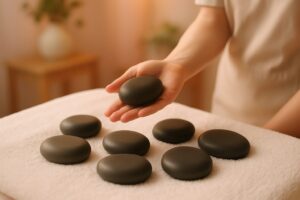
Depth of heat penetration. A hot bath warms the body’s surface and, over time, raises the core temperature slightly. A heating pad warms the area directly under it but the heat does not penetrate more than a centimetre or two into the tissue. Volcanic basalt, applied at the correct temperature (between 55 and 65 degrees Celsius) and moved correctly across the body, transfers heat to a depth of five to seven centimetres — reaching the deep paraspinal muscles, the deep hip rotators, the small muscles around the kidneys, and the periarticular tissues around the joints in a way that surface heat cannot.

Sustained working temperature. A heating pad cools as it transfers heat into the body and tends to be set at temperatures too high to be safe for prolonged contact (which is why most have automatic shut-offs). The basalt stones we use stay within the therapeutic range for fifteen to twenty minutes per stone, and we rotate through multiple stones to maintain even working temperature for the full session. The deep tissue receives sustained warming input rather than the rapid hot-cold-hot cycling of an electric pad.

Mechanical work combined with heat. The stones are not only static. A skilled volcanic stone session combines stationary placement (where stones rest on key points for several minutes) with active manipulation (where the stones glide along muscle groups and joint capsules). The combination of heat plus mechanical work addresses both the temperature and the postural-tension components of winter stiffness simultaneously. (For the foundational long-form guide to this technique — origin, variations, contraindications — see the volcanic stone massage guide.)

The Tirana protocol specifically

The volcanic stone work I do in winter differs in specific ways from the protocol used in summer or in other climates. The Tirana-specific adjustments include:

Longer pre-warming of the client. The client lies on a heated table for five to ten minutes before any stone is applied. This raises the surface temperature of the body so the first stone does not produce a startling temperature contrast that recruits the sympathetic nervous system.

More attention to the lumbar region. The lower back is where the wet-cold quality of the Tirana winter accumulates most consistently. We use a larger sacral stone for this region, and the stationary placement time is extended compared to the standard protocol.

Specific work on the hips and outer thighs. The lateral fascia from the iliotibial band to the outer hip becomes particularly tight in winter, and clients often do not notice this tightness until it is released. Stone work along this region in winter consistently produces a “lighter” sensation in walking afterwards.

Attention to the small joints of the hands. Tirana winter cold particularly affects the hands of people who spend time outdoors — walking dogs along Liqeni, commuting on foot, taking children to school. Small stones placed between the fingers and worked along the back of the hand produce significant relief.

Finishing with abdominal stones. Even when the primary complaint is musculoskeletal, finishing with stationary stones on the lower abdomen produces a general systemic warming effect that improves the overall therapeutic outcome.

What a typical winter client looks like

A representative client, from this past January: a woman in her late fifties, retired teacher, lives in a flat in central Tirana with adequate but not generous heating. She walks her grandson to school each morning. She has had mild osteoarthritis in her knees for several years that is generally manageable but flares up in winter to the point where she cannot kneel on the floor to play with the child. She had tried heating pads, knee braces, a magnesium supplement, and one course of physiotherapy that had not produced a substantial change.

She came in for a single ninety-minute volcanic stone session in early January. The protocol was the full winter version described above, with particular attention to the periarticular tissues of the knees.

She called the next day to say that she had slept through the night for the first time in three weeks and had been able to kneel that morning without pain.

This is, by itself, not a study. It is an anecdote. But it is a representative anecdote — the kind of report we hear consistently from winter clients with cold-pattern complaints. The single session produces noticeable improvement; the cumulative effect of several sessions across the winter produces something closer to the body’s normal baseline.

She continued coming once every two weeks through February and into early March. By the time she stopped (in part because the weather had warmed and her knees had stabilised), she had had six sessions across two months. Her knees stayed stable through the rest of the winter and the following spring.

The Liaoning observation

I cannot help observing, when I do this work in winter, the parallel with what my own family did in Liaoning when I was a child. We did not have basalt stones in our village. We had pieces of broken brick from old kilns, smoothed by time, that my grandmother kept in a wooden box near the stove. In the deepest weeks of January she would warm a stone in the stove embers (carefully — too hot would crack it), wrap it in cloth, and apply it to her own lower back or to my mother’s knees.

The principle was identical. The materials were what was locally available. The pattern — warm stone, applied to the lower back or joints, in the deep cold of winter — has been performed in some form in every cold-climate culture that has had access to dense stone and a way to heat it. The fact that we now do it in our parlour in Tirana with carefully sourced basalt and properly heated water does not change the underlying intervention. We have refined the precision; we have not changed the wisdom.

When to consider it, when not to

Volcanic stone therapy in winter is particularly useful for:

Chronic joint stiffness that worsens in cold weather (arthritis of the knees, hips, shoulders, fingers).

Lower back pain with a “cold and damp” quality — pain that responds to heat and worsens in damp weather.

Persistent cold extremities (cold hands, cold feet) that are not improving with the usual measures.

General fatigue and “the cold has gotten into me” feeling that does not lift with adequate sleep and warm clothing.

It is less useful for, or contraindicated in, the conditions listed in the main volcanic stone guide on the parlour website — particularly pregnancy, acute infection, uncontrolled cardiovascular disease, blood-thinning medication, and active DVT.

For winter use specifically, a series of three to six sessions across the cold months produces the most reliable lasting effect. A single session helps for one to two weeks; the cumulative effect builds over the series and produces a body that handles the winter more comfortably overall.

The treatment is, in its way, one of the older interventions for living in a cold climate — warm stone, patient hands, repeated through the worst of the season. In a Tirana January, when the cold comes down off Dajti and settles into the basin for weeks, this is not a small thing.


Yang Wang practises Chinese medicine at Chinese Massage – Tai Chi Tirana.

When Migraines Stop Coming on Tuesday

Erjona’s migraines used to arrive on Tuesday afternoons, between three and five o’clock, with a regularity that had made her stop scheduling client meetings for that window. She had tracked them for nearly a year before she came to see me — a small notebook with dates, weather, sleep hours, what she had eaten, what she had drunk, where she had been in her cycle. The notebook was the kind of document a person keeps when they have stopped expecting doctors to solve their problem and have decided to solve it themselves.

She was thirty-four. She worked in marketing for a logistics company with an office near Bllok. The migraines had started in 2024, six months after she moved back from Milan to take care of her mother through a long illness. They had outlasted her mother’s recovery by two years.

The neurologist she had seen — a kind, competent specialist at a private practice in Tirana — had given her sumatriptan for the acute episodes and propranolol as a preventive. The sumatriptan worked. The propranolol made her tired without reducing the frequency. She had tried magnesium, riboflavin, coenzyme Q10, the elimination of nightshades, the elimination of dairy, the elimination of red wine. The migraines kept arriving on Tuesday afternoons.

When she sat down in my office and showed me the notebook, I asked her one question.

“What happens on Monday evenings?”

She paused. She had not asked herself that question.

The pattern under the pattern

Migraines have a reputation for being unpredictable, but a careful look at the data — one’s own data, kept in a notebook — almost always reveals a pattern. The body does not produce a fifteen-hour vascular and neurological event at random. Something precedes it, sometimes by hours, sometimes by a full day. The trick is to find the upstream signal.

In Erjona’s case, the answer turned out to be small but consistent. Monday evenings, after work, she met three friends at a café in Bllok for what they called the catch-up. Two glasses of wine, often three, conversation that ran late. The wine she had eliminated once and then re-introduced after the migraines kept coming anyway. She had concluded the wine was not the trigger. She was wrong, but in a more interesting way than she had assumed.

The wine was not triggering the migraine. The wine was triggering a small, predictable disruption of her sleep architecture, which combined with elevated cortisol on Tuesday morning meetings, which combined with the late lunch she usually skipped on Tuesdays because of those meetings, which combined with — the actual immediate trigger — a small drop in blood sugar around three in the afternoon.

It was a stack of four small factors, none of them sufficient on its own. The pattern was visible only if you looked at all four together.

What acupuncture seems to do for migraine

I have read, over the years, that acupuncture is one of the better-tested traditional treatments for migraine, and that some European countries now suggest it for migraine sufferers when the usual medicines have not worked. The mechanism is still being worked out, as far as I understand it, but the broad picture goes something like this — and here I am simplifying what doctors much more qualified than me have written.

Migraine is, very roughly, a kind of over-reactive event in the brain. Something — stress, a hormonal shift, a missed meal, a glass of wine the night before — pushes the system over a threshold, and the migraine arrives. The brain of a migraine sufferer sits closer to that threshold than the average brain.

Acupuncture, done well and consistently, seems to raise the threshold by a small but useful amount. The needles work, as I understand it, partly on the nerves of the face and head, partly by quietening down inflammation, and partly through the nervous system as a whole — bringing the over-alert “fight or flight” mode back to a calmer baseline.

It is not a cure. It does not eliminate migraines for most patients. What it reliably does, in clients who respond, is reduce the frequency by between thirty and sixty percent and reduce the severity of the episodes that still occur. For someone having eight migraines a month, this means three or four migraines a month. The change is significant. It is also rarely dramatic enough to convince a sceptic in a single session.

What we did

I told Erjona the truth: her notebook had already done eighty percent of the work. The single most useful intervention she could make, before any needle touched her, was to address the Monday evening pattern. Not eliminate the friends. Not eliminate the wine. Reduce the wine to one glass, eat a real lunch on Tuesday before any meeting, carry a small protein snack for the three-o’clock window. She agreed to try this for six weeks.

In parallel, we began acupuncture. Twice a week for the first three weeks, then once a week. Points: Taiyang (the extra point at the temples), Fengchi (the gallbladder-20 point at the base of the skull), Hegu (large-intestine-4, in the hand), Taichong (liver-3, between the toes), and a rotating selection of secondary points based on what her pulse and tongue showed at each visit. A familiar pattern for migraine prevention, the kind of protocol many TCM practitioners have used for many years. Nothing experimental.

The first two weeks: no change. She had two migraines, both on Tuesday.

The third week: one migraine, on Wednesday rather than Tuesday. We discussed whether this was meaningful or coincidence. I told her honestly that I did not know yet.

The fourth week: no migraine.

The fifth week: no migraine.

The sixth week: no migraine.

She came in on the Tuesday of the seventh week, smiling for the first time since I had met her.

“I think I have not had a Tuesday afternoon in three years.”

What I told her, and what I tell anyone with a similar story

Erjona’s migraines have not vanished. She had one in the eighth week, mild, lifted with rest and a single dose of sumatriptan. She has had three more in the eleven months since. Three migraines in eleven months, compared with the previous frequency of two to three per month, is a meaningful change. It is not perfection. It is enough that she has her Tuesdays back.

The lesson I take from her case — and I have seen variations of it many times — is that acupuncture rarely fixes migraine on its own. It works best as part of an honest investigation into what the body is reacting to. The needles raise the threshold. The lifestyle changes lower the load. Together, the gap between threshold and load opens up enough that the migraines do not arrive. There is a short earlier piece on a different migraine-relief acupuncture story, if you want a second example.

If you are reading this and considering acupuncture for your own migraines, the suggestion I would make is this: keep a notebook for at least three months before your first session. Write down everything that seems irrelevant. Hours of sleep, what you drank the day before, where you were in your cycle if you have one, the weather, whether you ate breakfast. The patterns will surface. The acupuncturist’s job is then to help you address what the patterns are showing.

The needles are useful. They are not the whole story.

A small footnote about the diaspora

I notice in my practice that the migraine clients who improve the most are often those who have moved between countries — diaspora returnees, expatriates, people whose nervous systems have adapted twice or three times to new climates, new schedules, new languages. The migrating nervous system seems to be more sensitive to small ongoing disruptions. It also seems to respond particularly well to interventions that respect its complexity rather than trying to override it with a single drug.

I do not have data to back this up, only an impression from many client conversations. But it matches something I notice in myself, having moved from Liaoning to Tirana a few years ago: a body that has crossed borders carries a different kind of attention.

The work is to give it the right kind of quiet.


Yang Wang practises acupuncture at Chinese Massage – Tai Chi Tirana. The parlour is in central Tirana, near Bulevardi Gjergj Fishta. Names in client stories have been changed.
The Stubborn Hip: A Story of Six Tuesdays

Drita came in on a Tuesday in late September, the kind of afternoon when the heat had finally let go of Tirana and the air had a thin clean edge to it. She walked carefully. Not limping, not yet — but you could see her right hip carrying her in a way the left one wasn’t. She had a folder under her arm with two X-rays and a printout from a private practice in Pristina. She apologised for the folder before she sat down.

“Sorry. Doctors like papers.”

I told her the papers could wait. I asked her how she’d come up the stairs.

Three years of waiting for a miracle

Drita was sixty-one. She had been a school administrator for thirty-four years and was now two years from retirement. Her hip had started bothering her in the autumn of 2023 — a small ache after long days, dismissed as ordinary tiredness. By spring of 2024 the ache had moved closer to the surface and stayed there. By the time she came to see me, three years had passed.

In those three years she had seen, by her count: two general practitioners, an orthopaedic surgeon, a physiotherapist in Tirana, another physiotherapist in Pristina, a chiropractor in Skopje recommended by a cousin, and a reflexologist in Durrës who had told her the hip was a manifestation of unresolved family conflict. She had taken ibuprofen, naproxen, paracetamol, two short courses of celecoxib, magnesium, vitamin D, and a turmeric tincture from a herbalist in Korça. She had been told she needed surgery and she had been told she absolutely did not need surgery. She had been told to walk more, walk less, swim, not swim, and lose two kilograms.

By the time she sat across from me, what she wanted was not a miracle. What she wanted was someone to tell her honestly what they could and could not do for her.

What the body said when the papers were quiet

The X-rays showed what most hips that age show: mild osteoarthritic changes, joint space slightly narrower on the right than the left, no surgical indication. Nothing dramatic. Nothing that explained three years of progressive pain.

I asked her to lie on her back on the table without doing anything special — just settle. I watched her for about a minute before I touched her at all. The right leg was rotated outward by maybe fifteen degrees more than the left. The right ilium was sitting slightly higher. When I asked her to flex her right knee toward her chest, the range was halved compared to the left, and the stop point came not from the hip joint but from the gluteus medius — the small fan-shaped muscle that runs from the side of the pelvis to the top of the femur — which had become guarded and brittle from three years of compensating.

The hip itself was probably fine. The structure around it had quietly seized up.

This is the part where someone with a longer training might explain at length. In therapeutic Tui Na we have a shorthand for this kind of presentation — what classical texts call cold-damp obstruction in the lesser yang. The translation is not important. What my hands found was straightforward: muscles that have been holding still for too long, fibres that have lost their elasticity, fascia that has begun to behave like dried leather. (Readers whose hip pain travels down into the back may want to look at the related piece on therapeutic massage for back pain as well.)

The treatment is patient.

Mamica’s kind of patience

There is an Albanian word that does not have a direct equivalent in Chinese, though our culture has something close: the patience of someone who weathers a long winter without complaining about the snow. Mamica Kastrioti — Skanderbeg’s sister — had this quality. She is not in the schoolbooks the way her brother is. She moved through the resistance not with force but with composure, holding what she held without making noise about it. The body of a woman in her sixties who has worked the same job for thirty-four years has this kind of dignity built into it. It will not be rushed.

I told Drita the first session was for finding things. Mapping. No promises of dramatic change. She nodded. She did not want dramatic change. She had been promised dramatic change five times.

The protocol — slow, in three layers

We agreed on six weekly sessions, Tuesdays at four in the afternoon. The protocol was the unremarkable Tui Na sequence for chronic gluteal and trochanteric work, layered:

In the first two sessions, all the work was around the hip, not on it. We released the lower lumbar paraspinals on the right side, the quadratus lumborum, the iliopsoas through the abdomen (a manoeuvre many therapists skip because it is awkward to teach, but which makes the difference for these cases), and the lateral thigh fascia down to the knee. The hip itself was barely touched.

In the third and fourth sessions, we began direct work on the gluteus medius and the small external rotators — piriformis, quadratus femoris, the obturators. By the fourth session, Drita could bring her right knee to her chest at the same range as her left, which she had not been able to do for fourteen months.

In the fifth and sixth sessions, we worked the joint capsule with traction-and-release techniques, restored the rotation of the femoral head in the socket, and integrated the new range of motion with simple movement re-education — gentle leg circles on the table, then standing.

What she said on the seventh Tuesday

By the seventh Tuesday — which we had not originally planned, but which she came in for anyway — Drita walked up the stairs without holding the rail. She had not done that since 2024. She set the folder of X-rays down on the chair, and she laughed at it.

“All those papers, and what worked was an hour a week with someone who didn’t read them.”

I told her I had read them, on the second Tuesday, while she was on the table. They confirmed that what we were doing was safe. They did not explain her pain, because her pain had moved out of the joint and into the muscles around it, and X-rays do not photograph muscles.

She has been a regular for fourteen months now. We see her once a month — sometimes a maintenance session, sometimes she has overdone a weekend in Pogradec and needs the hip released again. She drives up from her village forty minutes away. We talk about her grandchildren, the school where she still works two days a week as a consultant, the way the seasons keep changing.

What I learned from her, not the other way around

There is a thing therapists do not often say: every patient teaches the therapist something. Drita taught me how much can be done with how little, if both sides agree on a time horizon. Six Tuesdays is not a long time when you have already waited three years. The body knows how to repair itself when its surroundings are made quiet enough. Our job is mostly to make the surroundings quiet.

When we said six sessions, we meant six. We did not stretch them to ten because we wanted to. We did not cut to four because she felt better at three. We made an agreement and we kept it. Besa, in its modern sense: a word given and honoured.

That is the work, mostly.


Yang Wang practises therapeutic massage and acupuncture at Chinese Massage – Tai Chi Tirana. Names in this story have been changed to protect client privacy; the sequence of sessions is described as it happened.

Acupuncture for Sleep: The Point Behind Your Ankle

There is a point on the inside of the ankle, in the small hollow between the back of the medial malleolus and the Achilles tendon, about a finger-width above the bone. Press it firmly with your thumb for thirty seconds, and most people will notice — if they are paying attention — a slight, slow feeling of heaviness moving up the leg. The breath drops a notch lower in the chest. The shoulders, almost imperceptibly, settle.

This is Taixi — the kidney-3 point. In a thousand years of Chinese practice it has been the single most-used point for sleep that does not arrive easily or does not stay through the night. We needle it almost every day in our parlour. It is not, by itself, a cure for insomnia. But it is one piece of a careful approach that addresses something most modern sleep advice misses: the body needs to want to sleep, and most insomniacs have a body that has lost the wanting.

Why pills work and then stop working

The usual medical approach is medicine. There are older sleeping pills and newer ones; doctors can advise on which is which. From what I have heard from clients and from doctors I trust, they often work on the first night and through the first week. After three or four weeks, two things tend to happen: the dose stops being enough, and the natural shape of sleep — the rhythm between deeper and lighter phases — gets flattened. The body has been put to sleep but not rested.

This is not a criticism of sleep medication. There are crises in which it is the right intervention, briefly. The problem is that it does not teach the body anything. When the medication is stopped, the body has not learned to fall asleep on its own; it has only learned to be put to sleep.

Acupuncture for sleep works on a completely different principle. It does not sedate. It does not produce drowsiness during the session. It works on the underlying patterns — what classical TCM calls deficiency, excess, or disharmony — that have caused the body to lose its sleep instinct in the first place.

Three patterns, three protocols

In Chinese medicine, insomnia is never a single condition. It is a symptom, and the protocol depends entirely on the pattern.

The mind-too-busy insomnia. The patient lies down tired but cannot stop thinking. Thoughts circle. The body is heavy but the head is alert. This is most common in office workers, students before exams, anyone running mental work in the evening. The TCM pattern: heart fire rising. The protocol: needles at Shenmen (heart-7, on the wrist crease), Yintang (between the eyebrows), and Taixi (the ankle point above). The goal is to bring the active mental energy downward, anchoring it in the lower body so the head can rest.

The body-too-tired insomnia. The patient is exhausted, falls asleep within minutes, but wakes between two and four in the morning and cannot return to sleep. They often feel a vague anxiety on waking, with no specific thought attached. This is the most common pattern in clients who have been chronically overworked, postpartum women, people in long-term grief. The TCM pattern: yin deficiency. The protocol: bilateral kidney-3 (Taixi), spleen-6 (Sanyinjiao), and a moxa application over the lower back — gentle, warming, rebuilding the deep reserve.

The digestive-disturbance insomnia. The patient sleeps fine until midnight, then wakes with bloating, slight nausea, or vivid disturbing dreams. They often eat late or eat in a stressed state. The TCM pattern: food stagnation. The protocol: stomach-36 (Zusanli), large intestine-4 (Hegu), pericardium-6 (Neiguan) — combined with dietary discussion. No needling alone will fix this one without the eating pattern shifting.

There are other patterns — the agitated insomnia of menopause, the cold-feet insomnia of poor peripheral circulation, the post-trauma insomnia where the nervous system has lost trust in the dark — but these three cover perhaps seventy percent of what walks into the parlour. If you are curious about how the meridian system underlying these points actually works, I have a longer piece on meridian conditioning in TCM that goes into the mapping in more detail.

The grandmother’s point

In the Liaoning of my childhood, grandmothers pressed a restless child’s Taixi point — this same ankle hollow — when the child could not settle to sleep. The pressure is firm but never sharp. The effect, observed by every generation of mothers without anyone writing it down, is that the child becomes calm. My own grandmother did it to me on the heated kang in winter, two fingers on the inside of the ankle, until my eyes gave up.

What she was doing, without the vocabulary for it, was working a neurological reflex. The point does not sedate. It settles. It tells a wound-up nervous system that the floor of the bed is, in fact, safe enough to fall through.

I think of her hands every time I needle that point. Tirana sleeps badly for reasons she never had to deal with — the café two floors down that mistakes midnight for early evening, the neighbour renovating a bathroom that was apparently load-bearing — but the ankle hollow has not changed, and neither has what it asks the body to do.

What to expect from an acupuncture session for sleep

The first session is rarely the one where the change happens. The body needs to register that something new is being offered.

Expect: a forty-five-minute appointment, including intake. About twenty minutes with needles in. Six to ten points, depending on the pattern. The needles are very fine — much finer than the hypodermic needles used for vaccinations — and most clients feel only a brief sensation on insertion, sometimes nothing at all. During the twenty minutes you may feel small involuntary movements in the muscles near the needles. This is normal and indicates the nervous system is engaging.

About one in three first-session clients sleep better that night. About one in two sleep better the third night after the session. The reliable improvement comes between the third and fourth session in a standard course of six.

What you should not expect: dramatic immediate change, lasting effects after a single session, or that acupuncture alone will fix a sleep problem that has structural causes (sleep apnoea, severe restless legs syndrome, hyperthyroidism, depression with insomnia features). For these, acupuncture can support but cannot substitute.

The honest part

I want to say this clearly because the field does not always say it clearly: acupuncture is not magic for sleep. There are clients for whom it works beautifully and clients for whom it makes no measurable difference. The percentage who respond well is, in my own practice, around three out of four. The other one out of four either needs a different intervention or has a sleep problem with an underlying cause we need to identify and address differently.

What I can promise is this: the work will be done with care, the protocol will be tailored to the actual pattern (not a generic insomnia recipe), and if four sessions in we are not seeing change, I will tell you honestly and we will talk about what else might help. Sometimes the answer is to send someone for a sleep study. Sometimes it is to address an anxiety condition with a psychologist first. Sometimes it is simpler — a client who has not made the connection between the espresso at four in the afternoon and the wakefulness at midnight.

Sleep is a delicate piece of the body’s intelligence. The needles, when they work, are not adding anything new. They are removing the small obstacles that have been keeping the body from doing what it already knows how to do.


Yang Wang practises acupuncture and Tui Na at Chinese Massage – Tai Chi Tirana.